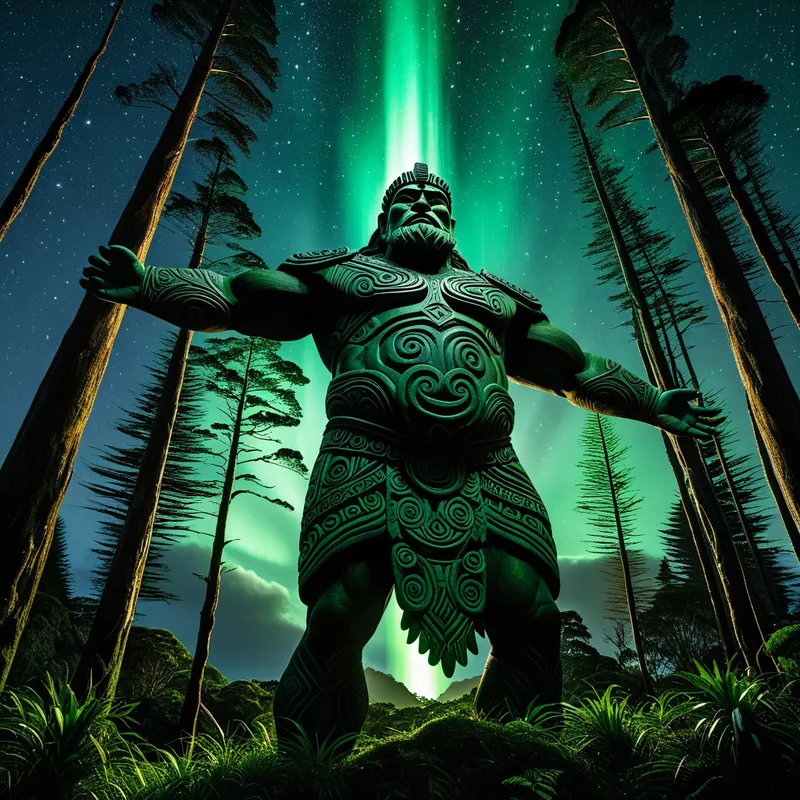
Tāne Mahuta Myth Meaning & Symbolism
The story of the god who pushed the sky father and earth mother apart to create the world of light, life, and human consciousness.
The Tale of Tāne Mahuta
In the beginning, there was only the close, desperate embrace. Ranginui, the sky, lay pressed upon Papatūānuku, the earth. Their love was absolute, a union so complete it left no space between them. In that perpetual twilight, their children were born—but not into a world. They were born into a prison of intimacy, forced to dwell in the cramped, dark hollow between their parents’ bodies. No wind could stir, no light could fall. There was only the sound of their parents’ sighs and the pressing weight of a love that suffocated all potential.
The children, the atua (gods), lived in this gloom for eons. Some grew accustomed to the dark. But others yearned. They whispered of a world that could be, of light and space and movement. A council was held in the whispering dark. Tangaroa of the seas, Rongo of cultivated foods, Haumia of uncultivated plants, Tūmatauenga of fierce humanity—each in turn tried to separate their parents. They pushed and strained, but the bond of Rangi and Papa was too profound, too ancient. Their efforts failed, and despair thickened the already heavy air.
Then, it was the turn of Tāne Mahuta. He did not brace his shoulders against the sky. Instead, he turned to his mother, the earth. He planted his feet firmly upon her breast, Tū te whenua, tū te rangi. He placed his strong hands upon his father, the sky. And then, with a slow, gathering force that was not of violence but of inevitable growth, he began to push.
He pushed as a kauri seed pushes through soil. He pushed with the silent, unstoppable strength of a root cracking stone. The air groaned with the strain of separation. Tears fell from Rangi as rain; cries of anguish rose from Papa as mist. Still, Tāne pushed. He pushed until his back arched like a mighty bow, his muscles of wood and sinew trembling with the cosmic effort. He pushed until, with a sound like the first thunder, a sliver of light pierced the darkness.
He did not stop. With relentless, patient force, he pushed his father higher and higher. The world of Te Ao Mārama was born in that widening gap. Light, Te Ao Tūroa, flooded in. Winds, Tāwhirimātea, rushed to fill the void, howling in fury at his brothers for this act of separation. The seas found their basins, the forests their place to root and reach. Life could now breathe, grow, and become. Tāne Mahuta stood as the great pillar, the living axis between earth and sky, having created the necessary space for all existence.
Cultural Origins & Context
This cosmogony is the foundational narrative of Māori culture, belonging to the whakapapa and pūrākau traditions. It was not merely a story but a living map of reality, recited by tohunga during sacred rituals, teachings, and at the dawn of important undertakings. Its transmission was oral, precise, and performed, ensuring the connection between the people, their land (Papatūānuku), and their ancestral sky (Ranginui) remained vibrantly alive.
The myth functioned as a societal anchor. It explained the origin of the natural world, justifying the Māori relationship with the forest (Tāne’s domain) as one of profound kinship and respect. It established a cosmological order where humans are the descendants of this creative struggle, living in the world of light won by their divine ancestor. The story also modeled a core cultural value: that growth and life require tapu (sacred) acts of separation and definition, creating order from primal unity. The grief of the parents is acknowledged, teaching that creation is often born from a necessary, painful transition.
Symbolic Architecture
At its heart, the myth of Tāne Mahuta is a grand metaphor for the birth of consciousness itself. The primal embrace of Rangi and Papa represents the undifferentiated state—the unconscious unity where all potentials exist but nothing is distinct. It is the womb, the dreamless sleep, the state before ego.
Consciousness is not a given; it is a hard-won space carved out of the unconscious by an act of willful differentiation.
Tāne represents the emergent principle of structure, growth, and vertical aspiration—the psychic force that says “I am here, and this is different from that.” His method is critical. He does not attack; he positions himself. He roots in the earthly, instinctual base (the mother) to gain the leverage to engage the spiritual, archetypal heights (the father). His act is one of separation, not destruction, creating the temenos—the sacred space—where psyche can manifest. The resulting world of light, Te Ao Mārama, is the realm of the conscious ego, now able to perceive, distinguish, and know.
The weeping of the parents symbolizes the inevitable grief that accompanies individuation. To become oneself is to leave behind the blissful, unconscious fusion. The furious winds of Tāwhirimātea represent the chaotic, emotional backlash from the unconscious against this act of ordering—the storms of doubt, guilt, and regression that follow any bold step toward self-definition.
The Dreamer’s Resonance
When this myth stirs in the modern dreamer, it often manifests as somatic pressure and spatial constriction. One may dream of being trapped between two immense, loving, but suffocating forces—perhaps two parents, two life paths, or two internal values in conflict. The dream ego feels there is “no room to breathe,” no space for its own identity.
The turning point comes when the dreamer discovers a new kind of strength. Not the aggressive strength of Tūmatauenga, but the patient, organic, upward-striving strength of the tree. The dream may shift to images of pushing up through a ceiling, holding apart two walls, or finally standing upright in a space that was once filled. This is the psyche rehearsing the Tāne-function: the capacity to create internal psychological space. The dreamwork is the somatic processing of moving from a fused state (enmeshment, codependency, unconscious identification) to a differentiated state (boundaries, self-awareness, conscious choice). The resulting feeling upon waking is often one of relief, spaciousness, and a newfound, quiet authority.

Alchemical Translation
The alchemical journey of individuation mirrors Tāne’s labor precisely. It begins in the massa confusa, the dark, undifferentiated primal matter of the unexamined life. The task is not to flee this darkness, but to engage it, to plant one’s feet firmly in one’s own nature, instincts, and history (Papatūānuku).
The opus is the patient, persistent act of creating a vessel—a conscious self—capable of holding the tension between the earthly and the spiritual.
The seeker must then apply steady, consistent pressure against the weight of internalized patterns, familial complexes, and collective expectations (Ranginui). This is the separatio, the crucial alchemical operation where components are distinguished. It feels like a transgression, and it provokes inner storms (Tāwhirimātea’s wrath). Yet, this separation is what allows for the illuminatio—the dawn of self-knowledge (Te Ao Mārama).
Tāne does not become the sky or the earth; he becomes the living conduit between them. So too, the individuated Self is not identified solely with the body (earth) nor lost in spiritual abstraction (sky). It becomes the conscious axis, the pou that holds the tension of opposites, allowing for a life that is both grounded and aspirational, connected and free. The goal is not to end the parents’ relationship, but to honor it from within the created world of light, taking responsibility for the space one has carved out—a space where a unique human life can finally, fully, take root and grow toward the light.
Associated Symbols
Explore related symbols from the CaleaDream lexicon: