
Tjukurpa Law and Dreaming Myth Meaning & Symbolism
The eternal, sacred law of creation where ancestral beings formed the world and its laws, a living blueprint connecting past, present, and future.
The Tale of Tjukurpa Law and Dreaming
In the beginning, there was the Dreaming. Not a time of sleep, but a time of potency, a vast, silent plain of pure being. Then, from within this deep stillness, the Ancestors stirred. They were not gods from a distant heaven, but beings of the earth itself—Rainbow Serpent, Mala, Yeperenye—emerging from the featureless ground, from the empty sky, from the silent waters.
They began to walk. And with every step, the world sang into existence. Where the Rainbow Serpent slid, her massive body carved out riverbeds and waterholes, her scales scattering to become the glittering minerals in the rocks. Where the Mala hopped, their powerful legs shaped the dunes and valleys. The Yeperenye chewed through rock, creating the first caves and canyons. They fought and loved, hunted and celebrated. Their epic battles raised mountain ranges; their tears of joy became the first rains; their resting places became sacred hills.
But this was not mere landscape gardening. With every action, they laid down Tjukurpa Law. When the Rainbow Serpent demanded respect for her waterholes, she established the law of custodianship. When the Mala shared food after a hunt, they established the law of kinship and reciprocity. Their journeys etched invisible pathways across the land—songlines—that are maps, story, and law all in one.
Finally, their work complete, the Ancestors did not die. They transformed. Some sank back into the land, becoming the very features they had created—that particular rock, that specific waterhole is the Ancestor, resting. Others ascended into the sky, becoming the stars, their stories written in constellations. They entered a state of sleep, but their power remained, woven into the fabric of the world. The Dreaming did not end; it became the enduring, vibrating foundation of all that is, a living memory held in the land itself, waiting to be sung back into awareness.
Cultural Origins & Context
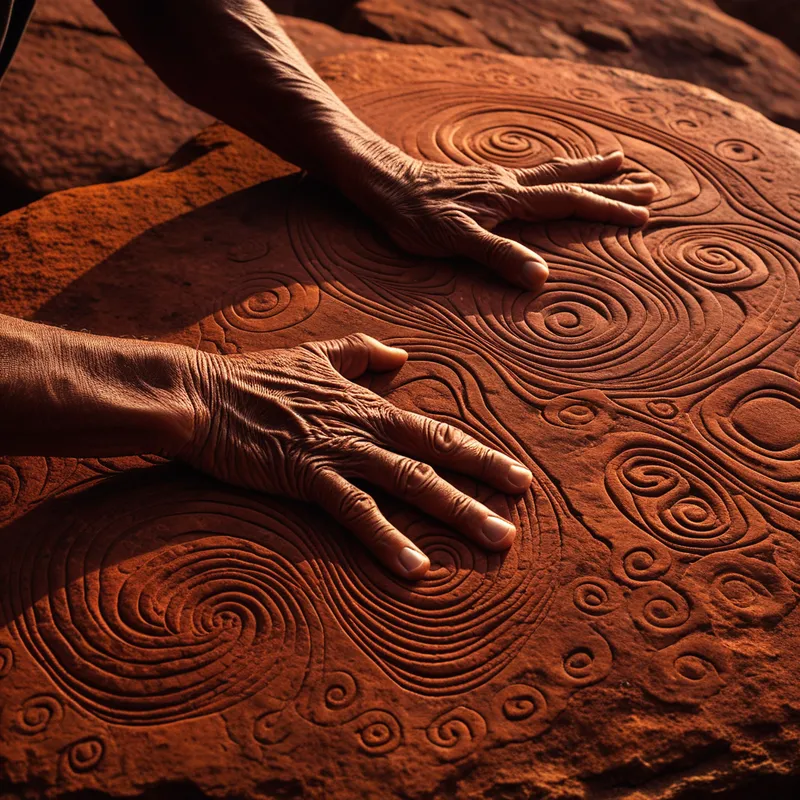
Tjukurpa (often broadly translated as “Dreaming” or “Dreamtime”) is the foundational concept of many Aboriginal Australian cultures, particularly in the Central Desert regions. It is not a single, unified myth but a vast, interconnected web of stories, laws, and relationships specific to Country—the ancestral lands of each language group. This knowledge is not recorded in books but is held in ceremony, art, song, and dance, passed down through generations by custodial Elders.
Its societal function is total. Tjukurpa is cosmology, legal system, moral code, historical record, and geographical map. It dictates kinship structures, marriage laws, and resource management. To know the stories of your Country’s Tjukurpa is to know who you are, your responsibilities, and your place in a living, sacred order. The act of performing the songs and ceremonies along the songlines is not a re-enactment; it is a participation in the ongoing creativity of the Ancestors, a ritual maintenance of the world.
Symbolic Architecture
Psychologically, Tjukurpa represents the archetypal [blueprint](/symbols/blueprint “Symbol: A blueprint represents the foundational plan or design for something, often symbolizing potential, structure, and the mapping of one’s inner self or future.”/) of the psyche itself. The featureless Dreaming is the unconscious in its potential state. The Ancestors are the primal, autonomous complexes and archetypes that emerge from this [depth](/symbols/depth “Symbol: Represents profound layers of consciousness, hidden truths, or the unknown aspects of existence, often symbolizing introspection and existential exploration.”/) to [structure](/symbols/structure “Symbol: Structure in dreams often symbolizes stability, organization, and the framework of one’s life, reflecting how one perceives their environment and personal life.”/) the inner world.
The world is not created once and for all; it is dreamed into being continuously through conscious participation in the foundational patterns.
Their journeys—the songlines—symbolize the innate, deep structures of the psyche, the neural pathways of instinct and [archetype](/symbols/archetype “Symbol: A universal, primordial pattern or prototype in the collective unconscious that shapes human experience, behavior, and creative expression.”/) that guide development. The Tjukurpa Law they establish is the natural, organic law of the Self, the inherent rules for psychic [health](/symbols/health “Symbol: Health embodies well-being, vitality, and the balance between physical, mental, and spiritual states.”/) and balance (individuation) that exist beyond personal ego. The Ancestors’ transformation into [landscape](/symbols/landscape “Symbol: Landscapes in dreams are powerful symbols representing the dreamer’s emotional state, personal journey, and the broader context of life situations.”/) signifies the process by which dynamic psychic energies become permanent structures of [personality](/symbols/personality “Symbol: Personality in dreams often symbolizes the traits and characteristics of the dreamer, reflecting how they perceive themselves and how they believe they are perceived by others.”/)—a [trauma](/symbols/trauma “Symbol: A deeply distressing or disturbing experience that overwhelms the psyche, often manifesting in dreams as unresolved emotional wounds or psychological injury.”/) becomes a “[mountain](/symbols/mountain “Symbol: Mountains often symbolize challenges, aspirations, and the journey toward self-discovery and enlightenment.”/)” of [defense](/symbols/defense “Symbol: A protective mechanism or barrier against perceived threats, representing boundaries, security, and resistance to external or internal challenges.”/), a creative [impulse](/symbols/impulse “Symbol: A sudden, powerful urge or drive that arises without conscious deliberation, often linked to primal instincts or emotional surges.”/) becomes a “[river](/symbols/river “Symbol: A river often symbolizes the flow of emotions, the passage of time, and life’s journey, reflecting transitions and movement in one’s life.”/)” of [expression](/symbols/expression “Symbol: Expression represents the act of conveying thoughts, emotions, and individuality, emphasizing personal communication and creativity.”/).
The Dreamer’s Resonance
When this mythic pattern stirs in the modern dreamer, it often manifests as dreams of discovering ancient, forgotten maps; of following animal guides through unfamiliar yet deeply familiar terrain; or of landscapes that are alive and communicative. There may be a somatic sense of the ground humming or songs arising unbidden.
This signals a profound process of re-orientation to the psyche’s innate law. The ego is being called to discover its own songline—its authentic path of development that was laid down not by culture or family, but by the ancestral patterns of the personal and collective unconscious. It is a confrontation with one’s own Tjukurpa. The dreamer is undergoing what the culture performs in ceremony: a ritual re-connection to the foundational stories that shape their reality, a need to “sing the country” of their own soul back into balance and remember their custodial duty to their inner life.

Alchemical Translation
The alchemical process modeled by Tjukurpa is that of unio mentalis—the union of mind and soul through engagement with the psychic ground. The prima materia is the modern condition of disconnection, the “featureless plain” of alienation. The first operation is the nigredo: allowing the great Ancestors—the powerful, often disruptive archetypal forces of rage, love, creativity, or fear—to emerge from the unconscious and begin their journeys.
Individuation is not about becoming something new, but about remembering and walking the sacred track that was inscribed in the soul from the beginning.
The long cross-country journey of the Ancestors is the albedo and citrinitas, the arduous work of consciousness tracing these inner patterns, facing the conflicts and triumphs they entail, and slowly extracting their inherent law. The final rubedo, the reddening, is the transformation of these dynamic journeys into permanent inner landscape—the establishment of a stable, lawful, and sacred inner Country. The ego does not become the Ancestor; it becomes the custodian of the territory the Ancestor shaped, responsible for maintaining its sacred laws through conscious living. The Self is realized as both the journey and the enduring, sung-into-being country that results.
Associated Symbols
Explore related symbols from the CaleaDream lexicon:
- Dream — The foundational, creative state of pure potential from which all forms and laws emerge, representing the unconscious as the source of being.
- Snake — Directly embodies the Rainbow Serpent, symbolizing primal creative energy, the carving of psychic pathways, and the cyclical nature of life and law.
- Water — Represents the life-giving and law-giving essence left by the Ancestors in waterholes and rivers, symbolizing the emotional and spiritual nourishment of the deep psyche.
- Earth — The living text and testament of the Tjukurpa, where every feature is a solidified ancestral event, representing the embodied, tangible reality of the psyche.
- Journey — The essential action of the Ancestors, whose travels create the world; it signifies the necessary psychic movement that structures consciousness and creates meaning.
- Song — The vibrational tool that maps, remembers, and actively maintains the created world, symbolizing the conscious attention and expression required to sustain psychic order.
- Law — The sacred, immutable code established by ancestral actions, representing the innate archetypal patterns and rules of the Self that guide individuation.
- Ancestor — The primordial beings who are both the creators and the substance of reality, symbolizing the autonomous, archetypal complexes that structure the personal psyche.
- Star — The transformed Ancestors who watch from above, their constellations mapping the stories, representing the guiding, transpersonal patterns that orient the soul’s journey.
- Map — The songline as a living cartography of story, law, and geography, symbolizing the psyche’s innate, navigable structure.
- Origin — The point within the Dreaming where a specific Ancestor or story emerges, representing the source point of a core psychic complex or life theme.
- Circle — The eternal, cyclical nature of Tjukurpa, where past, present, and future are co-present, symbolizing the wholeness and timelessness of the Self.