
Tithonus and Eos Myth Meaning & Symbolism
A goddess grants her mortal lover eternal life but forgets to ask for eternal youth, leading to his endless decay and her eternal grief.
The Tale of Tithonus and Eos
Before the sun’s chariot scorched [the sky](/myths/the-sky “Myth from Persian culture.”/), when [the world](/myths/the-world “Myth from Tarot culture.”/) was hushed and painted in the colors of a waking dream, Eos rose from her bed by [the river](/myths/the-river “Myth from Buddhist culture.”/) [Oceanus](/myths/oceanus “Myth from Greek culture.”/). Her fingers, rosy and tender, parted [the veil](/myths/the-veil “Myth from Various culture.”/) of night. Each morning, she performed this sacred duty, but her heart, a captive of mortal beauty, wandered [the earth](/myths/the-earth “Myth from Hindu culture.”/) below. It was in the gleaming halls of Dardania that her gaze fell upon [Tithonus](/myths/tithonus “Myth from Greek culture.”/). He was not just a prince; he was the embodiment of dawn itself in human form—youthful, radiant, with a grace that stilled the very winds.
Love, for a goddess, is a tempest. Eos, cloaked in her [saffron robes](/myths/saffron-robes “Myth from Hindu/Buddhist culture.”/), descended upon the mortal world and swept Tithonus away from the fields of men. She brought him to the eastern edge of the world, to a palace where the air smelled of eternal spring and the light was forever soft and new. Their joy was a song that echoed in the stars. But a shadow crept into Eos’s golden heart—[the shadow](/myths/the-shadow “Myth from Jungian culture.”/) of Chronos. She was eternal; he was dust-bound. She could not bear the thought of his bright eyes dimming, his strong form bending to age, of losing him to the silent, greedy earth.
Driven by a love both profound and possessive, Eos approached the great Zeus. She knelt before his smoky throne on Olympus, her voice a melody of desperate pleading. “Grant him immortality,” she begged. “Let him live forever at my side.” The Father of Gods, perhaps moved, perhaps amused, nodded his mighty head. Her wish was granted.
For decades, their paradise held. But a terrible flaw lay hidden in the gift, a crack in the divine decree that Eos, in her joyous haste, had failed to see. She had asked for life without end, but she had not asked for youth without end. The gift was incomplete, a cruel half-measure.
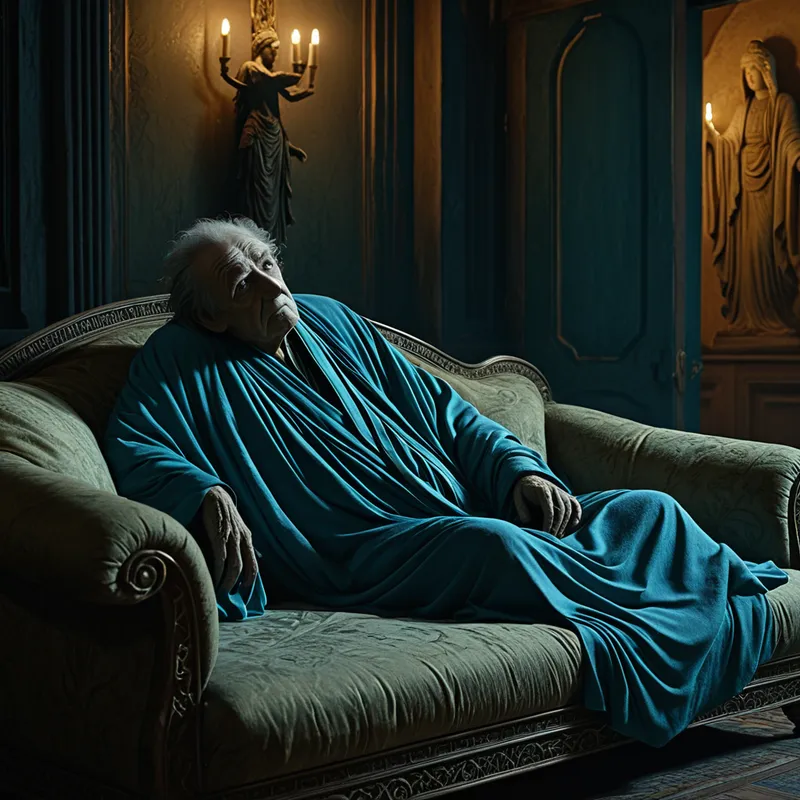
The first grey hair was a shock. The first stiffness in the limb, a mystery. Slowly, inexorably, the process Eos had sought to banish began its work upon Tithonus. His back curved. His skin, once smooth as river stone, grew thin and lined like a dried leaf. His strength ebbed, his voice became a reedy whisper. [The immortal](/myths/the-immortal “Myth from Taoist culture.”/) life force within him did not fight the decay; it fueled it, binding him to an endless cycle of aging. The prince became an old man, then a ancient, shrunken [thing](/myths/thing “Myth from Norse culture.”/), forever growing older, forever unable to die.
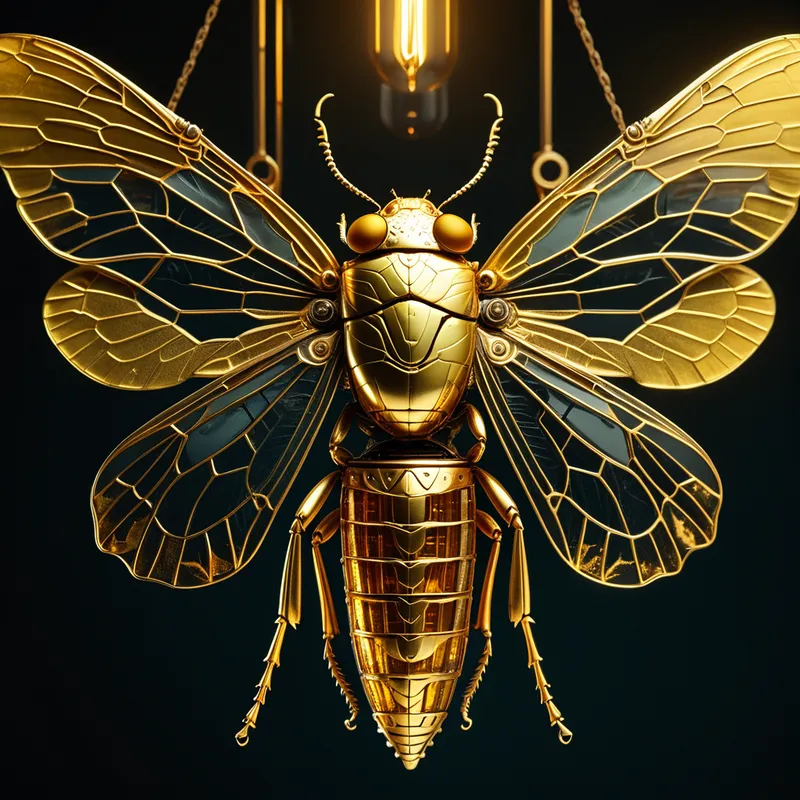
Eos’s dawn-lit halls became a prison of grief. The goddess who brought the day could not bring back her lover’s day. Her touch, which once ignited passion, now only felt the brittle cold of endless years. The sound of his frail, ceaseless pleading for a release that would never come filled the corridors. Love curdled into pity, and pity into a quiet, desperate horror. In the end, she could bear his presence no longer, yet she could not revoke the curse she had invoked. Legend says she transformed him, locking his endless, chattering consciousness into a small, dry body—that of a cicada, a creature that sings a relentless, shrill song with the last of its breath. And so, Eos rises each morning, her light beautiful and cruel, while the echo of her mistake sings endlessly from the trees, a living reminder of a prayer answered too literally.
Cultural Origins & Context
The myth of Tithonus is primarily preserved in the Homeric Hymn to Aphrodite and in fragments from later poets like Sappho. It belongs to a rich tapestry of Greco-Roman myths exploring the fraught relationships between gods and mortals—a genre of tragic romance where divine passion crashes against the unyielding wall of mortal limitation. These stories were not mere entertainment; they were ontological maps, explaining why the world is structured as it is, with an unbridgeable chasm between the eternal divine and the ephemeral human.
The tale would have been recited by bards and poets, serving as a potent [memento mori](/myths/memento-mori “Myth from Christian culture.”/) and a warning against overreaching. In a culture that prized the beauty and vigor of the youthful body (exemplified in its art and athletics), Tithonus’s fate was a nightmare. It functioned as a dark counterpart to more hopeful tales of apotheosis. It taught that the natural order, the boundary between mortal and immortal, was not just a line but a sacred law. To transgress it carelessly, even for love, was to invite a fate worse than death. The myth also subtly underscores the capricious nature of the gods; even Zeus’s gifts could be double-edged, and divine lovers were often disastrous for mortals.
Symbolic Architecture
At its core, this is a myth about the tyranny of incompletion. It is the ultimate [expression](/symbols/expression “Symbol: Expression represents the act of conveying thoughts, emotions, and individuality, emphasizing personal communication and creativity.”/) of a wish fulfilled in [letter](/symbols/letter “Symbol: A letter symbolizes communication, messages, and the sharing of thoughts and feelings.”/) but not in [spirit](/symbols/spirit “Symbol: Spirit symbolizes the essence of life, vitality, and the spiritual journey of the individual.”/), revealing the [shadow](/symbols/shadow “Symbol: The ‘shadow’ embodies the unconscious, repressed aspects of the self and often represents fears or hidden emotions.”/) side of our deepest desires.
To ask for life without death is to misunderstand the nature of life itself. The story whispers that mortality is not the opposite of life, but its necessary counterpart—the frame that gives the picture meaning.
Tithonus represents the ego that seeks permanence. He is the part of the [psyche](/myths/psyche “Myth from Greek culture.”/) that clings to a specific form, [identity](/symbols/identity “Symbol: Identity represents the sense of self, encompassing personal beliefs, cultural background, and social roles.”/), or state of being—in his [case](/symbols/case “Symbol: A case often signifies containment, protection of personal matters, and the need for organization in one’s life.”/), the beloved [prince](/symbols/prince “Symbol: A prince symbolizes nobility, leadership, and aspiration, often representing potential or personal authority.”/)—and begs to have it frozen in time. Eos represents the animating spirit or [life](/symbols/life “Symbol: The symbol of ‘Life’ represents a journey of growth, interconnectedness, and existential meaning, encompassing both the joys and challenges that define human experience.”/) force—passionate, impulsive, and capable of moving [heaven](/symbols/heaven “Symbol: A symbolic journey toward ultimate fulfillment, spiritual transcendence, or connection with the divine, often representing life’s highest aspirations.”/) and [earth](/symbols/earth “Symbol: The symbol of Earth often represents grounding, stability, and the physical realm, embodying a connection to nature and the innate support it provides.”/) to preserve what it loves. Yet, her plea is flawed because it arises from a fear of [loss](/symbols/loss “Symbol: Loss often symbolizes change, grief, and transformation in dreams, representing the emotional or psychological detachment from something or someone significant.”/), not a wisdom of cycles. Zeus, the [authority](/symbols/authority “Symbol: A symbol representing power structures, rules, and control, often reflecting one’s relationship with societal or personal governance.”/) of the objective [psyche](/myths/psyche “Myth from Greek culture.”/) (or [the Self](/myths/the-self “Myth from Jungian culture.”/)), grants the literal request, forcing a confrontation with [the law](/symbols/the-law “Symbol: Represents external rules, societal order, moral boundaries, and the tension between personal freedom and collective structure.”/) of [nature](/symbols/nature “Symbol: Nature symbolizes growth, connectivity, and the primal forces of existence.”/): all forms must change.
The transformation into a [cicada](/symbols/cicada “Symbol: Represents renewal, transformation, and the cyclic nature of life.”/) is not merely a grotesque end but a profound symbolic [resolution](/symbols/resolution “Symbol: In arts and music, resolution refers to the movement from dissonance to consonance, creating a sense of completion, release, or finality in a composition.”/). The [cicada](/symbols/cicada “Symbol: Represents renewal, transformation, and the cyclic nature of life.”/) lives underground for years before emerging to sing its brief, intense song. In this form, Tithonus becomes pure voice, pure sound—an essence stripped of its decaying form. He becomes the eternal lament, the psychic [symptom](/symbols/symptom “Symbol: A physical or emotional sign indicating an underlying imbalance, distress, or message from the unconscious mind.”/) that will not be silenced, the [truth](/symbols/truth “Symbol: Truth represents authenticity, honesty, and the quest for knowledge beyond mere appearances.”/) of the [condition](/symbols/condition “Symbol: Condition reflects the state of being, often focusing on physical, emotional, or situational aspects of life.”/) made audible.
The Dreamer’s Resonance
When this myth pattern stirs in the modern dreamer, it often signals a confrontation with a state of psychic entrapment. One may dream of being stuck in a room that shrinks, of watching one’s own hands wither in a mirror, or of hearing a constant, irritating sound one cannot locate or stop. Somatic feelings of stiffness, dryness, or being “stuck in a loop” upon waking are common.
Psychologically, this is the process of an outdated complex or a once-vital adaptation that has been granted “immortality” within the psyche. Perhaps it is a self-image from youth that the dreamer clings to long after it has served its purpose. Maybe it is a relationship dynamic, a career identity, or a trauma narrative that has been kept alive (by an “Eos”-like drive to preserve) but has been denied the rejuvenating energy needed to stay healthy. The dreamer is experiencing the consequences of an unexamined wish—the agony of getting what they thought they wanted, only to find it has become a prison. The psyche is presenting the bill for a bargain made in unconsciousness.

Alchemical Translation
The alchemical journey modeled here is not one of glorious [triumph](/myths/triumph “Myth from Roman culture.”/), but of the [nigredo](/myths/nigredo “Myth from Alchemical culture.”/)—the blackening, the putrefaction—taken to its absolute extreme. It is the process by which the soul learns, through brutal, undeniable experience, the cost of seeking wholeness through stasis.
The myth’s alchemy is in the transmutation of a personal love story into an impersonal cosmic truth. The individual tragedy becomes a universal lesson on the necessity of decay for rebirth.
For modern individuation, Tithonus’s fate is a stark warning against petitioning the “gods” (the unconscious, fate, or even one’s own will) for salvation without specificity and wisdom. The first step in transmuting this pattern is the recognition of the incomplete gift. The individual must see where in their life they are enduring an “immortal” suffering—a situation, habit, or belief that persists but brings no vitality, only endless, gradual decay.
The second, more crucial step is the Eos within must turn and face what she has created. This is the moment of taking responsibility, of bearing witness to the full horror of the avoidance of death (of an era, a identity, a way of being). This is profound shadow-work. Finally, the transformation into the “cicada” symbolizes a final, difficult alchemical stage: the reduction to essence. When the form can no longer be maintained, what is left? Only the voice, the truth, the core complaint or song. By accepting this reduced, essential state—by listening to that shrill, inner sound—the psychic energy bound in the decaying form is finally released. It is not a happy ending, but it is an ending that allows the dawn (consciousness) to rise again, wiser and more humble, having learned that love must sometimes mean letting go into the cycle, not arresting it.
Associated Symbols
Explore related symbols from the CaleaDream lexicon: