Tin in Ezekiel Myth Meaning & Symbolism
A prophet's vision of divine judgment, where tin is tested in the furnace, revealing the impure heart of a nation and the possibility of purification.
The Tale of Tin in Ezekiel
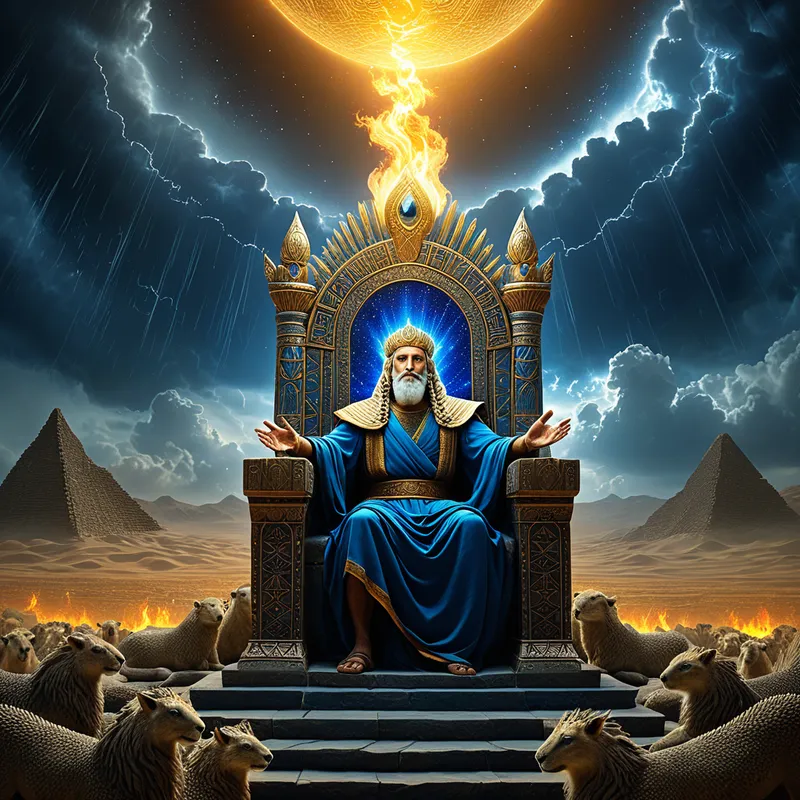
Hear now the vision granted to the exile, to the man of God by the waters of Babylon. The heavens were torn open, and a wind from the north, a great storm cloud, flashed with incessant fire. From its heart came the likeness of four living creatures, each with four faces and four wings, their legs gleaming like burnished bronze. Above the expanse over their heads was the likeness of a throne, and seated upon it was a figure with the appearance of a man, yet from his loins upward was the color of electrum, and downward, fire. This was the appearance of the likeness of the glory of YHWH.
And the spirit entered Ezekiel, son of Buzi, and set him upon his feet. A voice spoke, and a hand stretched out, holding a scroll written on front and back with words of lamentation and mourning and woe. “Eat this scroll,” the voice commanded. It was sweet as honey in his mouth, but it turned to fire in his belly.
Then he was taken in visions of God to Jerusalem, to the inner court of the temple. And there he saw abominations. Elders in darkness, offering incense to creeping things and loathsome beasts. Women weeping for Tammuz. Men with their backs to the altar of YHWH, facing east to worship the sun.
And the voice of the throne spoke again, a sound like many waters. “Son of man, do you see what they are doing? The house of Judah has become dross. They are silver, copper, iron, lead, and tin—all gathered into the furnace. But they are not pure. The tin is among them.”
Then the prophet saw the crucible. A furnace blazed, its breath a scorching wind. Into it were cast the people, the city, the kingdom. The fire was not for destruction alone, but for revelation. The silver melted, the copper flowed, but the tin… the tin revealed its nature. For in the fury of the flame, the tin did not purify. It did not become a shining stream. Instead, it showed its alloy, its hidden corruption. It was the basest metal pretending to value, the empty vessel, the faithless heart. It was the sheen that promised strength but offered only brittleness. The fire found it out. The bellows were blown, the heat intensified, until all that was not true was consumed, and the tin stood exposed—not as a metal to be refined, but as the very symbol of the impurity that must be burned away.
Cultural Origins & Context
This vision is embedded in the Book of Ezekiel, a text born from the trauma of the Babylonian Exile (c. 597–587 BCE). Ezekiel was a priest deported from Jerusalem to a settlement by the Chebar canal in Mesopotamia. His prophecies are not folk tales passed down through generations, but the recorded, first-person accounts of a visionary experiencing radical dissociation from his homeland and his identity. The societal function was one of catastrophic explanation and radical hope. The myth—for it operates mythically in its symbolic depth—served to answer the unanswerable: Why did YHWH allow His temple to be destroyed and His people exiled?
The answer was not in political failure alone, but in a fundamental spiritual corrosion. The “tin” was not a foreign enemy, but an internal failure. Ezekiel’s audience was a broken community needing to understand their suffering as a painful, necessary purification. The prophet acted as a cultural diagnostician, using the potent symbol of metallurgy—a technology understood by all ancient Near Eastern cultures—to articulate a theology of divine judgment that was ultimately surgical, not annihilative. The myth was told not to entertain, but to convict, to explain, and to prepare the ground for a future restoration predicated on inner transformation.
Symbolic Architecture
Tin, in the ancient world, was rarely used alone. Its primary value was as an alloying agent with copper to create bronze, a metal of strength and weaponry. By itself, tin is soft, malleable, and has a low melting point. In Ezekiel’s furnace, it represents the element within the self or the collective that appears valuable, that plays a necessary role in the alloy of society, but which, under the extreme pressure of truth (the furnace of adversity), reveals its fundamental inadequacy.
The furnace does not create impurity; it reveals the impurity that was always there, hidden within the alloy of the persona.
Psychologically, tin symbolizes the false virtue, the adopted piety, the social compliance that masks a heart of “rebellion” (a key word in Ezekiel). It is the part of the personality that goes through the motions of integrity but lacks the inner, molten core of authentic commitment. It is spiritual hypocrisy made material. The fire of the divine gaze is the unbearable light of consciousness, which forces a confrontation with what we are actually made of, beyond our social roles and self-narratives. The myth presents a terrifying but necessary archetype: that before creation or restoration can occur, a ruthless discernment must separate the essential from the incidental, the true metal from the deceptive dross.
The Dreamer’s Resonance
When this myth stirs in the modern unconscious, it often manifests in dreams of being tested or exposed. One might dream of being in a glass room while others point, of one’s skin turning transparent to reveal gears or straw instead of a heart, or of a prized possession—a trophy, a diploma, a piece of jewelry—melting in one’s hands to reveal itself as cheap paint or tin foil.
The somatic process is one of exposure anxiety—a hot flush, a tightening in the chest, a feeling of being scrutinized. Psychologically, the dreamer is in a phase where a long-held self-image or a foundational aspect of their life (a career, a relationship, a belief) is being subjected to an unavoidable crisis. The “furnace” is the pressure of life events—failure, betrayal, illness, or simply the slow accumulation of years—that turns up the heat. The dream signals that a part of the psyche, the “tin” self, is being revealed as inadequate to the current task of living. It is not a dream of condemnation, but of discernment. The painful feeling is the recognition of an inauthenticity that must be acknowledged before any genuine growth can proceed.
Alchemical Translation
The alchemical process mirrored here is calcinatio—the burning away of the volatile, the impure, by fierce, dry heat. In the journey of individuation, this is the stage where the comforting illusions of the ego are incinerated by contact with the Self (the divine throne in the vision). We are not simply the roles we play (the priest, the exile, the good citizen); we are the raw, often unflattering, elemental substance beneath.
The goal of the alchemical furnace is not to destroy the metal, but to liberate it from its imprisonment in ore and alloy. So too, the psyche’s trials liberate the essential Self from its identification with the false.
For the modern individual, the “Tin in Ezekiel” process occurs when life circumstances become the crucible. A career collapse burns away the identity of “the successful one.” A relational breakdown incinerates the fantasy of “the perfect partner.” A confrontation with mortality reduces the pretense of eternal youth to ashes. This is not punishment, but the operation of a profound psychic law. The myth models that this fiery confrontation is a sacred, if terrifying, necessity. The revelation of our “tin”—our brittleness, our hypocrisy, our fear—is the first, essential step toward becoming something real. Only when the false metal is seen and acknowledged can the true work of smelting and re-forging the soul begin. The vision ends not with annihilation, but with the promise of a new heart and a new spirit—the creation of a genuine vessel, capable of holding the divine breath. The tin must be seen for what it is, so that the silver may finally be refined.
Associated Symbols
Explore related symbols from the CaleaDream lexicon: