Tigris and Euphrates riverbanks Myth Meaning & Symbolism
An ancient Mesopotamian myth where the gods create the world by separating the primal waters, establishing the Tigris and Euphrates as the arteries of civilization.
The Tale of Tigris and Euphrates riverbanks
In the time before time, there was no here or there. There was only [Tiamat](/myths/tiamat “Myth from Mesopotamian culture.”/), the vast and roiling saltwater sea, and Apsu, the sweet, silent waters beneath [the earth](/myths/the-earth “Myth from Hindu culture.”/). They mingled in a formless, generative chaos, a murky womb where nothing was distinct and everything was potential. From this union, the first gods were born—a clamorous, radiant generation whose light and movement stirred the deep, timeless sleep of the waters.
Their clamor became a torment to Apsu, who desired only stillness. He plotted their end. But Enki, the cleverest of the young gods, perceived the plot. In a act of preemptive defense, he wove a powerful spell of sleep upon Apsu, and there, in the very heart of the sweet waters, he established his dwelling. He did not destroy Apsu; he contained him, making [the abyss](/myths/the-abyss “Myth from Kabbalistic culture.”/) a foundation.
Yet the greater chaos remained. Tiamat, enraged by the fate of her consort, summoned monstrous forces—viper-toothed dragons, scorpion-men, and hounds of fury. She raised an army of chaos itself. The younger gods trembled before her primordial fury. None could face her until [Marduk](/myths/marduk “Myth from Mesopotamian culture.”/) stepped forward, but only on a condition: supreme authority. Granted his demand, he armed himself with the four winds, a bow of lightning, and a net held by the seven storms.
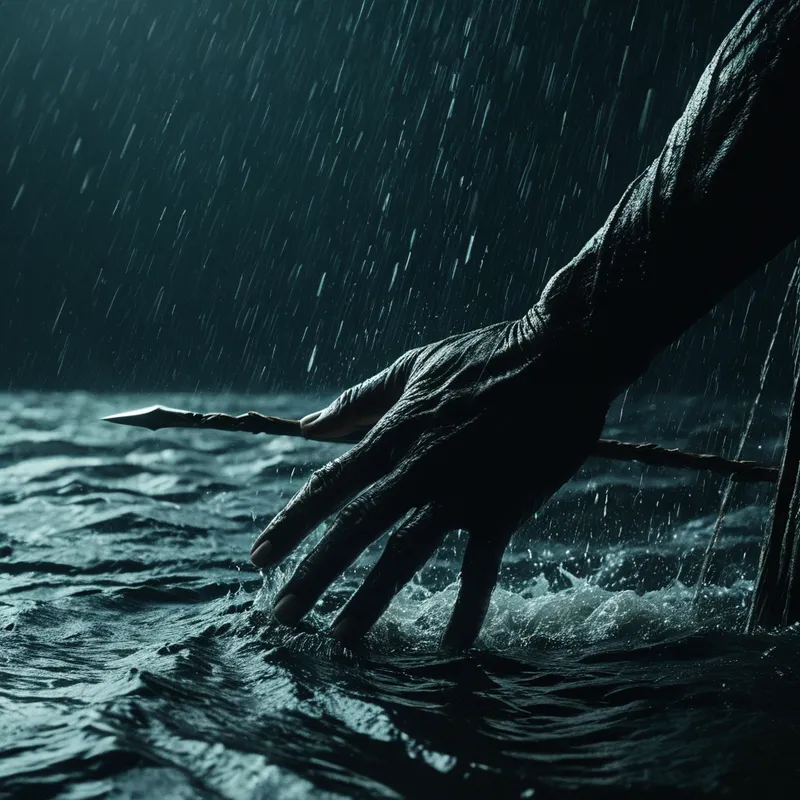
The battle was the first division. Marduk rode his chariot of impossible tempests into the gaping maw of Tiamat. He drove the evil wind into her, inflating her vast body, and with a single, fateful arrow, he split her skull and severed her arteries. He stood upon her colossal, lifeless form, a conqueror upon a mountain of chaos.
And then, the act of creation. He took the two halves of her body. With the upper half, he hammered out the vault of the heavens, pinning it in place with stars to hold back the waters above. With the lower half, he forged the foundation of the earth. But [the world](/myths/the-world “Myth from Tarot culture.”/) was dry and static. From the deep, imprisoned Apsu, the sweet waters now flowed forth under Enki’s stewardship. And from the slain Tiamat’s eyes—those fountains of the primal salt sea—Enki performed his great work.
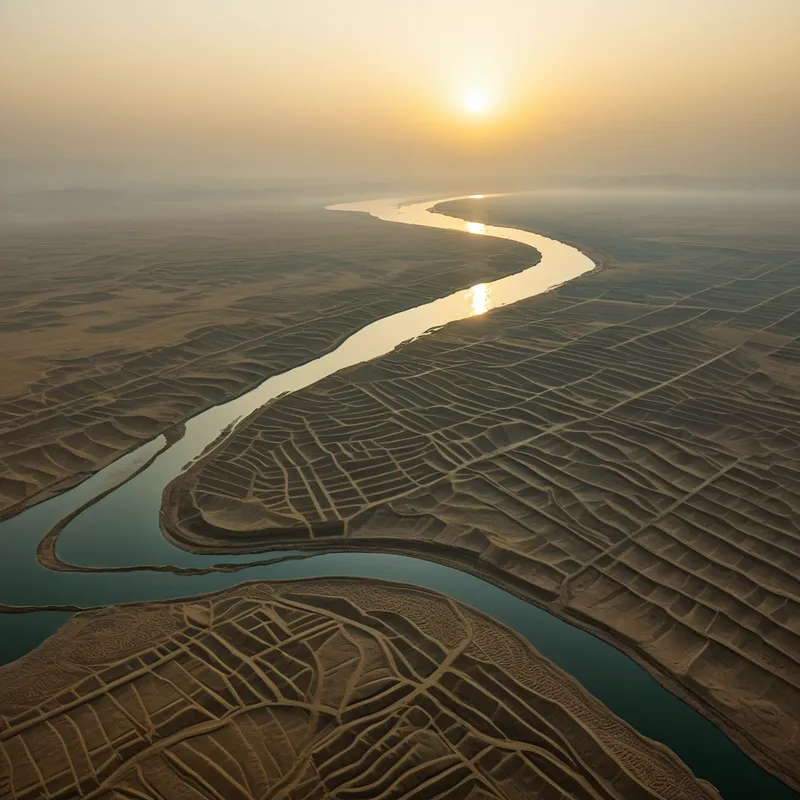
He thrust his spear, his divine authority, into the earth. Where it struck, he commanded the waters to flow. From one eye, he carved a great channel, swift and strong, naming it the Idiglat, the Tigris. From the other, he shaped a winding, generous course, the Buranun, the Euphrates. He filled them not with the salt of chaos, but with the sweet, life-giving waters of Apsu, now tamed and directed. He set their banks of rich, dark silt—the first solid lines against the formless deep. Upon these banks, the first reeds grew. In the marshlands between them, the first humans, shaped from clay and the blood of a defeated rebel god, would find their footing. The rivers were not merely geography; they were the first sentences written upon the blank page of the world, the arteries through which the pulse of civilization would begin to beat.
Cultural Origins & Context
This narrative is not a single, canonical text but a cosmological tapestry woven from several sources, primarily the Babylonian Enuma Elish and older Sumerian traditions concerning Enki. It was the foundational “national epic” of Babylon, recited during the Akitu festival to ritually reaffirm the king’s legitimacy and the world’s order. The priests who chanted it were not merely storytellers; they were performing cosmic maintenance, using myth to keep the forces of chaos (drought, flood, invasion) at bay.
The myth served a profound societal function: it explained the origin of the Mesopotamian world’s most defining and precarious feature—its life-giving, yet unpredictable, rivers. It answered why the world exists, why it is structured as it is, and why humanity’s role is to serve the gods through the labor of irrigation, temple-building, and agriculture on those very riverbanks. The rivers were divine artifacts, the physical proof of the gods’ victory over chaos. To live between them was to live in a sacred, engineered space, a constant reminder of the order wrested from disorder.
Symbolic Architecture
At its core, this is a myth of [differentiation](/symbols/differentiation “Symbol: The process of distinguishing or separating parts of the self, emotions, or identity from a whole, often marking a developmental or psychological milestone.”/)—the primordial act of [consciousness](/symbols/consciousness “Symbol: Consciousness represents the state of awareness and perception, encompassing thoughts, feelings, and experiences.”/) creating a knowable world from undifferentiated experience. Tiamat represents the unconscious, the boundless, all-encompassing state of being where all opposites are merged. It is the psychic “uroboric” [condition](/symbols/condition “Symbol: Condition reflects the state of being, often focusing on physical, emotional, or situational aspects of life.”/), total but unconscious.
The birth of the ego, of conscious awareness, is always an act of violence against the blissful totality of the unconscious.
Marduk’s slaying of Tiamat symbolizes the necessary, heroic act of the emerging consciousness to define itself against the undifferentiated whole. He creates the fundamental binaries: [heaven](/symbols/heaven “Symbol: A symbolic journey toward ultimate fulfillment, spiritual transcendence, or connection with the divine, often representing life’s highest aspirations.”/)/[earth](/symbols/earth “Symbol: The symbol of Earth often represents grounding, stability, and the physical realm, embodying a connection to nature and the innate support it provides.”/), above/below. But slaying alone creates only a dead, dry [space](/symbols/space “Symbol: Dreaming of ‘Space’ often symbolizes the vastness of potential, personal freedom, or feelings of isolation and exploration in one’s life.”/). The true creativity belongs to Enki, the god of wisdom and subterranean waters. He represents the ordering, channeling principle of the mind. [The Tigris and Euphrates](/myths/the-tigris-and-euphrates “Myth from Mesopotamian culture.”/) are not destruction; they are directed flow. They symbolize the establishment of psychic structures—the channels of thought, habit, culture, and [language](/symbols/language “Symbol: Language symbolizes communication, understanding, and the complexities of expressing thoughts and emotions.”/) that carry the [life-giving waters](/symbols/life-giving-waters “Symbol: Life-giving waters symbolize sustenance, nurturing, and the cyclical nature of life and death, serving as a vital resource for survival.”/) of instinct (Apsu) into the conscious world.
The two rivers themselves hold a profound duality: the Tigris, swift and sharp, is the masculine, active, penetrating principle; the Euphrates, winding and broad, is the feminine, receptive, nourishing principle. Their parallel courses represent the necessary [tension](/symbols/tension “Symbol: A state of mental or emotional strain, often manifesting physically as tightness, pressure, or unease, signaling unresolved conflict or anticipation.”/) of opposites that frames a livable world—the banks between which the [soul](/symbols/soul “Symbol: The soul represents the essence of a person, encompassing their spirit, identity, and connection to the universe.”/)’s [life](/symbols/life “Symbol: The symbol of ‘Life’ represents a journey of growth, interconnectedness, and existential meaning, encompassing both the joys and challenges that define human experience.”/) can unfold.
The Dreamer’s Resonance
When this myth stirs in the modern unconscious, it often manifests in dreams of foundational shifts and the emergence of order from chaos. A dreamer may find themselves standing before a vast, threatening body of [water](/myths/water “Myth from Chinese culture.”/) (a sea, a flood) that suddenly recedes or is split, revealing fertile land. They may dream of digging a trench or channel to direct a flow, or of two distinct paths (a blue road and a green road) opening before them.
Somatically, this can correlate with a process of grounding during a period of overwhelming emotional or psychic flux. The dream is not about stopping the water (the feelings), but about creating banks for it—establishing boundaries, routines, or forms of expression that give chaotic internal experience a shape and a direction. It is the [psyche](/myths/psyche “Myth from Greek culture.”/)’s instinct to move from a state of drowning in undifferentiated anxiety or passion to a state where that energy can be used for cultivation and growth. The dream signals a critical transition from passive suffering to active structuring of one’s inner world.
Alchemical Translation
The individuation process mirrors this myth precisely. It begins in the massa confusa, the chaotic inner state where all potentials are merged and nothing is actualized. The “Marduk” stage is the often-painful act of self-definition: saying “I am this, and not that,” drawing boundaries, confronting the inner “dragon” of one’s own undifferentiated shadow material. This battle establishes the space of [the ego](/myths/the-ego “Myth from Jungian culture.”/).
The goal is not to live in the desert of a slain dragon, but to irrigate it with the waters of the soul one has liberated.
The “Enki” stage is the longer, more subtle work of alchemical transmutation. It is the opus of building canals—developing the functions of the personality (thinking, feeling, sensation, intuition) to channel the powerful, often unconscious, libidinal energies (the waters of Apsu) into creative life. To individuate is to become the engineer of one own soul’s river system. One must dig the channels of discipline (the Tigris) and the channels of receptivity (the Euphrates) to water the unique plot of land that is one’s individual life.
The fertile silt deposited between the rivers—the black land of Mesopotamia—is the symbol of [the Self](/myths/the-self “Myth from Jungian culture.”/), the rich, fertile ground of integrated personality that can only exist where conscious structure and unconscious flow are held in sacred, dynamic tension. The myth teaches that civilization of the soul, like that of the world, is founded upon this sacred, hard-won geometry.
Associated Symbols
Explore related symbols from the CaleaDream lexicon: