Throne of Zeus Myth Meaning & Symbolism
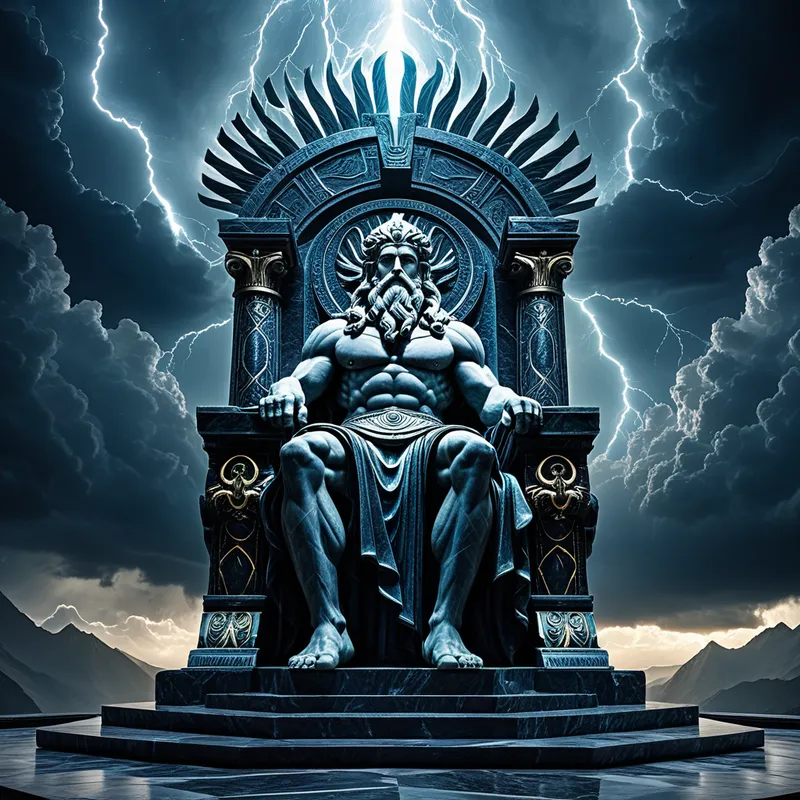
The myth of Zeus's unshakable throne, forged by the Cyclopes, symbolizes the establishment of cosmic order and the psychological seat of ultimate authority.
The Tale of the Throne of Zeus
Before [the world](/myths/the-world “Myth from Tarot culture.”/) knew its name, before mortals learned to fear the thunder, there was only chaos and the gnashing of teeth in the dark. The cosmos was a raw, screaming [thing](/myths/thing “Myth from Norse culture.”/), ruled by the primal terror of the Titans. But in the hidden places, a spark was nurtured. It was the spark of a new order, held in the heart of the youngest son, Zeus.
He had been secreted away, this child of storm, to a cave where the she-goat Amaltheia fed him and [the Curetes](/myths/the-curetes “Myth from Greek culture.”/) danced, their clashing shields drowning his infant cries from his devouring father, [Kronos](/myths/kronos “Myth from Greek culture.”/). There, he grew strong on the milk of destiny. When the time ripened, he returned. With cunning and a draught of emetic, he forced the Titan to disgorge his swallowed siblings: [Hestia](/myths/hestia “Myth from Global/Universal culture.”/), Demeter, [Hades](/myths/hades “Myth from Greek culture.”/), [Poseidon](/myths/poseidon “Myth from Greek culture.”/). A great alliance was forged in [the crucible](/myths/the-crucible “Myth from Alchemical culture.”/) of rebellion. Yet, against the entrenched might of [the Titans](/myths/the-titans “Myth from Greek culture.”/), their power was not enough. The war, the Titanomachy, shook the foundations of [the earth](/myths/the-earth “Myth from Hindu culture.”/) and scorched [the sky](/myths/the-sky “Myth from Persian culture.”/), a stalemate of primordial fury.
Zeus, his brow furrowed with the weight of a universe in balance, received an oracle. Victory lay not in the present struggle, but in the debts of the past. He journeyed to the deepest pit of the earth, to [Tartarus](/myths/tartarus “Myth from Greek culture.”/). There, he freed the ancient, forgotten ones: the Cyclopes and the hundred-armed Hekatoncheires. In gratitude, the Cyclopes, their single eyes burning with the fire of creation, undertook a work of supreme craft. They did not forge a sword or a shield. They forged a seat.
From the bones of the earth and the breath of storms, they crafted the Throne. It was not mere furniture; it was a nexus. They hammered into it the very essence of lightning, the unyielding solidity of the mountain, and the unwavering law of the sky. When Zeus, at the climax of the cosmic war, ascended this throne on the heights of [Mount Olympus](/myths/mount-olympus “Myth from Global/Universal culture.”/), something fundamental shifted. The throne held him, and in holding him, it stabilized the cosmos. From it, he unleashed the gifts: for himself, the thunderbolt; for Hades, the helmet of darkness; for Poseidon, the earth-shaking trident. With these arms and the might of the Hekatoncheires, the old order was shattered. The Titans were cast down, and a new age—the age of Olympian order—was proclaimed from a seat of absolute authority. The universe itself breathed a sigh, finding its center at last.
Cultural Origins & Context
This myth is not a simple story of succession; it is the foundational charter of Hellenic cosmic and social order. It comes to us primarily through the epic catalogs of Hesiod’s Theogony, a poem that served as a sacred text, mapping the genealogy and legitimacy of the gods. In an oral culture where kings derived their right to rule from divine sanction, the myth of Zeus’s throne was profoundly political. It answered the critical question: why is this order, this king, in charge? The answer was not mere brute force, but a narrative of liberation, strategic alliance, and the receipt of legitimizing symbols from primordial powers.
The throne established Zeus not as a tyrant, but as a sovereign whose authority brought stability. It provided a model for the Greek polis: order emerging from chaos through cunning ([metis](/myths/metis “Myth from Greek culture.”/)), [justice](/myths/justice “Myth from Tarot culture.”/) (dike), and the establishment of a fixed center of power. The myth was recited and performed, reinforcing the cultural understanding that true authority is not taken arbitrarily, but is constructed, earned, and serves as [the anchor](/myths/the-anchor “Myth from Christian culture.”/) for reality itself.
Symbolic Architecture
The [Throne](/symbols/throne “Symbol: A seat of authority, power, and sovereignty, representing leadership, divine right, or social hierarchy.”/) of Zeus is the ultimate [symbol](/symbols/symbol “Symbol: A symbol can represent an idea, concept, or belief, serving as a powerful tool for communication and understanding.”/) of established, legitimate sovereignty. It represents the [axis](/symbols/axis “Symbol: A central line or principle around which things revolve, representing stability, orientation, and the fundamental structure of reality or consciousness.”/) mundi, the fixed point around which the [cosmos](/symbols/cosmos “Symbol: The entire universe as an ordered, harmonious system, often representing the totality of existence, spiritual connection, and the unknown.”/) revolves. Psychologically, it is the seat of the conscious ego in its most developed, authoritative, and integrative form.
The throne is not the power itself, but the vessel that contains and directs it. Without it, lightning is mere chaos; upon it, lightning becomes divine judgment.
The Cyclopes, chthonic forces of focused, creative intellect, represent the necessary [integration](/symbols/integration “Symbol: The process of unifying disparate parts of the self or experience into a cohesive whole, often representing psychological wholeness or resolution of internal conflict.”/) of unconscious, primal skill (the forge) into the service of conscious order. The gifts they forge—the thunderbolt, [helmet](/symbols/helmet “Symbol: A helmet in dreams typically symbolizes protection, security, and the mental frameworks we use to shield ourselves from emotional pain.”/), and trident—symbolize the [differentiation](/symbols/differentiation “Symbol: The process of distinguishing or separating parts of the self, emotions, or identity from a whole, often marking a developmental or psychological milestone.”/) and [specialization](/symbols/specialization “Symbol: Focusing on a specific skill or body part, often reflecting identity formation, anxiety about competence, or emotional compartmentalization.”/) of psychic faculties: will, hiddenness, and emotional [depth](/symbols/depth “Symbol: Represents profound layers of consciousness, hidden truths, or the unknown aspects of existence, often symbolizing introspection and existential exploration.”/), all emanating from a central, ruling principle. The throne, therefore, is not a place of rest, but of immense [responsibility](/symbols/responsibility “Symbol: Responsibility in dreams often signifies the weight of duties and the expectations placed upon the dreamer.”/). It is the point where inner conviction meets outer [reality](/symbols/reality “Symbol: Reality signifies the state of existence and perception, often reflecting one’s understanding of truth and life experiences.”/) and imposes a coherent [structure](/symbols/structure “Symbol: Structure in dreams often symbolizes stability, organization, and the framework of one’s life, reflecting how one perceives their environment and personal life.”/). To sit upon one’s own “throne” is to have achieved a psychic integrity where one’s decisions and actions flow from a core of authentic, unshakable [authority](/symbols/authority “Symbol: A symbol representing power structures, rules, and control, often reflecting one’s relationship with societal or personal governance.”/).
The Dreamer’s Resonance
When this myth pattern stirs in the modern unconscious, it often manifests in dreams of finding or confronting a monumental chair, seat, or central platform. The somatic experience can be one of either profound dread or awe-inspiring magnetism.
A dreamer may find themselves in a vast, empty hall, drawn toward a throne that feels terrifyingly large, fearing they are not “enough” to fill it. This is the [psyche](/myths/psyche “Myth from Greek culture.”/) confronting the archetypal demand for self-authority, often experienced as impostor syndrome on a cosmic scale. Alternatively, they may dream of usurpers trying to occupy their seat, or of the throne being unstable, cracked, or missing entirely. These visions speak to a life situation where personal boundaries are violated, core values are compromised, or one’s foundational sense of right to exist and lead one’s own life is under attack. The throne in the dream is the dreamer’s psychological center of gravity; its condition directly reflects the state of their inner sovereignty.
Alchemical Translation
The individuation process modeled here is the transmutation of chaotic potential into ordered sovereignty. The initial state is the “Titanic” psyche: ruled by archaic, unconscious complexes (the devouring father, sibling rivalries) that create internal civil war. The “Zeus” principle is the emerging conscious self that must first retreat and nurture itself ([the cave](/myths/the-cave “Myth from Platonic culture.”/)) before it can engage.
The crucial alchemical operation is the descent to Tartarus—the confrontation with the deepest, most repressed contents of the personal and collective shadow (the imprisoned Cyclopes). These are not monsters to be slain, but creative powers to be liberated. The forging of the throne is the opus, [the great work](/myths/the-great-work “Myth from Alchemical culture.”/) of synthesizing these raw, primal energies (lightning, earth, sky) into a stable, functional structure for [the self](/myths/the-self “Myth from Jungian culture.”/).
To claim your throne is to stop fighting your nature and begin architecting it. You do not become the lightning; you become the seat that can harness its world-shaping power without being destroyed by it.
The final stage is ascension and governance. Sitting on the throne means accepting the full responsibility of consciousness: making choices, setting boundaries (casting down the Titans), and distributing energy wisely to the various domains of one’s life (the gifts to the other gods). The myth tells us that order is not a given; it is a hard-won achievement, forged in the depths and claimed in the heights, establishing the inner kingdom from which a coherent life can be ruled.
Associated Symbols
Explore related symbols from the CaleaDream lexicon: