Threads of Fate Myth Meaning & Symbolism
Three ancient goddesses spin, measure, and cut the thread of every life, weaving destiny into an unbreakable tapestry that even the gods must obey.
The Tale of Threads of Fate
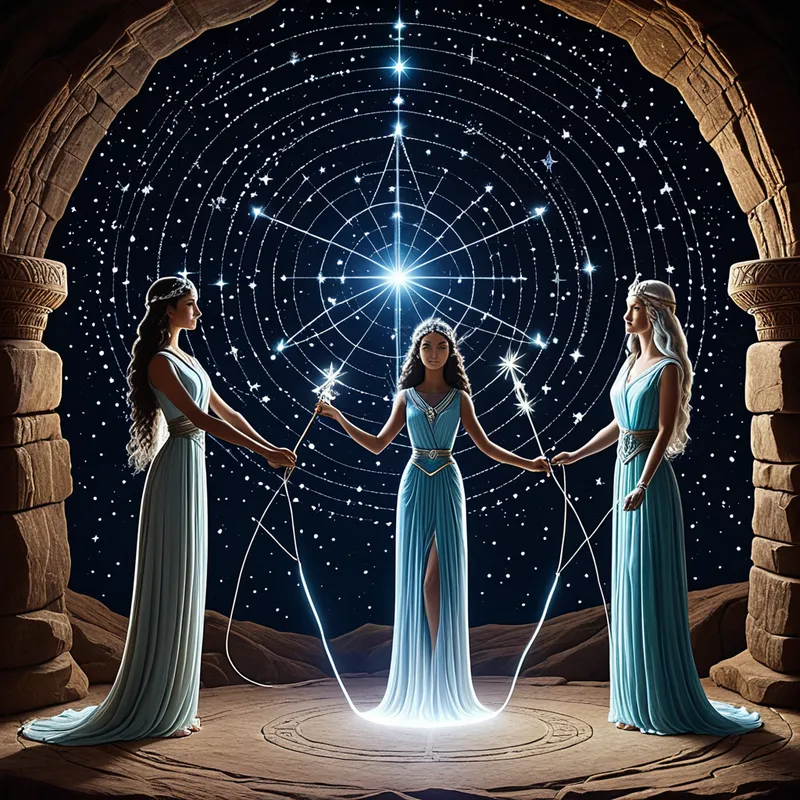
Listen. In the deep, before the first dawn, before the laughter of the gods echoed in the halls of Olympus, there was a cave. Not a cave of stone, but a cave of becoming, a womb of [the world](/myths/the-world “Myth from Tarot culture.”/). And in that cave sat [three sisters](/myths/three-sisters “Myth from Native American culture.”/), older than time, older than memory. They were the [Moirai](/myths/moirai “Myth from Greek culture.”/), and their breath was the rhythm of the cosmos.
The eldest, Clotho, sat with a silver distaff. Her fingers, thin and strong as roots, would reach into [the void](/myths/the-void “Myth from Buddhist culture.”/)—not emptiness, but potential—and draw forth a shimmering, nebulous stuff. With a hum that was the first note of a song, she would spin. She spun not wool, but essence. A faint, glowing strand would emerge, trembling with the promise of a breath, a cry, a name. This was the beginning. The moment of birth, drawn from the raw material of soul-stuff.
The thread passed to the second sister, Lachesis. Her eyes were not eyes, but pools of shifting constellations. She received the fragile thread and, without haste, measured it. She did not use a rule of inches or cubits, but a rod etched with all the possibilities of a life: moments of joy like points of light, stretches of sorrow like dark bands, turns of fortune like knots and bends. Her touch was impartial, her gaze all-seeing. She allotted the portion—the moira—the share of destiny. The length was set. The pattern, in its broadest strokes, was drawn.
Then it came to the third, Atropos. She was the smallest, yet her presence was the heaviest. In her lap lay a pair of shears, their blades forged from a substance darker than obsidian, colder than the void between stars—adamantine, the unbreakable. She did not smile. She did not frown. She watched the thread, now thrumming with the full story of a life, as it ran through her fingers. She felt its vibrations slow, its light begin to dim or flare one final time. And when the measure was complete, when the final note of the song woven into the thread had been sung, her shears would snip. A sound like the ending of a world, yet softer than a sigh. The thread fell silent. The story was complete.
Around them, on a loom as vast as the night sky, the threads were woven. Not one tapestry, but millions, billions, all interlacing—the life of a hero with the stumble of a slave, the love of a queen with the flight of a sparrow. This was the great tapestry of existence. And even Zeus, the thunderer, the father of gods and men, when he stood before their silent work, bowed his mighty head. He could plead, he could rage, but the shears of Atropos would not be stayed. For [the Fates](/myths/the-fates “Myth from Greek culture.”/) were the first law, the deep order upon which even the universe of the gods was built.
Cultural Origins & Context
The myth of the Moirai is not a story with a single author, but a bedrock belief that seeped into Greek consciousness from the earliest Mycenaean times, perhaps even earlier. They were pre-Olympian, chthonic powers, connected to the ancient concept of Moira—one’s allotted portion or share. This was not merely “fate” as a blind force, but a fundamental principle of cosmic distribution and limit.
[Homer](/myths/homer “Myth from Greek culture.”/) speaks of them in the Iliad, often as a singular power (“moira”) that gods themselves hesitate to cross. Hesiod, in his Theogony, systematizes them as daughters of Nyx (Night), placing them at the very foundation of the world-order. They were worshipped in few temples—their power was too vast, too impersonal for simple supplication—but were invoked in oaths and recognized in household rituals. Their societal function was profound: they provided a framework for understanding tragedy, success, and the ultimate limits of life. They answered the haunting question of “why?” with a calm, implacable “because it was allotted.” This was not nihilism, but a form of tragic acceptance that gave dignity to human struggle within a bounded, beautiful design.
Symbolic Architecture
The [symbolism](/symbols/symbolism “Symbol: The use of symbols to represent ideas or qualities, often conveying deeper meanings beyond literal interpretation. In dreams, it’s the language of the unconscious.”/) of the Fates is an elegant, terrifying map of the [human](/symbols/human “Symbol: The symbol of a human represents individuality, complexity of emotions, and social relationships.”/) [condition](/symbols/condition “Symbol: Condition reflects the state of being, often focusing on physical, emotional, or situational aspects of life.”/). They represent the tripartite [structure](/symbols/structure “Symbol: Structure in dreams often symbolizes stability, organization, and the framework of one’s life, reflecting how one perceives their environment and personal life.”/) of any [life](/symbols/life “Symbol: The symbol of ‘Life’ represents a journey of growth, interconnectedness, and existential meaning, encompassing both the joys and challenges that define human experience.”/) process: beginning, middle, and end. Clotho is pure potential, the spark of [consciousness](/symbols/consciousness “Symbol: Consciousness represents the state of awareness and perception, encompassing thoughts, feelings, and experiences.”/) emerging from the unconscious. Lachesis is the unfolding of that [consciousness](/symbols/consciousness “Symbol: Consciousness represents the state of awareness and perception, encompassing thoughts, feelings, and experiences.”/) through time and experience, the [narrative arc](/symbols/narrative-arc “Symbol: A narrative arc represents the structured path that a story follows from introduction to resolution, reflecting growth and transformation.”/) of a self. Atropos is the necessary limit, the finitude that gives shape and meaning to the whole.
The thread is not the life, but the story of the life. We are not the fiber, but the pattern that appears as it is woven.
Psychologically, they represent the superordinate psychic structures that govern [the ego](/myths/the-ego “Myth from Jungian culture.”/). The ego (our conscious self) may feel like it is spinning its own tale, but it operates within a larger, mostly unconscious [pattern](/symbols/pattern “Symbol: A ‘Pattern’ in dreams often signifies the underlying structure of experiences and thoughts, representing both order and the repetitiveness of life’s situations.”/)—[the Self](/myths/the-self “Myth from Jungian culture.”/), in Jungian terms. The Fates symbolize the archetypal laws of the [psyche](/myths/psyche “Myth from Greek culture.”/): the innate tendencies, the core complexes, the destined crises and gifts that form our individual “portion.” The shears of Atropos are the ultimate confrontation with the [reality](/symbols/reality “Symbol: Reality signifies the state of existence and perception, often reflecting one’s understanding of truth and life experiences.”/) principle, the [acceptance](/symbols/acceptance “Symbol: The experience of being welcomed, approved, or integrated into a group or situation, often involving validation of one’s identity or actions.”/) of [mortality](/symbols/mortality “Symbol: The awareness of life’s finitude, often representing transitions, impermanence, or existential reflection in dreams.”/) and limitation without which life has no contour or value.
The Dreamer’s Resonance
When this myth stirs in the modern dreamscape, it rarely appears as three classical goddesses. Instead, the dreamer encounters the process. You may dream of desperately trying to re-tie a broken thread, feeling its severed ends slip through your fingers—a somatic experience of loss, irreversible change, or the end of a life chapter. You may dream of a loom where the patterns turn chaotic, threads tangling into monstrous shapes. This is the psyche signaling a crisis of destiny, a feeling that one’s life narrative is unraveling or has been authored by another.
Conversely, a dream of carefully, lovingly measuring a length of beautiful cord suggests a conscious engagement with one’s life path, assessing its direction and value. The somatic sensation is often in the hands—the feeling of gripping, pulling, or releasing tension. These dreams mark thresholds. They occur during major transitions: career shifts, the end of relationships, the approach of middle age, or confrontations with mortality. The psyche is working to reconcile the ego’s desire for control with the deeper, often incomprehensible, pattern of the Self.
Alchemical Translation
The alchemical work modeled by the Fates is not about cheating the shears, but about understanding the weave. The modern individual’s journey of individuation—becoming who they are inherently meant to be—mirrors the process at the loom. First, we must own our spinning (Clotho). This is the act of consciousness-making, of taking the raw material of our instincts, talents, and traumas and beginning to craft a coherent narrative. “This is my thread. I spin it.”
Then, we must consciously measure (Lachesis). This is the stage of reflection, analysis, and life-review. We look at our choices, our relationships, our work, and see how they form a pattern. We assess what is essential and what is mere clutter. We accept that our thread has a certain length, a certain scope, and we strive to give it the richest pattern possible within those bounds.
The final, most profound transmutation is to willingly take up the shears oneself—not in suicide, but in the conscious sacrifice of what must end for the pattern to be complete.
This is the integration of Atropos. It is the ego’s surrender to the greater Self. We learn to consciously “cut” outdated identities, toxic attachments, and infantile fantasies. We accept necessary endings—of youth, of certain dreams, of life itself—not as a defeat, but as the final, defining act of authorship that grants the whole tapestry its meaning. To become whole, we must make peace with the Fates within, recognizing that our deepest destiny and our truest freedom are found not in escaping the thread, but in weaving it with awe-filled, courageous attention.
Associated Symbols
Explore related symbols from the CaleaDream lexicon: