Thoth's Tablets Myth Meaning & Symbolism
The story of the god Thoth inscribing divine knowledge onto tablets, a myth of creation, order, and the sacred burden of wisdom.
The Tale of Thoth's Tablets
Listen, and let the sands of time part. In the time before time, when the primordial waters of Nun had just receded, the world was raw and unformed. The sun, Ra, sailed his barque across the sky, but below, the hearts of gods and men were restless, governed by whim and chaos. There was no law, no measure, no word to bind reality together.
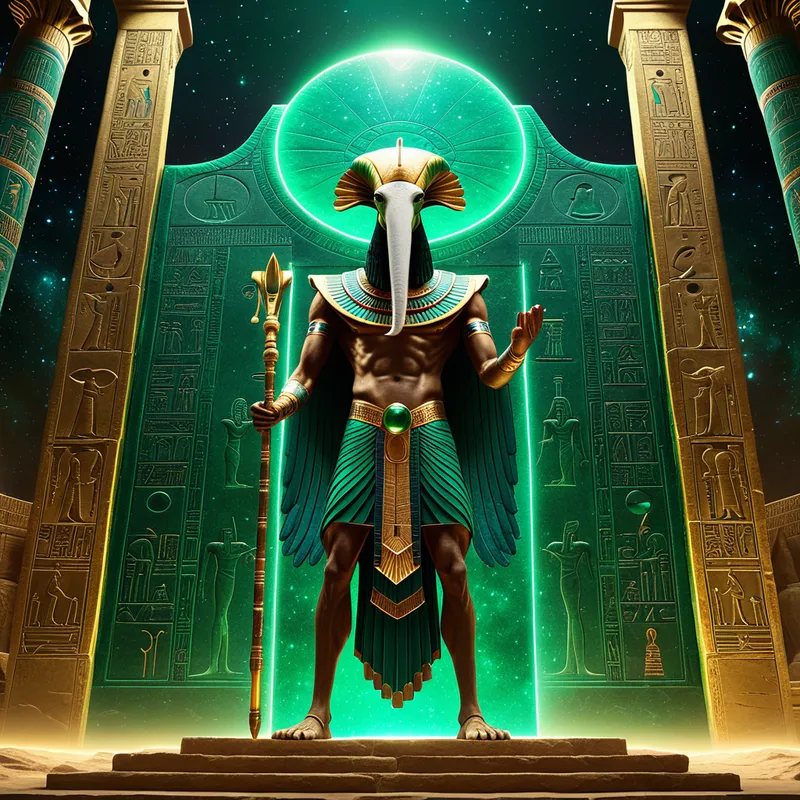
In the silent spaces between the stars, a figure took shape. He was Thoth, the self-created, the measurer. His head was that of the sacred ibis, a creature that probes the mud for hidden truths. In his heart burned not fire, but a cool, silver light—the light of the moon and the clarity of thought. He saw the beautiful, terrible disorder of creation and knew it could not stand. A world without a pattern is a song without a scale; it collapses into noise.
So, Thoth withdrew from the company of gods. He journeyed to a place beyond places, a chamber at the edge of the Nut's body and beneath the feet of Geb. There, in profound solitude, he performed the ultimate act of intellect. He did not fight a monster or conquer a land. He conjured substance from the void of potential. From the essence of order itself, he fashioned tablets—some say of emerald, others of indestructible celestial stone.
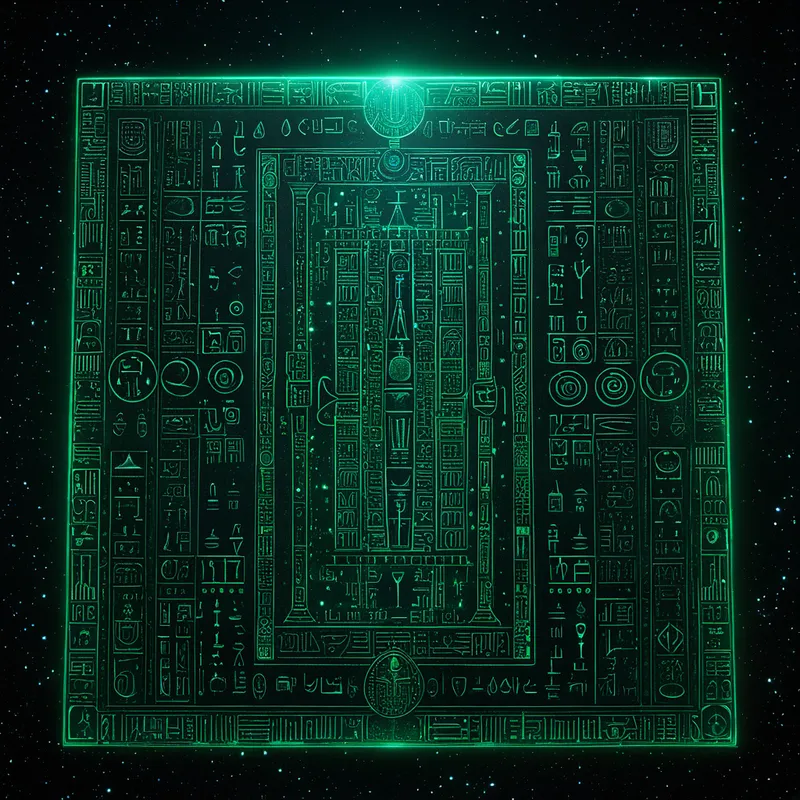
Then, with a stylus of divine fire, he began to write. He did not merely record; he inscribed. Each stroke of his tool was not a description, but a decree. He wrote the laws of the heavens, the mathematics of the stars' dance. He wrote the principles of justice, Maat, that would balance the hearts of men. He wrote the secrets of magic, the true names of things that hold power over their essence. He wrote the arts of healing, of architecture, of astronomy, and the sacred rituals that would maintain the cosmos. The tablets grew heavy with the weight of all that could be known, glowing with an inner, greenish fire.
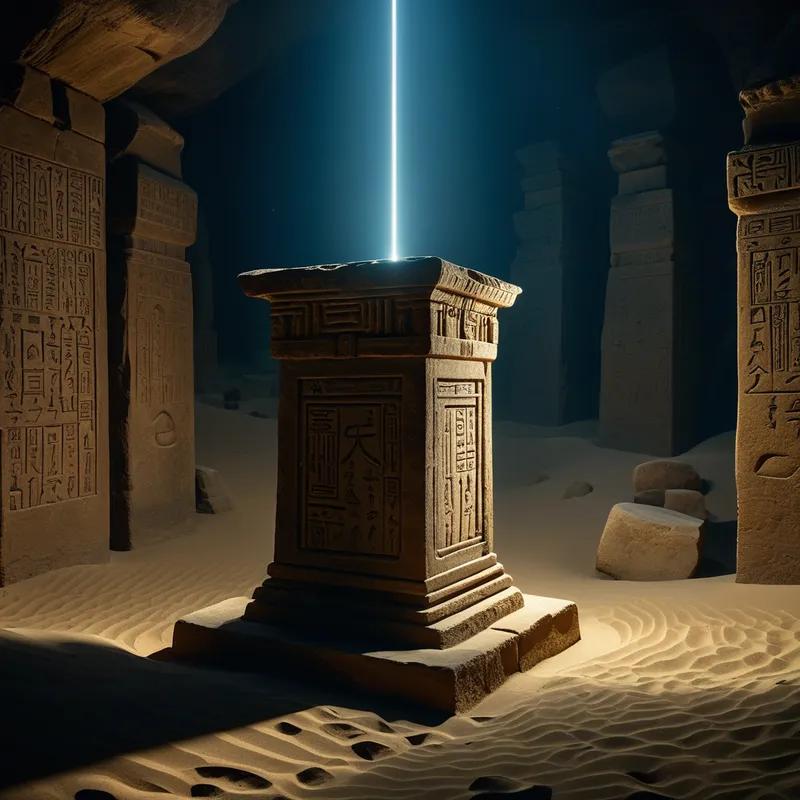
When he was done, he placed them in a hidden vault, a library of one. This knowledge was not a gift to be scattered lightly. It was the foundation stone of reality itself. To access it required worthiness, a heart balanced on the scales against the feather of Maat. The myth whispers that these tablets became the core of all sacred books, the hidden blueprint behind every law, every scientific truth, every moment of genuine inspiration. Thoth, the scribe, had not just recorded the world; he had, in a profound sense, written it into being, binding chaos with the sacred grammar of divine knowledge.
Cultural Origins & Context
The figure of Thoth is ancient, appearing in the Pyramid Texts of the Old Kingdom (c. 2400-2300 BCE), making him one of Egypt's most enduring deities. While a single, standardized "myth of the tablets" akin to a Greek epic does not exist, the concept is woven deeply into his identity. Thoth was the patron of scribes, the inventor of writing (hieroglyphs), and the divine record-keeper. In the Book of the Dead, he is the scribe who records the outcome of the weighing of the heart ceremony.
The idea of a celestial book or tablets containing all knowledge is implicit in his roles. This myth was likely part of an oral and priestly tradition, passed down among the lector priests and temple scholars. Its societal function was multifaceted: it sanctified the act of writing and knowledge-seeking, it explained the origin of cosmic and social order, and it established that true wisdom (Maat) was not human invention but a divine structure to be discovered and upheld. It served as a foundational narrative for an entire civilization built on bureaucracy, astronomy, and a profound belief in the power of the correct word and the accurate record.
Symbolic Architecture
At its core, the myth of Thoth's Tablets is about the imposition of consciousness upon chaos. Thoth represents the archetypal principle of Logos—the ordering word, the differentiating intellect. The unformed world is the unconscious, a sea of potential without structure. The tablets are the structures of consciousness themselves: language, law, number, and symbolic thought.
The tablet is not merely a record of knowledge; it is the very lattice upon which reality crystallizes from the soup of possibility.
The act of writing is profoundly creative. Thoth does not discover the tablets; he makes them and inscribes them. This symbolizes that the categories we use to understand the world—good/evil, light/dark, cause/effect—are not merely observed but are fundamental acts of psychic creation. The hidden vault signifies that this foundational knowledge is not surface-level information; it is the deep, often inaccessible architecture of the psyche and the cosmos. Wisdom, therefore, is not data collection but an alignment with these primordial patterns.
The Dreamer's Resonance
When this myth stirs in the modern unconscious, it often manifests in dreams of profound seeking or burdensome revelation. A dreamer may find themselves in an endless library, searching for a specific, crucial book. They may discover a heavy stone or metal tablet in a basement or garden, covered in symbols they feel compelled to but cannot read. They may dream of trying to write something of immense importance, but the pen fails or the words blur.
Somatically, this can feel like pressure in the head, a tightening in the chest, or a sense of sacred dread. Psychologically, this pattern emerges when the ego is being called to a new level of order and comprehension. It is the psyche's signal that a phase of chaos, confusion, or emotional turmoil is ready to be synthesized and understood. The indecipherable tablet represents knowledge that the conscious mind is not yet ready to integrate—perhaps a truth about one's shadow, a destined path, or a responsibility that feels too great to bear. The dream is an encounter with the Self's own "hidden vault," presenting the blueprint for the next stage of psychic organization.

Alchemical Translation
The alchemical journey mirrored in this myth is the opus of the mind, the transformation of the massa confusa of lived experience into the liber sapientiae—the book of wisdom. For the modern individual, the "primordial chaos" is the raw, undigested material of one's life: traumas, passions, fragmented memories, and unprocessed emotions. Thoth's withdrawal into solitude represents the necessary introversion, the turning inward to engage in the work of self-reflection.
The stylus is attention, and the tablet is the structure of the soul. We inscribe our being through the quality of our conscious focus.
The "writing of the tablets" is the process of active imagination, journaling, therapy, or any disciplined practice where we name, categorize, and give narrative form to our inner world. We are not just recalling events; we are, like Thoth, creating the lawful structure of our own psyche. We establish our personal Maat—our core values, ethics, and understanding. The "hidden vault" is the integrated Self, the total personality where this hard-won wisdom resides, not as egoic possession, but as a foundational truth that guides from within. The triumph is not becoming all-knowing, but achieving a state where one's inner order is in harmony with the outer world, allowing one to act with the authority of the scribe who has read the sacred patterns of their own soul.
Associated Symbols
Explore related symbols from the CaleaDream lexicon: