Thoth's Inkwell Myth Meaning & Symbolism
Thoth, the god of wisdom, sacrifices part of his divine essence to create the first ink, giving mortals the sacred tools of language and memory.
The Tale of Thoth's Inkwell
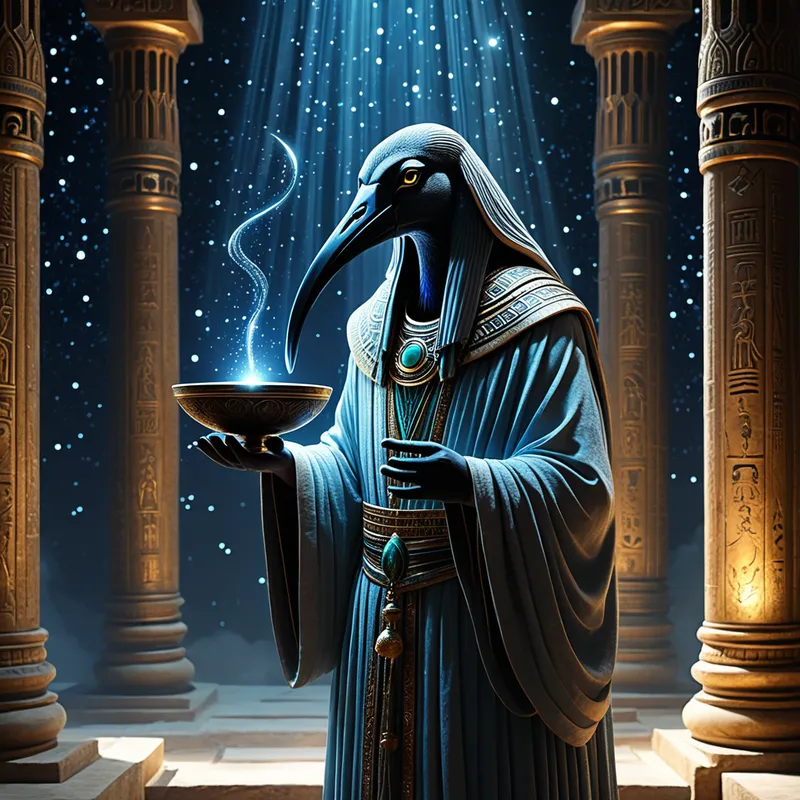
Before the first word was spoken, in the silence that cradled the dawn of the world, there was only the potential for sound. In the hall of stars where the Nun met the first mound of earth, sat Thoth. His form was that of a man with the keen head of an ibis, his eyes holding the patient depth of the moon on still water. Before him lay a blank expanse of papyrus, pure as untouched snow. Beside him sat an empty vessel of obsidian, cold and waiting.
Thoth, the measurer, the counter of hearts, the scribe of the gods, felt a stirring—not in the world, but for it. He saw the souls of mortals flickering like brief candles, their joys and sorrows, their laws and loves, all destined to vanish into the silence from which they came. Memory was a fragile reed in the river of time. The gods spoke in thunder and sunlight, but humanity had no tongue to speak across the generations, no way to hold a thought beyond the breath that carried it.
A profound melancholy settled in his sacred heart. Knowledge, unrecorded, was a bird with clipped wings. Justice, unwritten, was a rumor on the wind. He gazed into the void of the empty inkwell and knew what must be done. It would require a sacrifice, a pouring out of the self into the void to fill it with meaning.
He raised his moon-silver blade, not of metal, but of intention. Without a sound, he drew it across the palm of his own hand. But no blood flowed. Instead, from the sacred wound poured a stream of liquid midnight, speckled with points of silver light—it was the substance of his own divine consciousness, the very fabric of his knowing. This he caught in the obsidian vessel, the Inkwell. It shimmered, a captured piece of the star-filled night, holding within it the patterns of all things that are, were, and could be.
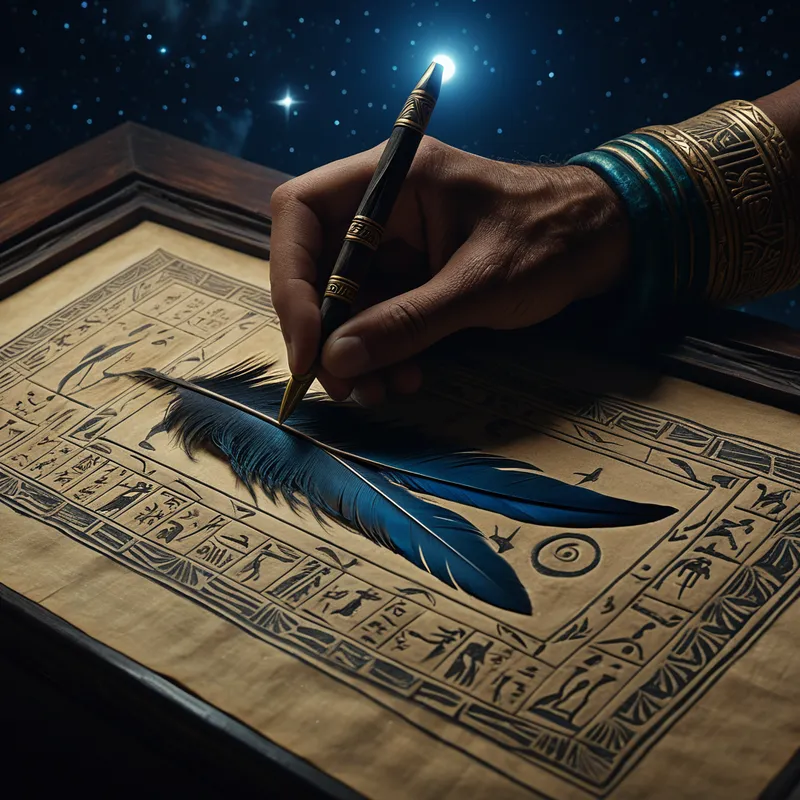
Next, he plucked a feather from his own ibis wing. As it left him, it stiffened, becoming the first pen, a bridge between the mind and the medium. He dipped the pen into the well of his own essence. The moment the tip touched the dark fluid, a hum resonated through the hall of stars. He brought the pen to the papyrus.
And he wrote.
He did not write a name or a story first. He wrote the principle of connection. The first hieroglyph glowed upon the page, a living sigil. With it, the silence of the world was forever broken. The ink was not mere pigment; it was solidified thought, a sacrament of memory. He gave this technology—the pen, the ink, the papyrus—to humanity. He did not give them answers, but the means to ask questions, to record their truths, to argue with the past, and to speak to the future. The gift was the vessel; the sacrifice was the content. From that day, a person was no longer just a voice crying in the dark, but a potential scribe of their own soul.
Cultural Origins & Context
The myth of Thoth’s Inkwell is not a single, codified narrative from one papyrus, but a profound theological implication woven through the entire tapestry of Egyptian thought. It is the sacred backstory to the practice of writing, or Medu Netjer. In a civilization where the act of writing was literally divine—a magic that made things real—the origin of its tools was necessarily a cosmic event.
This myth was lived by the scribes, the sesh, who began their training with libations to Thoth. Their ink palette was a miniature cosmos: the black cake of soot (the night, the fertile silt of the Nile) and the red cake of ochre (the day, the desert, danger). Mixing the ink with water was an act of creation, echoing Thoth’s initial sacrifice. The myth functioned as a grounding ritual, reminding every administrator, poet, and priest that the marks they made were not mundane. They were participating in the ongoing creation of reality, using substances born from a god’s self-offering to fight the ultimate chaos: forgetfulness.
Symbolic Architecture
At its core, the myth presents a foundational archetype of creative genesis: true creation requires a sacrifice of the creator’s own substance. The ink is not found; it is drawn from within.
The well of inspiration is not filled from an external spring, but from the conscious wounding of one’s own wholeness. To create is to willingly make oneself a vessel for an outpouring.
Thoth, as the Maat-bearing god of logic and language, performs an act that transcends his own domain. He injects the feeling of loss, the shadow of melancholy, into the mechanics of knowledge. The inkwell thus becomes a symbol of the contained unconscious—the dark, fluid, star-studded depth of the psyche where unformed thoughts swim. The pen is the disciplined intellect, the focused consciousness that must dare to dip into that chaotic, fertile darkness to bring forth form.
The act of writing becomes alchemical. The blank page (Nun) is ordered by the black ink (differentiated consciousness, Thoth’s sacrifice), creating a new, lasting reality (the recorded word). The myth warns that knowledge without a cost is superficial. Wisdom that does not stem from a piece of oneself given away is merely data.
The Dreamer's Resonance
When this myth stirs in the modern psyche, it often manifests in dreams of writing with impossible substances: blood, light, dark water that flows from one’s own body. To dream of a bottomless inkwell, or a pen that drinks deeply from a personal wound, signals a profound somatic and psychological process: the incubation of a creative or intellectual birth that demands personal cost.
The dreamer may be on the cusp of a project, a confession, a thesis, or a life decision that requires them to articulate something fundamental about their identity. The dream presents the archetypal truth that this articulation cannot be borrowed or fabricated. It must be extracted. There is a fear of depletion (“If I pour this out, what will be left of me?”) coupled with the awe of potential (“This darkness inside me holds stars”). The body might register this as a tension in the hands (the writing instruments) or a hollow feeling in the chest (the vessel being emptied). The dream is the psyche’s ritual preparation, its version of Thoth taking up the blade, acknowledging that to bring inner truth to light, one must first consent to touch the inner dark.

Alchemical Translation
For the individual on the path of individuation, Thoth’s Inkwell models the stage of solutio and coagulatio—dissolution and coagulation. The conscious personality (Thoth as the ordered scribe) must voluntarily dissolve a part of its hard-won structure (the divine essence) into the fluid unconscious (the ink). This is the sacrifice of certainty, of the ego’s pristine self-image, to the murky, ambiguous depths of the soul’s truth.
The journey to self-knowledge is written in an ink made of our own shadows mixed with our own light. We are both the sacrificer and the sacrificed, the well and the scribe.
The “writing” that follows is the act of life-creation. It is the individual taking the liquefied, complex material of their experiences, traumas, joys, and shadows, and giving it form—in relationships, in work, in art, in a lived philosophy. The blank page is the unlived life. The gift Thoth gives is not a pre-written destiny, but the terrifying, liberating tools: the capacity for self-reflection (the ink of consciousness) and the will to act (the pen of intention). The modern alchemist learns that their primary work is not to acquire wisdom from outside, but to courageously dip into their own inner inkwell—their complete self, light and dark—and author their existence with integrity. The myth ultimately promises that in the sacred sacrifice of our partial self to the process, we gain not emptiness, but a deeper, more resonant voice in the great story of being.
Associated Symbols
Explore related symbols from the CaleaDream lexicon: