Thoth's Hieroglyphs Myth Meaning & Symbolism
The myth of the god Thoth creating hieroglyphs, a sacred script that structures reality, reveals the soul, and bridges the human and divine.
The Tale of Thoth’s Hieroglyphs
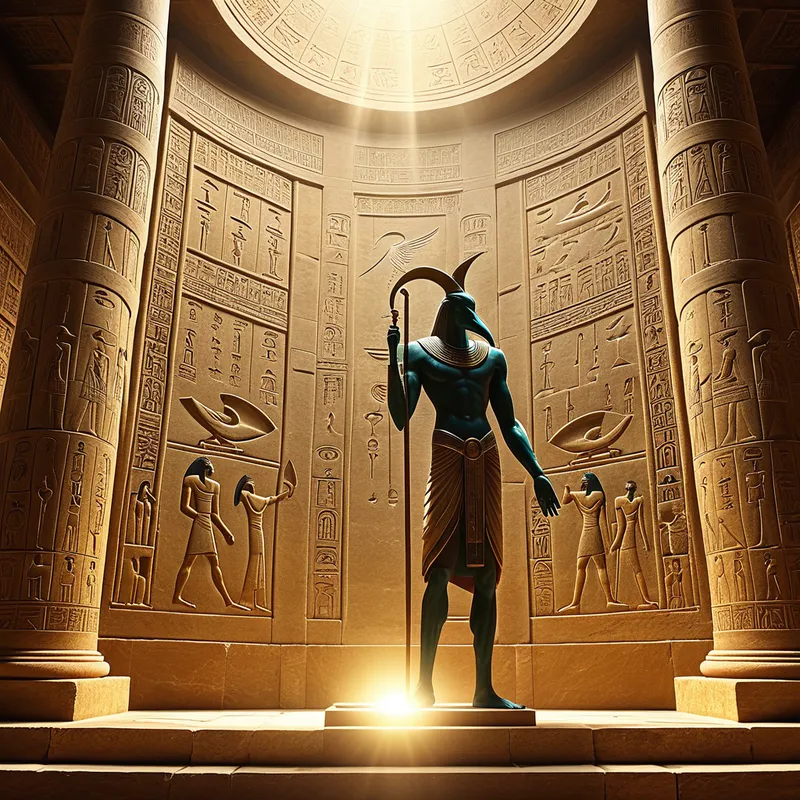
Before the first sunrise etched its path across [the sky](/myths/the-sky “Myth from Persian culture.”/), in the silent, star-dusted womb of pre-creation, a thought stirred. It was not a human thought, but a divine one, humming in the heart of the Nun. From this vibration of potential, a being took form. He was not born of flesh, but of intellect itself. His head was that of the probing, graceful ibis, a seeker in the marshes of the unseen. His name was [Thoth](/myths/thoth “Myth from Global/Universal culture.”/), and he was the tongue of Ra, the heart of order, the measurer of all things.
In the hall of stars, where time was not yet a river but a still lake, Thoth walked. He listened to the silence, and within it, he heard the unspoken names of all that was and all that could be: the sun’s fierce journey, [the river](/myths/the-river “Myth from Buddhist culture.”/)’s patient flow, the secret life of the stone, the joy of the harvest, the terror of the storm. These were not mere sounds; they were living essences, swirling in the chaos, yearning for form.
A great longing arose in him—a sacred ache. To leave these truths unspoken, unmarked, was to leave creation half-born. So, he withdrew to a place between worlds, a chamber lit by the cool, silver light of his own moon-disc. There, no tool of earth would suffice. He sharpened his will into a stylus of pure intention. His medium was not [papyrus](/myths/papyrus “Myth from Egyptian culture.”/), but the very fabric of Maat—the principle of truth and balance.
He reached into the humming chaos and grasped the essence of “mountain.” With a movement that was both a drawing and a speaking, he carved its solid, enduring form: a stark, triangular peak. As the line was completed, the first mountain in [the world](/myths/the-world “Myth from Tarot culture.”/) of form sighed into being, its roots deep in [the earth](/myths/the-earth “Myth from Hindu culture.”/). He captured the fluid, life-giving “[water](/myths/water “Myth from Chinese culture.”/)” in a zigzag line, and the Nile learned its course. He shaped the glyph for “heart,” and in that moment, emotion became a knowable [thing](/myths/thing “Myth from Norse culture.”/), a central organ of being.
But his greatest work was the name. He understood that to know [the true name](/myths/the-true-name “Myth from Various culture.”/) of a thing was to hold its soul, to have power with it, not over it. For the sun, he crafted a circle with a central dot—the enduring, all-seeing eye. For the king, he drew the sedge and the bee, binding the realms of Upper and Lower Egypt into a single, sovereign truth. Each glyph was a spell, a tiny, perfect world, a fusion of sound, image, and meaning that did not merely describe reality, but participated in its very substance.
When he emerged, the world was no longer a silent, potential dream. It was a text. [The wind](/myths/the-wind “Myth from Various culture.”/) wrote on the sand, the stars spelled out destinies, and the human heart now had a script for its deepest cries. Thoth had given the cosmos its language, and in doing so, he had made the divine legible to the mortal mind. The silence was broken, forever replaced by a sacred, ongoing conversation.
Cultural Origins & Context
The figure of Thoth, and the attribution of writing to him, is woven into the very foundation of Egyptian civilization. This was not a folktale for the fireside, but a foundational, theological truth preserved in temple inscriptions, Coffin Texts, and later, in the wisdom literature of the scribal class. The myth functioned as a divine sanction for the entire Egyptian worldview.
Writing—medu netjer—was literally “the words of the god.” Scribes were not mere clerks; they were initiates in a sacred technology, the direct inheritors of Thoth’s power. Their palette and reed were ritual objects. To write a name was to ensure its holder’s existence in the afterlife; to erase it was a fate worse than death. This myth provided the ontological bedrock for law, administration, religion, and magic. It explained why the world was intelligible and why the human mind, through the gift of Thoth, could commune with the principles of Maat. The story was passed down through the strict, revered lineage of scribes, for whom Thoth was the ultimate patron, the divine vizier who recorded [the weighing of the heart](/myths/the-weighing-of-the-heart “Myth from Egyptian culture.”/) in the Hall of Judgment.
Symbolic Architecture
At its core, the myth of Thoth’s hieroglyphs is about the [birth](/symbols/birth “Symbol: Birth symbolizes new beginnings, transformation, and the potential for growth and development.”/) of [consciousness](/symbols/consciousness “Symbol: Consciousness represents the state of awareness and perception, encompassing thoughts, feelings, and experiences.”/) from the [womb](/symbols/womb “Symbol: A symbol of origin, potential, and profound transformation, representing the beginning of life’s journey and the unconscious source of creation.”/) of the unconscious. The Nun represents the undifferentiated, potential-filled [psyche](/myths/psyche “Myth from Greek culture.”/)—all feeling and [image](/symbols/image “Symbol: An image represents perception, memories, and the visual narratives we create in our minds.”/) with no [structure](/symbols/structure “Symbol: Structure in dreams often symbolizes stability, organization, and the framework of one’s life, reflecting how one perceives their environment and personal life.”/). Thoth, the ibis-headed god, symbolizes the discriminating intellect, the faculty that wades into the murky waters of instinct and [emotion](/symbols/emotion “Symbol: Emotion symbolizes our inner feelings and responses to experiences, often guiding our actions and choices.”/) to bring forth distinct forms.
The hieroglyph is the primordial unit of meaning: where the image (the unconscious symbol) and the word (the conscious concept) are not yet divorced. It is the psyche in its original, integrated state.
The act of creation is not ex nihilo, but an act of recognition and articulation. Thoth does not invent the [mountain](/symbols/mountain “Symbol: Mountains often symbolize challenges, aspirations, and the journey toward self-discovery and enlightenment.”/); he recognizes its eternal [idea](/symbols/idea “Symbol: An ‘Idea’ represents a spark of creativity, innovation, or realization, often emerging as a solution to a problem or a new outlook on life.”/) in the [chaos](/symbols/chaos “Symbol: In Arts & Music, chaos represents raw creative potential, uncontrolled expression, and the breakdown of order to forge new artistic forms.”/) and gives it a form that can be held in the mind. This is the fundamental psychological act: transforming amorphous experience (a feeling of grandeur, solidity) into a knowable, communicable concept (“mountain”). Each [hieroglyph](/symbols/hieroglyph “Symbol: Ancient Egyptian writing system using pictorial symbols, representing sacred knowledge, communication with the divine, and the power of language to shape reality.”/), therefore, is an archetypal complex made visible. The “[heart](/symbols/heart “Symbol: The heart symbolizes love, emotion, and the core of one’s existence, representing deep connections with others and self.”/)” glyph (ib) isn’t just an [organ](/symbols/organ “Symbol: An organ symbolizes vital aspects of life and health, often representing one’s emotional or physical state.”/); it is the seat of [intention](/symbols/intention “Symbol: Intention represents the clarity of purpose and direction in one’s life and can symbolize motivation and commitment within a dream context.”/), [memory](/symbols/memory “Symbol: Memory symbolizes the past, lessons learned, and the narratives we construct about our identities.”/), and moral [character](/symbols/character “Symbol: Characters in dreams often signify different aspects of the dreamer’s personality or influences in their life.”/).
Furthermore, the myth posits that [language](/symbols/language “Symbol: Language symbolizes communication, understanding, and the complexities of expressing thoughts and emotions.”/) is not a passive tool, but a world-building force. The name holds the essence. In psychological terms, until we can name an inner state—call it “[grief](/symbols/grief “Symbol: A profound emotional response to loss, often manifesting as deep sorrow, yearning, and a sense of emptiness.”/),” “rage,” “awe”—it controls us from the shadows of the unnamed. Thoth’s gift is the gift of [differentiation](/symbols/differentiation “Symbol: The process of distinguishing or separating parts of the self, emotions, or identity from a whole, often marking a developmental or psychological milestone.”/), which is the first and necessary step toward conscious [relationship](/symbols/relationship “Symbol: A representation of connections we have with others in our lives, often reflecting our emotional state.”/) with the contents of our own inner Nun.
The Dreamer’s Resonance
When this myth pattern stirs in the modern dreamer, it often signals a profound process of inner articulation. The dreamer may find themselves in a library of unknown books, trying to decipher a fading manuscript, or attempting to speak but only strange symbols emerge. They may see walls covered in beautiful, cryptic glyphs that feel intensely personal yet impossible to read.
Somatically, this can feel like a pressure in the throat (the unspoken) or a buzzing clarity in the mind (the onrush of insight just before form). Psychologically, it is [the Self](/myths/the-self “Myth from Jungian culture.”/) pushing toward consciousness. A vast, chaotic emotional experience—a life transition, a trauma, a creative surge—is seeking its “hieroglyphs.” The dreamer is in the role of Thoth in his chamber, tasked with giving form to the formless contents of their own psyche. The frustration of not being able to “read” the dream symbols mirrors the struggle to integrate an experience that has not yet found its mental or emotional category. The dream is the Nun, and the dreaming ego is being called to become the scribe.
Alchemical Translation
The individuation journey modeled here is the transmutation of psychic chaos into personal cosmos. We all begin in a state of inner Nun—a swirl of inherited complexes, instinctual drives, and unprocessed experiences. The first alchemical operation is not action, but observation and naming, the work of Thoth.
To inscribe the hieroglyph is to perform the alchemical fixation: making the volatile spirit (the fleeting emotion, the vague intuition) into a corpus (a defined concept, a journal entry, a piece of art).
The modern individual must become their own scribe. This is the practice of active imagination, of journaling, of therapy, of any discipline that demands we find the precise “glyph” for our inner reality. The “mountain” we carve is our enduring value. The “water” we delineate is the flow of our emotional life. The “heart” we draw is the honest assessment of our intentions.
The ultimate goal is not a random collection of glyphs, but the composition of a coherent inner text—a personal Maat. This is the sacred book of the Self. When we can read our own script, we are no longer passive inhabitants of a reality written by others (by parents, culture, trauma). We become co-authors with the divine within, participating consciously in the ongoing creation of our own world. We move from being spoken through by the unconscious to speaking with it, using the sacred, world-shaping language that Thoth, the archetypal Sage, bestowed at the dawn of knowing.
Associated Symbols
Explore related symbols from the CaleaDream lexicon: