Thoth's calendar Myth Meaning & Symbolism
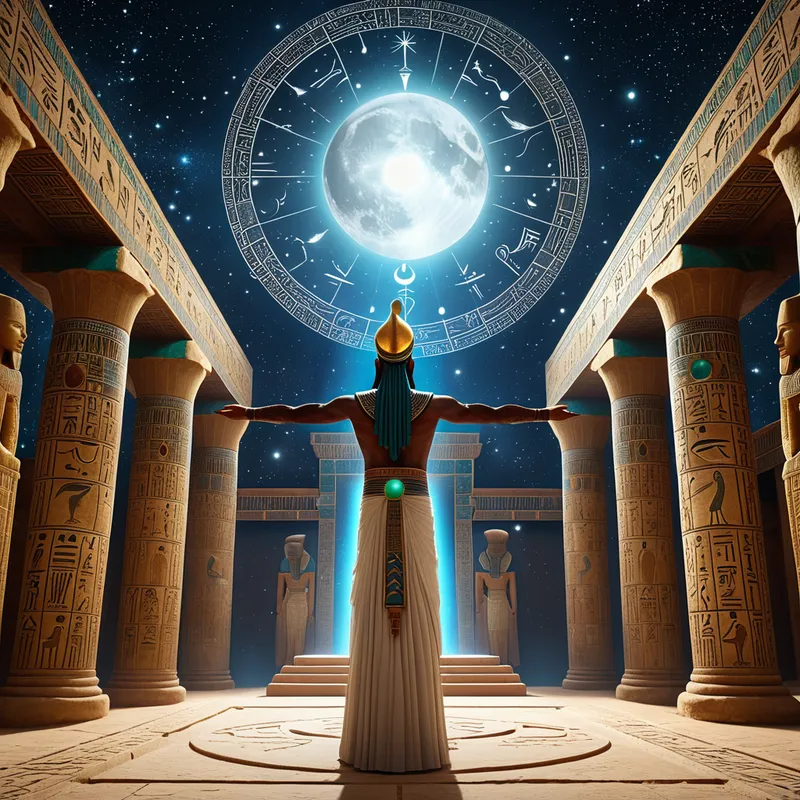
The ibis-headed god Thoth wins five sacred days from the moon to complete the year, birthing time and fate through cunning and cosmic sacrifice.
The Tale of Thoth’s calendar
In the time before years were counted, when the sky was a dark velvet cloak pinned only by the sun’s daily journey, the world was incomplete. The great sun god Ra sailed his barque across the heavens, but the earth below knew only chaos in its seasons. The Nile’s life-giving floods came unpredictably; seeds were sown too early or too late. The people suffered, and the gods saw that the great tapestry of creation had a fraying thread: there was no measure for life itself.
It was then that Thoth, whose mind held the secrets of the stars and whose tongue gave shape to all things, conceived of a remedy. He would create a vessel to hold the days—a sacred measure, a calendar. But the year, as the cosmos demanded, fell short. The moon, the silver measurer, ruled its cycle, and in its rhythm, the year was left with a gap of five days. Five days of non-existence, a crack in the cosmic egg through which chaos could seep.
Thoth went to Khonsu, the youthful moon god, whose light was a cool, gentle counterpoint to Ra’s fierce blaze. He found Khonsu in his celestial barque, casting a soft, silvery glow upon the sleeping world. “Great Khonsu,” Thoth spoke, his voice the sound of reeds whispering secrets, “your light is beautiful but inconstant. The people need a constant measure, a rhythm to bind earth to heaven. Lend me a portion of your light to fill the year.”
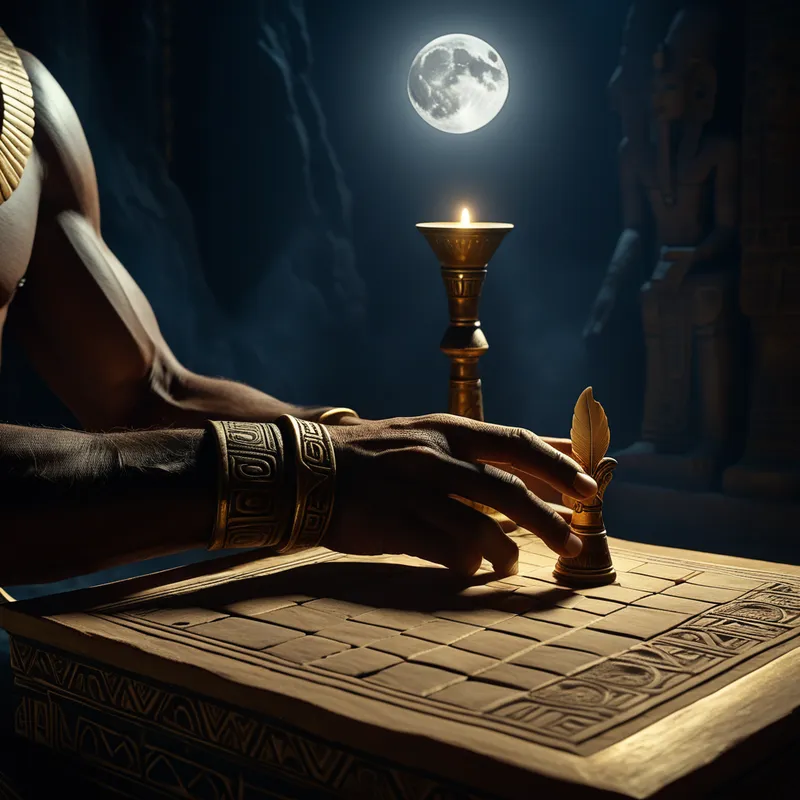
Khonsu, proud of his luminous domain, refused. His light was his essence, not to be given away. Seeing the moon’s resolve, Thoth, the master of all games and hidden knowledge, proposed a contest. A game of senet, the game of passing through the underworld, where fate itself is a player. Khonsu, confident and swift, agreed. The stakes? A measure of light for each game won.
They played not in a grand hall, but in a quiet space between the stars, the board laid upon the void. Thoth’s moves were not mere strategy; they were incantations. Each piece he advanced was a syllable of a spell, each capture a binding of cosmic law. Khonsu played with the passion of youth, his moves like the darting of silver fish, brilliant but predictable. Game after game, Thoth’s cunning prevailed. He won the first sliver, then the second, a crescent, a half-disk, until finally, he claimed the fifth and final portion.
With each victory, a piece of the moon’s silvery essence was drawn away, not stolen, but fairly won. Khonsu watched, his glow dimming not with anger, but with a dawning understanding of a greater necessity. From these five gleanings of moonlight, Thoth wove five new days. These were the Heru-renpet, the days upon the year. They did not belong to the old order of the moon or the sun; they were Thoth’s own creation, days of magic and potential. On these days, the great gods Osiris, Set, Isis, and Nephthys were born, and the fabric of fate was firmly knotted. Time, with all its seasons, festivals, and destinies, began its true, measured flow.
Cultural Origins & Context
This myth is not a simple folktale but a foundational etiological narrative, explaining the origin of the 365-day solar calendar, a cornerstone of Egyptian civilization. The Egyptians observed a discrepancy between the lunar year (roughly 354 days) and the solar cycle. The five “extra” days needed to reconcile this were the epagomenal days, a time considered both sacred and dangerous, existing outside the normal order.
The story is intimately tied to the Coffin Texts and later the Book of the Dead, where Thoth’s role as the divine scribe and arbiter of cosmic law is paramount. It was likely recounted by temple priests, particularly those of Khmunu (Hermopolis), Thoth’s cult center, during rituals marking the New Year or the epagomenal days themselves. Its societal function was profound: it legitimized the state calendar, which governed agriculture (the Nile floods), religious festivals, and pharaonic rule—the king’s duty to maintain Maat. The myth framed this practical necessity as a divine, magical act, transforming timekeeping from an administrative task into a sacred duty that kept chaos at bay.
Symbolic Architecture
At its heart, this myth is about the imposition of conscious order upon unconscious, cyclical nature. Thoth represents the intellect, language, and the structuring principle of the mind. Khonsu, the moon, symbolizes the rhythmic, emotional, and instinctual psyche—beautiful but changeable, tied to tides and moods.
The creation of order is never a neutral act; it is a negotiation with the wild, a sacrifice demanded of nature for the gift of structure.
The five won days are the quintessential symbol. They are the “liminal space,” the temenos or sacred precinct carved out of the formless. They are not of the old system but exist between systems, making them vessels for the new and the numinous—the birth of major deities. The game of senet is equally critical. It frames this cosmic negotiation not as a violent conquest but as a ritualized contest of wits, governed by rules. It signifies that true order must be earned through engagement with the opposing principle, not simply decreed. Thoth does not destroy the moon; he persuades a part of its essence into a new, collaborative function.
The Dreamer’s Resonance
When this myth stirs in the modern unconscious, it often manifests in dreams of measurement, missing pieces, or sacred games. A dreamer might find themselves trying to complete a puzzle with pieces that won’t fit, or watching a crucial clock whose hands are made of moonlight. They may dream of playing a high-stakes game for an intangible prize, feeling both the thrill of cunning and a pang of loss.
Psychologically, this signals a process of individuation where the conscious mind (Thoth) is attempting to structure a chaotic or emotionally overwhelming (lunar) life phase. The somatic feeling is often one of tension—a tightness in the chest or jaw—representing the effort of “holding it together,” of creating personal order. The five days symbolize the psychic energy—the time, focus, or emotional labor—that must be consciously “won” or reclaimed from the autonomous, mood-driven self (the inner Khonsu) to build a stable, purposeful life structure. The dreamer is in the senet house, playing for their own destiny.
Alchemical Translation
The alchemical journey modeled here is the transmutation of chaos into kosmos—personal cosmos. The prima materia is the raw, unmeasured flow of existence: procrastination, emotional reactivity, a life without rhythm or purpose. Thoth, the Magician archetype, is the active, discerning consciousness that initiates the work.
The first operation is separatio: distinguishing the lunar, instinctual self from the potential for solar, conscious order. The game is the coniunctio, the sacred marriage of opposites—intellect and intuition, rule and rhythm. Winning the five days is the mortificatio or sacrifice: the moon’s light dims. This is the crucial psychological cost. To gain self-discipline (the calendar), one must sacrifice a degree of unbridled emotional spontaneity. The bliss of ignorance is traded for the burden and gift of awareness.
The final stage is not just order, but hallowed time. The won days become the vessel for the birth of the gods—the emergence of one’s own inner deities, or ruling psychological principles (love, justice, resilience). The completed calendar is the lapis philosophorum, the philosopher’s stone of the psyche: a self-regulated life where time is not a tyrant but a sacred medium through which destiny consciously unfolds. The individual becomes the scribe of their own soul, writing their days with the pen of Thoth upon the papyrus of lived experience.
Associated Symbols
Explore related symbols from the CaleaDream lexicon: