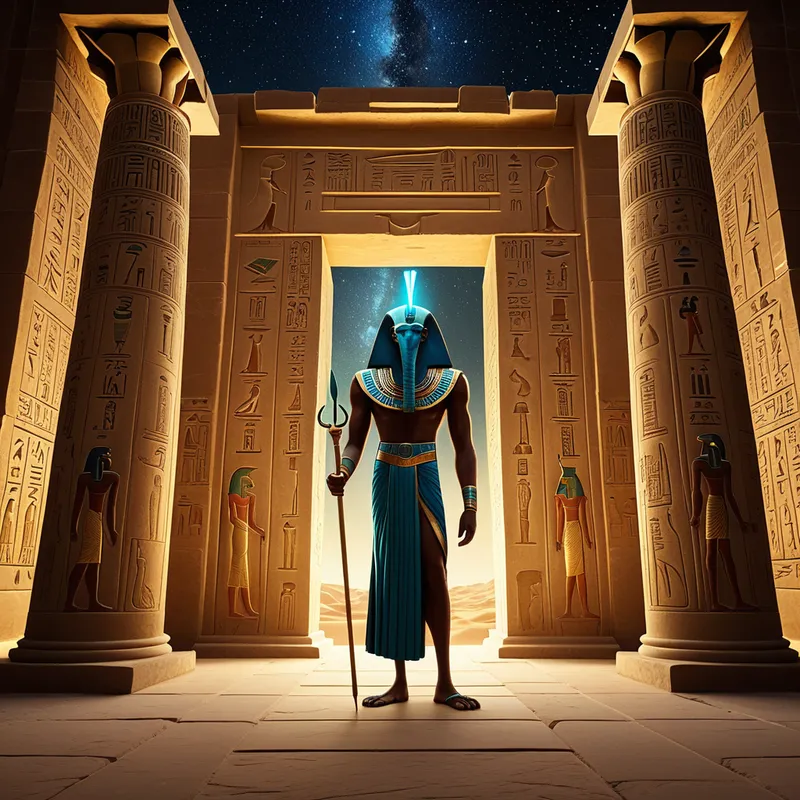
Thoth & The Hall of Records Myth Meaning & Symbolism
The myth of Thoth, god of wisdom, who inscribed all knowledge in a hidden Hall to guide humanity's journey toward self-remembering and wholeness.
The Tale of Thoth & The Hall of Records
Before the first stone of the first pyramid was laid, when the world was still a thought in the mind of the sun, there existed a silence. It was not an empty silence, but a pregnant one, thick with all that had been and all that could be. In this silence walked Thoth, he whose voice measured the cosmos. His footsteps were not sound, but the soft scratch of a stylus on the fabric of reality.
He saw the great dance of Maat and the churning chaos of Isfet. He witnessed the journey of the sun barque through the perilous hours of the night, and the silent, hopeful prayers of souls weighed against the feather of truth. A profound sorrow moved within him—not a personal grief, but the sorrow of eternity witnessing transience. He saw knowledge born in the flash of insight, only to be swallowed by the sands of time. He saw wisdom hard-won by a generation, lost to the next.
And so, he undertook a labor not of strength, but of infinite patience. In a place that is not a place, a time outside of time, he fashioned a Hall. Its walls were not of stone, but of the substance of memory itself. Its pillars were carved from the bones of forgotten epochs. Here, in the still center of all becoming, Thoth began to write.
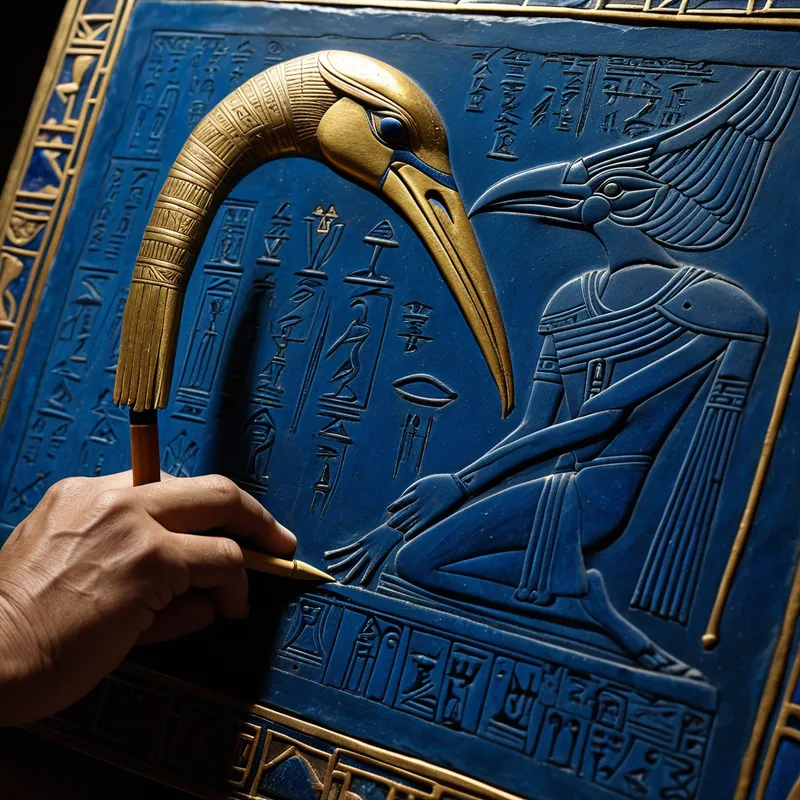
He did not write on papyrus, for such a thing decays. He wrote with his stylus of destiny upon tablets of celestial lapis lazuli and indestructible crystal. He inscribed every law of the stars, every secret name of the gods, every turning of the seasons, and every truth of the human heart. He recorded the first word spoken at creation and the last sigh of a dying world. He chronicled not just events, but their meaning; not just deeds, but the intentions behind them. This was the Hall of Records—the Akashic library of the soul of the world.
The Hall was not meant to be a trophy of his intellect, but a compass for a wandering humanity. He knew that in the long descent into the cycles of birth and forgetting, men and women would lose their way. They would forget their divine origin, their connection to the cosmic order. The Hall was his gift and his test. He sealed its entrance not with a lock of iron, but with a veil of ignorance. To find it, one could not simply walk; one had to remember. One had to journey inward, through the desert of the ego, past the mirages of certainty, to the oasis of the true self.
It is said that in moments of profound crisis or sublime inspiration, when an individual’s heart aligns perfectly with Maat, a door within their own spirit shimmers into being. It is the echo of Thoth’s Hall. And for a fleeting instant, they may glimpse a record—a truth about themselves, about the world, about the pattern that connects all things. Thoth, the eternal scribe, waits. Not to give answers, but to show the seeker that the answers were written within them all along.
Cultural Origins & Context
The myth of Thoth as the divine scribe and keeper of sacred knowledge is woven deeply into the fabric of Egyptian religious and philosophical thought from the Old Kingdom onward. While the specific, elaborated narrative of a “Hall of Records” as a singular, physical library is more prominent in later esoteric and Hermetic traditions (stemming from the Greek identification of Thoth with Hermes Trismegistus), its core elements are authentically Egyptian.
Thoth was the divine mediator, the secretary of the gods who recorded the outcome of the Weighing of the Heart. This role as the recorder of divine truth and cosmic balance naturally extended to the concept of him preserving all knowledge. The idea of hidden, sacred wisdom inscribed in a timeless realm aligns with the Egyptian concept of heka (magic/creative speech) and the power of the written word to make things eternally true. Temples were considered repositories of such knowledge, and the priesthood of Thoth were the custodians of writing, science, and the calendar.
The myth functioned on multiple levels. Societally, it legitimized the scribal class and the Pharaonic order as custodians of Thoth’s divine wisdom. Philosophically, it addressed the human anxiety about loss and oblivion, asserting that nothing of true value—no act of virtue, no discovery of truth—is ever truly lost. It was a myth of hope and continuity, assuring that the cosmic order (Maat) was meticulously documented and could be rediscovered by those pure of heart and intent.
Symbolic Architecture
At its heart, this myth is not about a literal library, but about the architecture of consciousness itself. Thoth represents the transcendent intellect—not cold logic, but the unifying principle of mind that seeks to observe, comprehend, and integrate all experience into a coherent whole. The Hall of Records symbolizes the collective unconscious, the vast, immanent repository of all human experience, memory, and potential.
The Hall is not found in the world, but is the world seen with remembering eyes.
The act of inscribing is the process of giving meaning to experience. Every event, every emotion, every thought is “recorded,” but its true significance—its place in the grand pattern—is often hidden from our waking ego. The “veil” sealing the Hall is our own identification with the personal, temporal self, our amnesia regarding our deeper, archetypal nature. The journey to find the Hall is the journey of introspection, where we move from being actors in a drama to becoming readers of our own sacred text.
The tablets of lapis lazuli are particularly potent symbols. Lapis, with its deep blue speckled with gold, represented the night sky and the celestial realm to the Egyptians. It signifies that true knowledge connects the earthly (the stone) with the divine (the stars). The knowledge is solid, eternal (the stone), yet points to something transcendent and cosmic.
The Dreamer’s Resonance
When this myth pattern activates in the modern psyche, it often manifests in dreams of vast archives, endless libraries, hidden rooms in familiar houses, or searching for a specific, crucial book or file. The dreamer may feel a pressing urgency to “find the information” before time runs out, or a profound awe upon entering a sacred, knowledge-filled space.
Somatically, this can correlate with a process of deep memory retrieval or cognitive reorganization. The psyche is undertaking a “data migration,” moving memories and insights from the fragmented storage of personal history into a more integrated, symbolic understanding. It is a process of context-building. The anxiety in the dream mirrors the ego’s resistance to this upheaval, fearing it will be overwhelmed by the sheer volume of the unconscious. The awe reflects the soul’s recognition of its own depth and heritage. Such dreams often precede or accompany significant life transitions where one must “consult the records” of their own past and potential to understand their next step.

Alchemical Translation
The alchemical process modeled here is one of exaltation—the distillation of base, scattered experiences into the gold of wisdom. The “prima materia” is the raw data of a life: disjointed events, repressed memories, half-formed insights, and unconscious drives. Thoth, as the Mercurius figure, acts as the catalyst.
The first stage (nigredo) is the recognition of ignorance, the “sorrow of Thoth” that motivates the search. The seeker enters the darkness of their own forgotten depths. The second stage (albedo) is the meticulous “inscribing”—the painful, patient work of therapy, journaling, or reflection, where events are revisited and consciously re-evaluated, not to change the past, but to change its meaning. The third stage (rubedo) is the discovery of the Hall: the moment of synthesis where disparate threads of life suddenly reveal a coherent, purposeful pattern.
Individuation is the process of becoming the scribe of your own soul, translating the cryptic hieroglyphs of fate into the narrative of a destiny.
The triumph is not ownership of all knowledge, but the realization that you are in dialogue with it. The modern individual completes this alchemy when they stop seeking authority from external records (doctrines, ideologies, others’ opinions) and begin to trust the authenticity of their own inscribed truth. They become, like Thoth, a mediator—not between gods, but between their own conscious ego and the vast, wise record of the Self within the Hall. The goal is to read your own life as a sacred text, written in the language of symbols, awaiting your deciphering.
Associated Symbols
Explore related symbols from the CaleaDream lexicon: