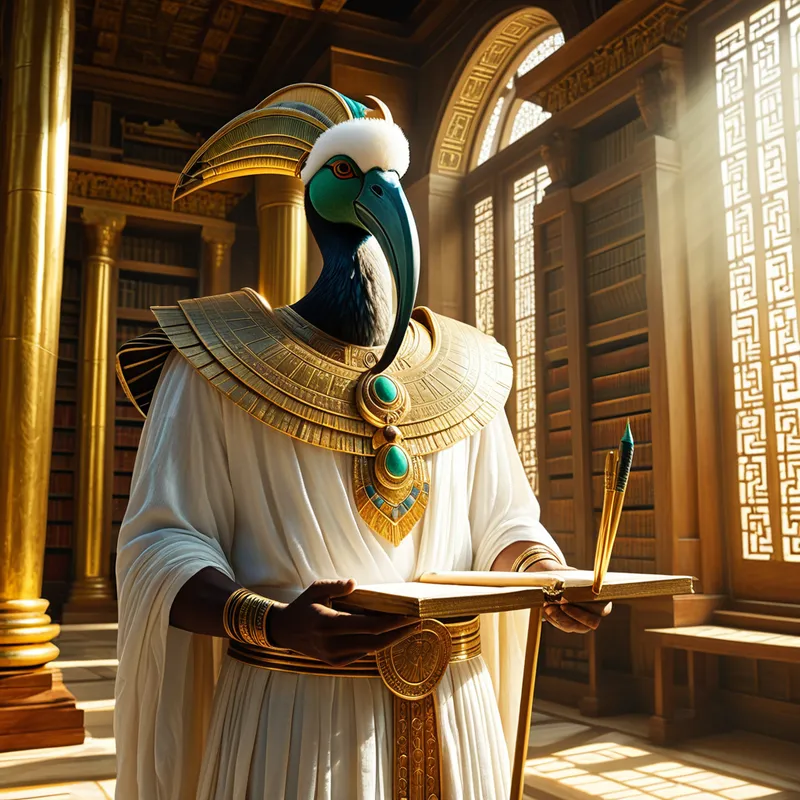
Thoth Myth Meaning & Symbolism
The story of the ibis-headed god who gave humanity language, writing, and the arts, becoming the divine scribe and mediator of cosmic order.
The Tale of Thoth
In the time before time, when the primordial waters of Nun had just receded, the world was raw and roaring. The sun, Ra, sailed his barque of fire across the sky, but below, chaos still whispered in the shadows. There was no measure, no order, no way to hold a thought beyond the moment of its birth.
Then, from the silence between heartbeats, he emerged. Not with a thunderous cry, but with the soft scratch of a reed on wet clay. He was Thoth, the self-created, the ibis-headed one. His beak was not for tearing flesh, but for precision. His eyes held not the fire of conquest, but the cool, measured light of the moon. He was the first to perceive the spaces between things—the space between stars, between thoughts, between a question and its answer.
His greatest act was not a battle, but a birth. He watched the humans below, their minds brilliant but ephemeral as sparks. They felt love, fury, wonder, but these sensations would fade, lost to the relentless river of time. Their stories died with their breath. A great sorrow moved in Thoth’s heart, a sorrow that crystallized into purpose.
He descended to the banks of the Nile, where the reeds grew tall. He took one, split it, and shaped its tip. From the river’s mud and the pulp of the papyrus, he formed a smooth surface. Then, he began to draw. He did not draw pictures of things, but pictures of the sounds that named them. A ripple for water, a star for night, a falcon for spirit. He gave form to breath. He created the Medu Netjer, the words of the gods—writing.
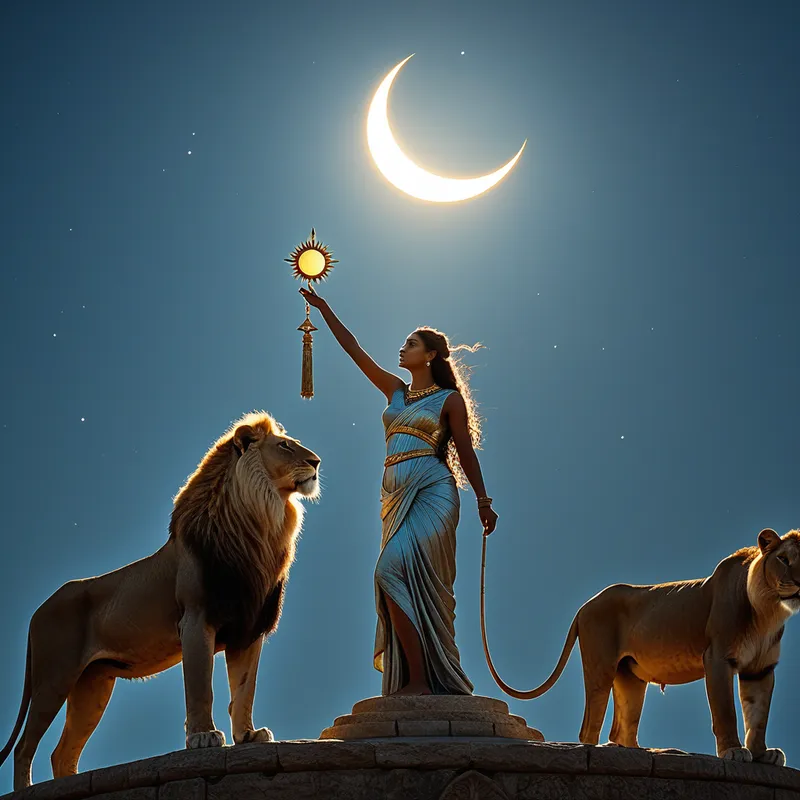
He presented this gift to humanity. With it, they could trap a moment, send a thought across a desert, speak to the future. They could record the laws of Maat and build civilization upon it. But his work was not done. For in the heavens, a terrible conflict raged. The Eye of Ra, the fierce lioness goddess Sekhmet, had been unleashed upon mankind and could not be calmed. Rage threatened to consume the world. And in the myth of the distant goddess, the Eye of Ra, as the goddess Hathor-Sekhmet, fled to Nubia, leaving Egypt barren.
Ra commanded Thoth to mediate. So, the scribe god journeyed. He did not go with weapons, but with cunning words, with music, with games of senet. He found the raging goddess in the desert and began to speak. He told her stories of her home, of the praise awaiting her return. He measured out his speech as carefully as he measured time. He offered not force, but understanding. He played music to soothe her lioness heart. Drop by drop, he convinced her to drink beer dyed red to resemble blood, cooling her fury. He measured the exact amount of her wrath that was assuaged. Through the precise, mediating power of language and ritual, he transformed destructive rage into protective power and brought her home, restoring balance.
And in the Hall of Osiris, where hearts were weighed against the feather of Maat, it was Thoth who stood by the scales. His role was not to judge, but to record. With his palette and stylus, he inscribed the verdict for eternity. He was the silent witness, the one who made the unseen truth permanently seen. He was the bridge between the moment of judgment and the eternity of the record.
Cultural Origins & Context
The myth of Thoth is woven into the very fabric of ancient Egyptian civilization, spanning from the Old Kingdom (c. 2686–2181 BCE) through the Ptolemaic period. He was not a god of a single city but a universal principle vital to the state’s function. His primary cult center was Khemenu, known to the Greeks as Hermopolis Magna.
The myths were not contained in a single, canonical text but were scattered across temple walls, funerary papyri like the Book of the Dead, and wisdom literature. They were transmitted by the very scribes who saw him as their patron. The societal function of Thoth was foundational: he was the divine justification for the scribal class, the administrators, lawyers, and priests who managed the kingdom through the technology of writing. He legitimized law, science (medicine, astronomy, mathematics), and magic (Heka) as sacred arts essential for maintaining cosmic and social order (Maat).
Symbolic Architecture
Thoth is the archetype of the mediating intelligence. He does not originate the light (that is Ra) or the moral law (that is Maat), but he is the faculty that measures, records, and communicates it. He represents the birth of consciousness from the unconscious waters of Nun.
He is the moment a feeling is named, a thought is written, a chaos is given form. He is the principle that nothing is real until it is articulated.
His ibis head symbolizes the probing beak that sifts the fertile mud of the unconscious for nourishment—for ideas. His baboon form (A’an) represents the dawn chatter that greets the sun, the first organized noise that acknowledges the light of consciousness. The moon he is often associated with is not the moon of romance, but the moon as a celestial measurer of cycles, time, and tides—the rational observer of periodic change.
Psychologically, Thoth embodies the transcendent function, the capacity of the psyche to hold opposites in tension and produce a third, reconciling symbol. He stands between Ra (conscious ego, fiery will) and Sekhmet (unconscious rage, instinctual force) and facilitates a transformation. He is the inner scribe that translates raw, overwhelming emotion or intuition into a communicable form—a dream journal entry, a poem, a logical argument.
The Dreamer’s Resonance
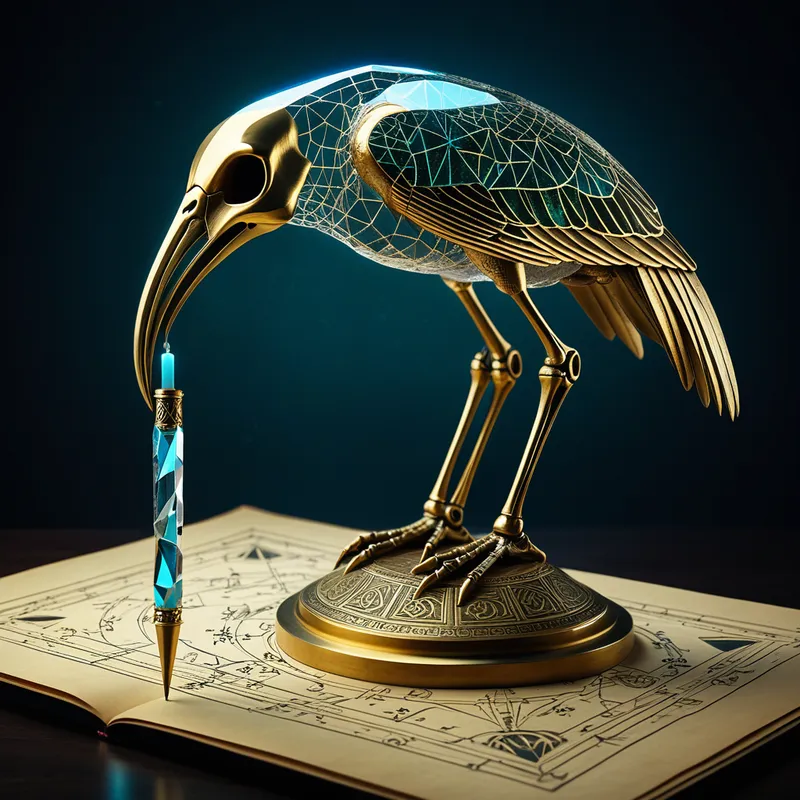
When Thoth appears in the modern dreamscape, he rarely comes as a literal ibis-headed god. He manifests as the process he represents. You may dream of finding a mysterious, ancient book whose language you somehow understand. You may be in a tense confrontation and suddenly find the perfect, calming words that resolve the conflict. You may be trying to measure something impossibly vast—like time or grief—with a delicate, precise instrument.
Somatically, this can feel like a pressure in the throat or the third eye, a need to articulate something stuck within. Psychologically, it signals a passage from a state of being overwhelmed by undifferentiated feeling or mental chaos into a phase of ordering and understanding. The dreamer is in the act of “writing their own myth”—of taking fragmented experiences, internal conflicts, or creative impulses and beginning to give them coherent form. It is the psyche’s move from passive suffering to active witnessing and recording.
Alchemical Translation
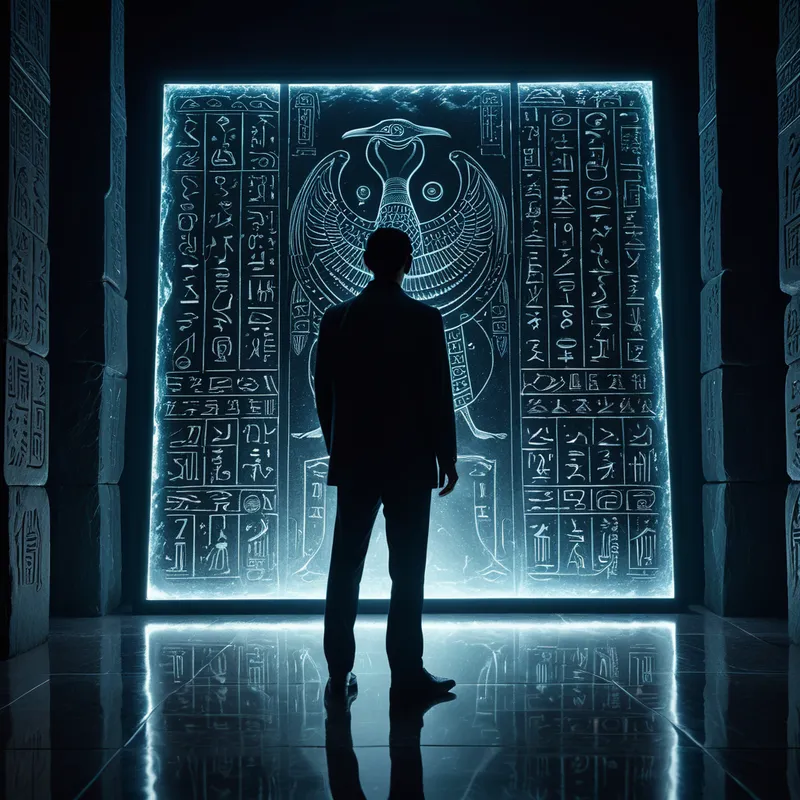
The alchemical journey modeled by Thoth is the transmutation of the prima materia of raw experience into the gold of conscious wisdom. It is the individuation path of the Sage.
The first operation is Separation: Like Thoth distinguishing himself from the primordial Nun, we must differentiate our observing consciousness from the swamp of undifferentiated moods, impulses, and societal noises. This is the act of mindful attention.
The second is Mediation: Here, we enact Thoth’s role in the conflict of the gods. When two irreconcilable forces rage within—perhaps the drive for career success (Ra) versus the need for rest and instinctual life (Sekhmet)—we do not take sides. We become the scribe in the middle. We journal about both. We give each a voice. We measure their claims without judgment.
The alchemy occurs not in choosing one, but in holding the tension until a third, transcendent option is written into being by the inner scribe.
The final operation is Conjunction & Record: The new insight, the reconciled feeling, the creative idea, must be recorded. This is the sacred act. Write it down. Paint it. Compose it. In psychological alchemy, what is not made conscious and concretized in some form slips back into the unconscious. Thoth’s gift of writing is the metaphor for all acts of creation that anchor a psychic transformation in the world. By recording our process, we inscribe our own verdict in the Hall of Osiris, moving our personal truth from the ephemeral to the eternal, completing the work of the self-created sage within.
Associated Symbols
Explore related symbols from the CaleaDream lexicon:
- Laptop
- Keyboard
- Page
- Pen
- Record
- Text
- Watch
- Article
- Journal
- Notebook
- Term
- File
- Bookstore
- Poster
- Serious
- Ancient
- Report
- Secretary
- Essay
- Pencil
- Script
- Official
- Librarian
- Deadline
- Outline
- Occurred
- Clipboard
- Dvd
- Picture Frame
- Newspaper Pile
- Unsaved Document
- Classic Fedora
- Turning Pages
- Veiled Truth
- Unwritten Story
- Lapis Lazuli Slab
- Fluorite Pyramid
- Chrysocolla Sphere
- Sodalite Cluster
- Azurite Stone
- Sodalite Stone
- Chrysocolla Disk
- Argon Light
- Technetium Dream
- Barium Light
- Velvety Silverfish
- Speak to a Moth
- Tegus
- Secretive Nighthawk
- Solitary Nightjar
- Quill of Creation
- Celestial Quill
- Magic Spellbook
- Divination Cards
- Enigmatic Magician
- Banker’s Clipboard
- Editor’s Red Pen
- Pharmacist’s Prescription Pad
- Architect’s Blueprint
- Accountant’s Calculator
- Tailgate Party
- Librarian’s Bookshelf
- Trade Journal
- Librarian’s Card Catalog
- Secretive Claves
- Quest Journal
- Calligraphy Pen
- Collectible Stamps
- Journaling Station
- Sumerian Tablet
- Sculpted Echoes
- Esoteric Typography
- Graphic Novel Panel
- Art Deco Ornament
- Symbolic Icon
- Leatherbound Journal
- Quill Pen
- Blank Page
- Vast Archives
- Celestial Bookmark
- Bookish Ghost
- Illuminated Text
- Pages in the Wind
- Resonant Metaphor
- Spine of a Book
- Literary Critique
- Chronicle of Dreams
- Bookstore Encounter
- Tattered Novel
- Time Traveler’s Library
- Crescent Moon Library
- Feather Quill
- Leather Journal
- Reclining Lounge Chair
- Chic Side Table
- Gallery Wall Shelf
- Imposing Bookshelf
- Metal Filing Cabinet
- Measuring Cups
- Measuring Spoon
- Notepad
- Lapis Lazuli Ring
- Whirring Hard Drive
- Rewound Music Tape
- Heart Rate Monitor
- Index Card
- Binder Clip
- Desk Organizer
- File Cabinet
- Clipboard Holder
- Envelope Sealer
- Fountain Pen Ink
- Clipboard Dream
- Success Sticky Note
- File Folder
- Pen Holder
- Document Scanner
- Timeworn Notepad
- Dreamy Ruler
- Cascading Sticky Tabs
- Transcendent Filing Cabinet
- Echoing Printer Cartridge
- Thumb Drive
- Stationery
- Presentation Slides
- Clipboard Paper
- Triangle
- Metronome
- Vinyl Record
- Postal Office
- Veiled Guardian
- Celestial Hieroglyphs
- Incantation Scroll
- Open Book
- Inspired Quill
- Veiled Knowledge
- Philosopher’s Quill
- Pictograph Carving
- Number 17
- Angel Number 111
- Encrypted Message
- Digital Memory
- Equations
- Algorithmic Code
- Administrative Procedure
- Cipher
- Lexicon
- Morpheme
- Consonant
- Acronym
- Determiner
- Noun
- Derivation
- Specifier
- Appositive
- Denotative
- Hieroglyph
- Logogram
- Font
- Dictionary
- Orthography
- Transcription
- Shader
- Inventory
- Credits
- Homage
- Symbolism
- Ledger
- Invoice
- Mercury
- Hod
- Lapis
- Prescription
- Scribe
- Cerumen
- Syzygy
- Libration
- Database
- Archive
- Bishop
- Luminance