Thor's Journey to Utgard Myth Meaning & Symbolism
The mighty Thor is humbled in a land of giants, where his strength fails and his perceptions are deceived, revealing a deeper truth about the self.
The Tale of Thor’s Journey to Utgard
The road was long and [the sky](/myths/the-sky “Myth from Persian culture.”/) was a bruise. Thor, whose chariot shakes [the nine worlds](/myths/the-nine-worlds “Myth from Norse culture.”/), walked on foot. Beside him, the silver-tongued Loki, and with them, a mortal youth named Thialfi, whose swift legs had earned him a place in this company. They sought [Utgard](/myths/utgard “Myth from Norse culture.”/), a fortress said to lie in the outermost wilds, a place of such power that even the Aesir spoke its name in hushed tones.
Their journey led them through a forest where the trees were like ribs of forgotten beasts, and into a vast, empty hall for the night. There, in the darkness, they felt [the earth](/myths/the-earth “Myth from Hindu culture.”/) tremble with monstrous breaths. At dawn, they found their host was no hall, but the thumb of a giant’s glove, and the giant himself, Skrymir, loomed over them like a moving mountain. He offered to guide them, but his pace was a cataclysm, his snores a tempest. In a fit of rage, Thor swung Mjolnir at the giant’s sleeping head, striking three thunderous blows. Each time, Skrymir merely stirred, asking if a leaf or an acorn had fallen on him.
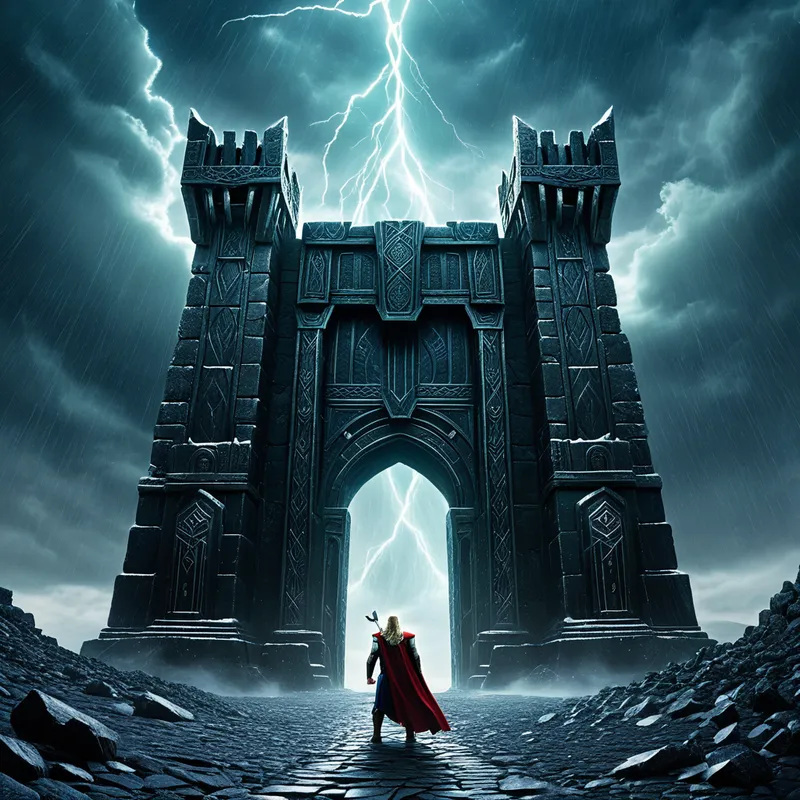
Abandoned, the three travelers finally stood before Utgard itself. Its gates were towers of black ice, its walls sheer cliffs that drank the light. Within, the king of that place, Utgard-Loki, sat upon a throne of frozen stars, surrounded by giants who laughed with the sound of grinding glaciers. He mocked their smallness. To prove their worth, he set them contests.
Loki, who claimed to eat faster than any, was matched against a being named Logi. They devoured meat from opposite ends of a trough. Loki ate all the meat, but Logi consumed the meat, the bones, and the trough itself. Loki had lost to Wildfire itself.
Thialfi, the swiftest of men, raced against a slender giant named Hugi. Thialfi ran as he had never run, but Hugi was at the finish line before Thialfi had taken three strides. Thialfi had lost to Thought.
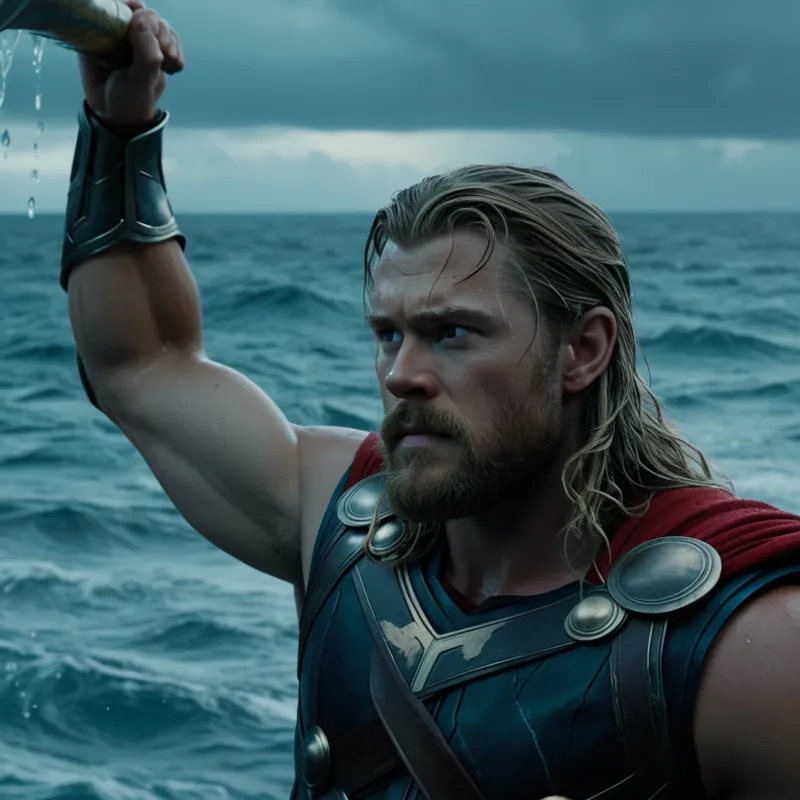
Then came Thor. First, a drinking contest. The king handed him a long, curved horn. “Our weakest men drain this in one draught,” he said. Thor put it to his lips and drank until his lungs burned, but the level in the horn had barely sunk. A second mighty pull, a third titanic effort—still, the horn was not empty.
Enraged, Thor demanded a test of strength. “Lift my grey cat,” the king sneered. Thor gripped the beast’s belly and heaved. The cat arched its back, and though Thor strained with the might that holds up the sky, he could only lift one paw from the floor.
Finally, humiliated, he challenged any to a wrestling match. The king called forth an old, bent crone named Elli. Thor locked with her, but the harder he pushed, the more she stood firm. His footing failed, his knees buckled, and he was brought to one knee.
The laughter of Utgard was a blizzard that froze the soul. Spurned and shamed, the three were sent away at dawn. But as they passed beyond the gates, Utgard-Loki appeared beside them, his form shimmering. The illusions fell away. The giant Skrymir had been Utgard-Loki’s magic, deflecting the hammer blows. Logi was wildfire, Hugi was his own thought. The drinking horn was connected to [the sea](/myths/the-sea “Myth from Greek culture.”/)—Thor’s three sips had created the ocean’s tides. The cat was [Jormungandr](/myths/jormungandr “Myth from Norse culture.”/), and he had shaken [the world](/myths/the-world “Myth from Tarot culture.”/). The old crone was Old Age itself, whom none can defeat.
“You will never see me again,” said Utgard-Loki, and the fortress vanished into mist. Thor raised his hammer in fury, but there was only the empty, mocking wind. They returned to Asgard not in [triumph](/myths/triumph “Myth from Roman culture.”/), but in a silence deeper than any they had known.
Cultural Origins & Context
This myth is preserved primarily in the Gylfaginning section of the Prose Edda, compiled by Snorri Sturluson in the 13th century. While filtered through a Christian lens and a literary sensibility, its roots stretch deep into the pre-Christian Norse worldview. It was not scripture, but part of a vibrant, living oral tradition, likely told in halls during the long winters. The storyteller (the skald) would have used it not just for entertainment, but for philosophical instruction.
Its societal function was multifaceted. For a culture that valorized strength, courage, and martial prowess, the tale served as a crucial corrective. It taught that raw power has its limits and that the world contains forces—deception, natural law, time itself—that cannot be overcome by brute force alone. It reinforced a worldview where perception is fragile, where the cosmos is filled with beings and powers that operate by rules beyond human (or even divine) understanding. The myth validated experience of being humbled by a world vaster and more cunning than one’s own self-assessment.
Symbolic Architecture
The [journey](/symbols/journey “Symbol: A journey in dreams typically signifies adventure, growth, or a significant life transition.”/) to Utgard is a masterful [allegory](/symbols/allegory “Symbol: A narrative device where characters, events, or settings represent abstract ideas or moral qualities, conveying deeper meanings through symbolic storytelling.”/) for [the ego](/myths/the-ego “Myth from Jungian culture.”/)’s confrontation with the unconscious. Utgard is not just a physical place, but the [Shadow](/symbols/shadow “Symbol: The ‘shadow’ embodies the unconscious, repressed aspects of the self and often represents fears or hidden emotions.”/) [realm](/symbols/realm “Symbol: The symbol of ‘Realm’ often signifies the boundaries of one’s consciousness, experiences, or emotional states, suggesting aspects of reality that are either explored or ignored.”/) par excellence—the land of giants, of everything the conscious “heroic” [identity](/symbols/identity “Symbol: Identity represents the sense of self, encompassing personal beliefs, cultural background, and social roles.”/) deems other, overwhelming, and [alien](/symbols/alien “Symbol: Represents the unknown, otherness, and the exploration of new ideas or experiences.”/).
The greatest tests are not of muscle, but of meaning. What you perceive as a cup to drain is the ocean; what you see as a cat to lift is the axis of the world.
Thor represents the conscious ego: direct, powerful, sure of its dominion. His failures are profound revelations. He does not lose to stronger opponents; he loses to the true [nature](/symbols/nature “Symbol: Nature symbolizes growth, connectivity, and the primal forces of existence.”/) of the opponents. He tries to out-drink the Sea, out-lift the World [Serpent](/symbols/serpent “Symbol: A powerful symbol of transformation, wisdom, and primal energy, often representing hidden knowledge, healing, or temptation.”/), and defeat Old Age. His might is real, but it is applied within a [framework](/symbols/framework “Symbol: Represents the underlying structure of one’s identity, emotions, or life. It signifies the mental or emotional scaffolding that supports or confines the self.”/) of illusion crafted by Utgard-Loki, the master of deception, who symbolizes the [trickster](/symbols/trickster “Symbol: A boundary-crossing archetype representing chaos, transformation, and the subversion of norms through cunning and humor.”/) [aspect](/symbols/aspect “Symbol: A distinct feature, quality, or perspective of something, often representing a partial view of a larger whole.”/) of the unconscious itself. The myth teaches that the ego, for all its [strength](/symbols/strength “Symbol: ‘Strength’ symbolizes resilience, courage, and the ability to overcome challenges.”/), is often operating on false premises, mistaking symbols for their referents, and battling phantoms of its own misunderstood [perception](/symbols/perception “Symbol: The process of becoming aware of something through the senses. In dreams, it often represents how one interprets reality or internal states.”/).
The final [revelation](/symbols/revelation “Symbol: A sudden, profound disclosure of truth or insight, often through artistic or musical means, that transforms understanding.”/) is the alchemical key: the humiliation is an [initiation](/symbols/initiation “Symbol: A symbolic beginning or transition into a new phase, status, or awareness, often involving tests, rituals, or profound personal change.”/). By being stripped of his certainty, Thor is granted a [vision](/symbols/vision “Symbol: Vision reflects perception, insight, and clarity — often signifying the ability to foresee or understand deeper truths.”/) of the true scale of the [cosmos](/symbols/cosmos “Symbol: The entire universe as an ordered, harmonious system, often representing the totality of existence, spiritual connection, and the unknown.”/). His power, though “failing” in the [contest](/symbols/contest “Symbol: A contest often symbolizes competition, personal challenges, and the desire for validation or achievement.”/), is shown to be cosmically significant—his sips move the tides, his strain shakes the serpent.
The Dreamer’s Resonance
When this myth patterns a modern dream, the dreamer is in a profound state of psychic reorientation. The somatic feeling is one of immense effort yielding bafflingly small results—pushing against a wall that gives like fog, or running in deep [water](/myths/water “Myth from Chinese culture.”/).
Psychologically, the dreamer is encountering their own “Utgard-Loki.” This is the part of the [psyche](/myths/psyche “Myth from Greek culture.”/) that constructs limiting self-perceptions and impossible tests. Dreaming of failing a crucial exam you didn’t study for, of a weapon turning to foam in your hand, or of a familiar room becoming a vast, labyrinthine fortress—these are echoes of Thor’s journey. The dream ego, like Thor, is being shown that its tools and strategies are mismatched to the true nature of the challenge. The challenge is not to “try harder” with the same conscious attitude, but to question the very framework of the contest. The dream is a call to withdraw the heroic [projection](/myths/projection “Myth from Alchemical culture.”/), to stop wrestling with “Elli” (an unavoidable life process like aging, grief, or a fundamental limitation) as if it were a fair fight.
Alchemical Translation
The alchemical process modeled here is mortificatio—the humbling, blackening, and dissolution of the ego’s pride, which is the necessary precursor to illuminatio. Thor begins in a state of inflation: the god of thunder, confident in his might. His journey is a forced descent into [the underworld](/myths/the-underworld “Myth from Greek culture.”/) of his own ignorance.
The hammer that shatters mountains cannot crack the mirror of illusion. First, the hand that holds it must tremble.
The contests are the furnace. Each failure burns away a layer of his assumed identity. The “victory” is in the incineration. When Utgard-Loki reveals the truths, it is the albedo—the whitening, the insight. Thor does not gain a new power; he gains a new understanding of the power he already wielded and the world in which it operates. His individuation path is not toward greater strength, but toward greater awareness. The integrated hero is not the one who never loses, but the one who has been broken open by loss and shown the hidden connections of the world.
For the modern individual, this myth instructs us to suspect our defeats. When we fail consistently in a domain—relationships, creativity, ambition—the Utgard-Loki of our psyche may be tricking us. We may be trying to drain the ocean when we are only meant to taste the salt, or wrestling with an immutable law of our nature. The triumph is to have the fortress of false perception vanish, leaving us alone, humbled, but finally in contact with a reality vaster and more strange than our vanquished pride could ever have imagined.
Associated Symbols
Explore related symbols from the CaleaDream lexicon: