Thomas the Apostle Myth Meaning & Symbolism
The apostle who demanded to touch the wounds of the risen Christ, transforming doubt into a testament of faith through physical encounter.
The Tale of Thomas the Apostle
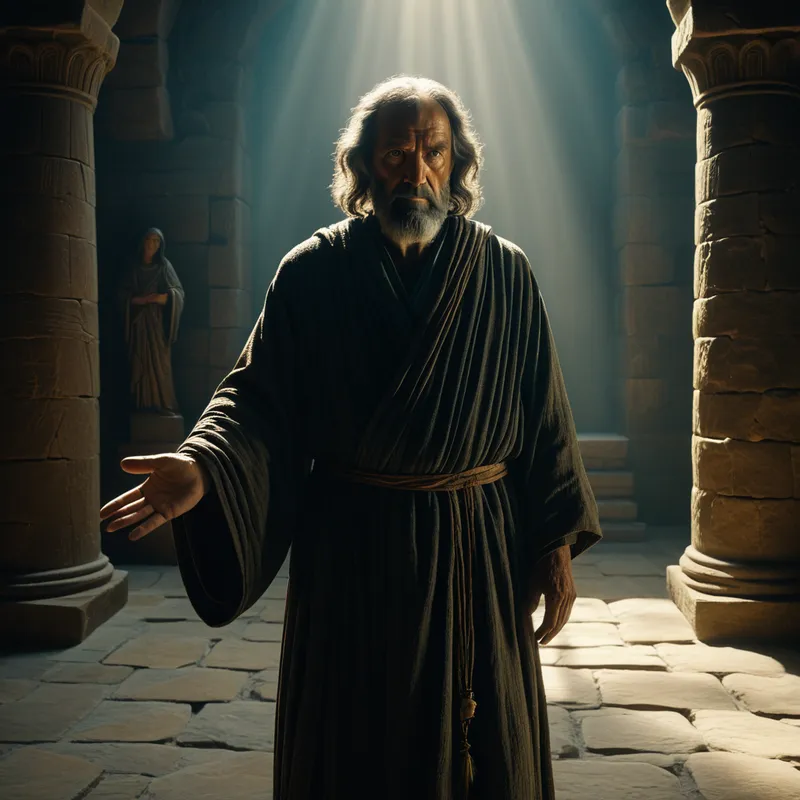
Listen. In the days when [the world](/myths/the-world “Myth from Tarot culture.”/) was cracked open and heaven bled into the dust, there was a man whose name meant Twin. He was called [Thomas](/myths/thomas “Myth from Christian culture.”/), and his soul was a room with two doors: one swung open to faith, the other bolted shut by a need to know. He walked with the one they called the Christ, heard [the parables](/myths/the-parables “Myth from Biblical culture.”/) that fell like seeds, saw the blind receive sight like a sudden dawn. Yet, within him, a quiet stone remained unturned.
Then came the darkness. The teacher was taken, nailed to rough wood, and laid in a tomb sealed with a stone as final as a period. The other disciples huddled in a locked room, breath held, the air thick with grief and fear. But Thomas was not there. He was walking alone through the streets of [Jerusalem](/myths/jerusalem “Myth from Biblical culture.”/), his doubt a heavier shroud than any grief. He needed the texture of truth, the geometry of fact. “Unless I see the nail marks in his hands,” he declared, his voice like flint on steel, “and put my finger where the nails were, and put my hand into his side, I will not believe.”
Eight days passed, a slow river of silence. Again, they were gathered behind locked doors. Suddenly, he was among them. Not through the door, but within the locked space itself, as if the walls were no more substantial than a thought. “Peace be with you,” he said. Then he turned his gaze to Thomas, and it was a gaze that knew the weight of the stone in the twin’s heart. “Put your finger here; see my hands. Reach out your hand and put it into my side. Stop doubting and believe.”
The air vanished from the room. Thomas, the twin of doubt, stood before the living wound of love. He did not need to touch. The evidence he had demanded was now an overwhelming, radiant fact that dissolved his conditions. His confession was not a whisper, but the bedrock of his being breaking open. “My Lord and my God!” he cried. And the one who had invited his touch replied, “Because you have seen me, you have believed; blessed are those who have not seen and yet have believed.”
Cultural Origins & Context
The story of Thomas is woven into the fabric of the Gospel of John, a text composed near the end of the first century CE. This was a period of fragile formation for the early [Jesus](/myths/jesus “Myth from Christian culture.”/) movement, a community defining itself against both traditional Judaism and the broader Hellenistic world. The myth was not a folk tale told around fires, but a theological narrative circulated within communities of believers, likely read aloud during gatherings.
Its function was multifaceted. For a community that had not physically witnessed [the resurrection](/myths/the-resurrection “Myth from Christian culture.”/), it directly addressed the tension between empirical proof and faith. Thomas becomes every believer’s proxy, his doubt legitimized and then transcended. The story also served a polemical purpose, affirming the physical, bodily reality of the resurrection against early Gnostic tendencies that might spiritualize it away. Thomas’s demand to touch the wounds anchors the central Christian mystery—the Incarnation—in tangible flesh. He is not a villain, but a crucial witness whose skepticism is the furnace that forges a stronger, more embodied confession.
Symbolic Architecture
Thomas represents the [archetype](/symbols/archetype “Symbol: A universal, primordial pattern or prototype in the collective unconscious that shapes human experience, behavior, and creative expression.”/) of the Rational [Seeker](/symbols/seeker “Symbol: A person actively searching for meaning, truth, or a higher purpose, often representing the dreamer’s own quest for identity or fulfillment.”/). He is the part of the [soul](/symbols/soul “Symbol: The soul represents the essence of a person, encompassing their spirit, identity, and connection to the universe.”/) that refuses easy answers, that finds hollow the consolations of inherited belief. His doubt is not a lack of [faith](/symbols/faith “Symbol: A profound trust or belief in something beyond empirical proof, often tied to spiritual conviction or deep-seated confidence in people, ideas, or outcomes.”/), but a profound respect for [reality](/symbols/reality “Symbol: Reality signifies the state of existence and perception, often reflecting one’s understanding of truth and life experiences.”/)—a demand that the sacred prove itself in the [realm](/symbols/realm “Symbol: The symbol of ‘Realm’ often signifies the boundaries of one’s consciousness, experiences, or emotional states, suggesting aspects of reality that are either explored or ignored.”/) of the senses.
The wound is the gateway. What is rejected—the evidence of suffering, the mark of mortality—becomes the very site of revelation and recognition.
His epithet, “the Twin,” is the master [symbol](/symbols/symbol “Symbol: A symbol can represent an idea, concept, or belief, serving as a powerful tool for communication and understanding.”/). It speaks to the duality of his [nature](/symbols/nature “Symbol: Nature symbolizes growth, connectivity, and the primal forces of existence.”/)—faith and doubt, [spirit](/symbols/spirit “Symbol: Spirit symbolizes the essence of life, vitality, and the spiritual journey of the individual.”/) and matter—and by extension, the duality within every individual. More profoundly, it suggests he is the twin of Christ himself, but of the incarnate, suffering Christ. He does not seek the glorified, disembodied spirit; he seeks the one who bears the scars. His [journey](/symbols/journey “Symbol: A journey in dreams typically signifies adventure, growth, or a significant life transition.”/) is to recognize his twin in the wounded divine, to see his own mortal, questioning [nature](/symbols/nature “Symbol: Nature symbolizes growth, connectivity, and the primal forces of existence.”/) reflected and sanctified in the resurrected [body](/symbols/body “Symbol: The body in dreams often symbolizes the dreamer’s self-identity, personal health, and the relationship they have with their physical existence.”/). The locked [room](/symbols/room “Symbol: A room in a dream often symbolizes the self, representing personal space, mental state, or aspects of one’s identity.”/) is the [psyche](/myths/psyche “Myth from Greek culture.”/) itself, and the miracle occurs when what we have locked out (doubt, [trauma](/symbols/trauma “Symbol: A deeply distressing or disturbing experience that overwhelms the psyche, often manifesting in dreams as unresolved emotional wounds or psychological injury.”/), the demand for proof) is invited in and met with unconditional [presence](/symbols/presence “Symbol: Presence in dreams often signifies awareness or acknowledgment of something significant in one’s life.”/).
The Dreamer’s Resonance
When this myth stirs in the modern dreamer, it signals a profound somatic and psychological process: the integration of a core skepticism that blocks wholeness. One may dream of refusing to believe a loved one is truly present, of needing to touch a phantom limb to confirm a healing, or of standing before a door they themselves have locked, afraid of what is inside.
The somatic signature is often in the hands—a feeling of paralysis, of wanting to reach out but being held back, or conversely, a compulsive need to touch surfaces to confirm their reality. Psychologically, this is the process of moving from a dissociated state (“This truth, this healing, cannot be real”) to an embodied one. The dream-Thomas is the part of [the self](/myths/the-self “Myth from Jungian culture.”/) that says, “I will not accept this transformation, this love, this insight, until it meets me on the ground of my own experience, in the language of my own senses.” The resolution in the dream, as in the myth, comes not from the dismissal of this part, but from its courageous expression and the subsequent, overwhelming encounter with a reality that satisfies its deepest criteria.

Alchemical Translation
The alchemy of Thomas models the stage of individuation known as the coniunctio—[the sacred marriage](/myths/the-sacred-marriage “Myth from Various culture.”/) of opposites. Here, the opposites are not male/female, but spirit/flesh, faith/doubt, the unseen/the tangible.
The first operation is [Nigredo](/myths/nigredo “Myth from Alchemical culture.”/): the blackening. This is Thomas’s absence, his despair, his stubborn refusal of the communal report. It is the necessary dissolution of second-hand belief, a descent into the black doubt that feels like spiritual death. The locked room is the alchemical vessel.
The second is Albedo: the whitening. This is the appearance of the risen one within the locked vessel of the self. The invitation—“Put your finger here”—is the crucial moment. The conscious ego (Thomas) is not asked to abandon its nature but to bring its defining function (skeptical inquiry) into direct contact with the transcendent symbol (the wounded Self).
The ultimate transmutation is not from doubt to blind faith, but from a doubt that separates into a knowing that unites. The wound, once a symbol of death, is alchemized into the proof of life eternal.
The final stage is [Rubedo](/myths/rubedo “Myth from Alchemical culture.”/): the reddening, the production of the sacred gold. This is Thomas’s confession, “My Lord and my God!” It is a knowing earned, a faith that has passed through the fire of its own negation and emerged embodied. For the modern individual, this is the process where our most stubborn, “unspiritual” doubts—about our worth, our healing, our purpose—are not shamed but invited to touch the very scars of our experiences. We become whole not by transcending our need for proof, but by finding that the proof was always in the wound, waiting to be recognized as the place where the divine and the human, belief and knowledge, eternally meet.
Associated Symbols
Explore related symbols from the CaleaDream lexicon: