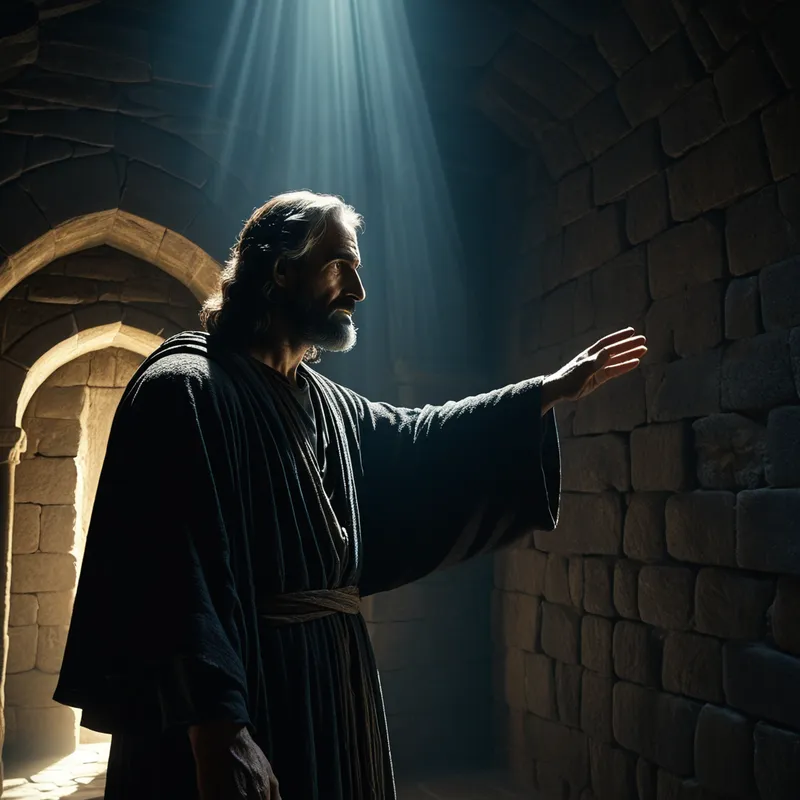
Thomas Myth Meaning & Symbolism
The apostle who demanded to touch the wounds of the risen Christ, transmuting doubt into a faith forged through the body and the senses.
The Tale of Thomas
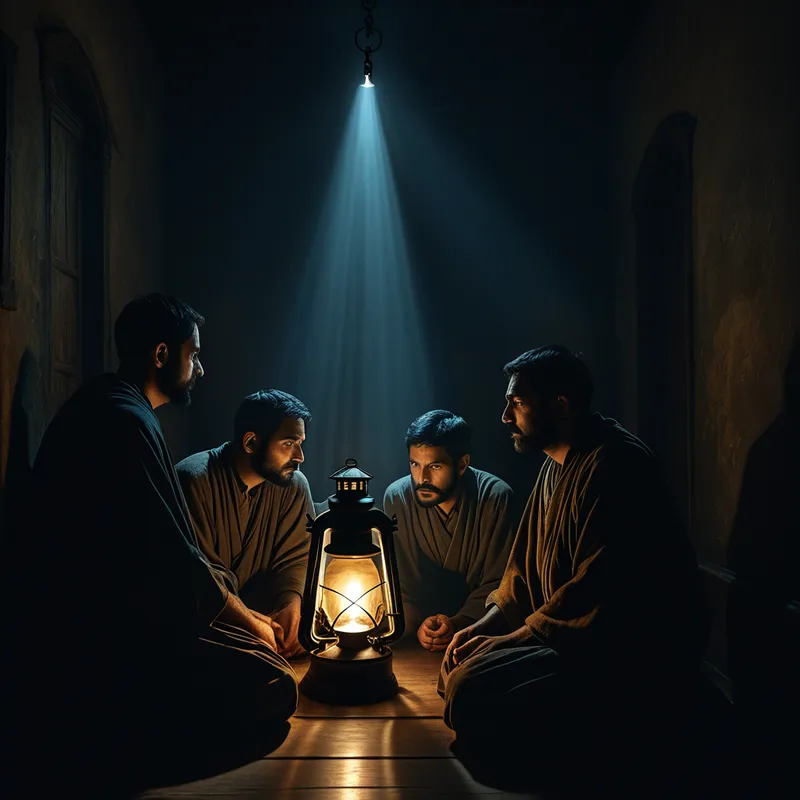
[The world](/myths/the-world “Myth from Tarot culture.”/) had shattered. The hope that had walked on [water](/myths/water “Myth from Chinese culture.”/) and multiplied loaves was nailed to a Roman cross, and with it died the light in the hearts of the men who had followed. They gathered now in a locked room, the air thick with the smell of fear and unwashed grief. The doors were barred not just against the authorities, but against a reality too brutal to face.
Among them was Thomas, called Didymus. His was a mind that worked in the substance of things—the grain of wood, the weight of a fishnet, the solidity of stone. He had seen the miracles, but he had also seen the blood, the finality of the spear. When the others, breathless with a wild, impossible joy, told him, “We have seen the Lord,” Thomas did not share their rapture. His grief had carved a hollow too deep for easy filling.
His voice, when it came, was not one of anger, but of a terrible, precise longing. “Unless I see the mark of the nails in his hands, and put my finger in the mark of the nails, and my hand in his side, I will not believe.” It was the oath of a craftsman, a testament to a truth that must be met in the flesh, or not at all. For eight days, he carried that lonely condition within him, a man exiled by his own integrity from the consolation of his brothers.
Then, again within the locked room, He was there. Not a ghost, not a memory, but a presence that filled the space without displacing the air. He stood among them and spoke peace. Then, his eyes finding Thomas, he did not offer a parable or a scolding. He offered his body. “Put your finger here and see my hands. Reach out your hand and put it in my side. Do not doubt but believe.”
The invitation hung in the sacred silence. All the stubbornness, the grief, the rational demand—it met its object not as an idea, but as a person, scarred and whole. Thomas did not need to complete the physical act. The offered reality, the divine vulnerability that met his human condition exactly where he stood, broke through the final barrier. His confession was not a whisper, but [the foundation stone](/myths/the-foundation-stone “Myth from Mesopotamian culture.”/) of a new understanding: “My Lord and my God!”
Cultural Origins & Context
The story of Thomas is found uniquely in the Gospel of John, a text composed towards the end of the first century CE. This was a period of consolidation for the early Christian community, which was grappling with its identity in a world that was often hostile and always skeptical. The community preserved oral traditions about the apostles, not merely as historical figures, but as archetypal representatives of different pathways to faith.
Thomas’s narrative served a critical sociological and theological function. For early believers facing persecution and doubt from within and without, Thomas modeled a permissible, even sacred, struggle. He was not condemned for his doubt but was met within it. The story legitimized the questioning mind, assuring communities that faith could be born from rigorous inquiry, not in spite of it. Furthermore, it anchored the central Christian proclamation—the Resurrection—not in vague spiritualism, but in a startlingly physical, empirical claim. The resurrected body was not a phantom; it bore the wounds of history, making it accessible to the senses and, by extension, to a form of knowing that the ancient world respected.
Symbolic Architecture
Thomas represents the [archetype](/symbols/archetype “Symbol: A universal, primordial pattern or prototype in the collective unconscious that shapes human experience, behavior, and creative expression.”/) of the empirical mind confronting the numinous. He is the part of the [psyche](/myths/psyche “Myth from Greek culture.”/) that says, “Prove it.” His doubt is not cynicism; it is the integrity of [the ego](/myths/the-ego “Myth from Jungian culture.”/) that refuses to assent to a [reality](/symbols/reality “Symbol: Reality signifies the state of existence and perception, often reflecting one’s understanding of truth and life experiences.”/) it has not integrated. The locked [room](/symbols/room “Symbol: A room in a dream often symbolizes the self, representing personal space, mental state, or aspects of one’s identity.”/) is the defended [psyche](/myths/psyche “Myth from Greek culture.”/), the intellectual and emotional [fortress](/symbols/fortress “Symbol: A fortress symbolizes security and protection, representing both physical and psychological safety from external threats.”/) we build after a profound disillusionment or [trauma](/symbols/trauma “Symbol: A deeply distressing or disturbing experience that overwhelms the psyche, often manifesting in dreams as unresolved emotional wounds or psychological injury.”/).
The wound is not an imperfection to be hidden, but the sacred interface where the human and the divine meet.
The critical symbols are the wounds and the touch. The resurrected Christ does not appear with healed, unblemished [skin](/symbols/skin “Symbol: Skin symbolizes the boundary between the self and the world, representing identity, protection, and vulnerability.”/). He presents his scars. These are the preserved wounds of suffering, now transformed into portals of [revelation](/symbols/revelation “Symbol: A sudden, profound disclosure of truth or insight, often through artistic or musical means, that transforms understanding.”/). They signify that transcendence does not erase [history](/symbols/history “Symbol: History in dreams often represents the dreamer’s past experiences, lessons learned, or unresolved issues that continue to influence their present.”/) or pain but transfigures it. Thomas’s demanded touch is the ultimate act of embodied knowing. It moves [faith](/symbols/faith “Symbol: A profound trust or belief in something beyond empirical proof, often tied to spiritual conviction or deep-seated confidence in people, ideas, or outcomes.”/) from the [realm](/symbols/realm “Symbol: The symbol of ‘Realm’ often signifies the boundaries of one’s consciousness, experiences, or emotional states, suggesting aspects of reality that are either explored or ignored.”/) of abstract belief into the realm of [relationship](/symbols/relationship “Symbol: A representation of connections we have with others in our lives, often reflecting our emotional state.”/) and direct experience—[gnosis](/symbols/gnosis “Symbol: Direct, intuitive spiritual knowledge or enlightenment that transcends ordinary understanding, often associated with mystical experiences and esoteric traditions.”/) in the truest sense.
The Dreamer’s Resonance
When the pattern of the Thomas myth stirs in the modern dreamer, it signals a profound somatic and psychological crossroads. To dream of demanding proof, of refusing to believe a wonderful or terrible truth without direct evidence, points to a deep integrity crisis. The dreamer may be surrounded by others who have accepted a new reality—a new relationship, a career path, a spiritual insight—but they themselves feel a stubborn, lonely resistance.
Somatically, this can manifest as a tightening in the chest, a literal “hardening of the heart,” or a feeling of being walled off. The dream may feature locked doors, impassable barriers, or the frustrating inability to touch something vitally important. This is the psyche’s enactment of Thomas’s eight-day vigil. The process underway is the ego’s necessary, often painful, insistence on meeting transformation on its own terms. It is a refusal of premature consolation, a demand that the new “resurrected” state of being prove its reality by engaging with the very wounds that created the old, “dead” one.

Alchemical Translation
The alchemical journey modeled by Thomas is the transmutation of skepticism into gnostic wisdom. It is the opus of the Sage archetype. The base material is the leaden weight of doubt and disillusionment. [The first stage](/myths/the-first-stage “Myth from Alchemical culture.”/) ([nigredo](/myths/nigredo “Myth from Alchemical culture.”/)) is the darkness of the locked room, the black despair following the death of a cherished ideal or hope.
The rising action is Thomas’s declaration—the [separatio](/myths/separatio “Myth from Alchemical culture.”/) where the conscious mind actively separates itself from collective belief to honor its own standard of truth. This is not the end of the work, but its crucial middle. The divine response—the offering of the wounded side—represents the coniunctio, [the sacred marriage](/myths/the-sacred-marriage “Myth from Various culture.”/). Here, the transcendent reality ([the Self](/myths/the-self “Myth from Jungian culture.”/)) does not overwhelm the questioning ego but presents itself to be met by it.
The ultimate faith is not belief without evidence, but the evidence born of a transformative encounter.
The final transmutation ([rubedo](/myths/rubedo “Myth from Alchemical culture.”/), the reddening) is Thomas’s confession, “My Lord and my God.” The ego’s standard of proof is not defeated; it is fulfilled and then surpassed. The knower and the known become united in a recognition that is personal (“my Lord”) and cosmic (“my God”). For the modern individual, this myth maps the path to an authentic, unshakable stance. It teaches that our deepest doubts are not obstacles to our becoming, but the very faculties through which a second, more profound naivety—a knowing forged in the fires of inquiry—is born. We are invited not to bypass our skepticism, but to follow it courageously all [the way](/myths/the-way “Myth from Taoist culture.”/) to the point where it, itself, becomes the hand that touches the divine.
Associated Symbols
Explore related symbols from the CaleaDream lexicon: