Thing Myth Meaning & Symbolism
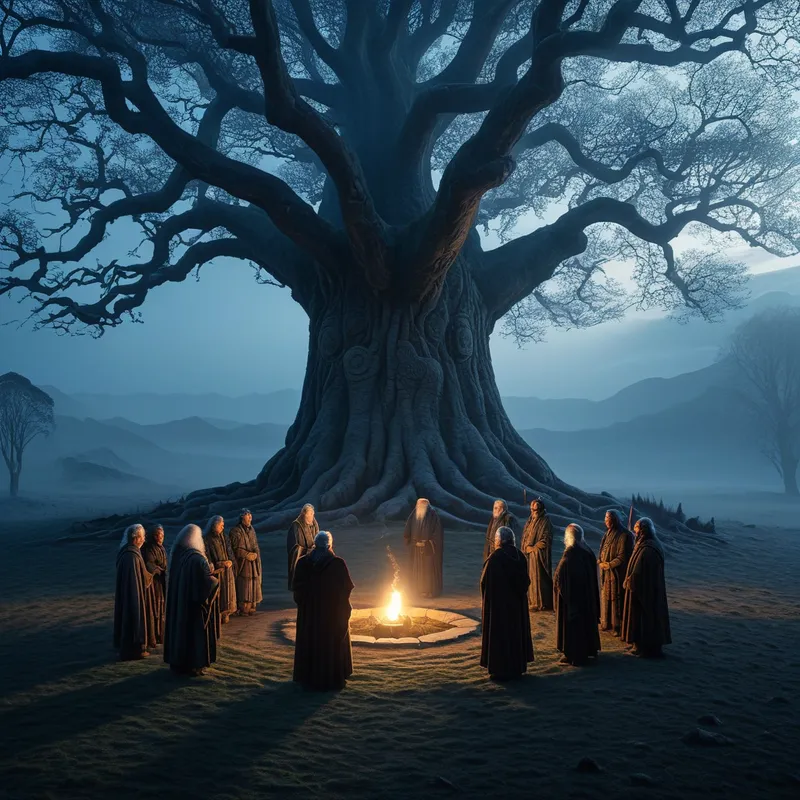
The myth of the sacred assembly where gods and men gather to speak law, settle disputes, and weave the world's order from chaos.
The Tale of Thing
Listen. Before the first axe-bit was forged, before the first longship’s keel kissed [the sea](/myths/the-sea “Myth from Greek culture.”/), there was the sound. Not the clash of steel, nor the roar of the storm, but the murmur of voices gathering. It began at the roots of the [Yggdrasil](/myths/yggdrasil “Myth from Global/Universal culture.”/), where the Well of Urd whispers secrets to the roots of [the world](/myths/the-world “Myth from Tarot culture.”/).
The Æsir, mighty and restless in their new-won realm of Asgard, felt a disquiet. Victories were won, halls were built, but a chaos of grievance simmered. A stolen cup here, a broken oath there. The strength that felled giants was useless against this creeping entropy. Odin, his one eye seeing the fraying edges of their reality, knew that force alone could not weave a lasting world. He journeyed, seeking counsel from the memory-laden waters of Urd’s well.
And there, from [the mist](/myths/the-mist “Myth from Celtic culture.”/) that rises between the worlds, the pattern was revealed. Not a fortress, but a forum. Not a weapon, but a word.
He returned to Asgard and called the host. Not to war, but to council. They gathered on the Idavollr, the shining field at the center of all things. A great circle was marked, a boundary more potent than any wall, for it was made of intention and mutual pledge. Within this holy ring, the Thórr laid down his hammer, [Gungnir](/myths/gungnir “Myth from Norse culture.”/) was planted upright, and even [the trickster](/myths/the-trickster “Myth from Various culture.”/) Loki was granted a place to speak.
Here, the first law was spoken into being. It was not a command from a throne, but a finding, a thing itself—a matter to be settled. Voices rose and fell. Accusations were laid bare like swords on an anvil. Oaths were sworn on the sacred ring. Decisions were made, not by the loudest shout, but by the collective recognition of a truth that served the whole. [Justice](/myths/justice “Myth from Tarot culture.”/) was not given; it was discovered through the alchemy of shared speech. And as each matter was settled, a thread of order was woven into the fabric of the world, holding back the ever-pressing chaos of the [Jötnar](/myths/jtnar “Myth from Norse culture.”/).
From that divine example, the pattern flowed down the trunk of Yggdrasil to the world of men. At appointed times, at crossroads marked by great stones, the people of the North would lay down their arms and gather. The Lawspeaker would stand upon his rock, and the circle would become alive once more. [The Thing](/myths/the-thing “Myth from Norse culture.”/) was born—a sanctuary of speech in a world of iron.
Cultural Origins & Context
The Thing was not merely a story to the Norse peoples; it was the bedrock of their social cosmos. These assemblies, held at specific, often ancient and hallowed sites, were the operating system of their society. Everything from property disputes and marriage contracts to declarations of war and outlawry was processed here. The myth of its divine origin at Idavollr served a critical function: it sacralized the very act of governance. Law was not a human invention but a divine principle, a fragment of cosmic order (ørlög) made accessible to community.
This myth was passed down not just in eddic poetry, but in the living practice of the Thing itself. The Lögsögumaðr, who recited [the law](/myths/the-law “Myth from Biblical culture.”/) from memory, was a keeper of this mythic continuity. By invoking the model of the gods’ assembly, he grounded contemporary judgments in primordial truth. The myth ensured that the authority of the Thing came from its alignment with a higher, collective wisdom, not from the temporary power of any individual chieftain. It was a story that made civilization possible for a fiercely independent people, transforming potential feuds into negotiated peace.
Symbolic Architecture
At its core, the myth of the Thing is an archetypal [drama](/symbols/drama “Symbol: Drama signifies narratives, emotional expression, and the exploration of human experiences.”/) of [consciousness](/symbols/consciousness “Symbol: Consciousness represents the state of awareness and perception, encompassing thoughts, feelings, and experiences.”/) imposing order on the unconscious. The chaotic, unspoken grievances and conflicts represent the shadowy, unintegrated contents of the [psyche](/myths/psyche “Myth from Greek culture.”/)—or of a tribe. The sacred, bounded circle of the Thing is the [symbol](/symbols/symbol “Symbol: A symbol can represent an idea, concept, or belief, serving as a powerful tool for communication and understanding.”/) of the conscious ego, creating a protected [space](/symbols/space “Symbol: Dreaming of ‘Space’ often symbolizes the vastness of potential, personal freedom, or feelings of isolation and exploration in one’s life.”/) where these contents can be safely examined.
The circle is not a wall to keep things out, but a vessel to hold a process within. It transforms the battlefield into the council ground.
The act of speaking [the law](/symbols/the-law “Symbol: Represents external rules, societal order, moral boundaries, and the tension between personal freedom and collective structure.”/), of giving voice to [accusation](/symbols/accusation “Symbol: A formal or informal charge of wrongdoing, often implying guilt, blame, or responsibility placed upon the dreamer or another figure.”/) and [defense](/symbols/defense “Symbol: A protective mechanism or barrier against perceived threats, representing boundaries, security, and resistance to external or internal challenges.”/), is the act of bringing the [shadow](/symbols/shadow “Symbol: The ‘shadow’ embodies the unconscious, repressed aspects of the self and often represents fears or hidden emotions.”/) into the light of collective [awareness](/symbols/awareness “Symbol: Conscious perception of self, surroundings, or internal states. Often signifies awakening, insight, or heightened sensitivity.”/). Gungnir, planted at the center, symbolizes the unwavering focus on [truth](/symbols/truth “Symbol: Truth represents authenticity, honesty, and the quest for knowledge beyond mere appearances.”/) and [destiny](/symbols/destiny “Symbol: A predetermined course of events or ultimate purpose, often linked to spiritual forces or cosmic order, representing life’s inherent direction.”/). Thórr’s hammer laid aside signifies that brute force is deliberately suspended, making [room](/symbols/room “Symbol: A room in a dream often symbolizes the self, representing personal space, mental state, or aspects of one’s identity.”/) for a more sophisticated power: the power of the [word](/symbols/word “Symbol: Words in dreams often represent communication, expression, and the power of language in shaping our realities.”/), of negotiated [reality](/symbols/reality “Symbol: Reality signifies the state of existence and perception, often reflecting one’s understanding of truth and life experiences.”/). The resulting judgment is not a “victory” for one side, but a new [synthesis](/symbols/synthesis “Symbol: The process of combining separate elements into a unified whole, representing integration, resolution, and the completion of a personal journey.”/)—a [piece](/symbols/piece “Symbol: A ‘piece’ in dreams often symbolizes a fragment of the self or a situation that requires integration, reflection, or understanding.”/) of ørlög made manifest—that restores balance to the whole [system](/symbols/system “Symbol: A system represents structure, organization, and interrelated components functioning together, often reflecting personal or social order.”/).
The Dreamer’s Resonance
When this myth stirs in the modern psyche, it often manifests in dreams of councils, meetings, or trials. You may dream of being in a vast, solemn chamber where figures representing different aspects of your life—the ambitious professional, the neglected artist, the weary parent—are all present, each demanding a hearing. There is a feeling of urgent, pressurized need for resolution.
Somatically, this can feel like a tightness in the chest or throat—the unsaid thing lodged within. The psychological process is one of discrimination and integration. The dream-ego is being called to convene its own internal Thing. The conflicting impulses, values, and loyalties that cause inner civil war must be brought into the circle of consciousness, named, and given their lawful due. The anxiety in such dreams is the fear of this process, the dread of facing one’s own internal contradictions. The resolution, when it comes, is not a dramatic battle, but a profound sense of order and clarity, a quiet internal treaty.

Alchemical Translation
The individuation journey modeled by the Thing is not one of slaying dragons, but of presiding over the assembly of [the self](/myths/the-self “Myth from Jungian culture.”/). The modern seeker must first establish [the sacred circle](/myths/the-sacred-circle “Myth from Various culture.”/)—a committed practice of introspection, therapy, or journaling that creates a bounded, respectful space for self-examination. This is the [temenos](/myths/temenos “Myth from Greek culture.”/), the sanctuary.
The alchemical fire is not in the forge, but in the debate. The gold is not won by conquest, but forged in the consensus of the soul’s many voices.
Next, one must “call the assembly.” This is the difficult work of inviting all inner figures—the inner critic, the wounded child, the grandiose hero, the lazy hedonist—to the council. Each must be allowed to speak its piece, its grievance, its desire. [The ego](/myths/the-ego “Myth from Jungian culture.”/), in the role of the Lawspeaker, must not identify with any one voice, but must hold the space and recite the “law”—one’s core values and authentic truth.
The conflict is the alchemical [nigredo](/myths/nigredo “Myth from Alchemical culture.”/), the blackening, where contradictions clash. The hearing and weighing of arguments is the albedo, the whitening, where things are clarified. The final judgment or integration is the [rubedo](/myths/rubedo “Myth from Alchemical culture.”/), the reddening, resulting in a new, more complex and lawful wholeness. One does not become a king by conquering territory, but by successfully governing the diverse and often warring populace of one’s own soul, weaving personal ørlög from the chaos of potential.
Associated Symbols
Explore related symbols from the CaleaDream lexicon: