Thesmophoria Myth Meaning & Symbolism
The secret autumn festival for women, honoring Demeter's grief and Persephone's descent, celebrating the fertile darkness and the mysteries of the grain.
The Tale of Thesmophoria
Hear now a tale not sung in the marble halls of heroes, but whispered in the hushed dark of women’s quarters, carried on the scent of crushed mint and barley. It is the story of the Thesmophoria.
When the sun weakens and the world tilts toward shadow, when the last grapes are pressed and the grain is cut, a profound silence falls upon the land. It is the silence of Demeter, whose heart is a hollowed-out husk. Her daughter, the bright Persephone, has been taken. The green has fled the world, not in rage, but in a grief so total it turns the soil to stone.
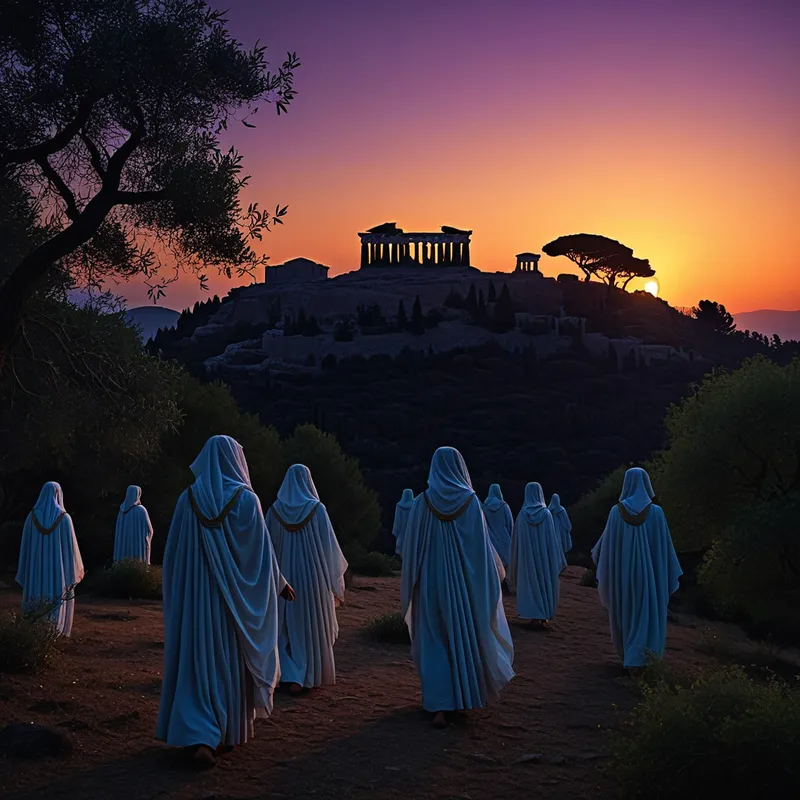
But in this silence, a secret pulse begins to beat. The women feel it first—a stirring in the blood, a memory in the bone. They leave their homes, their looms, their husbands’ names. They gather on the hillside, their faces solemn in the autumn light. For three days, the polis belongs to them alone. They build simple shelters, they fast. They remember the scream that tore from the earth when the chariot of Hades plunged into the cleft. They reenact the Mother’s desperate search, her torch a flickering star against the vast, uncaring night.
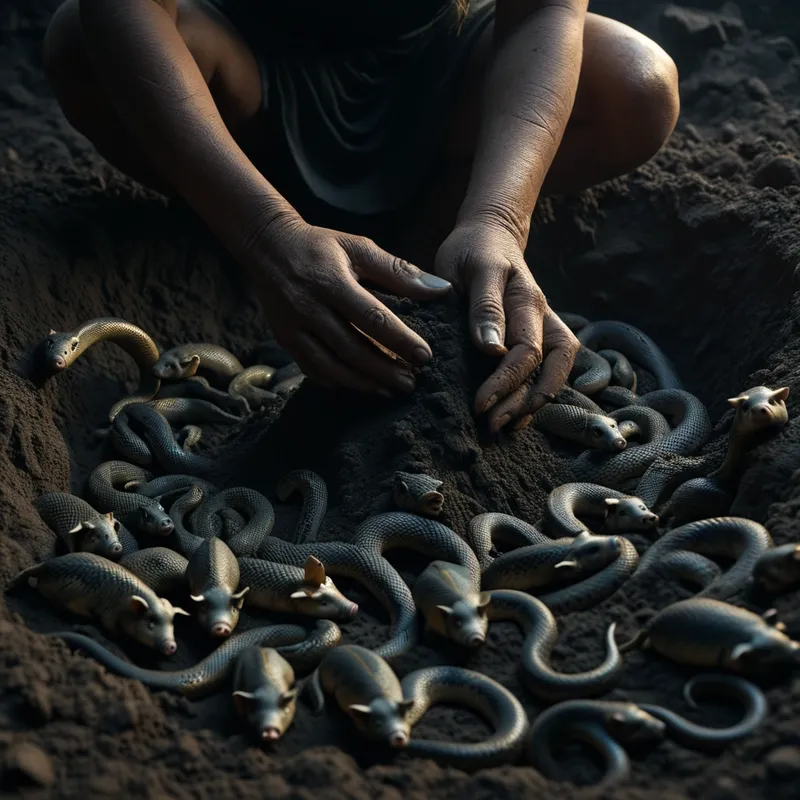
Then comes the heart of the mystery. From deep pits in the earth—the megara—they retrieve what was cast down months before: the rotted remains of piglets, thrown in offering to the powers below, mixed with pine branches and clay shapes of snakes and phalluses. The smell is overwhelming, rich and foul, the very scent of life-in-death. This sacred compost, this fertile decay, is brought up into the light and placed upon the altars. It is mixed with seed-corn, a promise to the sleeping earth.
On the final day, the Fast is broken. The women feast, they laugh with a wild, released joy. They call upon Kalligeneia, “She of the Beautiful Birth.” They celebrate not just the hope of spring’s return, but the power of the darkness itself. For they have held the paradox: the seed must descend into rot to be reborn. The daughter must become Queen. The Mother’s grief is the very ground of next year’s harvest.
Cultural Origins & Context
The Thesmophoria was not a single, unified myth but a widespread, state-sanctioned festival practiced across the Greek world, from Athens to Sicily. Its origins are pre-Olympian, rooted in the deep, Neolithic worship of a Grain Mother and a cycle of death and rebirth. It was the most important and widespread festival exclusive to citizen women, a profound exception in the highly public, male-dominated religious life of the polis.
The rites were passed down not through epic poetry but through practice—mother to daughter, older women to initiates. Men were strictly forbidden, and the specifics of the rituals were guarded by a sacred silence (arrhetos), a taboo so strong that our knowledge from ancient sources remains fragmentary and veiled. This secrecy was its power. For a few days, women ceased to be daughters, wives, and mothers in relation to the civic order. They became the sole intermediaries with the fundamental forces of life and death, performing a necessary service for the entire community’s survival. The festival functioned as a societal pressure valve, a sacred space for feminine solidarity, and a potent magical operation to ensure the fertility of both land and people.
Symbolic Architecture
The myth and ritual of the Thesmophoria constructs a symbolic universe centered on the feminine experience of cyclical transformation, utterly distinct from the heroic, linear quests of male mythology.
The deepest fertility is not found in endless light, but in the conscious descent into the nourishing dark.
The central symbol is the Pit (megara). It is the chasm of Hades, the womb of the earth, the tomb, and the place of composting potential. The act of retrieving the decayed offerings is a direct confrontation with the shadowy, chthonic (earthly) realm—not to conquer it, but to collaborate with it. The Piglets sacrificed are ancient symbols of agricultural fertility and the untamed, fecund power of life. Their decomposition represents the necessary stage of dissolution.
The Snake, shedder of skin, is the emblem of cyclical renewal, and its presence alongside phallic symbols in the pit unites the imagery of biological regeneration with spiritual transformation. The entire ritual is an alchemy of opposites: grief and joy, fasting and feasting, decay and new growth, descent and ascent. It presents a model of creation that is non-heroic; it is participatory, patient, and rooted in a acceptance of loss as part of the generative process.
The Dreamer’s Resonance
When the pattern of the Thesmophoria stirs in the modern psyche, it often manifests in dreams of subterranean spaces, forgotten cellars, or buried objects. One might dream of finding something valuable—a jewel, a book, a child’s toy—in a pile of compost or mud. There may be dreams of participating in a solemn, wordless ceremony with other women, or of tending to a garden that is both beautiful and strangely morbid, where flowers bloom from dark, rich soil that seems to pulse.
Psychologically, these dreams signal a process of retrieval. The dreamer is being called to descend into their own personal megara—the pit of forgotten griefs, abandoned creative impulses, repressed instincts, or unprocessed trauma. The “rotted offerings” are old patterns, painful memories, or aspects of the self that were cast aside and left to decompose. The dream suggests that the time has come to bring this material back into the light of consciousness, not as a horror, but as sacred compost. It is the somatic recognition that personal growth requires a period of fertile darkness, a withdrawal from the demands of the external world to tend to the inner, generative decay.
Alchemical Translation
The Thesmophoria offers a precise map for the alchemical stage of nigredo—the blackening, the descent, the putrefaction—and its resolution into new life. For the modern individual pursuing individuation, it models a crucial, often-overlooked phase.
Individuation is not a climb to a sunlit peak, but a rhythmic dance between the sown field and the sacred pit.
The first step is the Willing Descent. This is the conscious choice to enter a period of grief, introspection, or withdrawal (the “fast”). It is honoring the Demeter within—the part that feels bereft, barren, and lost when a cherished identity, relationship, or life phase ends (the Persephone that is taken).
The core work is the Retrieval of the Compost. This is the shadow work. It is the difficult, often “smelly” task of reaching into the unconscious to reclaim what we have disowned: our rage, our neediness, our primal sexuality, our animal vitality (the pigs and snakes). We do not do this to glorify these aspects, but to acknowledge them as necessary ingredients.
Finally, the Sacred Mixture. The retrieved material, once acknowledged and held in consciousness, is mixed with the “seed-corn” of our conscious intentions and talents. The decay becomes fertilizer. The grief becomes depth. The repressed instinct becomes creative energy. The feast of Kalligeneia that follows is the birth of a new attitude, one that has integrated the reality of loss and darkness into a more resilient, fertile, and whole sense of self. One becomes, in a sense, both the grieving Mother and the resilient Queen of the Underworld, capable of nurturing life precisely because one knows the terrain of death.
Associated Symbols
Explore related symbols from the CaleaDream lexicon: