Themis and Dike Myth Meaning & Symbolism
A myth of mother and daughter, divine order and earthly justice, charting humanity's evolution from instinctual law to conscious moral choice.
The Tale of Themis and Dike
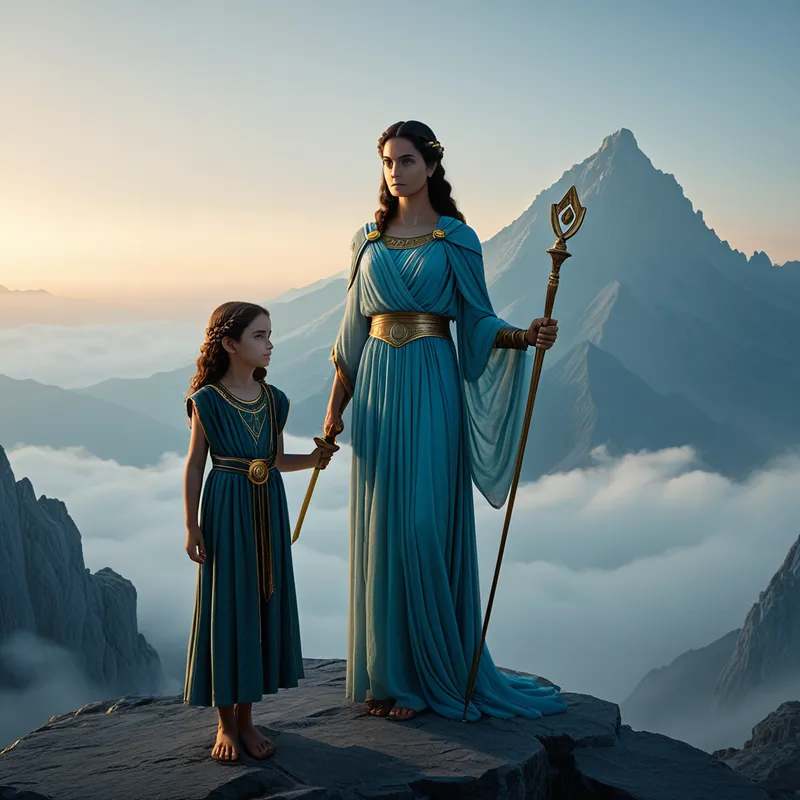
Listen, and hear the story of the foundation of [the world](/myths/the-world “Myth from Tarot culture.”/), not of stone and sea, but of law and consequence. In the age when the Titans still breathed the aether, there was [Themis](/myths/themis “Myth from Global/Universal culture.”/). She was not a goddess of thunder or passion, but of something far more primordial: the very bones of reality. She was the deep, humming order of the cosmos, the unspoken pattern of the seasons, the inevitable turn of the stars. Her voice was the whisper of prophecy in the rustling oak leaves of Dodona, her form the serene, unshakable presence beside the throne of Zeus himself. From her union with the new king of gods sprang a daughter, Dike.
Where Themis was [the law](/myths/the-law “Myth from Biblical culture.”/) written in the fabric of creation, Dike was its living breath. As a child, she played at her mother’s feet among the perfect, crystalline structures of divine decree. She learned the weight of the bronze scales, the meaning of their perfect balance. But her eyes were not fixed on the eternal heavens; they looked down, through the clouds, to the flickering lights of the human world below.
And what she saw there grieved her. She saw the scales of her mother’s law broken, lying in the dust. She saw strength masquerading as right, and cunning evading consequence. The beautiful, abstract order of Olympus was a forgotten song in the noisy, passionate streets of men. A great melancholy settled upon Dike, a divine homesickness for a [justice](/myths/justice “Myth from Tarot culture.”/) that did not yet exist on earth.
One evening, as the last light of [Helios](/myths/helios “Myth from Greek culture.”/) bled from [the sky](/myths/the-sky “Myth from Persian culture.”/), Dike stood at the edge of the divine precinct. She turned from the golden halls and faced her mother. Themis, understanding without words, placed a hand on her daughter’s shoulder. The touch was not to restrain, but to bless. It was a passing of the mantle, not of authority, but of mission.
So Dike descended. She did not arrive with a legion of angels or a blast of godly power. She came as a watchful spirit, a presence in the marketplace and the assembly. At first, she was a ghost of conscience, a cold shiver down the spine of the oath-breaker, a sudden pang in the heart of the corrupt judge. Then, she took form—a stern, beautiful maiden with a sword in one hand and her mother’s scales in the other. She became the avenger of the wronged, the pursuer of the guilty. Where Themis pronounced what is, Dike enacted what must be. Her season was the [Golden Age](/myths/golden-age “Myth from Universal culture.”/), but as humanity spiraled into ages of brass and iron, her task grew heavier, her footsteps slower.
The poets say she grew weary, that she finally folded her wings and ascended back to the heavens, becoming the constellation Virgo. But her departure was not an abandonment. It was a planting. She left the scales and the sword not as tools for gods to wield, but as an inheritance for humanity to grasp. The external goddess became an internal compass. The myth ends not with an absence, but with a charge hanging in the air: the order is given; now, you must choose to enact it.

Cultural Origins & Context
The figures of Themis and Dike are not the subjects of a single, epic narrative like the Iliad. Instead, they are woven into the very fabric of Greek thought, appearing in the works of Hesiod, the tragic playwrights like Aeschylus, and the philosophers from Solon to Plato. Hesiod, in his Works and Days, provides the most poignant narrative of Dike’s relationship to humanity’s declining ages, framing her as the divine barometer of societal health.
These concepts were not mere theology; they were active, civic psychology. Themis represented the foundational, customary law—the themistes—that preceded written codes, the ancestral agreements that held a community together. Dike represented the active application of justice in human disputes, the verdict (dikē) that restored balance. In the agora and the law courts, citizens were participating in the myth. To seek dikē was to invoke the presence of the goddess. The myth was told to explain why justice is often difficult, why it requires vigilance, and why a society that drives it out dooms itself. It was a story that linked the cosmic order to the civic order, making the health of [the polis](/myths/the-polis “Myth from Greek culture.”/) a matter of cosmic significance.
Symbolic Architecture
At its [heart](/symbols/heart “Symbol: The heart symbolizes love, emotion, and the core of one’s existence, representing deep connections with others and self.”/), this myth maps the [journey](/symbols/journey “Symbol: A journey in dreams typically signifies adventure, growth, or a significant life transition.”/) of law from an unconscious, given state to a conscious, achieved one. Themis is the [archetype](/symbols/archetype “Symbol: A universal, primordial pattern or prototype in the collective unconscious that shapes human experience, behavior, and creative expression.”/) of the Self-regulating [Pattern](/symbols/pattern “Symbol: A ‘Pattern’ in dreams often signifies the underlying structure of experiences and thoughts, representing both order and the repetitiveness of life’s situations.”/). She is the innate moral order Jung might associate with the primordial layers of the [psyche](/myths/psyche “Myth from Greek culture.”/), the instinct for fairness and balance that exists before any personal ego develops.
Themis is the law we inherit; Dike is the justice we must earn.
Dike is the Conscious Moral Agent. She symbolizes [the ego](/myths/the-ego “Myth from Jungian culture.”/)’s difficult [task](/symbols/task “Symbol: A task represents responsibilities, duties, or challenges one faces.”/) of taking raw, archetypal potential (cosmic order) and translating it into concrete [action](/symbols/action “Symbol: Action in dreams represents the drive for agency, motivation, and the ability to take control of situations in waking life.”/) in the flawed, ambiguous world of [human](/symbols/human “Symbol: The symbol of a human represents individuality, complexity of emotions, and social relationships.”/) relations. Her sword is discrimination—the painful but necessary act of cutting through deception, self-justification, and complexity to discern [truth](/symbols/truth “Symbol: Truth represents authenticity, honesty, and the quest for knowledge beyond mere appearances.”/). Her scales are the endless work of weighing context, motive, and consequence.
Their [relationship](/symbols/relationship “Symbol: A representation of connections we have with others in our lives, often reflecting our emotional state.”/) as [mother](/symbols/mother “Symbol: The symbol of ‘Mother’ represents nurturing, protection, and the foundational aspect of one’s emotional being, often associated with comfort and unconditional love.”/) and [daughter](/symbols/daughter “Symbol: In dreams, a daughter symbolizes innocence, potential, and the nurturing aspects of oneself or one’s relationships.”/) is crucial. It is not a conflict but a [lineage](/symbols/lineage “Symbol: Represents ancestral heritage, family connections, and the transmission of traits, values, and responsibilities across generations.”/). Themis does not oppose Dike’s descent; she enables it. This symbolizes that true, conscious justice is not a rebellion against natural order, but its natural flowering and refinement. The tragedy embedded in the myth—Dike’s eventual weary [departure](/symbols/departure “Symbol: A transition from one state to another, often representing change, growth, or leaving behind the familiar.”/)—speaks to the [soul](/symbols/soul “Symbol: The soul represents the essence of a person, encompassing their spirit, identity, and connection to the universe.”/)-cost of upholding justice in a world increasingly indifferent to it. It represents the burnout of the idealist, the [despair](/symbols/despair “Symbol: A profound emotional state of hopelessness and loss, often signaling a need for transformation or surrender to deeper truths.”/) of the righteous person in a corrupt [system](/symbols/system “Symbol: A system represents structure, organization, and interrelated components functioning together, often reflecting personal or social order.”/).
The Dreamer’s Resonance
When this myth stirs in the modern unconscious, it often manifests in dreams of weighted decisions, broken instruments, or a solemn female figure offering a tool. To dream of meticulously balancing strange scales, where the weights are intangible (like a memory versus a promise), signals the psyche working through a deep ethical dilemma. It is the somatic feel of dikē—the internal process of seeking a verdict that will restore psychic balance.
Dreams of finding a beautifully crafted sword that is rusted, or scales with a snapped chain, point to a perceived failure of one’s inner moral faculty. The dreamer may feel they have compromised their integrity or that the world’s injustice has rendered their personal sense of justice useless. Conversely, dreaming of receiving a simple, perfect bronze scale from an authoritative yet calm figure (Themis) suggests a reconnection with core, non-negotiable values—a return to one’s foundational themistes.
The figure of Dike appearing, not as an avenger but as a weary traveler asking for shelter, could indicate that the dreamer’s conscious mind is being asked to provide a home for a neglected sense of justice, to move it from an abstract ideal to a lived, protected principle.

Alchemical Translation
The alchemical work modeled here is the transmutation of inherited order into embodied truth. The [prima materia](/myths/prima-materia “Myth from Alchemical culture.”/) is the raw, unconscious sense of “[the way](/myths/the-way “Myth from Taoist culture.”/) things should be” that we absorb from family, culture, and instinct (Themis). The process begins with the [separatio](/myths/separatio “Myth from Alchemical culture.”/): Dike’s decisive turn away from the comfort of the divine realm. This is the individual’s necessary separation from blind adherence to tradition or external authority to test those laws in [the crucible](/myths/the-crucible “Myth from Alchemical culture.”/) of lived experience.
The descent into the human city is the [nigredo](/myths/nigredo “Myth from Alchemical culture.”/), the darkening. Here, the pure ideal meets the shadowy complexity of real life—with its compromises, betrayals, and gray areas. The sword’s work is the mortificatio, the killing of naive idealism and self-deception. The balancing of the scales is the endless coniunctio, seeking to marry mercy with severity, context with principle.
The ultimate goal is not to become a perfect judge, but to internalize the scales so completely that one’s life becomes their embodiment.
The myth’s “end” is the philosopher’s stone of this process: the internalization of the goddess. Dike does not vanish; she becomes the constellation Virgo—a pattern fixed in the heavens, a guiding light. Psychologically, this is the stage where just action arises not from strenuous moral calculation, but from an aligned character. The law is no longer an external command but the natural expression of a soul in harmony with Themis’s deep order. The individual achieves a sovereignty where their personal justice (dikē) is in authentic resonance with universal law (themis), completing the circle from heaven, to earth, and back to a now-conscious heaven within.
Associated Symbols
Explore related symbols from the CaleaDream lexicon: