The Ziggurat of Ur Myth Meaning & Symbolism
A story of baked bricks and divine ambition, where humanity builds a stairway to heaven, only to be scattered by the gods.
The Tale of The Ziggurat of Ur
Hear now, a tale from the land between the rivers, where the sun is a hammer and [the earth](/myths/the-earth “Myth from Hindu culture.”/) is clay. In the days when [the world](/myths/the-world “Myth from Tarot culture.”/) was young and the memory of [the great flood](/myths/the-great-flood “Myth from Biblical culture.”/) still whispered in [the wind](/myths/the-wind “Myth from Various culture.”/), the people of Ur looked upon the flat, endless plain and felt a longing. It was a yearning that gnawed at their bones, a desire to touch the realm of the Anunnaki, to bridge the terrible, beautiful gulf between the mud of Ki and the vault of Anu.
Their king, a man whose name is lost to the furnace-blast of time, heard this collective sigh. He gathered the elders and the priests of Nanna, and they conceived a plan of breathtaking audacity. “Let us build a city,” they declared, “and in its heart, a mountain that is not a mountain. A stairway that is not a stairway. Let us make a name for ourselves, lest we be scattered across the face of the earth.”
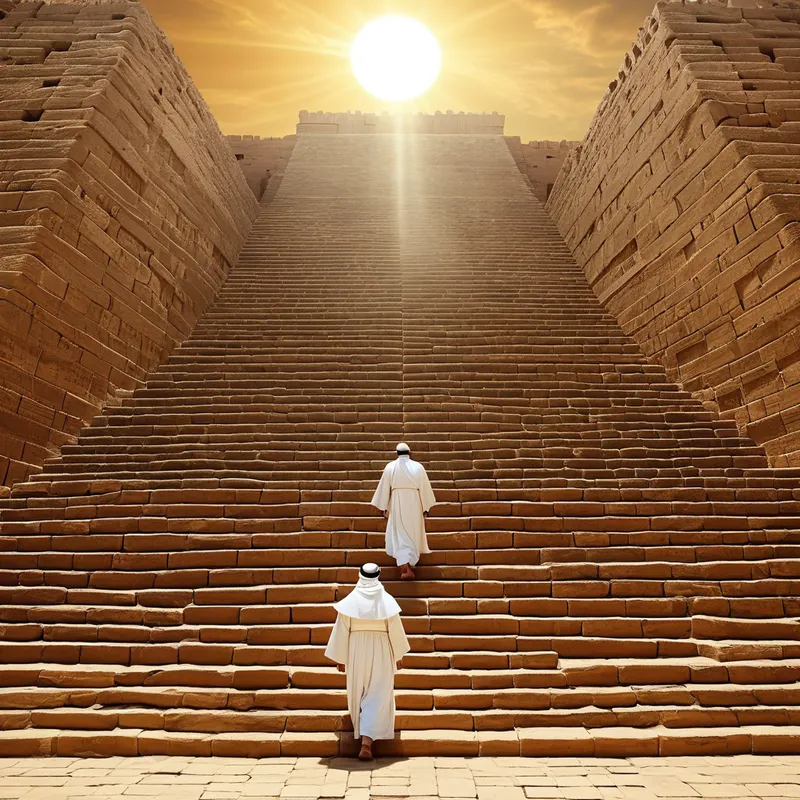
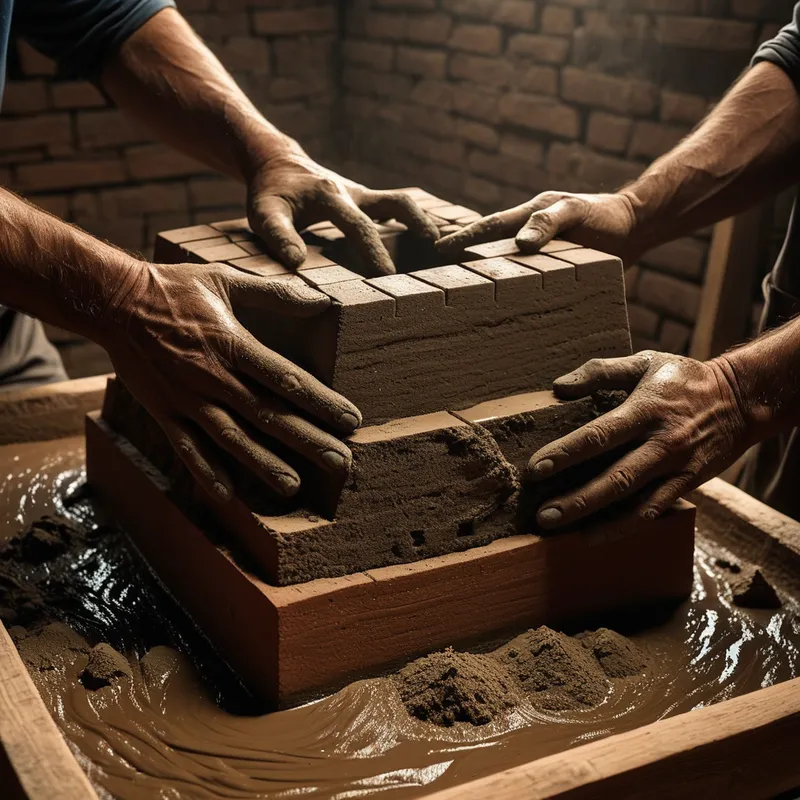
And so the work began. From the banks of the mighty Euphrates, they drew [water](/myths/water “Myth from Chinese culture.”/) to mix with the dust. They fashioned wooden molds and packed them with dark, fertile mud. These bricks were not left to the sun’s gentle kiss; no, they were thrust into roaring kilns, baked until they were hard as stone, the color of dried blood. Brick upon brick, layer upon layer, they built. The structure rose—a massive square, then a smaller square upon it, and another upon that. Three terraces, each a stepping-stone towards heaven. Grand staircases, wide enough for a procession of gods, cut diagonally up its flanks.
The scent of baking clay filled the air for miles. The sound of chanting priests and the grunt of laborers was a constant hymn. At its peak, they built the É, the sacred house, a chamber of blue-glazed brick meant for Nanna alone. They painted the tiers: the lowest black for the netherworld, the middle red for the human realm, the highest white for the celestial sphere. They called it Etemenniguru.
They looked upon their work and their hearts swelled. [The ziggurat](/myths/the-ziggurat “Myth from Mesopotamian culture.”/) stood against [the horizon](/myths/the-horizon “Myth from Various culture.”/), a defiant human finger pointing at the divine. They believed they had built a conduit, a place where the god could descend and they could ascend. They believed they had made their name eternal.
But in the high places, the gods took council. Anu, Enlil, and Enki looked down upon the brick mountain. They saw not piety, but presumption. They heard not a prayer, but a challenge. “Behold, they are one people, and they have all one language,” it was said. “And this is only the beginning of what they will do. Nothing that they propose to do will now be impossible for them.”
And so, the decree was issued. The unity that had built [the tower](/myths/the-tower “Myth from Tarot culture.”/) became its undoing. Enki, the cunning one, swam through the minds of men. Where there was one tongue, he planted a babble. A worker asked for mortar and was handed a brick. A foreman shouted an order, and it was heard as nonsense. Confusion, thick and sour, settled over the worksite. The great project stalled. The single, focused will of Ur shattered into a thousand fragments. Families who once understood each other now spoke in strange, new rhythms. They could no longer collaborate, no longer even commune. And so, they drifted apart, scattered to the four winds, leaving the great [ziggurat](/myths/ziggurat “Myth from Mesopotamian culture.”/) silent and unfinished against [the sky](/myths/the-sky “Myth from Persian culture.”/)—a monument not to their [triumph](/myths/triumph “Myth from Roman culture.”/), but to their fractured ambition.
Cultural Origins & Context
The [ziggurat of Ur](/myths/ziggurat-of-ur “Myth from Mesopotamian culture.”/), built around 2100 BCE by King Ur-Nammu, was not merely an architectural feat; it was [the axis mundi](/myths/the-axis-mundi “Myth from Chinese culture.”/) of Sumerian cosmology. The myth surrounding it, echoed in later fragments like the Epic of Atrahasis and the Hebrew [Tower of Babel](/myths/tower-of-babel “Myth from Biblical culture.”/) story, functioned as an etiological narrative. It explained the profound diversity of human languages and the dispersal of peoples, a reality keenly felt in the trade-rich, multi-ethnic Mesopotamian world.
This story was not written for the common laborer but for the scribal and priestly classes. It was told in temple schools and royal courts to reinforce a critical theological and social principle: the immutable hierarchy of the universe. The ziggurat was a controlled access point, a divine umbilical cord managed by the priesthood. The myth served as a warning against unauthorized ascent, against the human desire to bypass the established ritual intermediaries (the priests and kings) to grasp divinity directly. It affirmed that connection to the divine was a privilege granted by the gods through proper channels, not a right seized by human ingenuity.
Symbolic Architecture
The [ziggurat](/symbols/ziggurat “Symbol: A ziggurat symbolizes a connection between humanity and the divine, representing a structured path to spiritual elevation and cultural legacy.”/) is the ultimate [symbol](/symbols/symbol “Symbol: A symbol can represent an idea, concept, or belief, serving as a powerful tool for communication and understanding.”/) of the [axis](/symbols/axis “Symbol: A central line or principle around which things revolve, representing stability, orientation, and the fundamental structure of reality or consciousness.”/) mundi—the cosmic ladder. Its very [structure](/symbols/structure “Symbol: Structure in dreams often symbolizes stability, organization, and the framework of one’s life, reflecting how one perceives their environment and personal life.”/) is a map of [reality](/symbols/reality “Symbol: Reality signifies the state of existence and perception, often reflecting one’s understanding of truth and life experiences.”/): the [underworld](/symbols/underworld “Symbol: A symbolic journey into the unconscious, representing exploration of hidden aspects of self, transformation, or confronting repressed material.”/) (the [foundation](/symbols/foundation “Symbol: A foundation symbolizes the underlying support systems, values, and beliefs that shape one’s life, serving as the bedrock for growth and development.”/)), the earthly [plane](/symbols/plane “Symbol: Dreaming of a plane often symbolizes a desire for freedom, adventure, and new possibilities, as well as transitions in life.”/) (the middle tiers), and the heavenly [realm](/symbols/realm “Symbol: The symbol of ‘Realm’ often signifies the boundaries of one’s consciousness, experiences, or emotional states, suggesting aspects of reality that are either explored or ignored.”/) (the [summit](/symbols/summit “Symbol: The highest point of a mountain, representing achievement, perspective, and the culmination of effort.”/)).
The baked brick is the alchemized self—the raw, chaotic earth of instinct fired in the kiln of consciousness into a durable, intentional form.
The myth’s core conflict is between [ascent](/symbols/ascent “Symbol: Symbolizes upward movement, progress, spiritual elevation, or striving toward higher goals, often representing personal growth or transcendence.”/) and containment. The [human](/symbols/human “Symbol: The symbol of a human represents individuality, complexity of emotions, and social relationships.”/) drive to transcend, to know, to unite with the [source](/symbols/source “Symbol: The origin point of something, often representing beginnings, nourishment, or the fundamental cause behind phenomena.”/), is innate and heroic. Yet, the divine [response](/symbols/response “Symbol: Response in dreams symbolizes how one reacts to situations, often reflecting the subconscious mind’s processing of events.”/)—the “[confusion](/symbols/confusion “Symbol: A state of mental uncertainty or disorientation, often reflecting internal conflict, lack of clarity, or overwhelming choices in waking life.”/) of tongues”—is not merely punitive. It represents a necessary psychic [fragmentation](/symbols/fragmentation “Symbol: The experience of breaking apart, losing cohesion, or being separated into pieces. Often represents disintegration of self, relationships, or reality.”/). The unitary, ego-driven ambition (“let us make a name for ourselves”) must be broken apart for a more complex, differentiated [consciousness](/symbols/consciousness “Symbol: Consciousness represents the state of awareness and perception, encompassing thoughts, feelings, and experiences.”/) to emerge. The single [language](/symbols/language “Symbol: Language symbolizes communication, understanding, and the complexities of expressing thoughts and emotions.”/) symbolizes a monolithic, collective [identity](/symbols/identity “Symbol: Identity represents the sense of self, encompassing personal beliefs, cultural background, and social roles.”/), while the many languages represent the [birth](/symbols/birth “Symbol: Birth symbolizes new beginnings, transformation, and the potential for growth and development.”/) of individual [perspective](/symbols/perspective “Symbol: Perspective in dreams reflects one’s viewpoints, attitudes, and how one interprets experiences.”/) and cultural diversity. The scattering is not just a [punishment](/symbols/punishment “Symbol: A dream symbol representing consequences for actions, often tied to guilt, societal rules, or internal moral conflicts.”/), but the painful, necessary precondition for individuation.
The Dreamer’s Resonance
To dream of a ziggurat is to dream of ambition and isolation. You may be climbing its steep stairs, feeling the immense effort in your calves and lungs, yet [the summit](/myths/the-summit “Myth from Taoist culture.”/) remains shrouded in cloud, perpetually out of reach. This is the somatic signature of a striving ego, pushing towards a spiritual or professional goal that feels divinely ordained but impossibly distant.
Alternatively, you may dream of being at the base of a crumbling or unfinished ziggurat, hearing a cacophony of voices speaking in languages you cannot comprehend. This dream speaks to a profound experience of miscommunication and alienation. It often surfaces when one feels their sincere efforts or core identity are being fundamentally misunderstood by their family, community, or workplace. The dream is the [psyche](/myths/psyche “Myth from Greek culture.”/) staging its own “confusion of tongues,” reflecting a internal state where different parts of [the self](/myths/the-self “Myth from Jungian culture.”/) (the inner child, the critic, the achiever) have lost their common language and can no longer collaborate on your life’s project.
Alchemical Translation
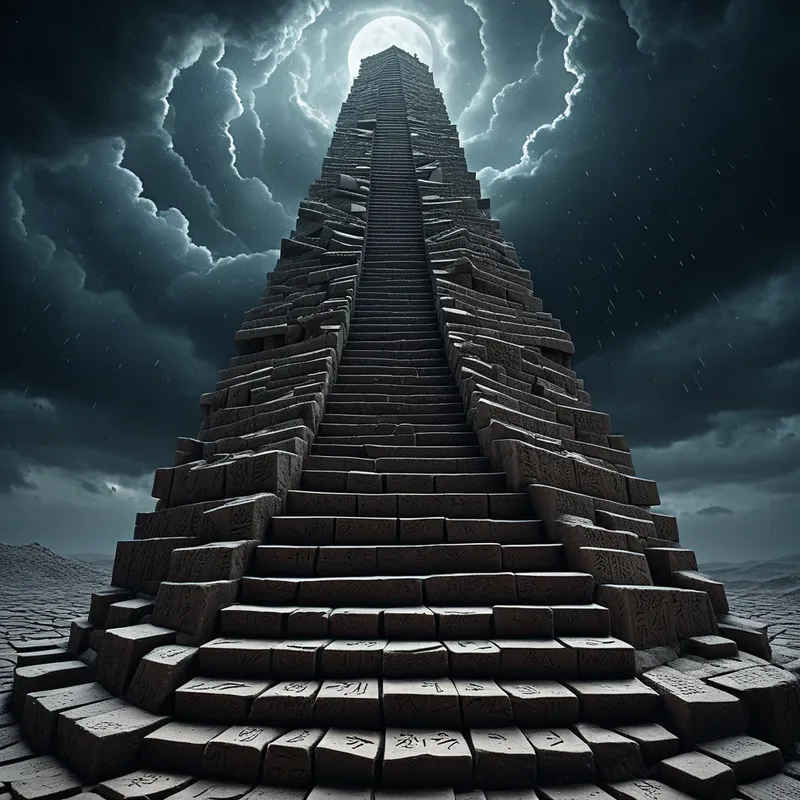
The myth of the Ziggurat of Ur models the critical, often devastating, phase in individuation where the conscious project of [the ego](/myths/the-ego “Myth from Jungian culture.”/)—the well-laid plan for self-perfection and transcendence—meets the ruthless, reorganizing power of the Self (the total, archetypal psyche).
The ego, like the king of Ur, seeks to build a direct, impressive staircase to the divine (wholeness). It bakes its bricks with discipline, stacks them with logic, and aims for the summit. This is a necessary and noble effort. However, the psyche in its totality knows that this ego-structure is too narrow, too proud. It is a monument to the ego’s name, not to the mystery of the Self.
The divine intervention, the “scattering,” is the psyche’s alchemical solve—the dissolving of the rigid, conscious structure so that a more authentic, less ego-centric connection can be forged.
The “confusion of tongues” is the experience of your own inner plurality breaking through. The languages of body, emotion, shadow, and spirit, long suppressed in service of the single goal, now demand to be heard. This feels like a failure, a collapse. The old unity (the single-minded ambition) is gone. Yet, this fragmentation is the prerequisite for a higher synthesis. You are not meant to live in a monolithic city of the self. You are meant to be a diaspora of parts, learning to translate between your own inner nations. The true connection to the divine is not achieved by building a tower to it, but by allowing the totality of your being—in all its scattered, confusing diversity—to become [the vessel](/myths/the-vessel “Myth from Alchemical culture.”/) through which it speaks. The unfinished ziggurat then stands not as a monument to defeat, but as a sacred ruin, reminding you that the goal was never to reach the heavens, but to understand why you longed for them in the first place.
Associated Symbols
Explore related symbols from the CaleaDream lexicon: