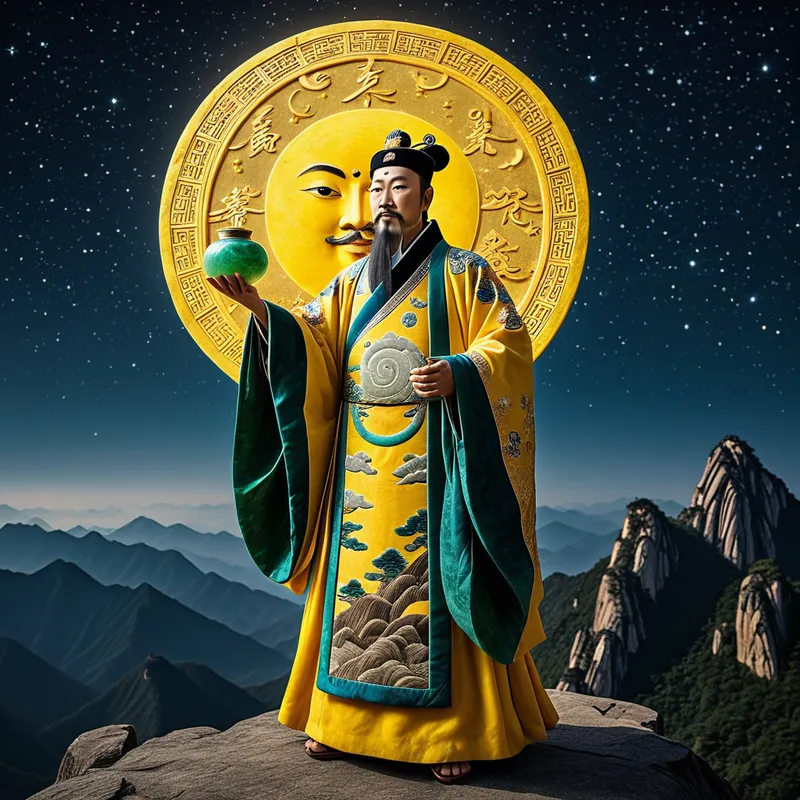
The Yellow Emperor's Robes Myth Meaning & Symbolism
A myth where the Yellow Emperor, Huangdi, crafts divine robes to embody cosmic order and establish his sacred rule over the chaotic world.
The Tale of The Yellow Emperor’s Robes
In the dawn-time of [the world](/myths/the-world “Myth from Tarot culture.”/), when [the earth](/myths/the-earth “Myth from Hindu culture.”/) was raw clay and [the sky](/myths/the-sky “Myth from Persian culture.”/) a formless mist, a great unease stirred in the heart of the land. Tribes warred, spirits roamed unchecked, and the seasons stumbled over one another in confusion. From this primal chaos arose a sovereign, not by conquest of arms alone, but by a vision of celestial harmony. His name was Huangdi, [the Yellow Emperor](/myths/the-yellow-emperor “Myth from Chinese culture.”/).
He ruled from a simple hall, his mind a tempest of concern. He gazed at the disordered heavens and the strife upon the earth and knew that dominion by force was a brittle [thing](/myths/thing “Myth from Norse culture.”/). True kingship, he perceived in a moment of profound stillness, must be a mirror. It must reflect the perfect, unwavering order of the cosmos itself. The idea came to him not as a strategy, but as an image, vivid and complete: a set of robes.
He summoned his most gifted artisans, those who could hear the whisper of silk and the song of metal. “You will not make garments for a man,” he instructed, his voice like distant thunder. “You will weave a microcosm. You will stitch a covenant between heaven and earth.”
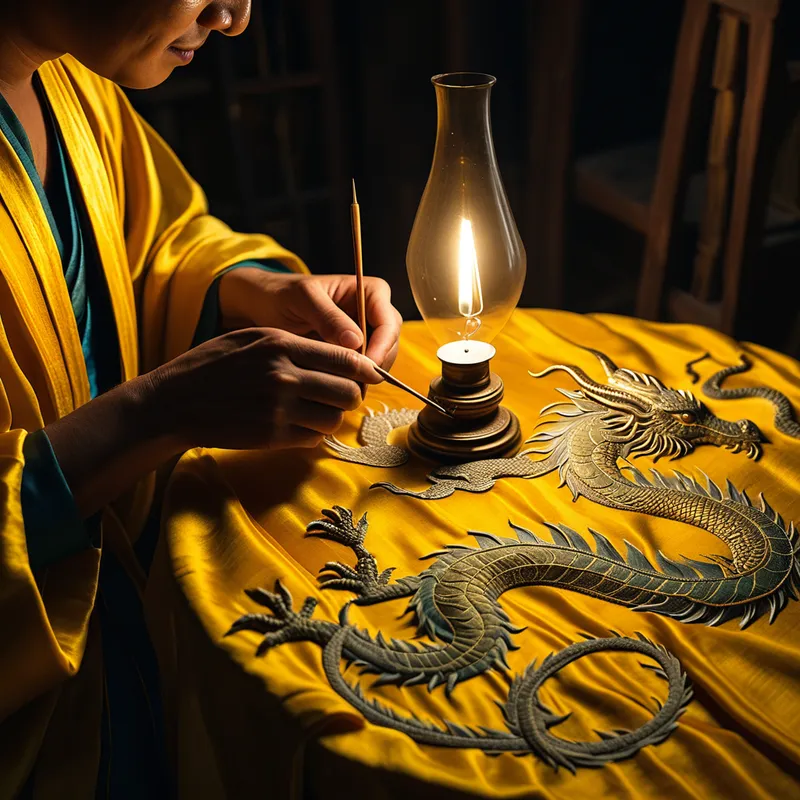
And so they began. The base cloth was the color of the rich, life-giving loess soil of [the Yellow River](/myths/the-yellow-river “Myth from Chinese culture.”/)—a deep, imperial yellow. Upon this ground, they embroidered the sun, a golden disk of fierce yang energy, and [the moon](/myths/the-moon “Myth from Tarot culture.”/), a silver crescent of gentle yin. Between them, they placed the constellations, each star a pinpoint of white jade thread, mapping the celestial bureaucracy. Around the hem flowed the great rivers, stitched in blue silk. Upon the shoulders rested the sacred mountains.
But the true marvels were the creatures. On the right sleeve coiled the Azure Dragon, scales of turquoise thread, its breath the spring winds. On the left, the Vermilion Bird spread wings of crimson, embodying summer’s fire. On the back, the Black [Tortoise](/myths/tortoise “Myth from Greek culture.”/) of winter stood firm, while the [White Tiger](/myths/white-tiger “Myth from Chinese culture.”/) of autumn prowled across the chest. At the very center, over the heart, they placed a magnificent, five-clawed golden dragon, the sovereign of all.
The day came for the donning. The court assembled in a hushed silence. As Huangdi stepped into the robes, a change occurred—not in the cloth, but in the very air. He seemed to grow, not in stature, but in presence. He was no longer merely a man leading other men. He was [the axis mundi](/myths/the-axis-mundi “Myth from Chinese culture.”/), the living pivot. The sun on his chest seemed to warm the hall; the constellations on his shoulders aligned with the stars visible through the high windows. A profound peace descended. The warring chieftains who had come in defiance felt their anger dissolve into awe. They did not see a warrior to fight, but an order to join. The chaotic spirits of land and river recognized their own domains woven into his vestments and bowed in acknowledgment. By wearing the cosmos, Huangdi had not claimed the world; he had made himself the living principle of its harmony, and the world, in seeing its own perfect pattern reflected, willingly aligned.
Cultural Origins & Context
This myth is embedded in the foundational strata of Chinese historiography and political philosophy. It is primarily found in texts like the Shangshu and later ritual compendiums. Unlike purely fantastical tales, the story of the Robes functions as a “charter myth,” a narrative that legitimizes and explains the core tenets of a civilization. It was told by court historians and Confucian scholars to illustrate the ideal of the Tianzi, the Son of Heaven.
Its societal function was profound. It established that legitimate rulership (zhengtong) was not derived from mere heredity or military might, but from a sacred, cosmological responsibility. The emperor’s power was legitimate only insofar as he embodied and maintained the harmony of the natural and human worlds. The robes were the ultimate symbol of this “Mandate of Heaven” (Tianming). They visually communicated that the emperor was the chief priest and mediator, his body the ritual vessel through which cosmic order flowed into societal order. This myth provided the template for millennia of imperial ritual, where clothing, crowns, and regalia were never mere decoration, but sacred tools of governance.
Symbolic Architecture
Psychologically, the myth presents a masterful [blueprint](/symbols/blueprint “Symbol: A blueprint represents the foundational plan or design for something, often symbolizing potential, structure, and the mapping of one’s inner self or future.”/) for the [integration](/symbols/integration “Symbol: The process of unifying disparate parts of the self or experience into a cohesive whole, often representing psychological wholeness or resolution of internal conflict.”/) of [consciousness](/symbols/consciousness “Symbol: Consciousness represents the state of awareness and perception, encompassing thoughts, feelings, and experiences.”/). The [Yellow Emperor](/myths/yellow-emperor “Myth from Chinese culture.”/) begins in a state of perceived [fragmentation](/symbols/fragmentation “Symbol: The experience of breaking apart, losing cohesion, or being separated into pieces. Often represents disintegration of self, relationships, or reality.”/)—a [kingdom](/symbols/kingdom “Symbol: A kingdom symbolizes authority, belonging, and a sense of identity within a larger context or community.”/) in [chaos](/symbols/chaos “Symbol: In Arts & Music, chaos represents raw creative potential, uncontrolled expression, and the breakdown of order to forge new artistic forms.”/) mirrors a [psyche](/myths/psyche “Myth from Greek culture.”/) at war with itself. The [Robes](/symbols/robes “Symbol: Robes symbolize social roles, authority, and spiritual or professional identity, often representing the persona one presents to the world.”/) represent the conscious act of creating a unifying [symbol](/symbols/symbol “Symbol: A symbol can represent an idea, concept, or belief, serving as a powerful tool for communication and understanding.”/), a Self-[image](/symbols/image “Symbol: An image represents perception, memories, and the visual narratives we create in our minds.”/) that can contain and harmonize the disparate, often conflicting, elements of one’s inner world.
The sovereign does not conquer the chaos; he weaves it into a garment of meaning and wears it as his own skin.
The chaotic tribes and spirits symbolize the unruly complexes, instincts, and archetypal forces of the unconscious. The artisan’s workshop is the disciplined, creative ego, tasked with the holy work of [synthesis](/symbols/synthesis “Symbol: The process of combining separate elements into a unified whole, representing integration, resolution, and the completion of a personal journey.”/). Each embroidered element is an [archetype](/symbols/archetype “Symbol: A universal, primordial pattern or prototype in the collective unconscious that shapes human experience, behavior, and creative expression.”/) integrated: the solar [dragon](/symbols/dragon “Symbol: Dragons are potent symbols of power, wisdom, and transformation, often embodying the duality of creation and destruction.”/) of assertive will (yang), the lunar [phoenix](/symbols/phoenix “Symbol: The Phoenix symbolizes rebirth, transformation, and the cycle of life, often representing the ability to rise from challenges stronger and renewed.”/) of receptive [intuition](/symbols/intuition “Symbol: The immediate, non-rational understanding of truth or insight, often described as a ‘gut feeling’ or inner knowing that bypasses conscious reasoning.”/) (yin), the [tiger](/symbols/tiger “Symbol: The tiger symbolizes power, courage, and primal instincts, often representing untamed energy and aggression.”/) of raw instinct tempered, the [tortoise](/symbols/tortoise “Symbol: Tortoises symbolize wisdom, longevity, and the importance of patience in achieving goals.”/) of deep, unconscious wisdom. The final act of donning the robes is the [moment](/symbols/moment “Symbol: The symbol of a ‘moment’ embodies the significance of transient experiences that encapsulate emotional depth or pivotal transformations in life.”/) of psychic incarnation—when the constructed symbol is fully inhabited and becomes the operating principle of the [personality](/symbols/personality “Symbol: Personality in dreams often symbolizes the traits and characteristics of the dreamer, reflecting how they perceive themselves and how they believe they are perceived by others.”/). The external [peace](/symbols/peace “Symbol: Peace represents a state of tranquility and harmony, both internally and externally, often reflecting a desire for resolution and serenity in one’s life.”/) that follows is the natural result of internal order; when the ruler within is integrated, the kingdom of the psyche finds its [harmony](/symbols/harmony “Symbol: A state of balance, agreement, and pleasing combination of elements, often associated with musical consonance and visual or social unity.”/).
The Dreamer’s Resonance
When this myth stirs in the modern dreamer, it often signals a critical juncture in the process of psychological authority and self-definition. One might dream of finding an incredibly ornate, heavy garment in a simple closet, or of being tasked with repairing a torn, celestial tapestry. The somatic feeling is often one of both awe and immense responsibility—a weight that is glorious yet burdensome.
Such dreams surface when an individual is being called to “step up” and own a larger identity, often after a period of chaos or personal disintegration (a career crisis, a relational ending, a loss of faith). The conflict in the dream mirrors the internal conflict: the fear of the role’s weight versus the deep, archetypal pull toward order and meaning. The dream may present the robes as ill-fitting, stolen, or impossibly complex to don, reflecting anxieties about inadequacy or imposter syndrome. The resolution, when it comes, is not through force, but through a patient, artisanal approach to [the self](/myths/the-self “Myth from Jungian culture.”/)—the slow, stitch-by-stitch work of acknowledging and integrating one’s own “sun and moon,” one’s own dragons and tigers, into a coherent whole.
Alchemical Translation
The alchemical process modeled here is the opus contra naturam—the work against nature—which in psychological terms means the work against one’s own unconscious, habitual chaos. The base material ([prima materia](/myths/prima-materia “Myth from Alchemical culture.”/)) is the raw, conflicted psyche and the disordered life situation. The Yellow Emperor’s contemplation is the [nigredo](/myths/nigredo “Myth from Alchemical culture.”/), [the dark night of the soul](/myths/the-dark-night-of-the-soul “Myth from Christian Mysticism culture.”/) where the problem is fully faced.
The crafting of the robes is the long, meticulous stage of albedo (whitening) and citrinitas (yellowing), where analysis, reflection, and conscious effort separate, purify, and recombine psychic elements. Each embroidered symbol is a coniunctio oppositorum (conjunction of opposites)—a fusion of a pair of opposites (e.g., instinct and spirit, aggression and grace) into a third, transcendent symbol.
Individuation is the art of becoming the tailor of your own soul, weaving the threads of fate, instinct, and aspiration into a garment of purpose only you can wear.
The final donning is the [rubedo](/myths/rubedo “Myth from Alchemical culture.”/) (reddening), the culmination where [the Philosopher’s Stone](/myths/the-philosophers-stone “Myth from Alchemical culture.”/)—the integrated Self—is realized and embodied. For the modern individual, this translates to the moment when a constructed philosophy of life, a hard-won set of values, or a personal code of conduct ceases to be an external idea and becomes an innate, operating identity. One becomes, in their own sphere, the peaceful sovereign. The external world may not bow, but one’s internal conflicts quiet, and actions flow from a center of gravity that is aligned, whole, and authentically powerful. The myth teaches that true authority is not seized from the world, but woven from the cosmos within.
Associated Symbols
Explore related symbols from the CaleaDream lexicon: