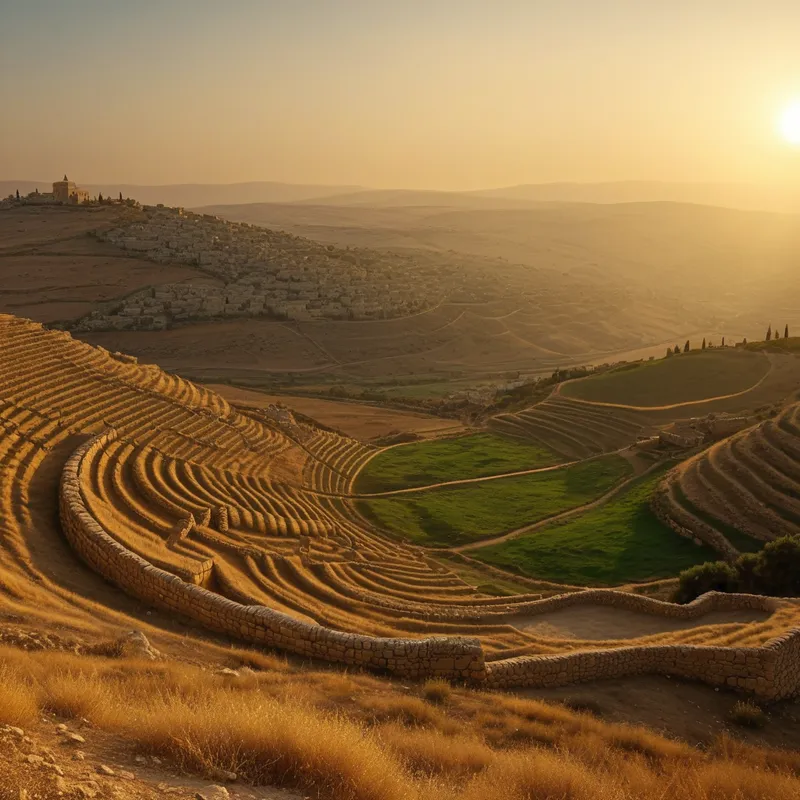
The Year of Jubilee Myth Meaning & Symbolism
A sacred cycle of societal and spiritual reset, where debts are forgiven, lands restored, and captives freed, mandated by divine law every fifty years.
The Tale of The Year of Jubilee
Hear now, you who dwell in houses of stone and till the soil that was your father’s. Listen to the rhythm woven into the very fabric of [the world](/myths/the-world “Myth from Tarot culture.”/), a rhythm deeper than the seasons, older than the hills. It is the rhythm of the great return.
For forty-nine years, the sun rises and sets. The plow cuts [the earth](/myths/the-earth “Myth from Hindu culture.”/), the harvest is gathered, the ledger is marked. A man may stumble. A poor harvest, a sickness in the family, a run of ill fortune, and he must go to his neighbor, his brother. He offers his strength for a wage, or worse, he pledges the land that sings in his blood—the land promised to his ancestors by the very voice from the mountain. He signs a parchment, and the field passes to another’s hand. His children are born not to soil, but to service. The chain is light at first, but with each passing season it grows heavier, until it is not just a debt of silver, but a debt of soul, a forgetting of one’s true name.
Then comes the year that is not like the others. It is the fiftieth year. The air itself grows still in anticipation after the Day of Atonement, when the high priest has entered the most holy place and the sins of the people are carried away into [the wilderness](/myths/the-wilderness “Myth from Biblical culture.”/). Then, as the sun hangs low, a sound splits the silence. It is not the sound of war, but of unraveling. It is the blast of the shofar, raw and yearning, echoing from hilltop to valley.
Where its voice travels, a great unclenching takes hold of the land. In the house of the creditor, the hand holding the debt-parchment goes slack; the ink seems to bleed away like mist. In the field, the hired worker straightens his aching back, and a knowledge older than memory stirs within him. He turns his face from the furrow he does not own and begins the walk, not to a master’s table, but home. To a plot of earth he has never worked, yet knows in his bones.
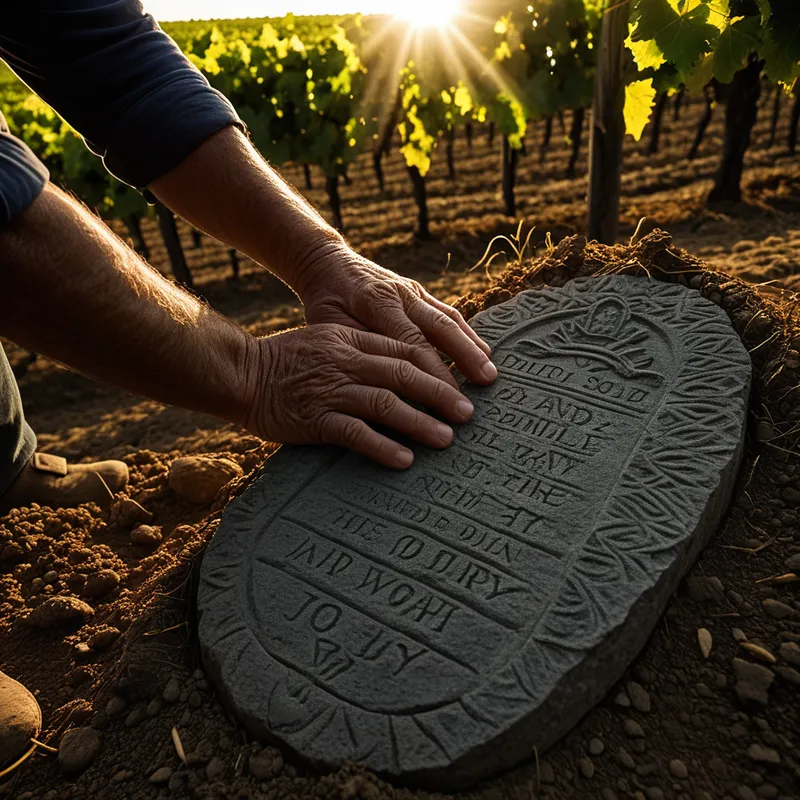
Boundary stones, sunk deep to mark a sale, are now lifted from the soil. They are not thrown aside in violence, but carried back and pressed into their original, sacred placements. The land itself exhales, released from its mortgage, free to lie fallow and dream. Families fragmented by necessity stream from scattered dwellings, converging on ancestral plots. There is weeping, but it is the weeping of a weight being lifted, of a name being remembered. It is the sound of the circle closing. The slate, scarred with forty-nine years of accounts, is wiped clean. The trumpet’s call does not create wealth; it dissolves the illusion of permanent loss. It proclaims a truth more solid than any contract: that no soul is meant to be forever indentured, and no land forever alienated. This is the Year of Jubilee. The great [Sabbath](/myths/sabbath “Myth from Judeo-Christian culture.”/) of Sabbaths. The homecoming written into [the law](/myths/the-law “Myth from Biblical culture.”/) of time itself.
Cultural Origins & Context
This was not merely a hopeful story, but a radical legal and theological statute embedded in the covenant law of ancient Israel, primarily found in the Book of Leviticus, Chapter 25. It functioned as the capstone of a smaller cyclical rhythm—[the Sabbath](/myths/the-sabbath “Myth from Abrahamic culture.”/) year, which occurred every seven years. The Jubilee amplified this principle, creating a socio-economic reset every fifty years (seven cycles of seven, plus one). It was a myth enacted, or at least intended to be enacted, within history.
Its custodians were the priestly and prophetic classes. The priests (Kohanim) preserved its precise legal mechanics: the counting, the trumpet blast on Yom Kippur, the rules of redemption and release. [The prophets](/myths/the-prophets “Myth from Biblical culture.”/) (Nevi’im), like [Isaiah](/myths/isaiah “Myth from Abrahamic culture.”/) and Jeremiah, invoked its spirit as a measure of societal [justice](/myths/justice “Myth from Tarot culture.”/), often chastising the people for their failure to uphold its principles of equity. Its societal function was profoundly stabilizing and ethical. It acted as a built-in check against the permanent concentration of wealth and the creation of a landed aristocracy or a perpetual underclass. It affirmed that the land ultimately belonged to YHWH, and the people were but tenants and stewards. This myth-in-practice was a constant reminder that human arrangements are provisional, and that divine [justice](/myths/justice “Myth from Tarot culture.”/) demands a periodic restoration of dignity and foundation.
Symbolic Architecture
At its core, the Jubilee is a myth of sacred [memory](/symbols/memory “Symbol: Memory symbolizes the past, lessons learned, and the narratives we construct about our identities.”/) and systemic grace. Its symbols form an [architecture](/symbols/architecture “Symbol: Architecture in dreams often signifies structure, stability, and the framing of personal identity or life’s journey.”/) of return.
The Fiftieth [Year](/symbols/year “Symbol: A unit of time measuring cycles, growth, and passage. Represents life stages, progress, and mortality.”/) symbolizes a transcendence of the known cyclical order (the seven). It represents a [moment](/symbols/moment “Symbol: The symbol of a ‘moment’ embodies the significance of transient experiences that encapsulate emotional depth or pivotal transformations in life.”/) outside of ordinary time, a [rupture](/symbols/rupture “Symbol: A sudden break or tear in continuity, often representing abrupt change, separation, or the shattering of established patterns.”/) in the predictable flow of cause and effect where a higher law intervenes. The [Shofar](/symbols/shofar “Symbol: A ram’s horn trumpet used in Jewish rituals, symbolizing divine calls, repentance, and spiritual awakening.”/) Blast is the activating sound of that higher law. It is the voice of the transcendent breaking into the immanent, the command that triggers a cosmic [reset](/symbols/reset “Symbol: A profound desire for renewal, erasure of past patterns, or a return to an original state. It represents the possibility of starting again from scratch.”/). It is not an [argument](/symbols/argument “Symbol: An argument symbolizes conflict, communication breakdown, and feelings of frustration or misunderstanding.”/) but a declaration.
The Return of Land is the most potent [symbol](/symbols/symbol “Symbol: A symbol can represent an idea, concept, or belief, serving as a powerful tool for communication and understanding.”/). Land is not mere [property](/symbols/property “Symbol: Property often represents one’s personal value, possessions, or self-worth.”/); it is [identity](/symbols/identity “Symbol: Identity represents the sense of self, encompassing personal beliefs, cultural background, and social roles.”/), inheritance, and [connection](/symbols/connection “Symbol: Connection symbolizes relationships, communication, and bonds among individuals.”/) to the past and future. Its restoration symbolizes the [recovery](/symbols/recovery “Symbol: The process of returning to health, strength, or normalcy after illness, injury, or loss; a journey of healing and restoration.”/) of one’s essential Self from the complex mortgages of [life](/symbols/life “Symbol: The symbol of ‘Life’ represents a journey of growth, interconnectedness, and existential meaning, encompassing both the joys and challenges that define human experience.”/)—the roles, debts, and compromises that alienate us from our core [identity](/symbols/identity “Symbol: Identity represents the sense of self, encompassing personal beliefs, cultural background, and social roles.”/).
The ultimate bondage is not to a master, but to the unpayable debt. Jubilee declares the debt an illusion against the backdrop of eternity.
The Release of Slaves/Debtors symbolizes the liberation of psychic [energy](/symbols/energy “Symbol: Energy symbolizes vitality, motivation, and the drive that fuels actions and ambitions.”/) trapped in servitude to outdated patterns, unresolved traumas, or the expectations of others. The Fallowness of the Land is equally crucial. It represents the necessary [period](/symbols/period “Symbol: Periods in dreams can symbolize cyclical patterns, renewal, and the associated emotions of loss or change throughout life.”/) of rest, receptivity, and non-doing that must precede any true renewal. The [soil](/symbols/soil “Symbol: Soil symbolizes fertility, nourishment, and the foundation of life, serving as a metaphor for growth and stability.”/), like the [soul](/symbols/soul “Symbol: The soul represents the essence of a person, encompassing their spirit, identity, and connection to the universe.”/), cannot produce indefinitely without a Sabbath.
The Dreamer’s Resonance
When this myth stirs in the modern [psyche](/myths/psyche “Myth from Greek culture.”/), it rarely appears as ancient Israelites returning to vineyards. Instead, it manifests as dreams of profound release and homecoming.
A dreamer may find themselves in a vast, oppressive office building (the system of debt), endlessly sorting papers that multiply as they work. Suddenly, an alarm sounds—not of danger, but of liberation—and the walls dissolve, revealing a path to a forgotten childhood home. This is the Jubilee pattern: the recognition of servitude to a self-imposed or culturally mandated “ledger,” followed by an authoritative call to stop, and a visceral pull toward an original, unencumbered state of being.
Somatically, the dreamer may experience a physical sensation of a weight lifting from the chest or shoulders upon waking, a deep sigh, or tears of relief without immediate cause. Psychologically, this dream emerges at a crossroads where one feels permanently defined by past mistakes, financial burdens, relational obligations, or a career path that has become a cage. The dream is the psyche’s shofar, announcing that the contract is not eternal. The process underway is the difficult, often terrifying, work of forgiving oneself and others, and daring to reclaim the “land” of one’s authentic passions and purpose, which feels both alien and deeply familiar.

Alchemical Translation
The alchemical journey of individuation is, in essence, a personal Jubilee. It is the process of reclaiming the psychic territory we have pawned to the complexes—the inner taskmasters of the [persona](/myths/persona “Myth from Greek culture.”/), [the shadow](/myths/the-shadow “Myth from Jungian culture.”/), and the collective expectations.
The initial [nigredo](/myths/nigredo “Myth from Alchemical culture.”/), or blackening, is the felt experience of enslavement—the depression, anxiety, or meaninglessness that comes from living a life mortgaged to the wrong values. We work land that is not ours, for a master (a complex) whose voice we have mistaken for our own. The counting of the years is the slow, often unconscious, accumulation of Self-knowledge through suffering and reflection.
The albedo, or whitening, is the clarion call of the shofar. In analysis, this is the moment of piercing insight, the interpretation that “sounds” through the confusion and names the bondage for what it is. It is the realization, “This life is not mine to live.” This sound initiates the separation from the oppressive complex.
The work of the soul is not to earn freedom, but to remember it is already decreed, and to have the courage to walk home.
The [rubedo](/myths/rubedo “Myth from Alchemical culture.”/), or reddening, is the homecoming itself. This is the active, often messy, work of reintegration. It is returning the “boundary stones”: reclaiming time for what truly nourishes us, setting boundaries that honor our innate territory, forgiving old emotional and psychic debts we carry for ourselves and others. The fallow period is essential here—a deliberate non-action, a Sabbath for the soul to integrate the shock of its own liberation before new, authentic growth can begin. The final gold is not a new possession, but the recovered state of being whole, unencumbered, and living in right relationship with one’s own inner law. The cycle completes, not as a return to childish innocence, but as a hard-won return to an integrity that was always meant to be ours.
Associated Symbols
Explore related symbols from the CaleaDream lexicon: