The Yazata Angels Myth Meaning & Symbolism
Celestial beings of light and order in Zoroastrianism, the Yazatas embody divine principles that guide the soul toward cosmic harmony and personal integrity.
The Tale of The Yazata Angels
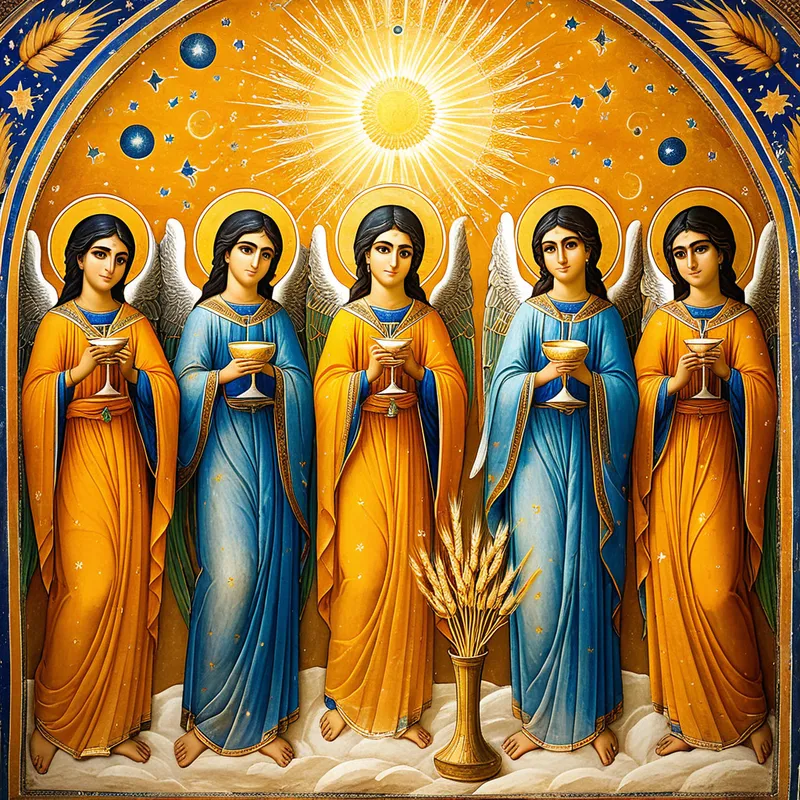
Listen, and let the veil between worlds grow thin. Before time was counted in years, when the sky was a deeper blue and the earth hummed with a purer song, the great [Ahura Mazda](/myths/ahura-mazda “Myth from Persian culture.”/) brought forth from His boundless light the first emanations of His perfect thought. These were the Yazatas, the Shining Ones. They were not born, but manifested—each a flawless note in the symphony of creation.
Among them walked Asha Vahishta, whose very presence made crooked paths straight and false words crumble to dust. His light was not of the sun, but of a principle: the unshakeable rightness of a stone fitting perfectly into an arch. There was Vohu Manah, whose form was the warmth of a wise friend’s counsel and the clarity of a dawn decision. To be near him was to feel one’s own mind expand, to see the good path unfold.
And there was Khshathra Vairya, who held not a scepter, but the concept of a well-tended kingdom, where every soul had its rightful place and purpose. His companion was Spenta Armaiti, her essence the patient silence of fertile earth and the unwavering love of a nurturing spirit. She whispered to the roots of the mountains and the hearts of the steadfast.
But the world was not complete. For from the void of absence, Angra Mainyu had stirred, bringing with him the lie, Druj, and the long shadow. He saw the luminous tapestry of the Yazatas and sought to unravel it with decay, doubt, and chaos. He poisoned rivers with salt and twisted men’s thoughts with envy.
The conflict was not a battle of swords, but a slow, grinding tension—the weight of a coming storm against the integrity of a temple pillar. The Yazatas did not rage; they endured. They upheld. Haurvatat, the angel of wholeness, stood by a blighted field, and where her light fell, a single, perfect stalk of barley pushed through the cracked earth. Ameretat, the angel of life unending, faced the specter of decay, and her breath became the scent of evergreen in a barren place.
The greatest test came for Tishtrya, the celestial warrior. Taking the form of a magnificent white stallion with a mane of streaming stars, he descended to the cosmic sea, Vourukasha. There, the demon of drought, Apaosha, a black, withered horse of terrifying strength, awaited him. For three days and nights they fought, hoof against hoof, light against thirst. Tishtrya faltered, weakened by the cheers of men who had forgotten to give him honor.
He retreated, not in defeat, but in need. And the people, feeling the parching of their own throats, remembered. They raised their voices in the ancient hymns, they offered the sacred drink, Haoma. Strengthened by this covenant of faith, Tishtrya returned. The final clash shook the foundations of the mountains. With a triumphant neigh that became the first rumble of thunder, Tishtrya struck down Apaosha and plunged into the waters. He emerged, and from his dripping mane fell the first, life-giving rains, filling the rivers Arvand and Veh, making the world flush with green once more. The Yazatas had held the line. The light was not merely preserved; it was reaffirmed through the active, devoted partnership of all creation.
Cultural Origins & Context
This celestial drama is the heart of Zoroastrianism, one of the world’s oldest continuously practiced religions, originating in ancient Persia (modern-day Iran) over three millennia ago. The stories of the Yazatas are not mere fables but sacred cosmology, preserved in the Avesta, particularly in the hymns known as the Yashts. They were transmitted orally for centuries by priestly magi before being committed to writing.
The societal function was profound. The Yazatas provided a model for an ethical, orderly universe and, by extension, an ethical, orderly society. Each Yazata governed an aspect of the natural world and a corresponding virtue in the human sphere. Worship was not passive supplication but active alignment—to honor Mithra was to uphold one’s own contracts and truthfulness. The myth served as a constant reminder that humanity is a co-worker with the divine (hamkar) in the ongoing battle against chaos and falsehood, a concept that deeply influenced later Abrahamic and Hellenistic thought.
Symbolic Architecture
The Yazatas represent the personification of archetypal principles necessary for a coherent psyche and a coherent world. They are not external gods to be feared, but internal capacities to be cultivated.
The Yazata is not a rescuer from without, but the awakened faculty within. To call upon Asha is to invoke one’s own latent integrity; to honor Vohu Manah is to court one’s own deepest wisdom.
They symbolize the [differentiation](/symbols/differentiation “Symbol: The process of distinguishing or separating parts of the self, emotions, or identity from a whole, often marking a developmental or psychological milestone.”/) of the unified light of the Self (Ahura Mazda) into specific, functional attributes. Khshathra Vairya is the psyche’s need for inner [structure](/symbols/structure “Symbol: Structure in dreams often symbolizes stability, organization, and the framework of one’s life, reflecting how one perceives their environment and personal life.”/) and rightful [authority](/symbols/authority “Symbol: A symbol representing power structures, rules, and control, often reflecting one’s relationship with societal or personal governance.”/) over one’s own impulses. Spenta Armaiti is the sacred devotion we must show to our own [soul](/symbols/soul “Symbol: The soul represents the essence of a person, encompassing their spirit, identity, and connection to the universe.”/)’s growth, the patience to tend the inner [soil](/symbols/soil “Symbol: Soil symbolizes fertility, nourishment, and the foundation of life, serving as a metaphor for growth and stability.”/). Their struggle against the Angra Mainyu forces represents the perpetual internal conflict between order and [chaos](/symbols/chaos “Symbol: In Arts & Music, chaos represents raw creative potential, uncontrolled expression, and the breakdown of order to forge new artistic forms.”/), meaning and [despair](/symbols/despair “Symbol: A profound emotional state of hopelessness and loss, often signaling a need for transformation or surrender to deeper truths.”/), conscious [choice](/symbols/choice “Symbol: The concept of choice often embodies decision-making, freedom, and the multitude of paths available in life.”/) and unconscious [entropy](/symbols/entropy “Symbol: In arts and music, entropy represents the inevitable decay of order into chaos, often symbolizing creative destruction, impermanence, and the natural progression toward disorder.”/).
The Dreamer’s Resonance
When the Yazata pattern stirs in the modern dreamer, it often signals a critical phase of seeking inner guidance and structure. One may dream of luminous, calm figures in a moment of crisis, not intervening directly, but illuminating a choice. Or one might dream of a parched landscape where finding a pure, hidden spring feels like a moral duty.
Somatically, this can feel like a tension in the chest or spine—a yearning for alignment, for the psyche to “stand up straight” according to its own true law. Psychologically, it is the process of moving from a state of confusion or moral ambiguity toward clarity and ethical commitment. The enemy in the dream is rarely a monster, but more often an atmosphere of decay, a spreading lie, or a paralyzing apathy—the psychic equivalents of the demon Apaosha. The dream asks: What inner covenant have you forgotten? What virtue have you left un-watered?

Alchemical Translation
The myth of the Yazatas models the alchemy of building a resilient, individuated psyche. It is not the drama of the Hero who slays the dragon once, but of the diligent steward who maintains the sacred precinct every day.
Individuation is less a spectacular victory and more a sustained, devoted attendance to the principles that give life its architecture.
The first stage is Invocation: recognizing the fragmented, chaotic state of the psyche (the world under threat). The second is Differentiation: consciously identifying and naming the needed inner principles—Where do I need more Truth (Asha)? Where do I need more Benevolent Purpose (Vohu Manah)? The third and crucial stage is Covenant: the fight of Tishtrya teaches that these inner principles weaken without the “ritual” of our own commitment—the daily choices, the honest reflections, the small acts of integrity that are our modern Haoma.
The final transmutation is Integration: the rains fall. The differentiated virtues, once nurtured and fought for, begin to work in harmony, creating an inner ecology that is fertile and whole (Haurvatat and Ameretat). The soul becomes not a battlefield, but a tended kingdom, a participant in the cosmic order it has helped to uphold.
Associated Symbols
Explore related symbols from the CaleaDream lexicon:
- Star — The Yazatas are often associated with celestial bodies, particularly Tishtrya with Sirius, representing distant, guiding lights of principle and hope in the dark vault of the unconscious.
- Light — The fundamental essence of the Yazatas; not merely illumination, but the principle of consciousness, order, and revelation that actively counters the darkness of chaos and ignorance.
- Water — Embodied in Tishtrya’s battle, it symbolizes the nourishing, life-giving psychic energy (libido) that is released when inner conflict is resolved through courage and devotion.
- Fire — The sacred element of Ahura Mazda, representing the purifying, transformative light of truth (Asha) that burns away deception and warms the soul with purpose.
- Order — The core domain of Asha Vahishta; it signifies the innate psychic need for a coherent, truthful structure within the self, the antidote to internal chaos.
- Horse — The form of Tishtrya in his battle, symbolizing the powerful, instinctual life force harnessed and directed toward a sacred, culture-building goal.
- Covenant — The critical pact between the divine and the human, mirrored internally as the promise the ego makes to the Self to uphold the principles of the psyche.
- Drought — The state of psychic aridity, depression, and stagnation that occurs when one’s inner virtues and commitments are neglected or forgotten.
- Rain — The blessing that follows upheld covenants; the shower of insight, emotional release, and renewed creative energy that fertilizes the parched soul.
- Temple — The psyche itself as a sacred space that must be maintained and ordered through ritual (conscious practice) to house the divine principles (Yazatas).
- Angel — A direct parallel to the Yazata as a benevolent, guiding emanation of a higher principle, acting as a messenger between the divine realm and the human heart.
- Healing — The domain of Haurvatat, representing the process of moving toward psychic wholeness and integration, the repair of fractures within the self.