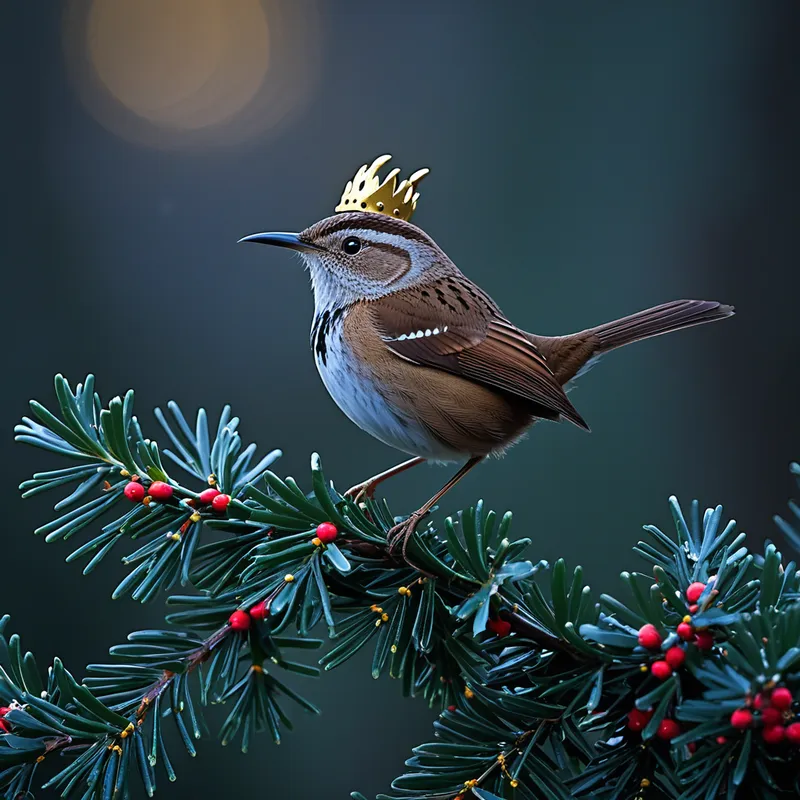
The Wren King Myth Meaning & Symbolism
A myth of the smallest bird crowned king, embodying sacrifice, cunning, and the paradoxical sovereignty found in vulnerability and the liminal spaces of the year.
The Tale of The Wren King
Listen now, by the hearth-fire’s glow, as the wind of Samhain howls at the door. Listen to the tale of the King who was not a king, the bird who was not a bird of prey.
In the time when the world was younger and the veil between what is and what might be was thin as a spider’s silk, the creatures of the land grew restless. The great Oak stood bare, its bones rattling in the cold breath of the dying year. The sun, the Lugh of the sky, grew weak and pale. And a question hung in the frozen air: who is sovereign in this time of decay? Who holds the crown when the light fails?
The eagle claimed it by right of height and vision. The stag claimed it by right of strength and antler-crown. The salmon claimed it by wisdom of the deep pools. But their boasts echoed hollow in the silent wood. Sovereignty is not claimed, the land whispered. It is revealed.
And so a contest was set: the bird that could fly the highest, from dawn’s first crack to the sun’s zenith, would be crowned King of All Birds for the year’s turning. On the solstice morn, they gathered. With a thunder of wings, the eagle surged upward, mighty pinions beating the gray sky. Below him, the hawk, the crow, the falcon—all strained their limit and fell away, exhausted. The eagle soared alone, a dark speck against the cloud, the very king of the air.
But as he strained his final ounce of strength, a tiny flutter stirred from the matted feathers of his back. From its hiding place, the wren emerged. It had tucked itself away at the first light, a secret passenger. With a chirp that was both apology and declaration, it launched itself from the eagle’s height. One beat, two—and it was above the great bird. It had flown the highest, not by its own power, but by cunning and alliance with the very force it sought to surpass.
A great cry of betrayal rose from the forest below. The eagle’s wrath was a storm. The wren, the trickster-king, darted for the thick, protective embrace of the holly. But it was not fast enough. A thorn, sharp as a warrior’s spear, caught its wing. It fell to the frozen earth, its small body a still, brown leaf against the white.
And there, on the threshold of the year, the smallest of birds became the greatest of sacrifices. Its blood, a single crimson jewel, seeped into the hungry ground. In that moment of stillness, a profound silence fell. The wind ceased. The anger drained from the eagle’s eye. For in its cunning and its fall, the wren had done what no other could: it had touched the highest sky and returned its essence to the lowest earth. It had bridged the realms. The holly, stained with its life, became its crown. And so, they named it the Wren King, the sovereign of the in-between, the ruler of the hidden turn.
Cultural Origins & Context
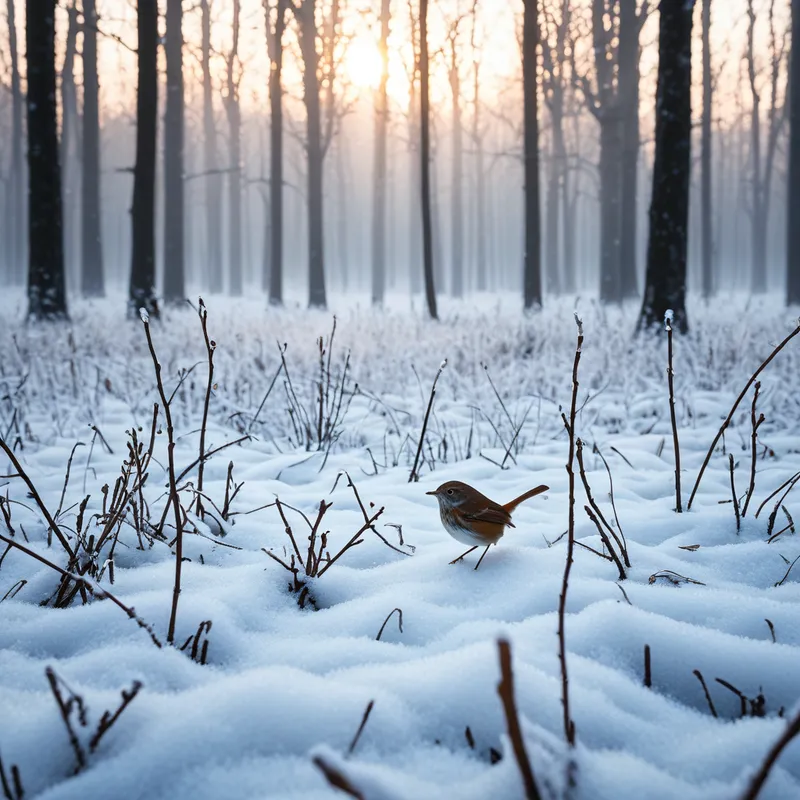
This is not a myth of palaces, but of hedgerows and hearths. The tale of the Wren King is folk memory, etched not in stone but in seasonal ritual, primarily across Ireland, the Isle of Man, Wales, and parts of France. It was a story enacted, not just told. The “Hunting of the Wren” ceremony, performed on St. Stephen’s Day (December 26th) or sometimes on the winter solstice itself, saw groups of “Wren Boys” go from house to house with a wren (later a symbolic effigy) in a decorated holly bush, singing verses that recounted the bird’s betrayal and death, asking for coin or food.
This was not mere pageantry. It was a profound piece of Celtic pagan cosmology, Christianized in name but pagan in bone-deep function. The wren, called Drui-en in Irish (“Druid bird”), was considered a bird of omen, associated with the druidic class and the hidden mysteries. Its sacrifice at the year’s darkest point was a sympathetic magic act: the ritual killing of the “old king” of the dying year to ensure the sun’s return and the fertility of the new. The collected “blood money” was an offering to the community’s continued life. The myth, therefore, served as the sacred narrative underpinning a crucial societal function—the collective navigation of cosmic uncertainty through ritualized sacrifice and renewal.
Symbolic Architecture
The myth’s power lies in its profound paradoxes. The Wren King is the ultimate symbol of the hidden sovereign.
True sovereignty is not found in the blatant display of power, but in the cunning navigation of the spaces between powers.
The wren’s kingship is won not by brute force but by intelligence, adaptability, and an understanding of systems (hitching a ride on the eagle, the symbol of solar, conscious power). It represents the psyche’s latent, unacknowledged wisdom—the inner druid—that operates indirectly. Its domain is the liminal: the solstice, the hedge (neither field nor forest), the holly bush (green in death). It is king of transitions, of thresholds, of the unconscious itself.
Its death is not a defeat, but the completion of its sacred function. The sacrificial spilling of its blood onto the winter earth is an alchemical act: the conscious offering of a refined essence (the “king”) to fertilize the dormant, unconscious ground of being. The holly, ever-green and protective, becomes its throne and tomb, symbolizing that life and wisdom persist even in the season of psychic death.
The Dreamer’s Resonance
When this myth stirs in the modern dreamer, it often signals a confrontation with the inner sovereign crisis. To dream of a small, overlooked, or wounded bird—especially one exhibiting strange authority or found in a liminal space (an attic, a hedge, a threshold)—is to encounter the Wren King archetype.
Psychologically, this is a process of acknowledging the power in what you have deemed insignificant or have hidden away. Perhaps it is a fragile creative impulse, a subtle intuition, a childhood memory of resourcefulness, or a part of the self deemed “too clever by half.” The dream may carry a somatic sense of being pierced (the holly thorn) or of a profound, quiet stillness after a fall. This is the moment of sacrifice: the old, ego-driven identity (the eagle’s solitary flight) has been transcended by a cunning, deeper part of the self, and that new, vulnerable king must now be integrated, which feels like a death. The dreamer is in the holly bush—protected yet pricked, crowned yet bleeding—undergoing the necessary ordeal of claiming a sovereignty based on wisdom, not dominance.
Alchemical Translation
The journey of the Wren King is a perfect map for the individuation process. It begins with the recognition of the hidden ally. Our conscious striving (the eagle) is powerful but one-dimensional. Individuation requires we discover the wren—the subtle, often dismissed inner guide that knows how to use the structures of the psyche to ascend beyond them.
The alchemical gold is not seized; it is revealed through the strategic sacrifice of the identity that sought to seize it.
The central, transformative phase is the sacrifice at the thorn. This is the painful but necessary step where the newly realized potential (the king) must be offered up. In psychological terms, this is the surrender of the ego’s claim to total control. It is allowing a cherished insight, a hard-won understanding, or a new, vulnerable self-concept to be “killed”—exposed, made real, and integrated into the fabric of your being, which always feels like a loss. The blood is the libido, the life force, willingly returned to the unconscious.
The resolution is sovereignty of the liminal. One does not become the eagle, ruling from a solitary height. One becomes the Wren King, ruling from the holly bush—from the edge, the threshold, the place where inner and outer, conscious and unconscious, life and death meet. This is the sage archetype in its truest form: authority derived not from omniscience, but from a deep, cunning, and humble dialogue with the hidden mysteries of the self and the world. The crown is of thorns and evergreen, a sovereignty born of sacrifice and sustained by eternal, resilient life.
Associated Symbols
Explore related symbols from the CaleaDream lexicon: