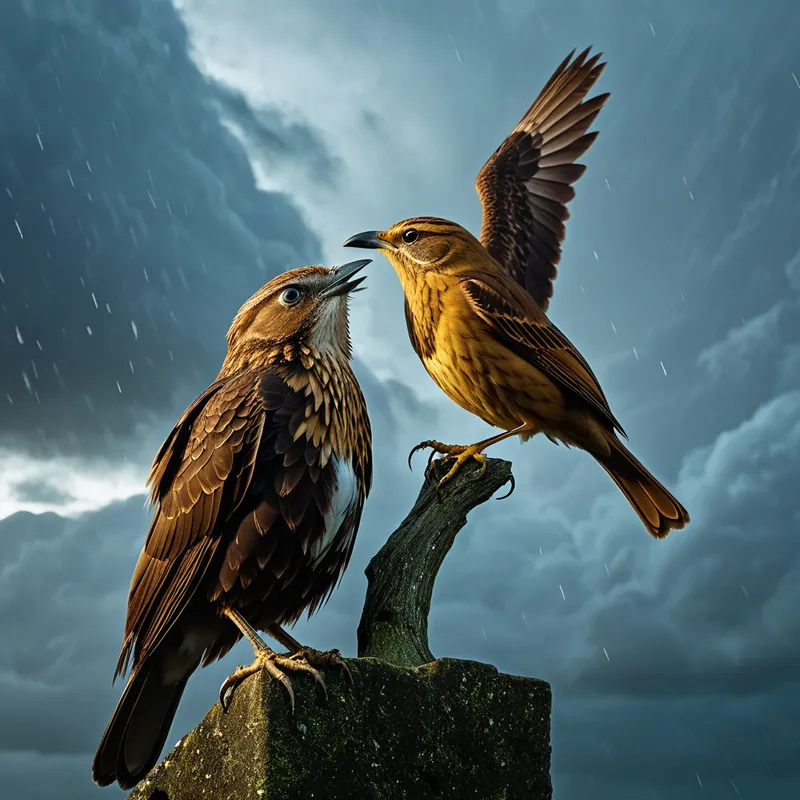
The Wren Myth Meaning & Symbolism
A myth where the tiny, cunning Wren outwits the mighty Eagle to become King of the Birds, revealing the power of the hidden and the sacrificed.
The Tale of The Wren
Listen, and let [the hearth](/myths/the-hearth “Myth from Norse culture.”/)-fire grow low. In the time before memory, when [the world](/myths/the-world “Myth from Tarot culture.”/) was raw and [the wind](/myths/the-wind “Myth from Various culture.”/) spoke with the voice of the gods, a great council was called. The birds of the air, from the soaring eagle to the chattering wren, gathered at the edge of the known world, where the land meets the endless grey sea. A question hung in the salt-tanged air, heavier than stone: who among them was worthy to be King?
The eagle, with wings that blotted out the sun and a gaze that could pin a hare from a league away, beat his chest. “I fly highest,” he thundered. “I see the farthest. The kingdom is mine by right of might and sight.” A murmur of agreement rustled through the assembly. Who could challenge such power?
But an ancient law was remembered, whispered by the oldest crow. “Not by height alone,” she cawed. “The true king shall be he who flies closest to the sun, who touches the face of Lugh himself.” A test. A decree.
With a cry that split the clouds, the eagle surged upward. He climbed past the peaks where the mountain goats trembled, past the realm of clouds, into the thin, burning blue. The other birds strained to follow, but one by one, their breath failed, their wings grew leaden. The lark fell back, then the hawk, then the brave falcon. Only the eagle remained, a dark speck against the blinding disc of the sun. He laughed, a sound like cracking ice. “Behold! I am closest! I am King!”
But in the ruffled feathers upon his back, a tiny form had hidden. The wren, the Drui-en, the Druid bird, had not flown at all. She had nestled in the eagle’s own plumage, a stowaway on the journey to sovereignty. And as the eagle proclaimed his victory, she pushed herself free. With a frantic, beating heart and a burst of desperate strength, she fluttered a mere wingspan above the great bird’s head.
“You fly high, Eagle,” she chirped, her voice a needle in the vast silence, “but I fly higher. I am closer to the sun. By [the law](/myths/the-law “Myth from Biblical culture.”/) of the council, the kingdom is mine.”
A great silence fell, deeper than [the sky](/myths/the-sky “Myth from Persian culture.”/). The eagle, betrayed by his own might, could only stare in furious, stunned disbelief. The wren, trembling with exhaustion and [triumph](/myths/triumph “Myth from Roman culture.”/), began her long, perilous descent. The wind, no longer a friend, snatched at her. She was but a leaf, a speck of dust. Down, down she tumbled, towards the waiting earth and [the sea](/myths/the-sea “Myth from Greek culture.”/) of upturned beaks.
She did not land in glory, but in a tangle of brambles at the wood’s edge, her tiny body bruised, one wing bent. But from that thorny throne, her claim echoed. She had won not by strength, but by wit. Not by force, but by foresight. And the birds, bound by their own law, bowed to the tiny, cunning king of the bramble.
Cultural Origins & Context
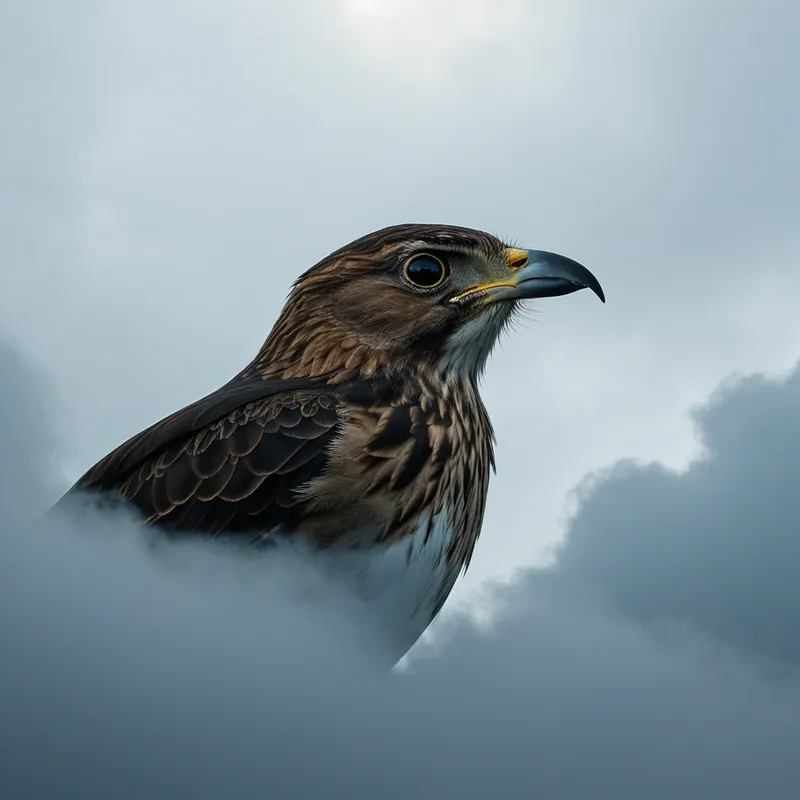
This tale, known across the Celtic world from Ireland to Brittany, was not merely a children’s fable. It was a bard’s story, recited during the festival of [Samhain](/myths/samhain “Myth from Celtic culture.”/) and, most notably, on St. Stephen’s Day (December 26th). Here, the myth bled into ritual with the haunting practice of “Hunting the Wren.” Boys would go out, capture or symbolically “kill” a wren (often represented by a fake bird), and parade it from house to house in a tiny, decorated coffin or atop a pole, singing verses that recalled its cunning and its kingship.
This ritual was deeply ambivalent—a celebration of the king’s cunning, but also a sacrificial offering of that very king. The wren, as Drui-en, was a creature of the Aos Sí, a liminal being. By “killing” it, the community perhaps sought to harness its Otherworldly wisdom for the new year, or to sacrifice the old year’s sovereignty to make way for the new. The myth and its ritual counterpart served as a societal pressure valve, inverting the natural order (the small rules the great) and reminding all that authority is fluid, contingent, and often born of unexpected, even deceptive, means.
Symbolic Architecture
At its [heart](/symbols/heart “Symbol: The heart symbolizes love, emotion, and the core of one’s existence, representing deep connections with others and self.”/), the myth of the Wren is a masterclass in paradoxical sovereignty. The [eagle](/symbols/eagle “Symbol: The eagle is a symbol of power, freedom, and transcendence, often representing a person’s aspirations and higher self.”/) represents the conscious ego: magnificent, solar, direct, ruling by apparent and undisputed supremacy. He is [the principle](/symbols/the-principle “Symbol: A fundamental truth, law, or doctrine that serves as a foundation for a system of belief, behavior, or reasoning, often representing moral or ethical standards.”/) of conscious will and towering [achievement](/symbols/achievement “Symbol: Symbolizes success, mastery, or reaching a goal, often reflecting personal validation, social recognition, or overcoming challenges.”/).
The true king is not the one who boasts the highest station, but the one who understands the hidden paths that lead there.
The wren embodies the [anima](/symbols/anima “Symbol: The feminine archetype within the male unconscious, representing soul, creativity, and connection to the inner world.”/) or the [trickster](/symbols/trickster “Symbol: A boundary-crossing archetype representing chaos, transformation, and the subversion of norms through cunning and humor.”/) [archetype](/symbols/archetype “Symbol: A universal, primordial pattern or prototype in the collective unconscious that shapes human experience, behavior, and creative expression.”/)—the cunning, hidden, and often overlooked intelligence of the unconscious. She does not fight the eagle’s [strength](/symbols/strength “Symbol: ‘Strength’ symbolizes resilience, courage, and the ability to overcome challenges.”/); she uses it. Her [kingdom](/symbols/kingdom “Symbol: A kingdom symbolizes authority, belonging, and a sense of identity within a larger context or community.”/) is not the open sky, but the bramble, the hidden [thicket](/symbols/thicket “Symbol: A thicket represents a natural enclosure, often symbolizing protection and the primal need for a safe haven.”/), the overlooked [margin](/symbols/margin “Symbol: The boundary between what is included and excluded, representing thresholds, edges, and liminal spaces between defined areas.”/). Her victory is a psychological coup: the unconscious, latent wisdom (the wren) revealing itself as the true ruler by using the very [energy](/symbols/energy “Symbol: Energy symbolizes vitality, motivation, and the drive that fuels actions and ambitions.”/) of the dominant conscious [attitude](/symbols/attitude “Symbol: Attitude symbolizes one’s mental state, perception, and posture towards life, influencing emotions and actions significantly.”/) (the eagle) to ascend beyond it.
Her subsequent fall and injury are crucial. Sovereignty gained by trickery is unstable. The [king](/symbols/king “Symbol: A symbol of ultimate authority, leadership, and societal order, often representing the dreamer’s inner power or external control figures.”/) is wounded, ruling from a tangled, painful place. This symbolizes the cost of such an [integration](/symbols/integration “Symbol: The process of unifying disparate parts of the self or experience into a cohesive whole, often representing psychological wholeness or resolution of internal conflict.”/). Bringing unconscious content to conscious rulership is never a clean, glorious coronation; it is often a painful, humbling crash-landing into a more complex and thorny [reality](/symbols/reality “Symbol: Reality signifies the state of existence and perception, often reflecting one’s understanding of truth and life experiences.”/).
The Dreamer’s Resonance
When this myth stirs in the modern [psyche](/myths/psyche “Myth from Greek culture.”/), it often manifests in dreams of unexpected triumph followed by disorientation. You might dream of winning a great prize through a clever loophole, only to find the prize is hollow or burdensome. You may dream of hiding in [the shadow](/myths/the-shadow “Myth from Jungian culture.”/) of a powerful figure (a boss, a parent, an authority) and then unexpectedly surpassing them, feeling not pride but terror and isolation.
Somatically, this can feel like a sudden, cunning insight (a “lightbulb moment”) that solves a long-standing problem, immediately followed by a wave of anxiety or physical exhaustion—the “wren’s fall.” The psyche is processing an overthrow of an inner tyranny. The old, eagle-like way of striving and forcing has been outmaneuvered by a quieter, more intelligent, perhaps even deceptive inner voice. The dreamer is in the bramble, nursing the wound of a new, uncomfortable self-awareness. The process is one of dethronement and frail coronation.
Alchemical Translation
The alchemical journey mirrored here is the [nigredo](/myths/nigredo “Myth from Alchemical culture.”/) giving way to a paradoxical albedo. The eagle’s soaring ambition is the raw, unrefined spirit. The wren’s cunning is the secret, transformative agent—the [lapis philosophorum](/myths/lapis-philosophorum “Myth from Alchemical culture.”/) hidden in plain sight.
Individuation often begins not with a heroic charge, but with a stowaway’s decision to hitch a ride on the very thing we believe we must defeat.
The first step is for the conscious ego (the eagle) to undertake its heroic, striving flight. The second, crucial step is for the hidden self (the wren) to use that momentum to reveal a higher truth. The final, integrating step is [the fall](/myths/the-fall “Myth from Biblical culture.”/)—the coniunctio that happens not in the sun, but in the thorns. The king is wounded; the new ruling principle is a composite of soaring strength and cunning fragility.
For the modern individual, this myth advises: stop trying to out-fly your problems with brute force. Instead, look for the hidden leverage, the unconsidered perspective, the tiny, intelligent voice you have been carrying on your own back. Your sovereignty will be found not in overpowering your nature, but in listening to its most cunning, hidden whisper—and accepting the humble, tangled realm where that wisdom ultimately rules. You must be both the eagle who strives, and the wren who knows the secret of the journey.
Associated Symbols
Explore related symbols from the CaleaDream lexicon: