
The World Tree Siberian Myth Meaning & Symbolism
A cosmic tree connects all worlds, a sacred axis where shamans journey to heal, and the soul navigates the realms of spirit, earth, and underworld.
The Tale of The World Tree Siberian
Listen. In the time before time, when the earth was young and the cold breath of the north wind first learned to sing, there stood a tree. Not a tree of wood and leaf as you know it, but the First Tree, the Axis of All That Is. Its roots, gnarled and vast as mountain ranges, plunged deep into the Lower World, a realm of dark waters and whispering bones. Its trunk, wider than a river and whiter than the winter moon, pierced the world of the living, the Middle World of taiga, steppe, and human struggle. And its branches, infinite and ever-reaching, cradled the Upper World, where the great spirits danced among the eternal stars and the sun and moon took their rest.
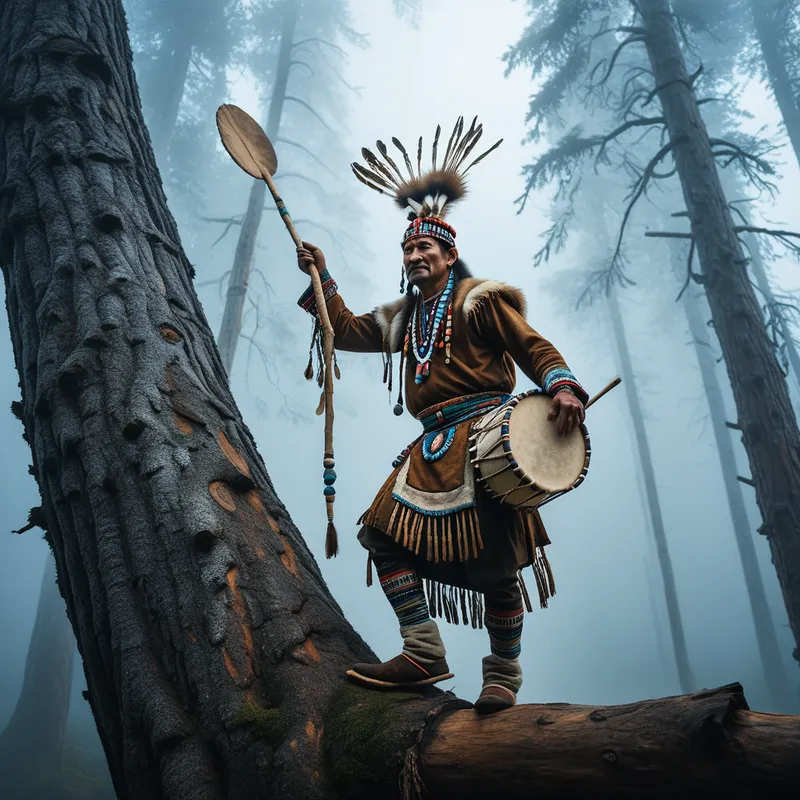
This was the ladder of the cosmos, the bridge of the soul. And upon it climbed the Shaman. He did not climb with hands and feet, but with the thunder of his drum—a heartbeat stolen from the world’s core. The drum was the hoofbeat of the Spirit Horse, carrying him upward from the smoky confines of the birch-bark tent, through the smoke-hole that was itself a symbol of the tree’s passage.
His journey was perilous. In the Lower World, among the roots, the Serpent of forgetfulness coiled, and the shadows of un-avenged ancestors reached with cold fingers. In the Middle World, clinging to the trunk, storms of human folly and sickness raged. And in the Upper World, among the highest branches, the great Sky Gods demanded proof of purpose, their gaze like the piercing light of the midday sun.
The shaman’s quest was always one of restoration. A soul stolen by a trickster spirit and trapped in a root-knot. A sickness sent as a curse from the world below. He would bargain, fight, plead, and sing. He would offer Sacrifice—not of blood, but of pride, of certainty. He would retrieve the lost piece of soul, capture it like a bird in the cage of his chant, and return. The descent was as dangerous as the ascent, for the pull of the other worlds was sweet and strong. But the drum called him back, down the great trunk, through the worlds, to the trembling body of the patient lying by the hearth. With a gasp, the shaman would return, the soul-piece restored, the cosmic balance momentarily healed. And the Tree stood, silent and eternal, having borne another journey, another story etched into its timeless bark.
Cultural Origins & Context
The World Tree is not a single, unified myth from a monolithic “Siberian” culture, but a profound cosmological concept shared across the diverse Indigenous peoples of Siberia—from the Altai and Buryat to the Evenki and Khanty. It was the central pillar of a shamanic worldview, a lived geography of the spirit. This myth was not merely told; it was performed. It was enacted in the dim light of the ritual tent, through the rhythmic drumming, chanting, and ecstatic dance of the shaman. The shaman was the myth’s living narrator and its protagonist.
The myth’s societal function was paramount: it was a map for navigating crisis. In a world where illness, misfortune, and ecological imbalance were seen as dislocations in the relationship between the human, natural, and spirit worlds, the World Tree provided the pathway for repair. It legitimized the shaman’s role as psychopomp and healer, and it offered the community a model of a universe that was interconnected, intelligible, and responsive to ritual action. The tree was often specifically envisioned as a great birch or larch, trees sacred in the Siberian landscape, thus rooting the infinite cosmos firmly in the local, tangible world.
Symbolic Architecture
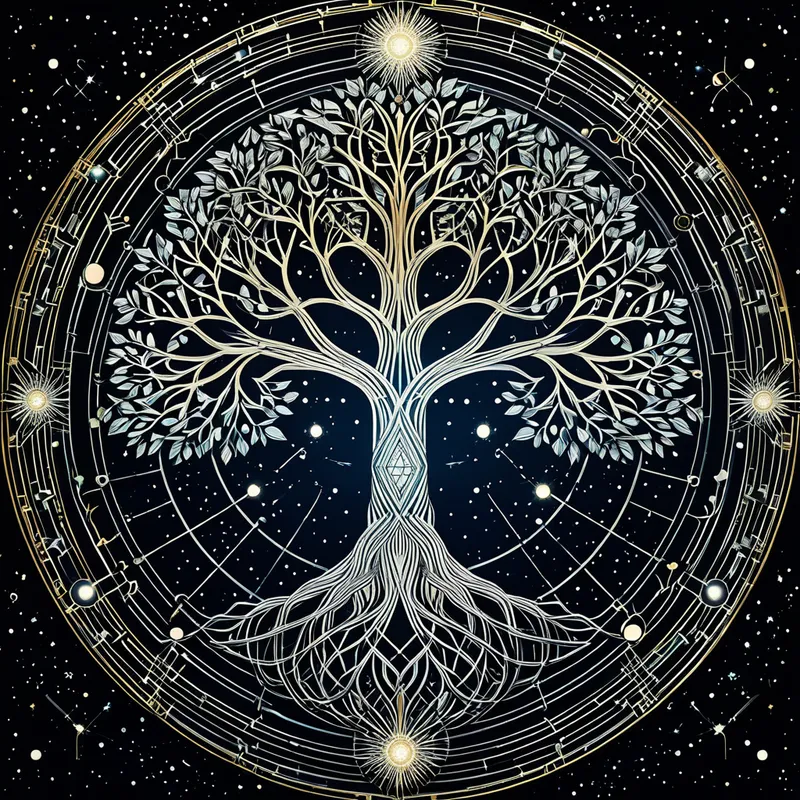
At its core, the World [Tree](/symbols/tree “Symbol: In dreams, the tree often symbolizes growth, stability, and the interconnectedness of life.”/) is the ultimate [symbol](/symbols/symbol “Symbol: A symbol can represent an idea, concept, or belief, serving as a powerful tool for communication and understanding.”/) of the [axis](/symbols/axis “Symbol: A central line or principle around which things revolve, representing stability, orientation, and the fundamental structure of reality or consciousness.”/) mundi. It represents the structuring principle of [reality](/symbols/reality “Symbol: Reality signifies the state of existence and perception, often reflecting one’s understanding of truth and life experiences.”/) itself—the vertical [dimension](/symbols/dimension “Symbol: Represents the fundamental structure of reality, consciousness, or existence beyond ordinary perception.”/) that orders [chaos](/symbols/chaos “Symbol: In Arts & Music, chaos represents raw creative potential, uncontrolled expression, and the breakdown of order to forge new artistic forms.”/) into the distinct yet connected realms of instinct (below), ego (middle), and [spirit](/symbols/spirit “Symbol: Spirit symbolizes the essence of life, vitality, and the spiritual journey of the individual.”/) (above).
The tree does not choose between its roots and its branches; it is the tension that holds them apart and the sap that makes them one.
Psychologically, the tree is the Self in its totality. The roots symbolize the unconscious—the deep, instinctual, and ancestral layers of the psyche, often perceived as dark or chthonic. The [trunk](/symbols/trunk “Symbol: The trunk in dreams typically denotes the core structure or foundation of one’s identity, values, or beliefs.”/) is the conscious ego and the [realm](/symbols/realm “Symbol: The symbol of ‘Realm’ often signifies the boundaries of one’s consciousness, experiences, or emotional states, suggesting aspects of reality that are either explored or ignored.”/) of lived experience. The branches represent the spiritual aspirations, higher ideals, and transpersonal potentials of the psyche. The [shaman](/symbols/shaman “Symbol: A spiritual mediator who bridges the human and spirit worlds, often through altered states, healing, and guidance.”/)’s [journey](/symbols/journey “Symbol: A journey in dreams typically signifies adventure, growth, or a significant life transition.”/) is the ego’s (the [shaman](/symbols/shaman “Symbol: A spiritual mediator who bridges the human and spirit worlds, often through altered states, healing, and guidance.”/)) daring [expedition](/symbols/expedition “Symbol: A purposeful journey into the unknown, representing exploration of the unconscious, life transitions, or quests for meaning.”/) into these other layers to retrieve vital [energy](/symbols/energy “Symbol: Energy symbolizes vitality, motivation, and the drive that fuels actions and ambitions.”/) (the lost [soul](/symbols/soul “Symbol: The soul represents the essence of a person, encompassing their spirit, identity, and connection to the universe.”/)) and restore wholeness. The [Serpent](/symbols/serpent “Symbol: A powerful symbol of transformation, wisdom, and primal energy, often representing hidden knowledge, healing, or temptation.”/) at the roots is not merely evil; it is the [guardian](/symbols/guardian “Symbol: A protector figure representing safety, authority, and guidance, often embodying parental, societal, or spiritual oversight.”/) of the deepest mysteries, the [resistance](/symbols/resistance “Symbol: An object or tool representing opposition, struggle, or the act of pushing back against external forces or internal changes.”/) that must be faced to gain transformative [knowledge](/symbols/knowledge “Symbol: Knowledge symbolizes learning, understanding, and wisdom, embodying the acquisition of information and enlightenment.”/).
The Dreamer’s Resonance
When this mythic pattern stirs in modern dreams, it often signals a profound process of psychic reorientation. To dream of climbing a vast, impossible tree is to feel the call to explore one’s own inner architecture. The somatic sensation is often one of ascent or precarious balance—a feeling in the dream body of effort, height, and exposure.
Dreaming of the roots may indicate a confrontation with repressed material, family patterns, or primal fears (the Shadow). It is a descent into the personal and collective basement. Dreaming of the branches reaching into starry skies suggests a yearning for meaning, guidance, or connection to something greater than the self. The dream may present helpers or obstacles in the form of animals (Wolf, Eagle) or elemental forces. Such dreams mark a phase where the psyche is attempting to integrate disparate levels of experience, often during times of life transition, spiritual crisis, or deep therapy.
Alchemical Translation
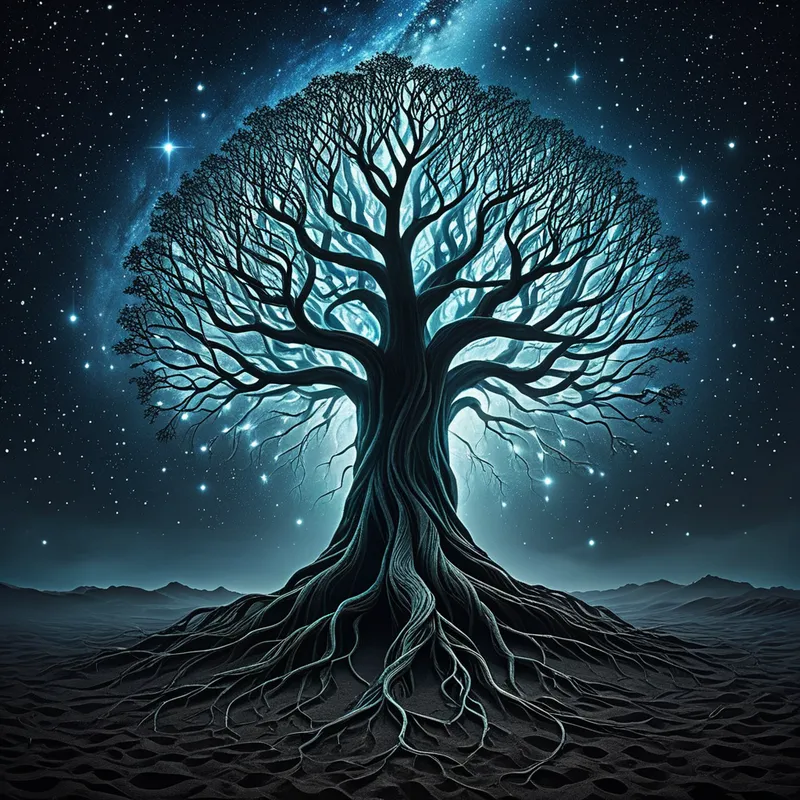
The myth of the World Tree is a perfect allegory for the Jungian process of individuation—the psychic transmutation of the base metal of a fragmented personality into the gold of an integrated Self. The shaman’s journey is the ego’s heroic task of venturing beyond its own dominion.
The process begins with a Call—an illness, a loss, a deep dissatisfaction (the stolen soul). The ego must consent to the Descent, navigating the dark waters of the personal unconscious (the Lower World). Here, one encounters and makes peace with the Serpent and ancestral ghosts. The subsequent Ascent is the struggle to assimilate this shadow material and connect it to a higher symbolic order (the Upper World), often mediated by encounters with archetypal figures (the Sage, the Goddess).
The treasure is never in one world alone; it is the circuit completed, the sap flowing from root to crown and back again.
The final and most critical stage is the Return. The modern individual must bring the retrieved insight—the “soul-piece”—back into ordinary life. This is the alchemical rubedo, the reddening, where the spiritual gold must be embodied in relationships, work, and community. Failure to return is spiritual inflation—becoming lost in the branches. The ultimate triumph is not residing in the Upper World, but becoming, like the Tree itself, a living conduit between all realms, grounded yet transcendent, a stabilized center in one’s own psychic universe.
Associated Symbols
Explore related symbols from the CaleaDream lexicon:
- Tree of Life — The Siberian World Tree is the primordial archetype of the Tree of Life, representing the interconnectedness of all existence and the flow of vitality through all planes of reality.
- Root — Symbolizes the deep, anchoring connection to the ancestral past, the unconscious, and the chthonic powers that nourish and challenge the soul’s growth.
- Journey — The shaman’s ascent and descent along the tree is the archetypal journey of the soul, a necessary passage through unknown realms to achieve healing and knowledge.
- Bridge — The World Tree functions as the ultimate bridge or ladder, spanning the impossible chasm between the divine, the human, and the underworld.
- Spirit — The entire myth is an engagement with the spirit world, with the tree as the central channel through which spiritual communication and exchange occur.
- Drum — The shaman’s drum is the vehicle for the journey, its rhythm the heartbeat of the World Tree itself, altering consciousness to travel the axis.
- Eagle — Often a spirit helper residing in the upper branches, the eagle represents the lofty perspective, spiritual vision, and messenger function between the gods and humanity.
- Serpent — The guardian of the roots and the underworld, representing the primal, instinctual wisdom that must be confronted and integrated for wholeness.
- Sacrifice — The necessary offering—of ego, comfort, or certainty—required to gain passage and favor from the powers of the other worlds along the tree.
- Rebirth — Each successful shamanic journey results in a symbolic rebirth, for the patient whose soul is restored and for the shaman who returns transformed.
- Shadow — The Lower World among the roots is the realm of the psychological shadow, where disowned parts of the self and ancestral legacies reside.
- Axis Mundi — This is the core function of the World Tree: the central pillar, the world navel, and the stabilizing axis around which the cosmos is ordered.