The World Tree Mongolian Myth Meaning & Symbolism
A sacred tree connects the three realms of existence, embodying cosmic order, ancestral wisdom, and the soul's journey through the Mongolian steppe.
The Tale of The World Tree Mongolian
Listen. Beyond the thunder of ten thousand hooves, beneath the eternal gaze of the Tengri, there stands a silence. It is the silence at the heart of the world. And in that silence grows the Tree.
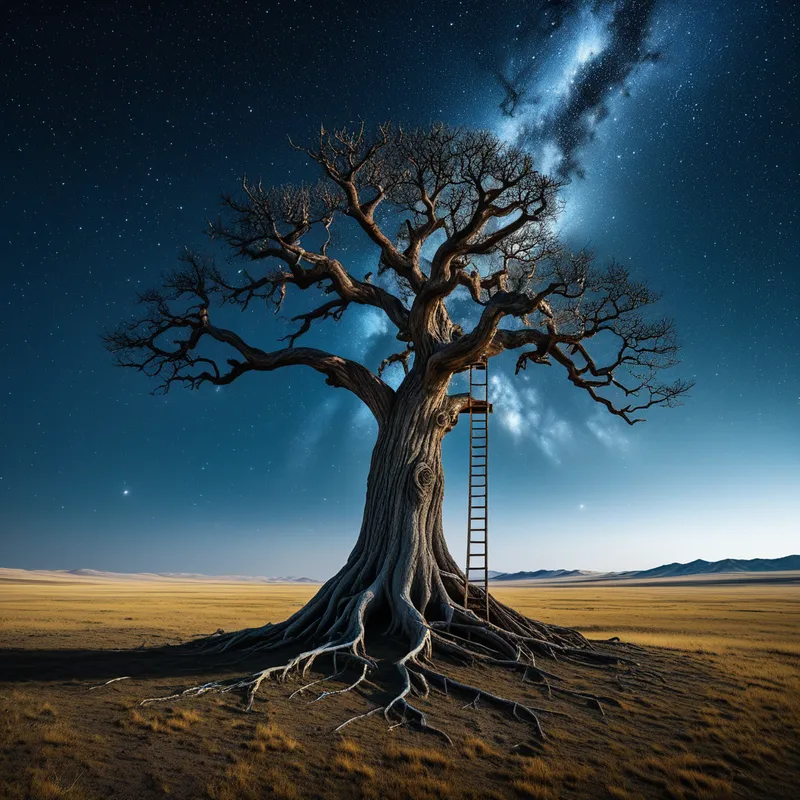
Its roots are not of wood, but of cold, patient iron, plunging deep into the dark womb of the earth, the realm of Eje. There, in the perpetual twilight, they drink from waters older than time, waters that remember the first song. From these roots rises a trunk that is the world’s pillar, a column of living stone and shimmering bark that pierces the world of the living—our world of wind-swept grass, galloping herds, and circling hawks.
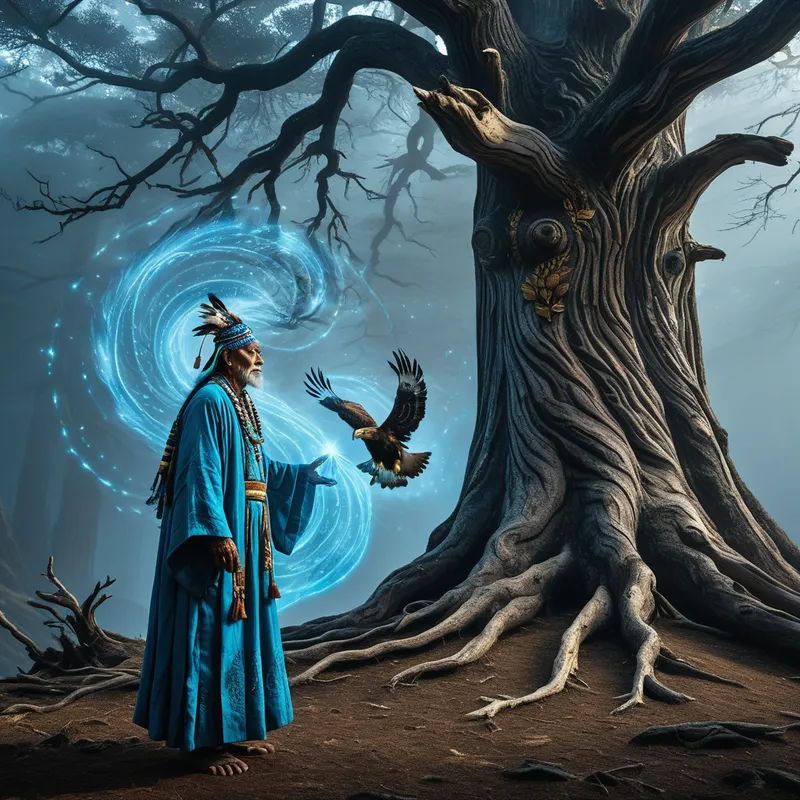
And its branches… ah, its branches are of molten silver, reaching ever upward. They do not merely touch the sky; they become the lattice upon which the Tengri pins the stars. Upon the highest branch, which never ceases its striving ascent, sits the sun during the day and the moon by night. An eagle, its feathers the color of polished obsidian, makes its nest here, its cry the sound of the wind before a storm.
This is the axis. This is the center that has no location, yet is everywhere the shaman’s drumbeat finds it. It is the ladder. Up its impossible height climb the souls of the pure, the brave, and the wise, ascending to the bliss of the eternal blue. Down its length flow the blessings of the ancestors and the will of the heavens, raining upon the earth as life-giving sun and timely rain. And through its very heart, coursing like a second sap, runs the destiny of all things—the connection of the below to the above, the past to the future, the one to the all.
No human hand planted it. No storm can break it. It simply is. The first thing and the last. The breath of the world given form. To know it is to know the order of the universe. To journey upon it is the task of a lifetime, and the destiny of the soul.
Cultural Origins & Context
This cosmic arboreal vision is not a singular, codified myth from a holy book, but a living, breathing layer of the Mongolian worldview, deeply intertwined with the ancient, animistic-shamanic tradition of Tengrism. It was not recited verbatim but evoked—in the rhythmic pulse of the shaman’s drum, in the patterns of felt appliqué on a ger, in the epic songs (tuuli) of heroes who travel between worlds.
The tellers were the böö (shamans), the community’s psychopomps and healers. For them, the World Tree was not a metaphor but a spiritual geography, a map used for their ecstatic journeys. By drumming, they would ascend its branches to petition the sky gods for good fortune or descend its roots to retrieve lost souls or negotiate with the spirits of the underworld. The myth’s function was profoundly practical: it explained the structure of the cosmos, validated the shaman’s role, and provided a model for harmony. It taught that human life exists in a delicate balance between the forces of the upper, middle, and lower worlds, and that spiritual and ecological equilibrium depends on respecting this vertical axis.
Symbolic Architecture
The World Tree is the ultimate symbol of the axis mundi—the world axis or cosmic pillar. It is the central point around which reality organizes itself, the still point in the turning world.
The tree is not in the landscape; the landscape, and indeed the cosmos, exists within the tree. It is the primordial template of connection.
Psychologically, it represents the structure of the psyche itself. The roots delve into the collective unconscious, the dark, fertile soil of instincts, ancestral memory, and archetypal patterns (the realm of Eje). The trunk is the conscious ego, the “I” that stands in the daylight world of reality and personal identity. The branches reach toward the spiritual or transpersonal unconscious—the realm of ideals, higher meaning, and the Self (the realm of Tengri). The eagle represents the soaring spirit, the capacity for transcendent vision that can see the whole pattern from above.
The iron roots speak of an unbreakable connection to the foundational, often hard truths of our nature and history. The silver branches reflect the refinement of raw experience into wisdom and spiritual insight. The tree does not choose between heaven and earth; it is the necessary conduit between them, insisting that wholeness requires acknowledging every level of existence.
The Dreamer’s Resonance
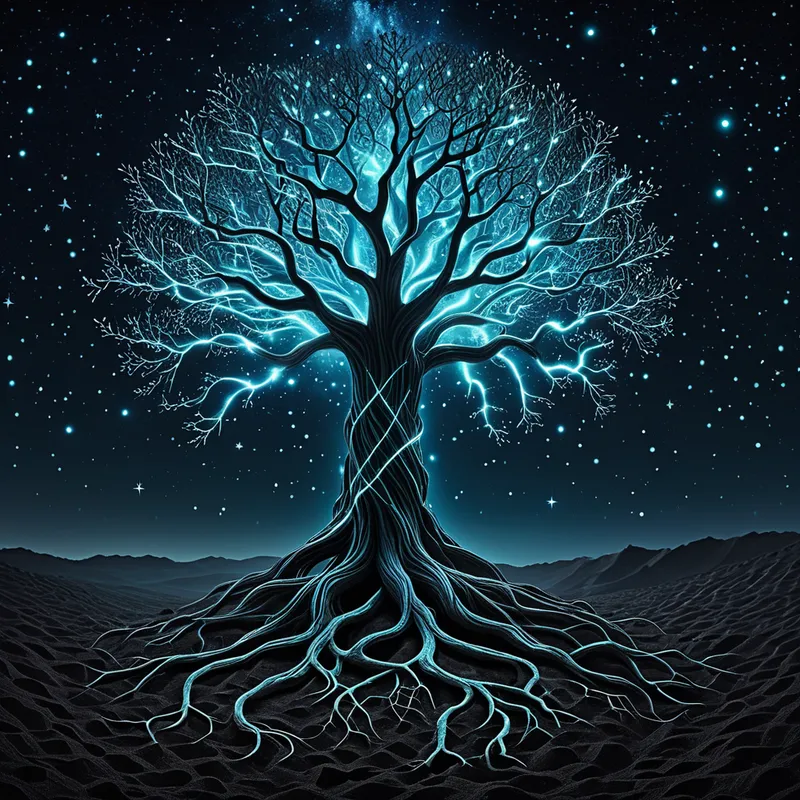
When this archetype stirs in the modern dreamer, it often signals a profound reorientation of the psyche. One may not dream of a literal Mongolian tree, but of a towering skyscraper with roots in subway tunnels, a brilliant neural network glowing in darkness, or a family tree whose branches pierce the clouds.
Such dreams emerge during life transitions where one feels ungrounded (rootless) or spiritually adrift (branchless). The somatic sensation is often one of vertical tension—a feeling of being stretched between a deep, gravitational pull downward (into depression, regression, or the past) and an aspirational pull upward (toward ambition, spirituality, or the future). The psyche is attempting to re-establish its own axis mundi, to find its core pillar of meaning and stability amidst internal or external chaos.
To dream of climbing the tree is to engage in active individuation. To dream of its roots breaking through your floor is to confront the undeniable power of the unconscious.
The dream presents the tree as a task: to consciously inhabit the trunk—your present, embodied life—while honoring the depths that feed you and the heights that call you, without being torn apart by either.
Alchemical Translation
The myth models the alchemical process of psychic transmutation—the individuation journey—with elegant clarity. The goal is not to escape to the heavens or to remain buried in the earth, but to become the fully realized tree: a being that integrates all three realms.
The initial stage often feels like a descent to the roots: confronting the “iron” of one’s personal and ancestral shadow, the repressed grief, shame, or primal fears (the underworld). This is the nigredo, the blackening, essential for grounding. From this dark nourishment, consciousness (the trunk) is strengthened and given substance.
The conscious work in the middle world is the albedo, the whitening—the clarification of the ego and its values in the clear light of day, on the open steppe of one’s life. Finally, the ascent toward the branches is the rubedo, the reddening or golden dawn, where the insights gained below are synthesized into a higher, guiding wisdom. The silver of the branches symbolizes this refined, conscious connection to the transpersonal Self.
The shaman’s journey up and down the tree is the psyche’s perpetual motion of introspection (descent) and inspiration (ascent). Wholeness is in the circulation, not in permanent residence at any single point.
For the modern individual, this means the courage to explore one’s deepest complexes and family patterns (the roots), to build a resilient and authentic life in the world (the trunk), and to consciously relate to one’s sense of purpose, ethics, and connection to something greater (the branches). The myth teaches that healing, wisdom, and identity are found not in isolation, but in becoming a living bridge between all parts of one’s being.
Associated Symbols
Explore related symbols from the CaleaDream lexicon:
- Tree of Life — The universal archetype of the axis mundi, of which the Mongolian World Tree is a powerful, culturally-specific expression, representing the interconnectedness of all life and realms.
- Root — Symbolizes the deep, often unseen connection to the ancestral past, the collective unconscious, and the foundational instincts and memories that nourish the conscious self.
- Eagle — Represents the soaring spirit, transcendent vision, and the ability to ascend to the heights of consciousness to gain a panoramic understanding of one’s life path.
- Mountain — Like the World Tree, it serves as a natural axis mundi, a meeting point between heaven and earth, symbolizing a challenging but sacred ascent toward enlightenment or clarity.
- Sky — The realm of Tengri, representing the transpersonal, the divine, higher consciousness, and the ultimate destination of the soul’s aspiration.
- Earth — The realm of Eje, symbolizing the grounding, material world, the body, nature, and the fertile darkness of the unconscious from which all growth emerges.
- Shaman — The human embodiment of the tree’s function, the mediator who travels between roots and branches to restore balance, representing the psyche’s own integrative capacity.
- Journey — The core narrative of the myth is a vertical journey through the realms of being, mirroring the internal process of psychological exploration and integration.
- Bridge — The World Tree is the ultimate psychic bridge, connecting the conscious and unconscious, the personal and transpersonal, enabling dialogue and exchange between disparate parts of the self.
- Axis Mundi — The central, ordering principle of the cosmos and the psyche; the World Tree is its quintessential symbol, providing stability and meaning by connecting all levels of reality.
- Spirit — The invisible force that animates the tree and travels upon it; represents the non-material essence of life, consciousness, and ancestral presence that flows through the axis of existence.
- Star — The celestial bodies pinned upon the silver branches, representing destiny, guidance, and the luminous points of insight that emerge from connecting to the higher Self.