The World Tree Myth Meaning & Symbolism
A sacred tree connects all worlds; a hero's perilous journey through its roots and branches reveals the price of wisdom and the unity of all existence.
The Tale of The World Tree
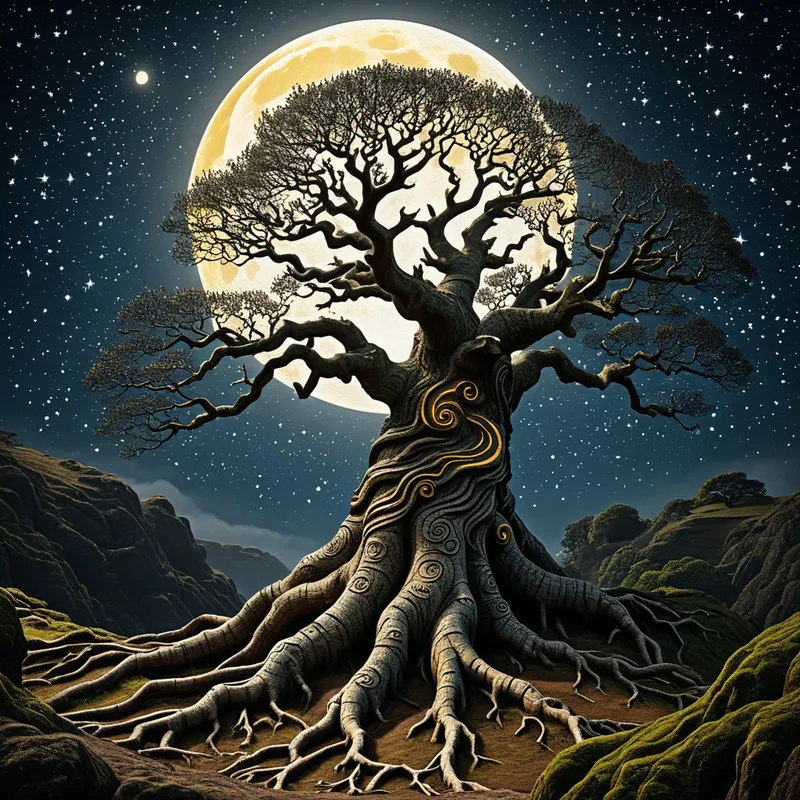
Listen. Before the memory of stone, before the naming of rivers, there stood the Tree. It was not born of seed, but of the first breath that separated the Otherworld from the world of flesh. Its roots, thicker than the coils of the great serpent, plunged deep into the Annwn. There, in the cool, silent dark, they drank from wells of memory and dream, where the faces of all who ever were and ever might be shimmered in the black water.
Its trunk, a pillar of weathered oak and silver birch fused as one, rose through the Middle Realm, our world of green hills and sighing winds. Its bark was a living map—whorls and spirals told of kingship and catastrophe, of battles fought and treaties sworn beneath its boughs. Animals of every kind found sanctuary in its hollows, and the air around it hummed with the song of bees and the whispers of the Sidhe.
And its branches… ah, its branches reached into the upper realms, where the stars are nailed to the vault of the sky. Among its highest limbs rested the silver cup of the moon and the golden wheel of the sun. An eagle of piercing sight kept watch from the crown, while in the roots, a great salmon of wisdom swam in the deepest pool.
But knowledge of the whole—the taste of the water from the root, the understanding of the speech of the eagle, the vision that sees all three worlds as one—this was not given. It was won. A seeker, a fili or a hero marked by fate, would come. They would stand before the Tree, feeling the immense pull of the depths and the dizzying call of the heights. To gain its wisdom, they could not climb. They had to descend.
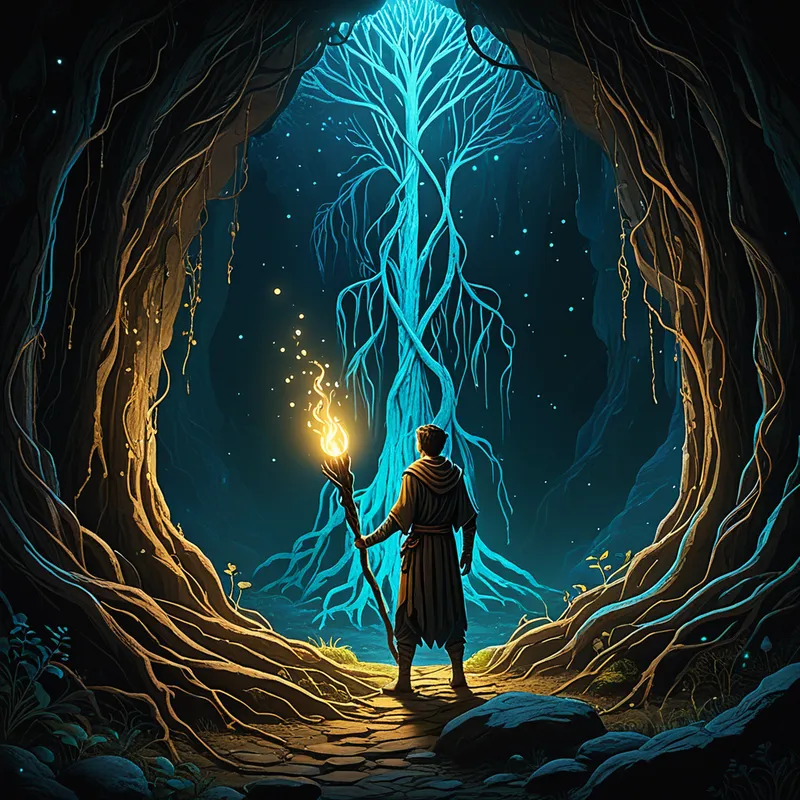
Leaving the sun behind, they would enter the cavern where the greatest root breached our world. The air would grow cold and thick. The light would come not from fire, but from the faint, phosphorescent glow of fungi and the pulsing veins of crystal in the earth. Guardians would stir—shadowy hounds with eyes like coals, the ancient horned god of the wild wood, the Morrígan in one of her myriad forms. The seeker would have no weapon but their intent, no shield but their truth.
If their heart held pure purpose, not for power but for understanding, the roots would part. They would journey through the labyrinth of the underworld, past the silent hosts of ancestors, to the very source: the Well of Segais. There, the salmon of wisdom swam, and nine sacred hazel trees dropped their nuts into the water, imbuing it with all knowledge.
To drink was to see the pattern of all things—the sorrow in joy, the death in birth, the love in wrath. It was a crushing, glorious burden. The seeker would return, not by the path they came, but through the Tree itself, feeling its sap as their blood, its rings as their years, its reaching as their soul. They would emerge, forever changed, their eyes holding the darkness of the root and the light of the highest star. They became the living bridge, the human embodiment of the axis mundi. The Tree’s story was now theirs to tell, in whispers that made the stones listen.
Cultural Origins & Context
The Celtic World Tree was never a single, codified myth like the Norse Yggdrasil. It is a pervasive, implicit archetype reconstructed from fragments—the veneration of specific trees (the oak, the yew, the ash), the symbolic logic of early Irish literature, and the cosmological insights of the Druidic tradition. This was an oral culture; its deepest truths were not written but woven into the landscape and recited in ritual.
The myth lived in the sacred groves, the nemeton, where rituals were performed. It was told by the fili to explain the structure of reality: a tripartite cosmos of Land, Sea, and Sky (or This World, the Otherworld, and the Upper World) held together by a central, connective axis. This axis was often imagined as a tree, a pillar, or a great chieftain whose rightful rule maintained cosmic order. The tale of a hero like Fionn mac Cumhaill gaining wisdom from the Salmon of Knowledge in the River Boyne (a terrestrial echo of the underworld well) is a clear narrative fragment of the World Tree pattern—the descent to the watery source of wisdom.
Its societal function was profound. It provided a model of sacred kingship, where the rightful king was metaphorically “married” to the land and served as its human pillar. It explained the source of poetic inspiration (imbas), seen as a tapping into the nourishing sap flowing from the Otherworld roots. Most importantly, it offered a map of the soul’s journey, teaching that true wisdom and power come not from domination, but from a perilous, humble engagement with the unseen depths that support the visible world.
Symbolic Architecture
The World Tree is the ultimate symbol of the interconnected self. It represents the psyche in its full, vertical dimension.
The roots are not buried in dirt, but in the dark water of the unconscious—the personal and collective past, our forgotten memories, our instincts, and the chaotic soup of potential from which all form emerges.
The trunk is the ego, the conscious “I” that stands in the daylight world, shaped by experience (the rings), tasked with mediating between the depths and the heights. The branches are the spirit, our aspirations, ideals, and connection to the transpersonal—the patterns of fate, the gods, the realm of abstract meaning and cosmic order.
The perilous descent into the roots is the critical symbolic action. It inverts the common heroic impulse to ascend and conquer.
To seek wisdom, one must first be humbled, must confront the shadowy guardians of one’s own depths—the repressed fears, the ancestral wounds, the raw, untamed instincts symbolized by the hounds and the horned god.
The Well of Segais is the coniunctio oppositorum, the union of opposites: the hazelnuts (symbolizing concentrated wisdom from the upper world) fall into the dark water (the unconscious), and are consumed by the Salmon (the guiding, instinctive wisdom of the deep self). To drink this water is to achieve a moment of psychic integration, where conscious knowledge and unconscious knowing merge. The seeker becomes the living axis, no longer identified solely with the trunk of ego, but embodying the full circuit of the Tree.
The Dreamer’s Resonance
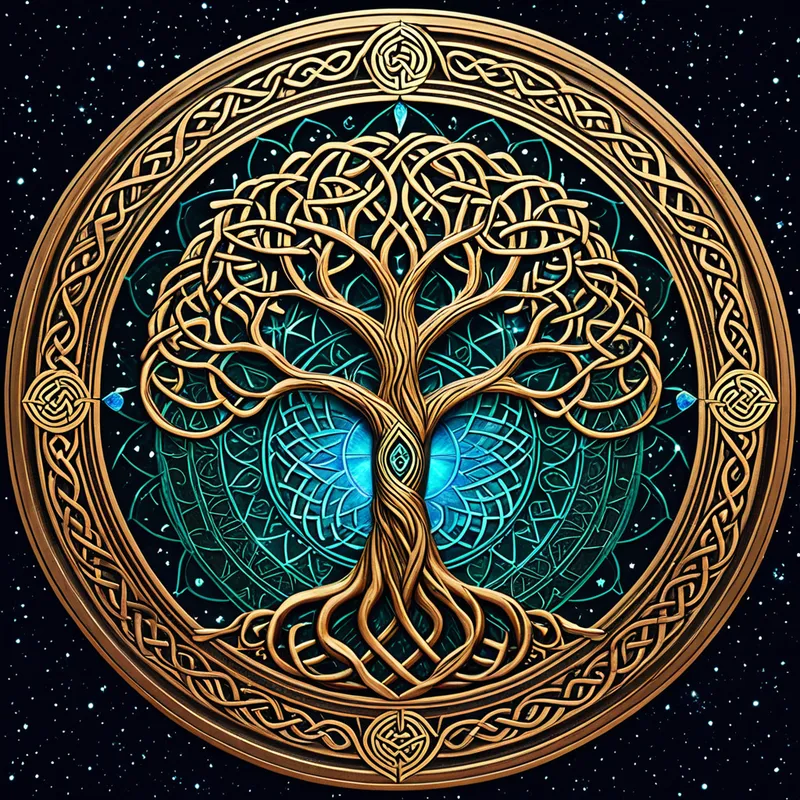
When the World Tree appears in a modern dream, it signals a powerful process of psychic reorientation. The dreamer is being called to acknowledge the full scale of their being.
Dreaming of climbing the Tree might speak to a striving for spiritual transcendence or intellectual achievement, but often with a warning of becoming ungrounded. Dreaming of the roots, however—especially finding oneself in caverns, tunnels, or cellars that are strangely alive with wood or water—points directly to active engagement with the unconscious. This is the somatic signal of descent. The dreamer may feel anxiety, cold, or pressure, mirroring the psychological weight of confronting what has been buried.
A dream where the Tree is dying or sick often reflects a felt disconnection in the dreamer’s life—a sense that their daily existence (the trunk) has lost contact with both its foundational purpose (the roots) and its aspirational meaning (the branches). It is a call to nourish the depths through introspection and to tend to the heights through creativity or contemplation.
Conversely, dreaming of becoming the Tree, feeling roots grow from one’s feet into the earth and branches from one’s hands into the sky, is a profound experience of individuation in progress. It embodies the realization of being a conduit between the personal and the cosmic, the mortal and the eternal. The body itself becomes the myth.
Alchemical Translation
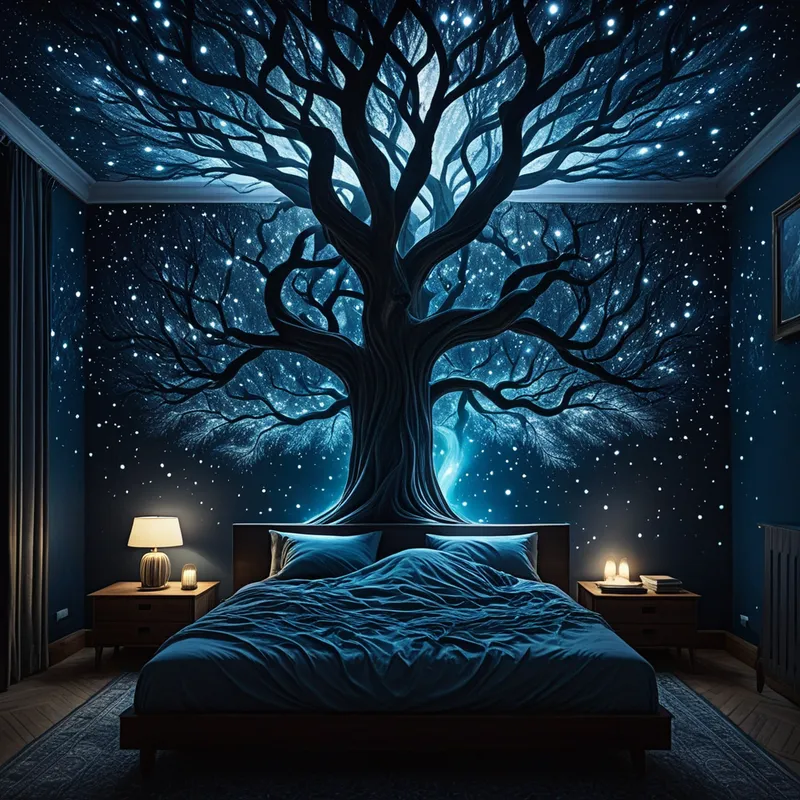
The alchemical process mirrored in the World Tree myth is the opus contra naturam—the work against nature, which here means against our natural, ego-centric tendency to seek light and avoid darkness. The psychic transmutation is from a state of fragmented identification (seeing oneself only as the trunk) to a state of wholeness as the mediating axis.
The descent is the nigredo, the blackening. It is the necessary dissolution of the ego’s certainty as it enters the chaotic, fertile darkness of the unconscious. The confrontation with guardians is the engagement with the shadow and the anima/animus—those inner figures that both terrify and hold the keys to deeper life.
The moment at the Well is the albedo, the whitening, where the distilled essence of wisdom is extracted from the union of opposites. It is insight, the flash of lucidity that comes only after the struggle in the dark.
The return, the integration of this knowledge into the fabric of the conscious personality, is the rubedo, the reddening. The seeker does not return as a mere human with a secret, but as a transformed being whose very substance has been altered by the journey. Their “red gold” is a wisdom that is embodied, humbled, and life-giving. They carry the Tree within.
For the modern individual, this myth models the journey of depth psychology. It insists that healing, creativity, and true sovereignty are not found in positive thinking alone, but in the courageous, respectful descent into one’s own historical and psychic underworld. One must drink from the well of one’s own pain, memory, and forgotten potential to become a true vessel of wisdom. The goal is not to escape the human condition, but to become its most conscious, connected expression—to stand, like the Tree, rooted in darkness, resilient in the world, and forever reaching for the light.
Associated Symbols
Explore related symbols from the CaleaDream lexicon:
- Cypress Knees
- Spreading Birch
- Giant Cross
- Maple Tree
- Oak Root
- Preposition
- Node
- Microcosm of Insects
- Outdoor Swing
- Sleek Entertainment Center
- Swing Set
- Propositional
- Rutilated Quartz
- Tree Branches as Veins
- Horticulturist’s Seed Packets
- Stretching Charging Dock
- Bass Guitar Vibes
- Celestial Shrines
- Wind-Borne Seeds
- Thermosphere
- Mythic Symbol
- Layered Sediment