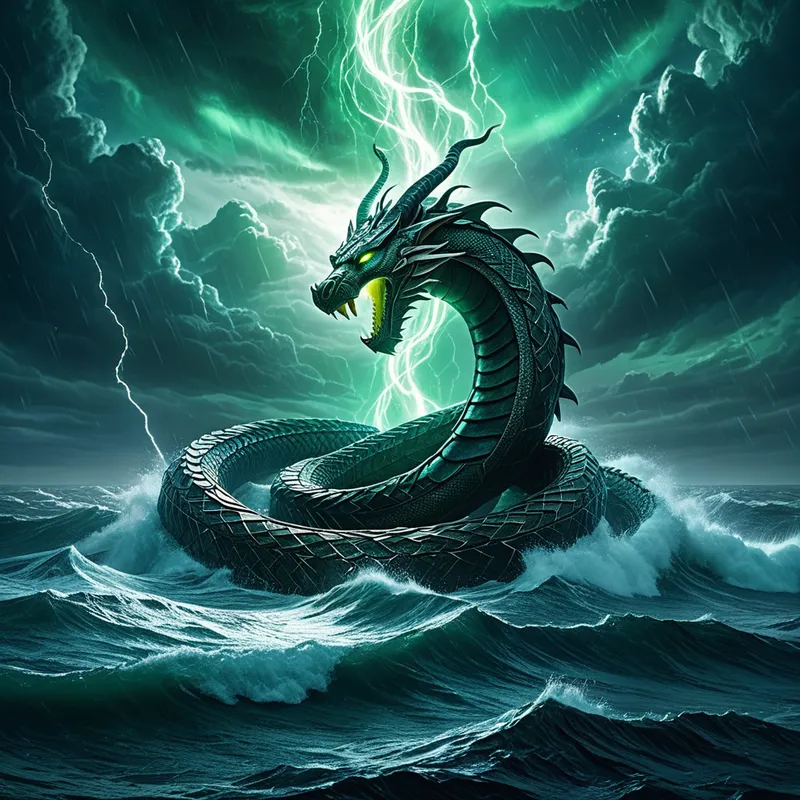
The World Serpent, Jörmungandr Myth Meaning & Symbolism
The monstrous serpent cast into the sea, destined to encircle the world and battle Thor at the twilight of the gods.
The Tale of The World Serpent, Jörmungandr
Hear now a tale of the deep, of the cold salt-sea that gnaws at the roots of the world. In the dawn of days, when the Jötnar walked the steaming rims of creation, the All-Father Odin looked upon three children born of the trickster Loki and the giantess Angrboða. One was a wolf whose growls shook the mountains. One was a girl, half-corpse, half-living queen. And the third… the third was a serpent.
It was not a serpent of the grass or the stone. From its first breath, it grew, and grew, and did not cease. Its scales were dark as polished basalt, its eyes twin pools of primordial malice. It hissed, and the very air curdled. Seeing this unbounded threat, Odin acted. With a mighty heave, he seized the coiling horror and cast it from the high halls of Asgard. Down, down it fell, through the void of Ginnungagap, until it struck the outer ocean that rings the lands of mortals, Midgard.
The impact sent tidal waves crashing against the shores. The serpent sank into the abyssal dark, into the crushing pressure of the world-sea. And there, in the cold and the black, it grew. It stretched its length, coiling tail to mouth, until it formed a perfect, monstrous circle around all the lands of men. Jörmungandr had become the boundary of the known world, the living limit, biting its own tail in an endless loop of contained fury.
Its sleep was not peace. Its stirrings were the earthquakes that split the land, its breath the tempests that drowned fleets. And it waited. It waited for the one whose destiny was knotted with its own: the thunderer, Thor.
Their first meeting was a ruse. The giant Útgarða-Loki challenged Thor to lift a cat. Grinning, the god thrust his hands beneath its belly and heaved. The heavens trembled. The earth groaned. He lifted one paw, and only one, for the cat was Jörmungandr in disguise, and to raise it fully would have unbound the world.
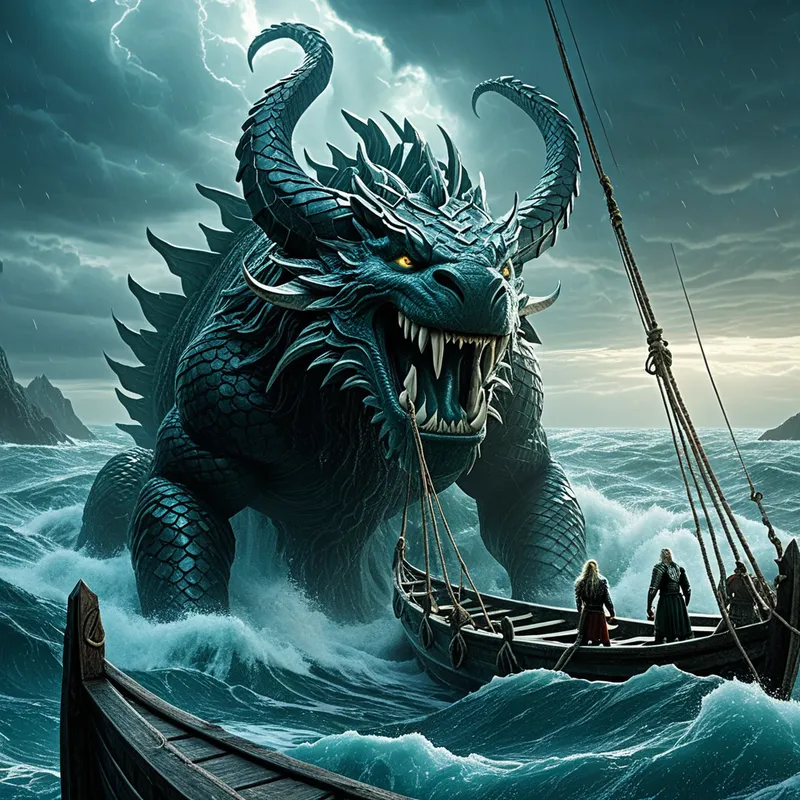
Their second meeting was a hunt. Thor, disguised, went fishing with the giant Hymir. For bait, he took the head of the greatest ox. He rowed to where the sea grows old and dark, cast his line, and felt a pull that nearly sundered the boat. With a roar that split the sky, Thor planted his feet on the ocean floor—the sea foaming at his waist—and hauled. Up came the monstrous head, eyes like dying stars, jaws wide enough to swallow the sun. The venom dripped, sizzling on the waves. In that moment, serpent and god beheld their doom in each other’s gaze. As Thor raised his hammer, Hymir, in terror, cut the line. The serpent sank back into the deep, leaving only a vortex of hatred and the certainty of a final, third meeting.
For the third meeting is written in the runes of fate. At Ragnarök, when the bonds of all things break, Jörmungandr will writhe from the ocean, poisoning sky and sea. Thor will come, lightning in his eyes, and they will fight their last battle. The god will slay the serpent, staggering nine paces before falling, drowned in the Serpent’s venom. Bound at birth, they are bound in death: the keeper of order and the force of chaos, ending each other, ending the world, so a new one may be born from the silence that follows.
Cultural Origins & Context
This myth survives primarily in the Poetic Edda and the later Prose Edda, texts compiled in Christianized Iceland centuries after the Viking Age. They are echoes of a deeper, older oral tradition. These stories were not mere entertainment; they were the metaphysical bedrock of a culture living at the mercy of a capricious natural world. The sea, for the Norse, was both highway and grave, a source of bounty and a yawning abyss. Jörmungandr is the personification of that abyss—the chaotic, annihilating power that surrounds the fragile island of human civilization (Midgard).
The myth was likely told in halls smoky with firelight, a way to give shape and story to the existential dread of the open ocean, of earthquakes, and of inevitable cataclysm. It functioned as a cosmological map, explaining why the world had limits and what forces pressed against them. More importantly, it framed existence itself as a temporary containment of chaos, a heroic but doomed act of ordering, with courage measured by one’s willingness to face the inevitable, encircling shadow.
Symbolic Architecture
Jörmungandr is not merely a monster. It is a profound symbolic entity, an embodiment of the uncontained, the unconscious, and the cyclical nature of existence itself.
The serpent that bites its own tail is the perfect symbol of a system with no outside, a closed loop of cause and effect, of creation and destruction contained within one form.
Psychologically, Jörmungandr represents the Shadow in its most vast and impersonal form. It is not just an individual’s repressed traits, but the collective, archetypal chaos that underlies all psychic order. Odin’s act of casting it into the sea is the ego’s necessary, foundational act: pushing the unbearable, the too-large, the formless aspects of existence out of conscious awareness to create a habitable inner world (Midgard). Yet, by encircling the world, the Shadow does not disappear; it defines the very boundaries of the self. We live inside the circle of our own repression.
The serpent’s venom symbolizes the corrosive, disintegrating power of unintegrated psychic material—bitterness, rage, envy—that, if unleashed, pooses the entire system. Thor’s battles with it represent the ego’s (Thor as the conscious, assertive principle) repeated, necessary, yet ultimately incomplete struggles to overcome or control the unconscious. He can challenge it, even wound it, but he cannot finally eliminate it without destroying himself and his world.
The Dreamer’s Resonance
When the image of the World Serpent surfaces in modern dreams, it signals a profound encounter with the personal or collective Shadow at a systemic level. This is not a dream of a small snake in the grass, but of something vast, oceanic, and world-encompassing.
The dreamer may feel a somatic sense of immense pressure, of being encircled or constrained by a force too large to comprehend. They may dream of tidal waves, of the ground shaking, or of looking out at a horizon that is itself a coiled, living entity. This often coincides with life periods where foundational structures—a career, a relationship, a core identity—feel threatened from their very roots. The serpent’s stirrings in the deep mirror the uprising of long-buried fears, rages, or needs that the psyche can no longer keep submerged. The dream is an announcement: the containing circle is under stress. The unconscious is rising to meet consciousness, and a great reckoning, a personal Ragnarök, may be brewing.
Alchemical Translation
The myth of Jörmungandr models a critical, if terrifying, phase of individuation: the confrontation with the Self as a system that includes its own annihilation. The alchemical goal is not to slay the serpent, but to integrate its reality.
The ultimate psychic transmutation occurs when we realize that the circle which constrains us is also what holds us together, and that the poison is a potential medicine in unbearable concentration.
The first step, Odin’s casting out, is necessary for consciousness to form. But the mature work is Thor’s fishing trip: the conscious ego (Thor) must voluntarily venture into the deep (the unconscious), with great strength and sacred bait (a sincere offering of attention), to deliberately engage the Shadow. The moment of eye-contact—of mutual recognition between god and serpent—is pivotal. It is the moment of seeing the Shadow not as a foreign monster, but as one’s own fate, one’s own twin in destiny.
The failed kill is instructive. The ego cannot “solve” or eliminate the Shadow. To do so is psychic death. The work is in the hauling, the seeing, the enduring of the gaze. The venom that kills Thor at Ragnarök is the final, total acceptance of the Shadow’s power—a death of the old, heroic ego that believed it could rule without cost. This “death” is the prerequisite for rebirth. To integrate Jörmungandr is to accept that chaos, limitation, and destructive potential are intrinsic parts of the whole Self. We become, like the serpent, a complete circle. We contain our own beginning and our own end, and in that containment, find a terrifying, oceanic wholeness. The world that ends is the world of illusion; the one that emerges from the waves is built on the truth of what we have finally dared to see.
Associated Symbols
Explore related symbols from the CaleaDream lexicon: