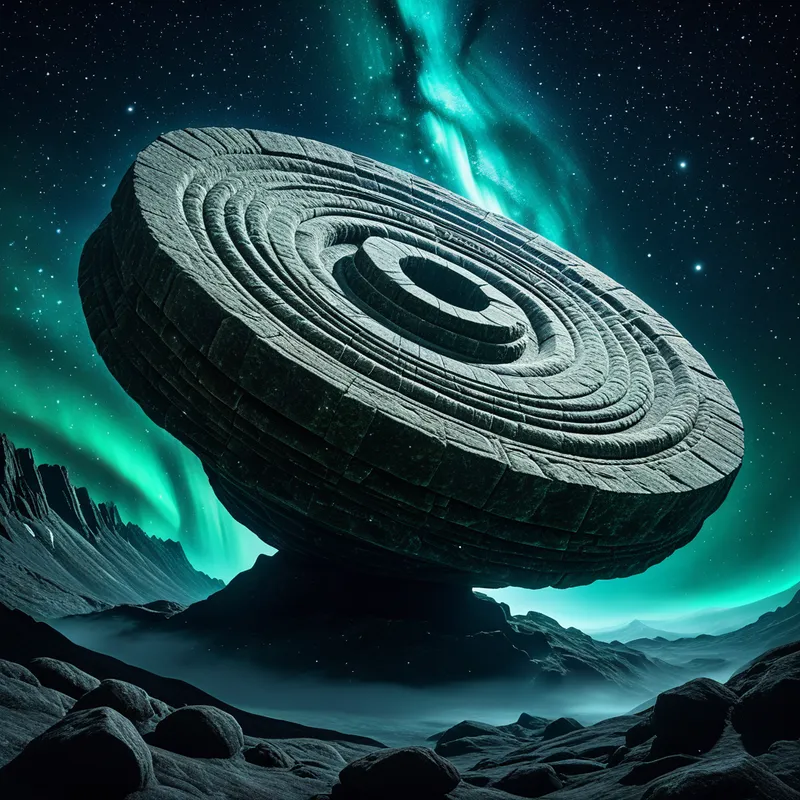
The World Mill Myth Meaning & Symbolism
A cosmic millstone grinds the substance of reality, a myth of order, chaos, and the soul's necessary disintegration for renewal.
The Tale of The World Mill
Hear now, a tale not of a single hero’s might, but of a grinding, a turning, a groaning that is the very heartbeat of the world. In the time before memory, when the bones of the earth were still soft, there existed a mill. Not a humble thing for grain, but a titan of stone and magic, its name whispered on the winds of fate: Grotti.
It was crafted by hands unseen, a wheel of destiny set deep within the roots of the world. And to turn it, the gods required strength beyond even their own. They took two maidens from the race of Jotnar, Fenja and Menja, sisters of immense power and sorrow. Their arms were like oak roots, their spirits like the deep sea. They were set to the mill’s handle, and the god-king Odin commanded them: “Grind. Grind not meal, but grind wealth, grind peace, grind fortune for my hall.”
And so they ground. The great stone of Grotti turned, and from its core flowed gold, abundance, and the sweet music of contentment for the god Frey</. The sisters toiled, their song a lament woven into the grindstone’s hum. But the greed of men is a poison. Their master, the king Fródi, would grant them no rest. “Grind longer! Grind more!” he demanded, forgetting the balance of all things.
Exhaustion turned to fury. The song of Fenja and Menja changed. No longer a lament for lost home, but a chant of awakening rage. “We have ground long enough for Frodi’s greed,” they sang, their voices shaking the earth. “Let us grind now what we will!” And they turned the mill’s purpose. No longer gold, but an army. They ground out a host of warriors, led by the sea-king Mysing, who came in the night and brought fire and blood, ending Frodi’s reign.
But the mill, once awakened to its true power, could not be stilled. Mysing took it aboard his ship, and commanded the sisters to grind salt, for it was precious. And grind they did, with a fury unbound. They ground until the ship sank under the weight of salt, and the mill, Grotti, fell into the grey embrace of the sea. There, at the bottom of the ocean, it grinds on eternally. Its turning churns the currents, its groan is the tide, and the salt it endlessly produces is the very salt of the sea. And it is said that this grinding, this eternal motion at the world’s root, is what holds the great serpent Jörmungandr in place, lest it shake the foundations of Midgard loose.
Cultural Origins & Context
The myth of the World Mill is not found in a single, tidy narrative like those in the Prose Edda. Instead, its fragments are scattered like mill-dust across the poetic tradition. The primary source is the Grottasöngr or “Song of Grotti,” a powerful poem preserved in the Codex Regius. This poem gives us the poignant story of the giantesses Fenja and Menja. The broader concept of the mill as a cosmic axis, however, is inferred from kennings (poetic metaphors) and later folklore that speaks of a veraldarmylna or “world-mill” causing the ocean’s whirlpools.
This was a myth told not to explain simple origins, but to articulate a profound cosmological principle. In the skalds’ verses and the fireside tales, it modeled a universe in constant, laborious motion. The mill was operated by the socially marginal yet cosmically central figures—the giantesses—reflecting a deep understanding that the forces maintaining order are often outsourced, enslaved, or taken for granted until they rebel. The myth served as a warning against unsustainable greed and a meditation on the hidden, grinding machinery behind apparent peace and prosperity.
Symbolic Architecture
At its core, the World Mill is the archetypal symbol of process itself. It is not a static object but an eternal action: the act of grinding, of reducing wholes to parts, of transforming one substance into another. It represents the necessary friction that generates reality.
The cosmos is not a static creation but an ongoing grinding. Order is not a given; it is milled, moment by moment, from the raw flour of chaos.
The millstone is the wheel of time and fate, the axis mundi around which the worlds turn. The two giantesses, Fenja and Menja, embody the dual forces required for this work: endurance and explosive change, service and revolution. Their initial grinding of peace and gold represents the civilized, ordered output of nature’s raw power. Their rebellion and grinding of salt—an element both preservative and corrosive, essential and barren—signify the moment the process escapes human control and reverts to a pure, elemental, and endless state.
The final resting place of Grotti at the bottom of the sea is its most potent symbolic home. The sea is the collective unconscious, the realm of Loki and his monstrous children. The mill’s eternal grinding there is the subconscious, psychic activity that structures our perceived reality. It churns out the “salt” of experience—the bitterness, wisdom, and essential flavor of life—and in its motion, it pins in place the world-serpent, the latent chaos that forever threatens to unravel all things.
The Dreamer’s Resonance
When the image of the World Mill surfaces in modern dreams, it rarely appears as a literal Norse artifact. Instead, the dreamer may find themselves in a vast, subterranean factory with immense, slow-moving gears. They may be tasked with operating a machine whose purpose is obscure but feels vitally important, or they may be part of the machinery, feeling their own bones grind. They may dream of whirlpools, of circular motions that feel both inevitable and exhausting.
This is the psyche signaling a profound process of psychic grinding. The somatic feeling is often one of deep pressure, weight, and relentless cyclical movement. Psychologically, it indicates that the dreamer is in the midst of an essential but arduous disintegration. Old structures of identity, belief, or trauma are being slowly, methodically broken down. It is not the dramatic battle of the Ragnarök archetype, but the slow, pre-dawn work of the soul. The dream asks: What are you grinding? Are you, like Frodi, grinding for an insatiable greed that will lead to your downfall? Or are you, like the giantesses, finding the power to redirect the grind toward a necessary, if cataclysmic, liberation?
Alchemical Translation
The journey of the World Mill within the individual is the alchemical process of solve et coagula—dissolve and coagulate. The first stage, the grinding under the master’s command, is the ego’s initial, often coerced, engagement with the work of individuation. We grind out what society or our inner “king” demands: success, persona, stability. But this is unsustainable.
The rebellion of the giantess within is not the end of the work, but its true beginning. It is the moment the psyche reclaims the mill-handle for its own sovereign purpose.
The sinking of the mill into the sea is the critical descent of this process into the unconscious. Here, in the salty depths of the soul, the grinding continues autonomously. This is the stage of mortificatio or nigredo, the blackening, where the old self is ground to nothing. The endless production of salt is the accumulation of essential wisdom born from this dissolution—painful, preservative, and giving life its definitive taste.
Finally, the mill’s role in restraining Jörmungandr reveals the ultimate goal. The transformed individual does not eliminate chaos (the serpent). Instead, through the constant, integrated turning of their own world-mill—the conscious engagement with unconscious process—they learn to hold that chaos in tension. The grinding becomes not a labor of oppression, but the very rotation of a centered self, creating the stable axis around which a meaningful life can coherently turn, generation after generation.
Associated Symbols
Explore related symbols from the CaleaDream lexicon: