The Word Myth Meaning & Symbolism
In the beginning was the Word, a divine utterance that shaped reality. It later became flesh, bridging the infinite and the human.
The Tale of The Word
Before time, there was a silence so profound it was a presence. Not an empty silence, but a pregnant, potent fullness—a tohu wa-bohu, a deep and darkness upon the face of the deep. And within this silence, there was a Presence, a breath of intention. And the Presence willed to speak.
It began not with a bang, but with a sound that was the source of all sound. A vibration that was meaning itself. “Let there be light.” And there was. The Word was not a description; it was an act. It was a command that contained its own fulfillment, a sound that forged substance. With each utterance, the chaos recoiled and took shape: the vault of [the sky](/myths/the-sky “Myth from Persian culture.”/), the gathering of seas, the burning sun, the creeping life. The Word was the chisel that carved order from [the void](/myths/the-void “Myth from Buddhist culture.”/), the loom on which the tapestry of reality was woven.
Eons turned. The Word, which had spoken worlds into being, now whispered through the mouths of prophets. It was a fire in the bones of Jeremiah, a vision in the eyes of [Isaiah](/myths/isaiah “Myth from Abrahamic culture.”/). It was law on stone tablets and lament in psalms. It was a promise, echoing down the generations: a promise of return, of reconciliation.
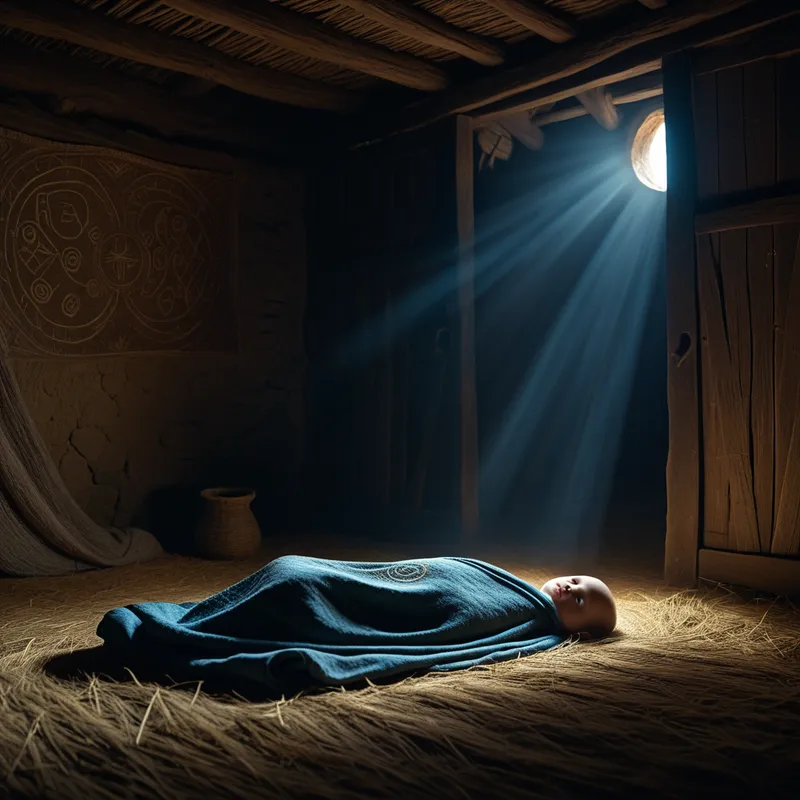
Then, in the fullness of time, under the watch of a foreign emperor and the bright eye of a strange star, the unthinkable occurred. The Word, which existed with the Presence from the beginning, through which all things were made, did not remain in the realm of pure sound and spirit. It became flesh. It dwelt among the dust and sweat and laughter and tears of humanity. The voice that shaped galaxies now cried in a [manger](/myths/manger “Myth from Biblical culture.”/). The logic of the cosmos learned a carpenter’s trade. The ultimate meaning walked on two feet, spoke with a local accent, and touched lepers with human hands.
This was the great descent, the ultimate translation. The abstract became concrete. The principle became a person. He spoke, and his words were not just about life; they were life. He called himself [the way](/myths/the-way “Myth from Taoist culture.”/), the truth, and the life. He spoke forgiveness, and burdens fell away. He said “rise,” and the dead stirred. But [the world](/myths/the-world “Myth from Tarot culture.”/), shaped by the Word, did not recognize him. The voice of order was condemned as a disruptor. The logic of love was nailed to a tree of execution. And in that final, gasping breath—“It is finished”—it seemed the Word had been silenced by the very chaos it once subdued.
But the silence that followed was again a pregnant one. For on the third day, the tomb, the ultimate symbol of finality, was found empty. The Word had passed through the heart of darkness and death itself and was not undone. It was resurrected, speaking peace to the terrified, breathing spirit on the lost. The story does not end with an ascension, a return to abstract remoteness, but with a lingering promise: “I am with you always.” The Word, having become flesh, forever bridges the chasm between the silent, creative Presence and the noisy, yearning human heart.
Cultural Origins & Context
This narrative of The Word (Greek: [Logos](/myths/logos “Myth from Christian culture.”/)) is woven from two primary textual tapestries: the Hebrew creation poem of Genesis and the theological prologue of the Gospel of John. Genesis 1 is a priestly text, likely refined during the Babylonian Exile. Its repetitive, liturgical structure (“And God said… and it was so”) was not just a story but a ritual assertion of order and divine sovereignty against the backdrop of national trauma and cosmic chaos. It affirmed that their God was not a local deity but the foundational speaker of reality.
Centuries later, the author of John’s Gospel, writing for a Hellenistic Jewish and early Gentile audience, deliberately echoes Genesis 1. He employs the Greek philosophical concept of Logos—the rational principle governing the cosmos—and identifies it not just with the God of Israel but with the person of [Jesus of Nazareth](/myths/jesus-of-nazareth “Myth from Christian culture.”/). This was a revolutionary cultural synthesis. It positioned the Christian story within the grandest possible framework: the very architecture of creation. The myth was passed down through liturgical recitation, scripture reading, and theological discourse, serving to define community identity, explain the nature of Christ, and provide a metaphysical map of reality where meaning (Logos) was both its source and its redeemer.
Symbolic Architecture
At its core, the myth of The [Word](/symbols/word “Symbol: Words in dreams often represent communication, expression, and the power of language in shaping our realities.”/) symbolizes [the principle](/symbols/the-principle “Symbol: A fundamental truth, law, or doctrine that serves as a foundation for a system of belief, behavior, or reasoning, often representing moral or ethical standards.”/) of Meaningful Order emerging from Unformed Potential. It is the [archetype](/symbols/archetype “Symbol: A universal, primordial pattern or prototype in the collective unconscious that shapes human experience, behavior, and creative expression.”/) of [differentiation](/symbols/differentiation “Symbol: The process of distinguishing or separating parts of the self, emotions, or identity from a whole, often marking a developmental or psychological milestone.”/), the act of [consciousness](/symbols/consciousness “Symbol: Consciousness represents the state of awareness and perception, encompassing thoughts, feelings, and experiences.”/) that separates “this” from “that” and in doing so, creates a knowable world.
The Word is the bridge between the unknowable ground of being and the knowable world of experience. It is the first act of consciousness, which by naming, creates reality.
Psychologically, The Word represents the Ego in its most essential, creative function. Just as the divine Logos structures [chaos](/symbols/chaos “Symbol: In Arts & Music, chaos represents raw creative potential, uncontrolled expression, and the breakdown of order to forge new artistic forms.”/) into [cosmos](/symbols/cosmos “Symbol: The entire universe as an ordered, harmonious system, often representing the totality of existence, spiritual connection, and the unknown.”/), the [human](/symbols/human “Symbol: The symbol of a human represents individuality, complexity of emotions, and social relationships.”/) ego, through [perception](/symbols/perception “Symbol: The process of becoming aware of something through the senses. In dreams, it often represents how one interprets reality or internal states.”/), [language](/symbols/language “Symbol: Language symbolizes communication, understanding, and the complexities of expressing thoughts and emotions.”/), and cognition, structures the chaotic flow of psychic and sensory data into a coherent “I” and a stable world. It is the organizing principle of the [psyche](/myths/psyche “Myth from Greek culture.”/). The incarnation—The Word becoming flesh—symbolizes the ultimate [integration](/symbols/integration “Symbol: The process of unifying disparate parts of the self or experience into a cohesive whole, often representing psychological wholeness or resolution of internal conflict.”/). It is the descent of meaning, [spirit](/symbols/spirit “Symbol: Spirit symbolizes the essence of life, vitality, and the spiritual journey of the individual.”/), and transcendent values ([the Self](/myths/the-self “Myth from Jungian culture.”/)) into the concrete, temporal, and often messy [reality](/symbols/reality “Symbol: Reality signifies the state of existence and perception, often reflecting one’s understanding of truth and life experiences.”/) of [human](/symbols/human “Symbol: The symbol of a human represents individuality, complexity of emotions, and social relationships.”/) [life](/symbols/life “Symbol: The symbol of ‘Life’ represents a journey of growth, interconnectedness, and existential meaning, encompassing both the joys and challenges that define human experience.”/) and [body](/symbols/body “Symbol: The body in dreams often symbolizes the dreamer’s self-identity, personal health, and the relationship they have with their physical existence.”/) ([the ego](/myths/the-ego “Myth from Jungian culture.”/)). The crucifixion represents the inevitable suffering of this process—the [death](/symbols/death “Symbol: Symbolizes transformation, endings, and new beginnings; often associated with fear of the unknown.”/) of the old, purely spiritual or purely [material](/symbols/material “Symbol: Material signifies the tangible aspects of life, often representing physical resources, desires, and the physical world’s influence on our existence.”/) understanding—and [the resurrection](/myths/the-resurrection “Myth from Christian culture.”/) signifies the [birth](/symbols/birth “Symbol: Birth symbolizes new beginnings, transformation, and the potential for growth and development.”/) of a new, unified consciousness that has assimilated the [reality](/symbols/reality “Symbol: Reality signifies the state of existence and perception, often reflecting one’s understanding of truth and life experiences.”/) of both.
The Dreamer’s Resonance
When this myth stirs in the modern unconscious, it often manifests in dreams of potent, unrealized speech or creative power. You may dream of finding a sacred, ancient book whose pages are blank, or of knowing a world-altering truth but being unable to articulate it, your voice stolen. These are dreams of the unlived Logos—of a personal meaning, a true voice, or a creative vision that is seeking incarnation but is blocked.
Conversely, you might dream of speaking a single word that causes rooms to rearrange or landscapes to blossom. This is the somatic thrill of ego-strength and authentic self-expression aligning with the deeper Self. The psychological process here is one of individuation through articulation—the struggle to give authentic, coherent form to the formless potentials within. The dreamer is navigating the tension between the inner chaos of unprocessed feelings or ideas and the need to “speak them into being,” to claim their own creative authority and define their world.
Alchemical Translation
The alchemical journey mirrored in this myth is the opus contra naturam: the work against nature, or rather, the work of refining base nature into spiritual gold. [The prima materia](/myths/the-prima-materia “Myth from Alchemical culture.”/) is the tohu wa-bohu—the inner chaos, confusion, and un-differentiated psychic mass.
The incarnation is the alchemical solve: the spirit dissolves into matter. The crucifixion is the coagula: a fixed, painful form. The resurrection is the rubedo: the reddening, the final stage yielding the Philosopher’s Stone—a consciousness that is fully human and fully divine.
For the modern individual, the process begins in the “void”—states of depression, meaninglessness, or creative blockage. The first step is the faint impulse toward meaning, a “let there be light” moment of intention. This is the spark of the ego seeking order. The hard work is the incarnation: committing that vague inspiration or deep feeling to concrete form. Write the book. Start the project. Have the difficult conversation. This is The Word becoming flesh—vulnerable, tangible, and subject to rejection.
The inevitable “crucifixion” is the criticism, the failure, the ego’s humiliation when its grand vision meets resistant reality. This is not the end of the process but its crucial center. One must let the identified-with idea of oneself die. The resurrection is the unexpected insight, resilience, or new direction that emerges from that surrender. The individual does not return to a purely spiritual fantasy nor remain a defeated materialist. They are transformed, possessing a newfound, grounded authority—a personal Logos that has been tested, broken, and reconstituted. They become, in a small but real way, a co-creator of their world, speaking not with omnipotence, but with the hard-won authenticity of meaning that has taken flesh.
Associated Symbols
Explore related symbols from the CaleaDream lexicon: