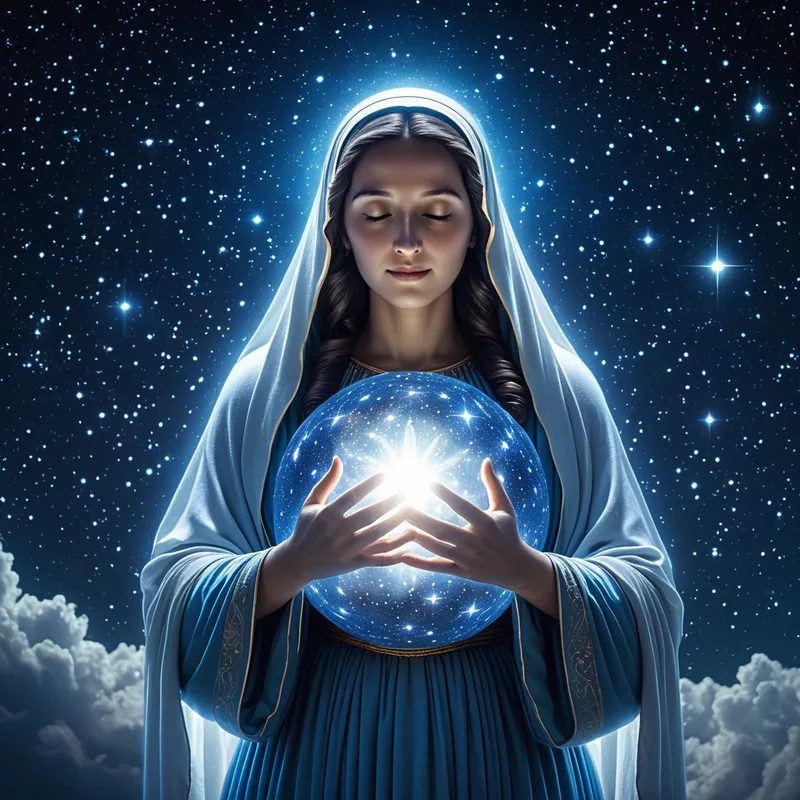
The Womb of Mary Myth Meaning & Symbolism
A myth of divine conception where the human soul becomes the sacred vessel for the birth of the transcendent Self.
The Tale of The Womb of Mary
Listen, and let the silence between the stars speak.
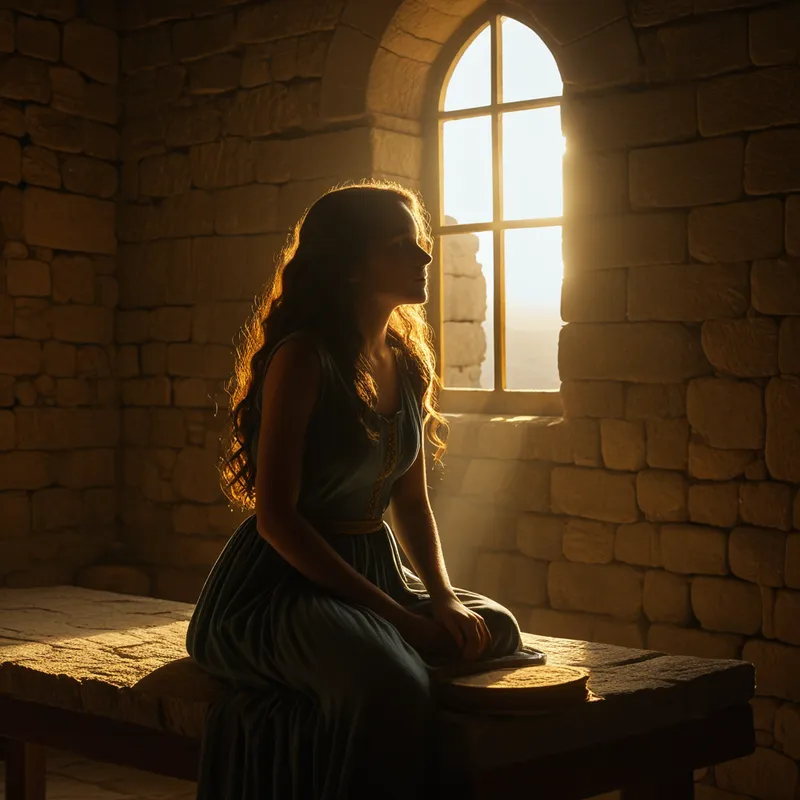
In a time when the world was heavy with waiting, in a town of dust and stone called Nazareth, there lived a maiden. Her name was Mary, and her spirit was like a clear vessel, empty yet full of a quiet, listening light. The air in her small room was still, smelling of olive oil and dry earth. She was weaving, perhaps, or simply sitting in the twilight, her thoughts a gentle stream.
Then, the atmosphere changed. Not with thunder, but with a deepening of the quiet, a thickening of the air as if space itself held its breath. A presence, vast yet intimate, filled the room—not as a man fills a space, but as a fragrance fills it, or a melody. It was the angel Gabriel, though his form was less a body and more a condensation of meaning, a being of distilled announcement. His voice was not a sound that struck the ear, but one that arose within the soul.
“Hail, favored one,” the presence intoned, a resonance that vibrated in the marrow of the house. “The Lord is with you.”
Mary felt the words not as language, but as a seismic shift in her very substance. She was troubled, not with fear of the messenger, but with the terrifying gravity of the address. What did it mean to be “favored”? To have the unnamable with you?
The angel continued, weaving a destiny in the air. “You will conceive in your womb and bear a son, and you shall call his name Jesus. He will be great, and will be called the Son of the Most High.”
The conflict was immediate and profound. It was not a refusal, but the cry of logic against mystery. “How can this be,” Mary whispered, the question hanging in the charged air, “since I have known no man?” Her question was the last bastion of the known world, the final anchor in the realm of cause and effect.
The angel’s answer dissolved that anchor. “The Holy Spirit will come upon you, and the power of the Most High will overshadow you; therefore the child to be born will be called holy—the Son of God.”
Here was the impossible equation: the Infinite seeking a home in the finite. The Uncreated, wishing to be created. The resolution would not come from argument, but from a surrender so complete it became an act of supreme creativity. The entire cosmos seemed to pause, hinging on the consent of one human soul.
And Mary, in that eternal moment, let go. She released the known, the safe, the comprehensible. Her words were the unlocking of the universe: “Behold, I am the servant of the Lord; let it be to me according to your word.”
In that utterance, the miracle was sealed. The Incarnation began not with a cosmic bang, but with a whispered “yes” in a dark room. The divine spark, the Logos, was implanted. Her womb—an ordinary, human space of blood and potential—was consecrated. It became the sealed garden, the closed gate, the holy of holies. It became the crucible where heaven and earth, spirit and matter, eternity and time, were woven into a single, beating heart. For nine moons, she carried the secret, a walking temple, her body the first altar of the new covenant. The world went about its business, unaware that deep within a young woman, the axis of history had quietly, irrevocably, turned.
Cultural Origins & Context
This narrative, central to Christian belief, is found in the Gospel of Luke. It is the story of the Annunciation. While not a myth in the polytheistic sense, it functions mythologically within the Christian framework as the foundational sacred story of divine intervention and human cooperation. It was passed down orally within early communities before being codified in scripture, told and retold to explain the paradoxical origin of Christ.
Its societal function was multifaceted. For early Christians, often persecuted, it affirmed that God chose the humble and obscure, not the powerful, to enact salvation. It established Mary’s unique role as Theotokos, a doctrine fiercely debated and defended in early Church councils. The story served as the ultimate model of faithful obedience, positioning Mary as the New Eve whose “yes” repaired the “no” of the first mother in Eden. In monastic and mystical traditions, particularly in the Hesychast and Rhineland traditions, her womb became a central metaphor for the inner, receptive chamber of the soul where God could be born anew.
Symbolic Architecture
The Womb of Mary is not merely a biological location; it is the ultimate symbol of the vas, the sacred vessel of alchemical and psychological transformation. It represents the human capacity to become a container for the transcendent.
The soul must become a hollow bone, a cleared space, for the divine wind to whistle through and become song.
Mary herself symbolizes the purified human psyche—the anima in its highest form—that has achieved a state of inner unity (virginity as psychological integrity) capable of receiving the Self. The angel Gabriel represents the sudden, numinous intrusion of the unconscious, a call from the deep that shatters ordinary consciousness. His message is the annunciation of a new potential, a destiny that feels both terrifying and fated.
The central, miraculous conception symbolizes the hieros gamos, the sacred marriage between the conscious ego (Mary) and the unconscious, transpersonal contents (the Holy Spirit). The womb is the psychic crucible where this union gestates. The resulting child, Jesus, is the nascent Self—the integrated, divine-human totality that is the goal of individuation.
The Dreamer’s Resonance
When this mythic pattern stirs in modern dreams, it signals a profound process of psychic pregnancy. The dreamer may find themselves in a secluded, enclosed space—a room, a cave, a cocoon—that feels both protective and charged with potential. They may discover a precious, fragile object (a jewel, a scroll, a child) within this space or within their own body.
Somatically, this can correlate with feelings of fullness, pressure, or a mysterious “quickening” in the abdomen or chest, unrelated to physical illness. Psychologically, it marks the stage after a deep insight or a painful dissolution of an old identity. The new consciousness has been conceived, but it is not yet born. The dreamer is in the gestational dark. This is a time of necessary waiting, protection, and inward focus. Anxiety dreams of losing the precious contents or of the space being violated speak to the fear that this nascent Self will be aborted by the demands of the outer world or the critical voices of the inner critic.
Alchemical Translation
The alchemical journey mirrored in this myth is the opus of nigredo giving way to the secret, formative work of albedo. The “annunciation” is the shocking, illuminating flash of the lumen naturae—the light of nature—that reveals our deeper purpose. Our initial question, “How can this be?” is the ego’s rightful confusion. The answer, “The Holy Spirit will overshadow you,” demands the crucial, terrifying step: the ego’s surrender of control.
Individuation begins not with a act of will, but with an act of permission.
To say “let it be” is to consent to the process orchestrated by the Self. Our conscious mind becomes the Mary, the vessel. Our life becomes the womb. The long gestation is the period of silent integration, where insights from dreams, synchronicities, and suffering are woven together below the surface of daily awareness. We are called to protect this process, to withdraw energy from outer dramas and nourish the inner life.
The eventual “birth” is the conscious emergence of the renewed personality, the filius philosophorum, who can engage the world with a wisdom that is both human and grounded in something transcendent. The myth teaches that the greatest creation—the birth of the true Self—requires us to first become empty, receptive, and brave enough to carry the divine spark in the humble, human dark of our own being.
Associated Symbols
Explore related symbols from the CaleaDream lexicon: