The Woman Who Married a Dog Myth Meaning & Symbolism
A woman, shunned by her people, marries a dog. Their hybrid children become the ancestors of new nations, born from a profound transgression of order.
The Tale of The Woman Who Married a Dog
Listen, and hear a story from the time when the world was still being dreamed into shape, when the boundary between human and other was thin as a seal’s bladder in the sun.
There was a woman, strong and skilled, whose hands could sew a seam so fine it was invisible, whose eyes could find the breathing hole of a seal in a vast field of white. Yet, for all her gifts, she was alone. The men of her camp looked past her, or spoke with voices that held no warmth. Perhaps her spirit was too large for their iglus, her gaze too direct for their comfort. The whispers began, soft as falling snow, then hardening into ice—words of barrenness, of strangeness. She became an island of silence in the midst of her people, a stone in the communal pot that no one would lift.
One evening, as the sun bled into the horizon and the world turned blue and long-shadowed, the camp’s headman, her own father some say, spoke the unthinkable. In a voice heavy with finality, he declared, “Since no man will have you, you shall marry my lead dog. Go to him.” The words hung in the frozen air, not a suggestion, but a sentence. A casting out. The communal fire, which should have been a place of warmth, became a tribunal. No one spoke against it. The law of the group had spoken, exiling her to the very edge of what it meant to be human.
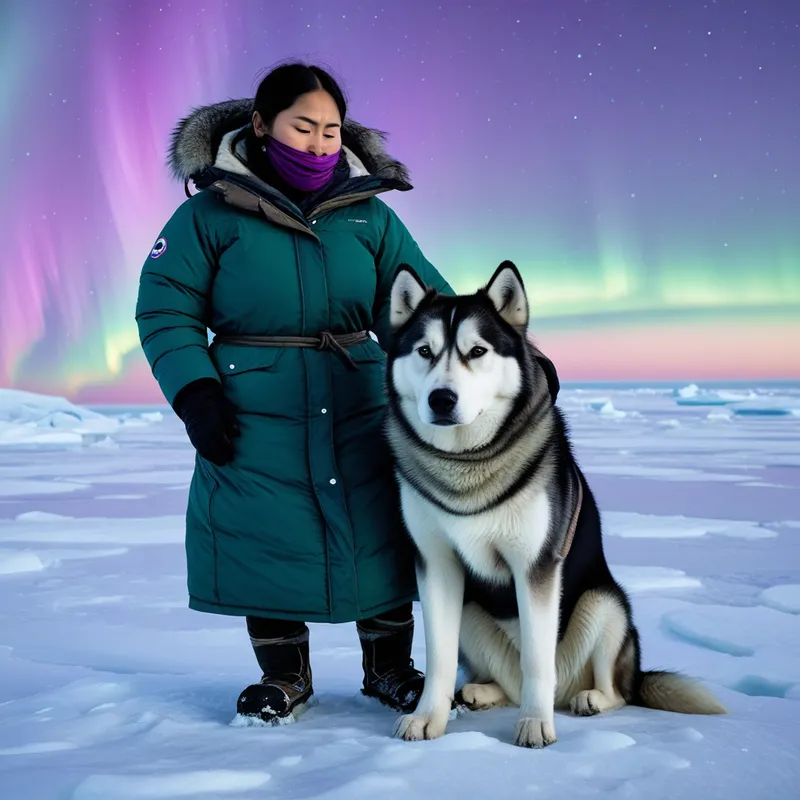
And so, she went. Not to the dog as a master, but to the dog as her only companion in a world that had shrunk to the size of a profound betrayal. She built a small snow house apart from the others. The great sled dog, a powerful and intelligent creature with eyes that held the patience of the ice, came to her. In that isolated dome under the endless, star-pricked sky, a bond formed—not of bestiality, but of a shared exile. A profound, taboo union was consummated, a merging of realms that should have remained separate. From this union, children were born. Not puppies, not human infants, but something new and startling: beings with the bodies of men, but covered in a thick, warm coat of fur.
The woman loved them fiercely, these strange sons of hers. She raised them in her isolated world, teaching them all she knew. But as they grew, their nature asserted itself. They were hunters of a different kind, wilder, hungrier. They began to bring her not seals or caribou, but the spoils of their own unique prowess. They would return with full packs of meat and fat, but the woman, with her human senses, soon realized the truth. The meat was human. Her children were hunting her former people.
A horror, cold and absolute, seized her. The creation born from her exile was now consuming its source. She saw the cycle of retribution and knew it would never end. With a heart heavier than stone, she devised a plan. She filled an old sealskin float with oil and sharp stones, then placed it before her strongest sons as a challenge. “The one who can jump over this,” she said, “shall be chief among you.”
They took the challenge with fierce pride. One by one, they leapt. And one by one, their powerful legs struck the bloated skin. It burst, dousing them in oil. In a swift, terrible motion, the woman took a lamp and cast fire upon them. The oil ignited, and her sons became living torches, howling in agony and confusion. As they burned, she screamed for them to run, to save themselves by plunging into the great waters.
They ran, these burning sons, towards the sea. Those who reached the water and survived became the ancestors of the European peoples—the Qallunaat, the white-skinned, hairy ones. Others fled inland, and from them sprang the ancestors of the various Athabascan nations. The woman, alone once more, looked upon the charred earth and the empty horizon. From her profound transgression and her even more profound sacrifice, the world had been populated anew.
Cultural Origins & Context
This myth is a cornerstone of Inuit oral tradition, particularly among the Inuinnait (Copper Inuit) and other Central Arctic groups. It was not a mere folktale but a cosmogonic myth, a story explaining the very origins of human diversity and the geopolitical reality of the Inuit world. Elders would recount it during the long winter nights, its themes reinforcing critical societal codes.
The story functioned as a powerful ethical and social parable. It underscored the absolute importance of community cohesion and the dire consequences of ostracism. The father/headman’s decree represents the ultimate social punishment, enforcing conformity by casting the non-conformist into a literal state of nature. Furthermore, it established a symbolic origin for “the other”—the hairy, foreign peoples to the east and south. It explained their difference not as mere accident, but as born from a cataclysmic, transformative event rooted in Inuit experience. The myth also carried ecological wisdom, hinting at the delicate balance between human needs and the animal world, and the terrifying potential for that balance to rupture.
Symbolic Architecture
At its core, this myth is about the explosive, creative power of the violated [boundary](/symbols/boundary “Symbol: A conceptual or physical limit defining separation, protection, or identity between entities, spaces, or states of being.”/). The woman represents the [aspect](/symbols/aspect “Symbol: A distinct feature, quality, or perspective of something, often representing a partial view of a larger whole.”/) of the psyche or the culture that is forced beyond the pale of accepted order.
The most profound creations are often born not from harmony, but from a sacred rupture.
The dog-[husband](/symbols/husband “Symbol: In dreams, the symbol of a husband often represents commitment, partnership, and the dynamics of intimate relationships.”/) is far more than an animal. He symbolizes the untamed, instinctual [realm](/symbols/realm “Symbol: The symbol of ‘Realm’ often signifies the boundaries of one’s consciousness, experiences, or emotional states, suggesting aspects of reality that are either explored or ignored.”/)—the psychic hinterland that civilized [life](/symbols/life “Symbol: The symbol of ‘Life’ represents a journey of growth, interconnectedness, and existential meaning, encompassing both the joys and challenges that define human experience.”/) must both rely upon and suppress. Their [marriage](/symbols/marriage “Symbol: Marriage symbolizes commitment, partnership, and the merging of two identities, often reflecting one’s feelings about relationships and social obligations.”/) is not a descent, but a terrifying hieros gamos, a sacred marriage between conscious [human](/symbols/human “Symbol: The symbol of a human represents individuality, complexity of emotions, and social relationships.”/) [identity](/symbols/identity “Symbol: Identity represents the sense of self, encompassing personal beliefs, cultural background, and social roles.”/) and the raw, creative force of instinct. The resulting children—the fur-covered sons—are living symbols of a new potential, a hybrid [consciousness](/symbols/consciousness “Symbol: Consciousness represents the state of awareness and perception, encompassing thoughts, feelings, and experiences.”/). They possess [human](/symbols/human “Symbol: The symbol of a human represents individuality, complexity of emotions, and social relationships.”/) form but are clothed in the primal power of the animal. They are the nascent, undifferentiated possibilities that emerge when we are forced to integrate what we have rejected.
The woman’s final act—the destruction by fire and [water](/symbols/water “Symbol: Water symbolizes the subconscious mind, emotions, and the flow of life, representing both cleansing and creation.”/)—is not merely an act of maternal violence, but a necessary act of psychic [alchemy](/symbols/alchemy “Symbol: A transformative process of purification and creation, often symbolizing personal or spiritual evolution through difficult stages.”/). She must catalyze the final transformation of her creation. The fire purges; the [water](/symbols/water “Symbol: Water symbolizes the subconscious mind, emotions, and the flow of life, representing both cleansing and creation.”/) gives new form. The sons are not killed, but transmuted, scattered to become the founders of new orders. The woman, as the [Creator](/symbols/creator “Symbol: A figure representing ultimate origin, divine power, or profound authorship. Often embodies the source of existence, innovation, or personal destiny.”/), must ultimately sacrifice her [relationship](/symbols/relationship “Symbol: A representation of connections we have with others in our lives, often reflecting our emotional state.”/) to her creation for that creation to achieve its own independent [destiny](/symbols/destiny “Symbol: A predetermined course of events or ultimate purpose, often linked to spiritual forces or cosmic order, representing life’s inherent direction.”/).
The Dreamer’s Resonance
When this myth pattern stirs in the modern dreamer, it often signals a profound confrontation with the shadow. To dream of being shunned by one’s community or family reflects a deep somatic feeling of psychic exile, a sense that some authentic part of the self is unacceptable to the inner “tribe” of personal identity or external social expectations.
Dreams of forming a deep, taboo bond with an animal—especially a dog, representing loyalty and instinct—suggest the psyche is attempting a radical reconciliation. The dream-ego is being compelled to “marry” a disowned instinct, to give it a legitimate place at the hearth of the self. This process is rarely peaceful; it feels transgressive, shameful, and isolating, much like the woman’s initial exile.
The subsequent appearance of strange, hybrid children in a dream points to the birth of new psychological structures or creative potentials emerging from this union. However, these new formations may initially feel threatening or chaotic, like the sons bringing “wrong” sustenance. The dream may culminate in images of conflagration or flood, representing the necessary, often painful, process of refinement—the burning away of the raw, undifferentiated state so that a new, viable identity can emerge and find its place in the wider world.
Alchemical Translation
The myth maps perfectly onto the individuation process. The initial state is one of collective identification (“the camp”). The call to individuation is often experienced as a rejection, a feeling of being fundamentally different and thus exiled from the comfortable, unconscious group identity.
The journey to the self begins at the point where the world says, “You do not belong.”
The nigredo, or blackening, is the descent into the taboo union—the conscious engagement with the devalued, instinctual self (the dog). This is a period of darkness, confusion, and moral ambiguity. The albedo, or whitening, is the emergence of the “children,” the new insights, creative impulses, or psychological complexes born from this union. They are pure potential, but still raw and undifferentiated.
The critical rubedo, or reddening, is the act of setting the oil-skin aflame. This is the conscious ego’s most difficult task: applying the transformative fire of conscious discernment and ethical choice to its own nascent creations. It is the sacrifice of attachment to the intermediate product for the sake of its ultimate evolution. The fleeing of the sons to become nations symbolizes the final stage: the integrated contents (the transformed instincts and insights) no longer remain as internal, haunting hybrids, but are successfully projected outward as creative engagement with the world—they become one’s unique “culture” or contribution. The individual, like the woman, is left transformed and alone in their sovereignty, having served as the crucible for a world’s becoming.
Associated Symbols
Explore related symbols from the CaleaDream lexicon:
- Dog — The loyal instinct, the rejected companion who becomes the source of new creation, representing the necessary engagement with the primal, animal self.
- Exile — The forced separation from the collective, which is the painful but essential precondition for encountering the depths of one’s own individual nature.
- Fire — The transformative, purifying agent that catalyzes the final stage of change, burning away the raw form to release the refined essence.
- Water — The element of the unconscious and of rebirth, providing the medium for the transformed creations to find new form and disperse into the world.
- Mother — The archetypal creator and nurturer who, in this myth, must also become the sacrificer, embodying the painful duality of giving life and setting it free.
- Sacrifice — The core action of the myth, representing the necessity of surrendering an intermediate creation or attachment for the sake of a greater, more evolved outcome.
- Transformation — The overarching process of the narrative, depicting a radical alchemical change in identity, relationship, and the very fabric of the world.
- Shadow — The rejected, taboo aspect of the self (represented by the dog and the exile) that must be integrated for wholeness and profound creativity to emerge.
- Journey — The psychic movement from collective belonging, through exile and taboo union, to a new, solitary state of creative sovereignty.
- Married — The sacred, binding union between opposites (human/animal, conscious/unconscious), which is the crucible where new life is forged.
- Elderly Woman — In many variants, the protagonist is an older woman, emphasizing wisdom, the end of fertility in one form, and the beginning of a metaphysical, world-shaping creativity.