The Woman at the Well Myth Meaning & Symbolism
A solitary woman drawing water meets a stranger who reveals her hidden life, offering not judgment but a spring of eternal truth.
The Tale of The Woman at the Well
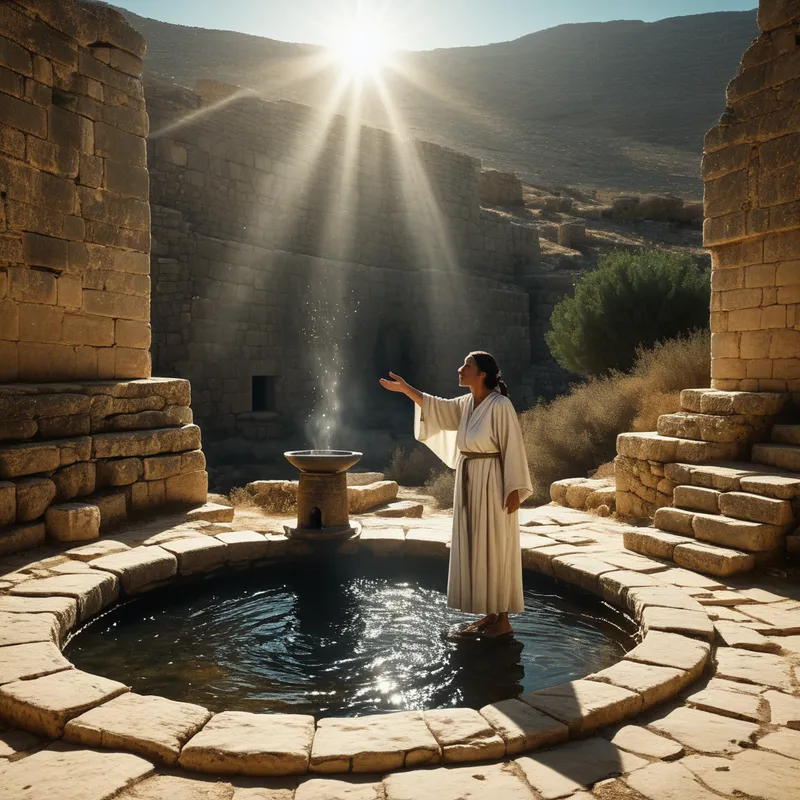
The sun was a hammer on the anvil of the earth. It was the sixth hour, the hour of no shadows, when the world holds its breath and all things flee to their corners. The road to Sychar was a dusty, white scar, empty but for the heat-shimmer. At the place of the old stones, where the patriarch Jacob had dug deep centuries before, a woman came.
She came alone, which was strange. The morning and evening choruses of women, their laughter and gossip echoing around the well, were long silent. She came at the solitary hour, bearing her heavy jar, a figure moving through a world bleached of color and mercy. Her steps were measured, a ritual of necessity, her eyes downcast, seeing only the dust on her own sandals.
At the well, a man sat. He was weary, travel-stained, a stranger. His posture spoke of a long road, but his eyes were not clouded by the heat. They were like the well itself: deep, still, knowing. He watched her approach, this woman who carried her isolation like a second jar.
“Give me a drink,” he said. The words broke the sacred silence of the hour.
She stopped, jar poised. A Samaritan woman, she knew the rules. The walls between her people and his were older than the stones of this well. “How is it that you, a Jew, ask for a drink from me, a Samaritan woman?” Her voice was cautious, edged with the weariness of a thousand such divisions.
He did not answer the question of tribe. He spoke to the thirst beneath it. “If you knew the gift of God, and who it is that is saying to you, ‘Give me a drink,’ you would have asked him, and he would have given you living water.”
Living water. The phrase hung in the air. She knew water—the heavy haul from the deep dark, the tepid storage in clay, the constant return to the source. “Sir, you have nothing to draw water with, and the well is deep. Where do you get that living water? Are you greater than our father Jacob, who gave us this well?”
Then he spoke the words that pierced the jar of her life. “Everyone who drinks of this water will be thirsty again. But whoever drinks of the water that I will give will never be thirsty again. The water that I will give will become a spring of water welling up to eternal life.”
“Sir,” she said, a spark of hope, or desperation, kindling, “give me this water, so that I may never be thirsty or have to keep coming here to draw.”
“Go, call your husband, and come back,” he said.
And here, at the axis of the tale, the well of her past opened up. “I have no husband,” she replied, the practiced, partial truth.
“You are right in saying, ‘I have no husband’; for you have had five husbands, and the one you have now is not your husband. What you have said is true.”
The hammer-blow of the sun was nothing to the shock of this seeing. He knew. He saw the five empty jars of her history, the sixth that offered no covenant, the shame that drove her to the well at the lonely hour. Yet in his voice was no condemnation, only the clear, cool fact of the matter. This was not an exposure to harm, but a revelation to heal. The stranger at the well saw her—all of her—and did not turn away.
In that moment, the walls of Sychar, of Samaria, of her own life, fell away. The conversation leapt from water to worship, from past to spirit. She spoke of the messiah, the Christos, who would declare all things.
“I am he,” the stranger said, “the one who is speaking to you.”
The disciples returned then, breaking the spell, marveling. The woman left her water jar—the very vessel of her old life, her old thirst—abandoned at the well. She ran back to the city, to the people from whom she hid, and her words were a torrent: “Come and see a man who told me everything I have ever done! He cannot be the Messiah, can he?”
The one who came to draw water became a spring. The one who came in hiding became a herald. The well in the desert of noon had yielded not just water, but witness.
Cultural Origins & Context
This narrative originates from the Gospel of John, a text composed in the late 1st century CE within the complex milieu of early Jesus-followers negotiating their identity within and beyond Second Temple Judaism. The story functions on multiple cultural fault lines. It is set in Samaria, a land and people viewed with deep suspicion and theological rivalry by Jews, making the encounter inherently transgressive.
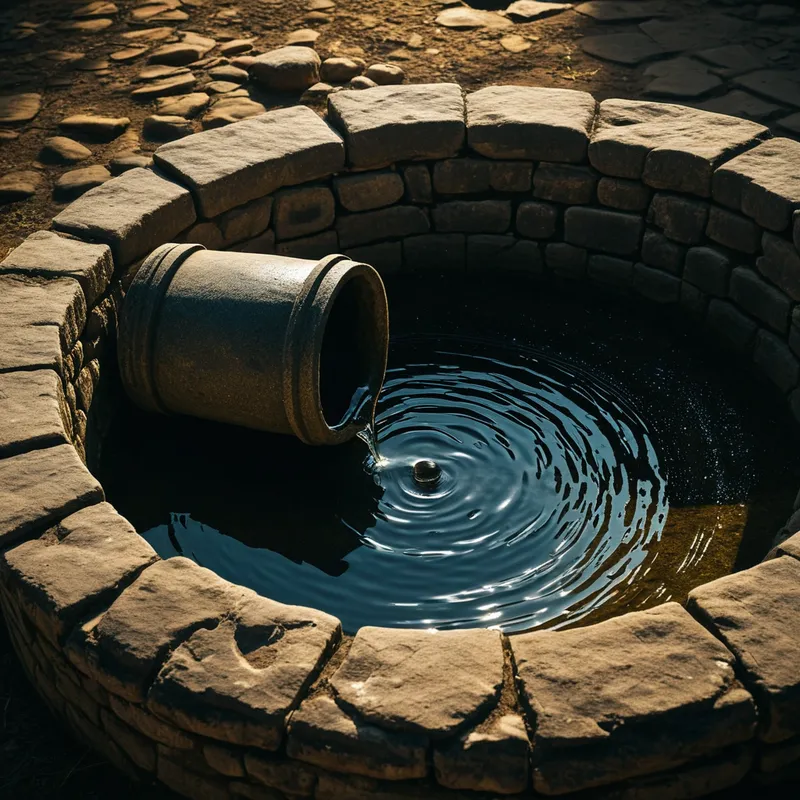
The well of Jacob is not a random setting; it is a numinous locus, a tangible link to the patriarchal promises. Wells were also social hubs, the domain of women. For a woman to draw water alone at noon suggests profound social alienation, likely related to her marital history, which would have rendered her morally suspect in her community. The story was passed down orally within early Christian communities before being inscribed in John’s theological narrative, serving not just as a biographical anecdote but as a potent paradigm. Its societal function was revolutionary: it presented the core message of the movement as breaking boundaries of ethnicity (Jew/Samaritan), gender (a male rabbi teaching a woman), and moral status (the “sinner” becomes the first evangelist to non-Jews), modeling a new, inclusive community born from direct, personal revelation.
Symbolic Architecture
At its heart, this is a myth of recognition and the source of true sustenance. The well is the psyche itself—a deep, ancient structure reaching into the collective past (Jacob). The water drawn with effort is the ego’s sustenance: relationships, social standing, identity, all of which are temporary and require exhausting repetition.
The living water is the conscious connection to the Self, the archetypal wellspring of meaning that, once integrated, flows autonomously, ending the compulsive quest for external validation.
The woman represents the conscious personality, specifically the anima or the marginalized soul, operating on autopilot (“I have no husband”), yet bearing a hidden, complex history (the five husbands). The stranger is the archetypal Sage or the emergent Self, who arrives at the point of greatest tension (the “sixth hour”) and fatigue. His request, “Give me a drink,” is the crucial first gesture: the Self asks for acknowledgment from the conscious ego. The revelation of her history is not a shaming but a profound act of seeing—the essential prerequisite for integration. The abandoned water jar is the discarded ego-container, now obsolete because the source is internalized.
The Dreamer’s Resonance
When this myth stirs in the modern dreamer, it often manifests as dreams of forgotten or broken vessels, of meeting a significant but calm stranger at a crossroads or resource, or of discovering a hidden spring in a barren place. The somatic feeling is one of profound thirst suddenly quenched by an unexpected source, or of a heavy weight (the jar) being set down.
Psychologically, this dream pattern signals a critical moment in shadow-work. The “five husbands” may appear as repetitive, failed relationship patterns, addictive behaviors, or hollow societal roles the dreamer has cycled through. The “man who is not a husband” represents the current, unintegrated, or unconscious complex driving behavior. The dream is an invitation to the noon-hour confrontation: to go to the isolated place of one’s history and meet the part of the Self that sees it all without flinching. The process is one of moving from shame-based hiding to truth-based witnessing, where the very facts of one’s life become the foundation for a new, authentic voice.

Alchemical Translation
The alchemy here is the transmutation of historical water (the leaden weight of personal narrative, of “everything I have ever done”) into living water (the gold of liberated consciousness). The prima materia is the unexamined life, the daily, weary trek to the same old source. The catalyst is the encounter with the Other at the axis of time and place—the moment one is ready.
The operation begins with the request, which disrupts the automatic ritual. It proceeds through the dialogue, where the ego’s literal understanding (“you have no bucket”) is challenged by the symbolic promise of an internal source. The crucial fire is applied in the revelation—the nigredo or darkening, where the shadow is fully exposed to the light of awareness. This is not a destructive fire, but a clarifying one.
The goal of the work is not to erase the history, but to have it fully seen by a consciousness greater than the ego, thereby dissolving its compulsive power.
The albedo, or whitening, is the woman’s astonished shift from defense to inquiry, from personal shame to theological curiosity. The final stage, the rubedo or reddening, is the act of abandonment and proclamation. She leaves her jar (the old identity vessel) and runs to the city (the world, the community) to testify. The psychic transmutation is complete: the once-alienated element becomes the vital conduit, the one who was thirsty becomes the spring. For the modern individual, the myth models that the path to individuation winds through the desert of our own avoided truth, to a well where, if we dare to be seen, we are given not just a drink, but the source itself.
Associated Symbols
Explore related symbols from the CaleaDream lexicon: