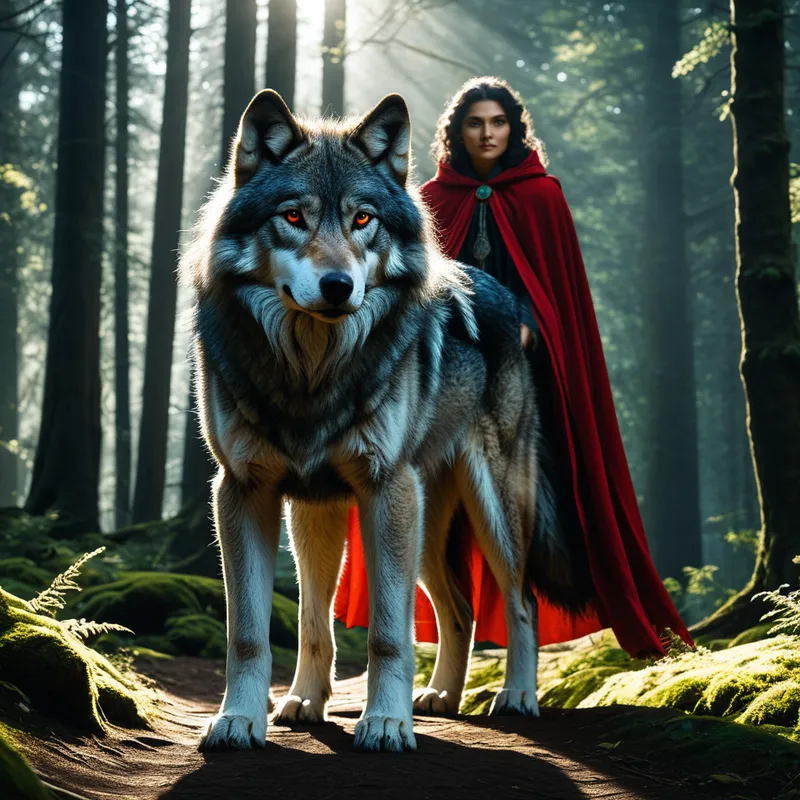
The Wolf in Little Red Riding Hood Myth Meaning & Symbolism
A girl in a red cloak journeys through the deep woods, encountering a wolf who embodies the peril and power of the untamed world within and without.
The Tale of The Wolf in Little Red Riding Hood
Listen. There is a path. Not just any path, but the one that leads from the safe, sunlit village of baked bread and chimney smoke, into the throat of the Deep Woods. Upon this path walks a child, but she is marked. A Crimson Hood, a gift from a beloved elder, drapes her shoulders like a second skin, a beacon against the green-grey gloom.
The air in the woods is different. It smells of damp earth, rotting leaves, and something else—a sharp, musky scent on [the wind](/myths/the-wind “Myth from Various culture.”/). The trees crowd close, their branches like bony fingers. And then, he is there. Not with a crash, but with a silence that parts the [ferns](/myths/ferns “Myth from Celtic culture.”/). The Wolf. His coat is the grey of storm clouds and tombstone, his eyes two chips of polished amber holding a knowledge as old as hunger. He does not pounce. He converses. His voice is a low, smooth gravel. “Where go you, little one?” And the girl, in her innocence, pours out her destination: the cottage of her ailing grandmother, at the other side of the wood.
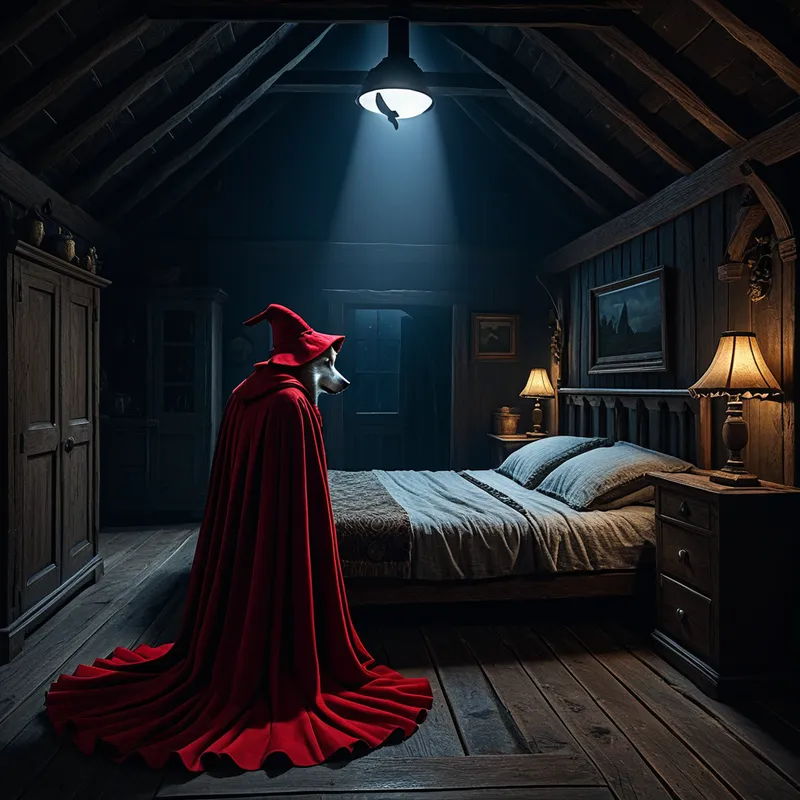
The Wolf knows a faster path. He suggests she gather flowers, to delay her. As she bends to pluck woodland blooms, he runs. He runs with the speed of a thought, of a fear made real. He reaches the cottage, and with a knock that is not a knock, he gains entry. What happens next is the old, dark magic of consumption. The grandmother is gone. The Wolf dons her cap, her spectacles, climbs into her bed. The familiar is made a trap.
The girl arrives. The cottage is too quiet. “Grandmother,” she says, stepping inside, “what big ears you have!” “All the better to hear you with,” rumbles the voice from the bed. “What big eyes you have!” “All the better to see you with.” “What big hands you have!” “All the better to hold you with.” And then, the final, chilling revelation: “What a big mouth you have!” The reply is the unveiling of the primal truth: “All the better to eat you with!”
In one version, the tale ends there, in the dark belly of the beast. But in another, a third figure enters—the Woodcutter. Drawn by the commotion, he bursts in. His axe, a tool of division and clarity, splits the Wolf open. From the dark cavity, the grandmother and the girl emerge, whole, rebirthed from the belly of the predator. The Wolf is slain, his skin perhaps taken as a trophy. The path back to the village is walked again, but the one who returns is not the same who left. The red hood may be stained, but the eyes beneath it have seen the teeth behind the smile.
Cultural Origins & Context
This tale is not the property of a single author, but a ember carried on the breath of countless storytellers across Europe, most notably in France and Germany. It belongs to the great oral tradition of Kinder- und Hausmärchen (Children’s and Household Tales). Told by [the hearth](/myths/the-hearth “Myth from Norse culture.”/), in the spinning room, or on the edge of the forest itself, its primary function was pedagogical and initiatory. It was a map, drawn in narrative, of very real dangers.
The “woods” were not merely symbolic; they were the literal, untamed wilderness bordering villages, places of wolves, bandits, and the unknown. The red hood may have signaled puberty, a girl’s emergence into sexual awareness, making her a target. The story served as a stark primer, especially for young women, on the perils of straying from the path, of talking to strangers, of the charming predator who lurks in the social and literal wilderness. It was a cultural container for anxieties about female autonomy, the threat of male predation, and the fragile boundary between the civilized hearth and the wild that sought to consume it.
Symbolic Architecture
The myth is a perfect, terrifying [blueprint](/symbols/blueprint “Symbol: A blueprint represents the foundational plan or design for something, often symbolizing potential, structure, and the mapping of one’s inner self or future.”/) of a psychological encounter. Every element is an [aspect](/symbols/aspect “Symbol: A distinct feature, quality, or perspective of something, often representing a partial view of a larger whole.”/) of the inner [landscape](/symbols/landscape “Symbol: Landscapes in dreams are powerful symbols representing the dreamer’s emotional state, personal journey, and the broader context of life situations.”/).
The Little Red Riding [Hood](/symbols/hood “Symbol: A hood symbolizes concealment, protection, and sometimes a journey into self-discovery and transformation.”/) is the Innocent [archetype](/symbols/archetype “Symbol: A universal, primordial pattern or prototype in the collective unconscious that shapes human experience, behavior, and creative expression.”/). Her red [cloak](/symbols/cloak “Symbol: A garment that conceals identity, protects from elements, or signifies authority and transformation in dreams.”/) is the vivid, unavoidable spark of individual [life](/symbols/life “Symbol: The symbol of ‘Life’ represents a journey of growth, interconnectedness, and existential meaning, encompassing both the joys and challenges that define human experience.”/) and budding sexuality moving through [the world](/myths/the-world “Myth from Tarot culture.”/). It is both her protection and her peril.
The path is never just a path; it is the trajectory of a life, and to leave it is to enter the realm of the unscripted self.
The [Wolf](/symbols/wolf “Symbol: Wolves in dreams symbolize instinct, intelligence, freedom, and a deep connection to the wilderness and primal instincts.”/) is the ultimate [Shadow](/symbols/shadow “Symbol: The ‘shadow’ embodies the unconscious, repressed aspects of the self and often represents fears or hidden emotions.”/) figure. He is not evil in a simplistic sense, but amoral [appetite](/symbols/appetite “Symbol: Represents desire, need, and consumption in physical, emotional, or spiritual realms. Often signals unmet needs or excessive cravings.”/), cunning, and the raw force of [nature](/symbols/nature “Symbol: Nature symbolizes growth, connectivity, and the primal forces of existence.”/). He represents the seductive and devouring aspects of the unconscious—lust, greed, rage—that can consume the naive ego if it is not discerning. His act of impersonation shows how the [shadow](/symbols/shadow “Symbol: The ‘shadow’ embodies the unconscious, repressed aspects of the self and often represents fears or hidden emotions.”/) can cloak itself in the familiar, wearing the face of [authority](/symbols/authority “Symbol: A symbol representing power structures, rules, and control, often reflecting one’s relationship with societal or personal governance.”/) (the [grandmother](/symbols/grandmother “Symbol: The symbol of ‘Grandmother’ often represents wisdom, nurturing, and heritage, reflecting the influence of maternal figures in one’s life.”/)) to lure us into its grasp.
The Grandmother symbolizes the old, perhaps outdated, [structure](/symbols/structure “Symbol: Structure in dreams often symbolizes stability, organization, and the framework of one’s life, reflecting how one perceives their environment and personal life.”/) of the [psyche](/myths/psyche “Myth from Greek culture.”/) or [family](/symbols/family “Symbol: The symbol of ‘family’ represents foundational relationships and emotional connections that shape an individual’s identity and personal development.”/) [system](/symbols/system “Symbol: A system represents structure, organization, and interrelated components functioning together, often reflecting personal or social order.”/) that is easily overwhelmed by undifferentiated instinct. Her consumption signifies a [crisis](/symbols/crisis “Symbol: A crisis symbolizes turmoil, urgent challenges, and the need for immediate resolution or change.”/) where old protections fail.
The Woodcutter represents the sudden, often external, intervention of [consciousness](/symbols/consciousness “Symbol: Consciousness represents the state of awareness and perception, encompassing thoughts, feelings, and experiences.”/) or societal law that can, in a crisis, forcibly separate [the ego](/myths/the-ego “Myth from Jungian culture.”/) from the devouring complex. His axe is the act of brutal [clarity](/symbols/clarity “Symbol: A state of mental transparency and sharp focus, often representing resolution of confusion or attainment of insight.”/).

The Dreamer’s Resonance
When this myth stirs in modern dreams, it signals a profound somatic and psychological process: an encounter with a consumptive complex. Dreaming of being pursued or tricked by a wolf-figure points to a feeling of being “eaten alive” by a situation, a relationship, or an inner drive. The dreamer may feel their energy, will, or identity is being devoured.
Dreaming of being the wolf, or feeling a wolfish hunger, indicates a confrontation with one’s own repressed instincts or predatory impulses. The “belly of the wolf” is a classic symbol of a depressive or stuck state, a psychological imprisonment where one feels trapped in a dark, enveloping situation. The somatic resonance is often in the gut—a tightening, a sinking feeling, a literal indigestion of an experience one cannot process. The dream is the psyche’s way of staging this dangerous but necessary meeting with [the shadow](/myths/the-shadow “Myth from Jungian culture.”/), forcing the dreamer to recognize what they have been naively walking toward, or what has already swallowed them whole.
Alchemical Translation
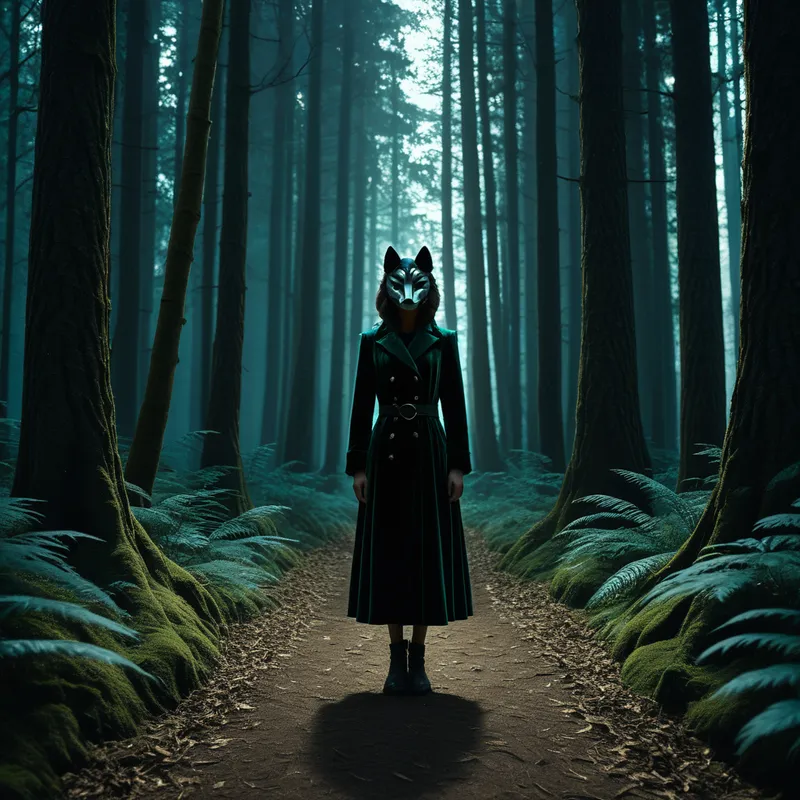
The journey of Little Red Riding Hood is a stark model of individuation, the alchemical transmutation of the psyche. It begins in the [nigredo](/myths/nigredo “Myth from Alchemical culture.”/), the blackening: the innocent, undifferentiated consciousness (the girl) is sent into the [prima materia](/myths/prima-materia “Myth from Alchemical culture.”/) of the unconscious (the woods).
Individuation requires a descent into the belly of the beast, for one must know the devourer to cease being its meal.
The meeting with the Wolf is the confrontation with the shadow, the essential, terrifying first step. The Wolf’s cunning represents the intelligence of the unconscious, which often works through trickery and seduction to get our attention. His consumption of both grandmother and girl is a symbolic death, a necessary dissolution of the old ego-structure and its naive projections.
The arrival of the Woodcutter is the albedo, the whitening. It is the emergence of a conscious, discriminating function that can perform the necessary violence—the cutting apart of the identification with the complex. This is not a gentle process; it is the axe-blow of insight, the difficult decision, the boundary finally set.
The emergence, whole, from the Wolf’s belly is the [rubedo](/myths/rubedo “Myth from Alchemical culture.”/), the reddening. It is rebirth at a higher level of integration. The red of the cloak is no longer just innocent vitality; it is vitality tempered by experience, by the knowledge of the wolf within and without. The individual who completes this cycle does not simply kill and forget the beast. They carry its memory in their bones. They have metabolized the predator and gained its wisdom—the wisdom of caution, of discernment, and crucially, of their own latent, wild power. The path is still there, but the one who walks it now knows the shadows that walk beside it.
Associated Symbols
Explore related symbols from the CaleaDream lexicon: