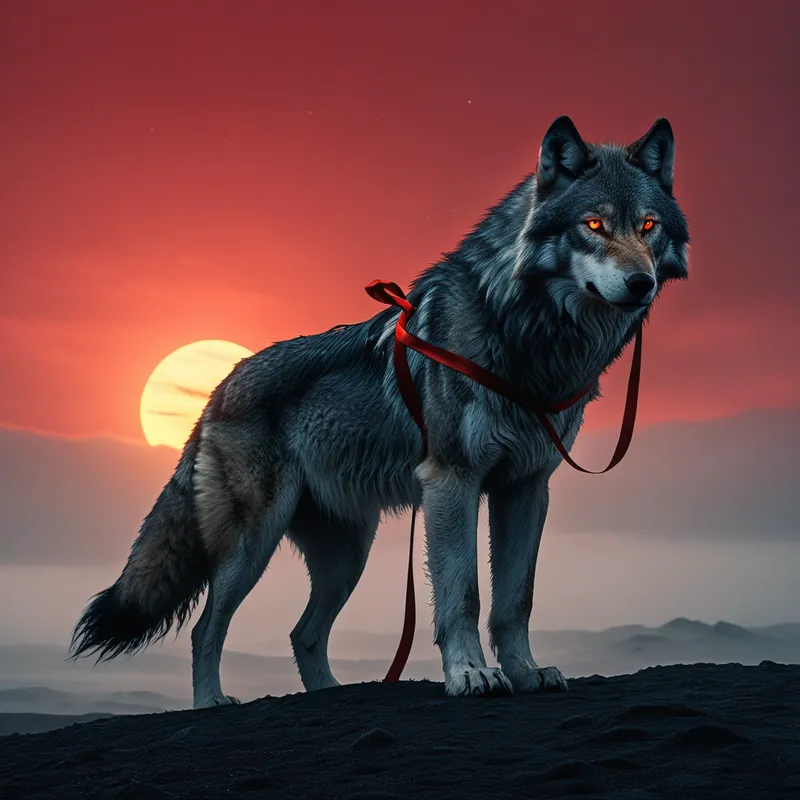
The Wolf Fenrir - In Norse myt Myth Meaning & Symbolism
The prophecy of a wolf who will devour the gods, bound by trickery and sacrifice, embodying the chaos that order both fears and creates.
The Tale of The Wolf Fenrir - In Norse myt
Listen, and hear the tale whispered from the roots of the Yggdrasil. In the dawn of the worlds, when the gods of Asgard walked with the certainty of their own power, a shadow was born. It was not a shadow of darkness, but of becoming. From the union of the trickster Loki and the giantess Angrboða, three children came into being, each a living prophecy. And the first, the most terrible, was a wolf pup named Fenrir.
He was not terrible in his infancy. He was strong, yes, and grew with a speed that chilled the blood of even the All-Father, Odin</ab title>. The gods saw his playful snaps and knew them for what they were: the first testing of jaws that would one day seek the sun and moon. A seeress had spoken it. The wolf would be their doom. So, with smiles that did not reach their eyes, they brought him to Asgard, to watch him, to manage him.
But you cannot manage destiny. Fenrir grew, and his strength became a tide that threatened to wash away the golden halls. The gods knew they must bind him. They brought forth a mighty chain, Lædingr. “Test your strength, glorious one,” they said. Fenrir looked at the thick links, shrugged his mountainous shoulders, and shattered it with a single stretch. Next came Drómi, twice as strong. Again, the wolf strained, muscles like tectonic plates shifting, and the chain exploded into fragments.
Fear, cold and sharp, settled in the hearts of the Æsir. They turned to the cunning of the dwarves in Svartálfheimr. From impossible things—the sound of a cat’s footfall, the beard of a woman, the roots of a mountain, the sinews of a bear, the breath of a fish, and the spittle of a bird—the dwarves fashioned Gleipnir. A ribbon. Silken, smooth, lighter than a memory. But it held the strength of absence, the binding power of paradox.
They took Fenrir to the lonely island of Lyngvi, in the lake Ámsvartnir. They showed him the ribbon. The wolf’s golden eyes, windows to a vast and cunning intellect, narrowed. “I see no fame in breaking such a slight band,” he rumbled, his voice like grinding stones. “But I smell treachery in its making. If this is a trick, a device of magic to hold me forever, who among you will place your hand in my mouth as a pledge of good faith?”
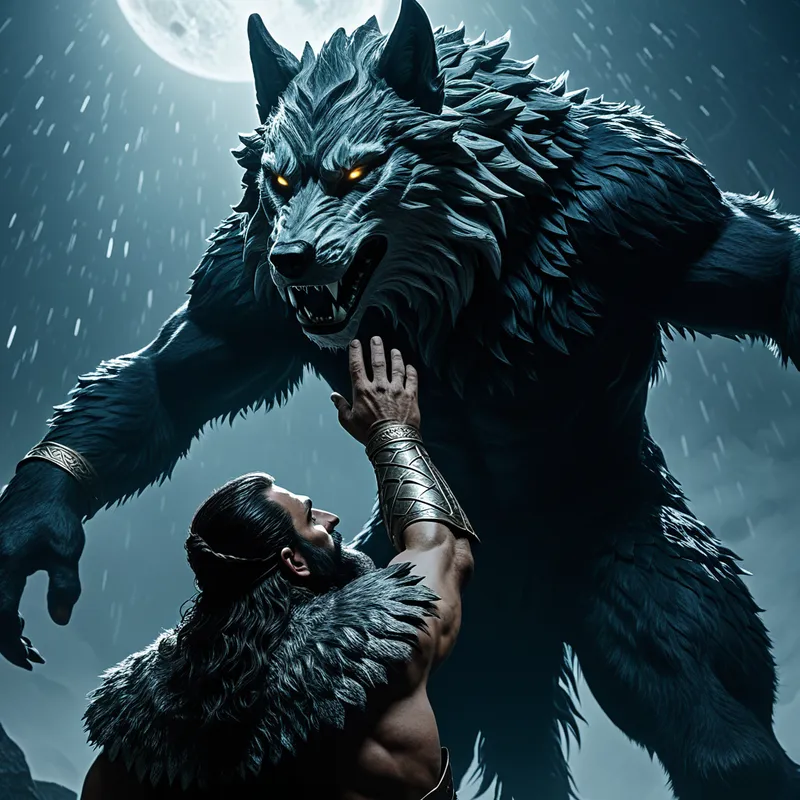
The gods fell silent. The wind hissed through the marsh grass. Then one figure stepped forward. Tyr, whose word was law, whose courage was as steadfast as his sword. Without a word, he placed his right hand—the hand of oath and deed—between the jaws of the beast.
The gods bound Fenrir. The more he struggled, the tighter the silken band became, biting into his flesh, fusing with his fate. When he realized the trick, he clamped his jaws. The sound of breaking bone echoed across the silent waters. Tyr did not cry out, but his sacrifice was complete. His hand was gone, his honor kept.
They threaded a great sword through the wolf’s jaws, propping them horribly open. His howls of rage and betrayal became a river of froth, Ván, that flooded the land. There he lies, bound until the final days. Until the chains of the world break. Until Ragnarök.
Cultural Origins & Context
This myth is preserved primarily in the Poetic Edda and the later Prose Edda. These texts are our windows into a worldview forged in the harsh, sublime landscapes of Scandinavia, where order was a fragile hall built against a wilderness of ice, sea, and forest. The myths were not mere stories but a sacred narrative technology, passed by skalds (poets) and seers, used to map the psyche of a culture onto the cosmos.
The tale of Fenrir functioned as a profound cultural paradox. It validated the necessity of law, oath, and social order (represented by the gods, especially Tyr), while simultaneously acknowledging that this order was built upon a foundational act of betrayal against a raw, natural force. It taught that even divine power has limits, that fate is inexorable, and that the price of maintaining the world as it is can be a terrible, maiming sacrifice. The myth served as a container for societal anxiety about chaos, the “other,” and the inevitable crumbling of all structures.
Symbolic Architecture
Fenrir is not merely a monster. He is the embodiment of the inevitable consequence, the shadow of the gods’ own actions. He is the unchecked potential, the wild psyche, the prophecy that must fulfill itself precisely because one tries to prevent it.
The bound wolf is the power we refuse to integrate, which therefore grows in the dark until it becomes our destroyer.
He symbolizes the primal, instinctual force that civilization—whether Asgard or the human ego—must initially suppress to exist. The binding is not a victory, but a tragic, necessary postponement. The fetter Gleipnir, made of impossible things, represents the psychological “trick” we use to bind our own shadows: rationalization, complex narratives, and the repression of things deemed impossible or taboo (like the sound of a cat’s footfall). Tyr’s sacrifice is the core of the myth’s moral architecture. It represents the conscious acceptance of terrible cost, the understanding that to engage with the shadow, to make an oath with destiny, one must willingly offer up a piece of one’s own perceived wholeness and control.
The Dreamer’s Resonance
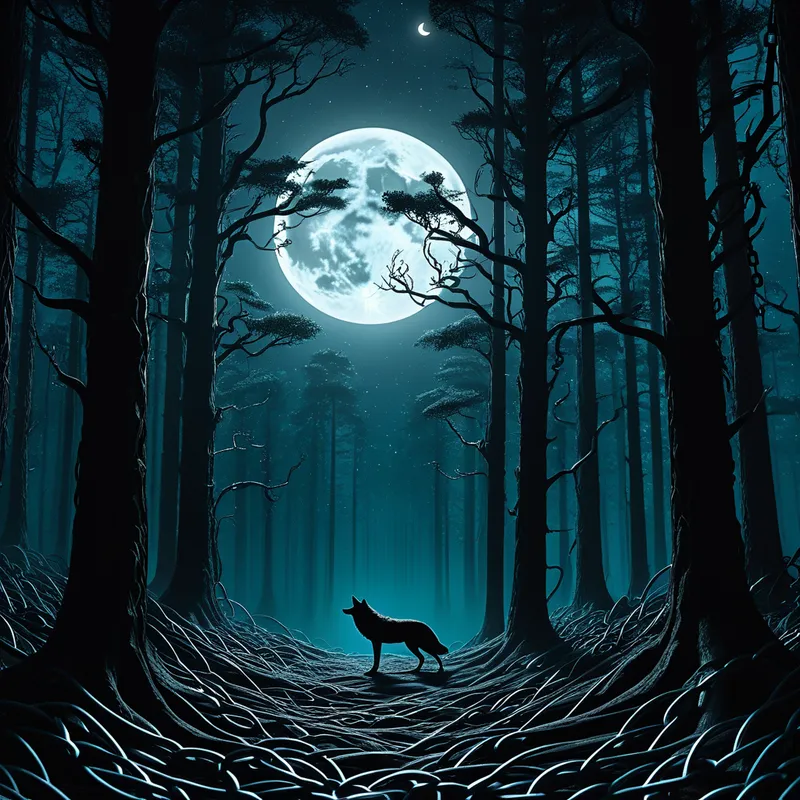
When Fenrir pads into the modern dreamscape, he rarely appears as a literal wolf. He may manifest as a feeling of being trapped or bound by a seemingly insignificant, silken thread—a social obligation, a subtle anxiety, a repressed emotion that holds immense power. He is the growing dread, the project you fear will consume you, the addiction, the rage you keep muzzled.
Dreams of Fenrir often accompany a somatic process of confronting a “too-big” feeling. The dreamer may feel their own jaw locked, or hear a distant, resonant howl that vibrates in their bones. This is the psyche signaling that a contained force is straining at its bindings. The drool-river Ván translates as the psychic energy—the anxiety, the anticipation, the “what if”—that floods our life when a major part of our nature is imprisoned and salivating for release.
Alchemical Translation
The myth of Fenrir models a critical, non-negotiable stage of individuation: the confrontation with the Self as both creator and destroyer. The ego (the society of the gods) builds its identity by binding the terrifying, transformative power of the unconscious (Fenrir). This is necessary for a time, to establish a coherent personality.
The alchemical work is not to slay the wolf, but to sit at the edge of the river Ván and finally listen to what it has been howling for all these years.
The process begins with recognizing the “Gleipnir” in our own life—the clever, subtle stories we’ve woven to keep our raw power in check. The alchemical translation is the journey to Lyngvi, the isolated place within where this binding occurs. There, one must make a Tyr-like sacrifice: to willingly offer one’s hand—one’s capacity for control and sure action—into the maw of the repressed content. This is the act of conscious suffering, of allowing a part of the old, controlling ego to be severed so that a deeper integrity can emerge.
The goal is not to unleash chaos, but to transform the relationship from one of binding to one of recognition. At Ragnarök, Fenrir breaks free and fulfills his destiny. Psychologically, this is the moment when the repressed content finally erupts, often as a crisis that destroys the old, rigid personality structure. The alchemical work seeks to initiate a “Ragnarök-by-consent”—a voluntary dissolution of the outmoded ego so that the wolf can be met not as an external destroyer, but as an immense, terrifying, and essential part of the whole Self. In this meeting, at the end of one world and the beginning of another, lies the only true freedom.
Associated Symbols
Explore related symbols from the CaleaDream lexicon: