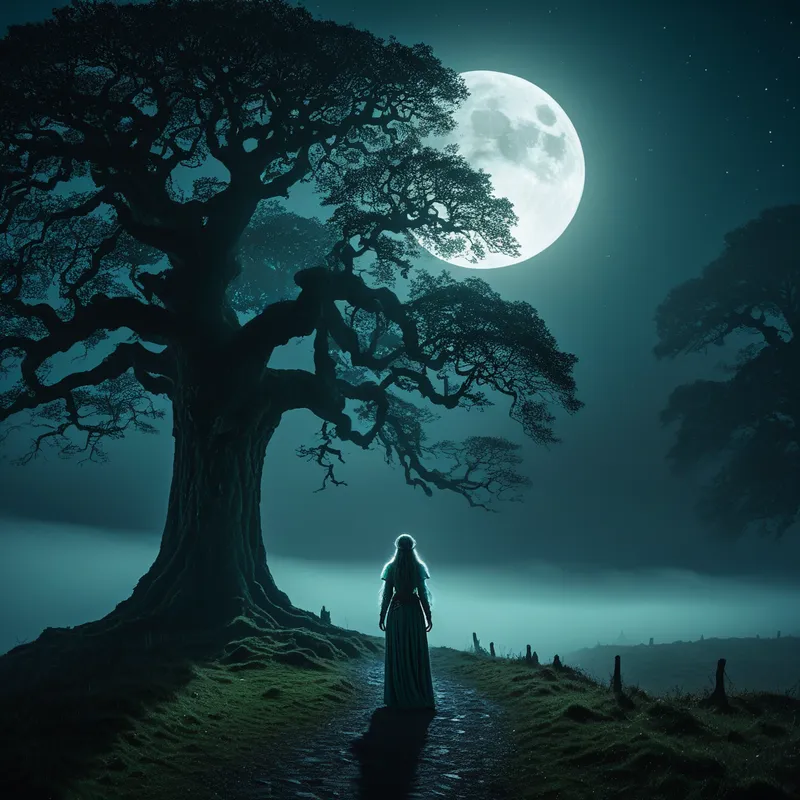
The Witching Hour Myth Meaning & Symbolism
A mythic tale of the liminal hour where the Otherworld bleeds into our own, demanding courage, respect, and the integration of the unseen.
The Tale of The Witching Hour
Listen now, and pull your cloak tight. The fire is low, and the wind carries a scent of damp earth and cold stone. This is the hour when the world holds its breath—the space between the last note of the owl’s cry and the first hint of the lark’s song. They call it the Witching Hour.
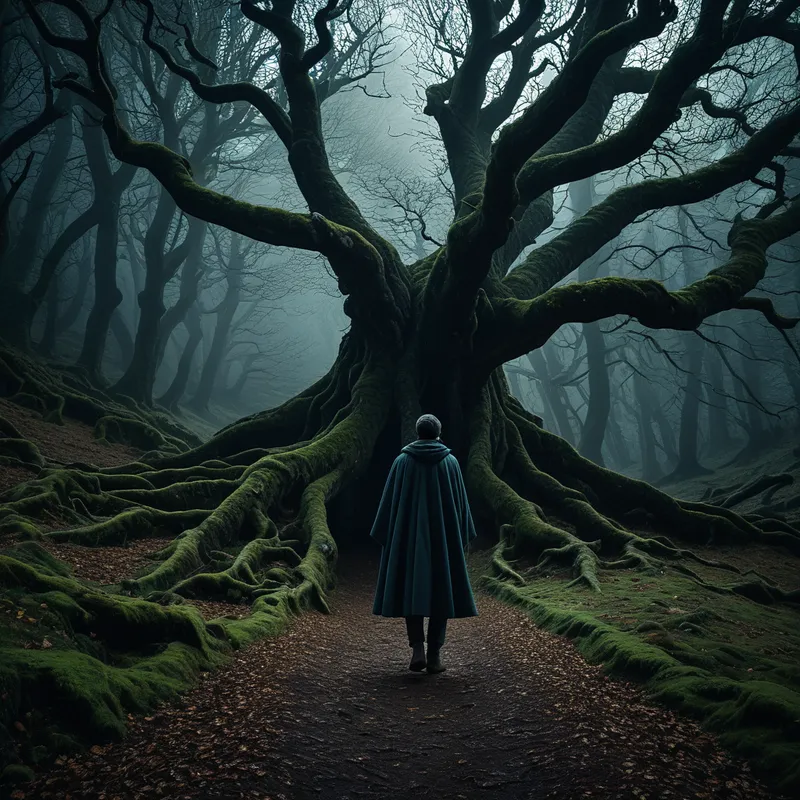
In the heart of the Dúiche Dorcha, where the roots of the oak know the secrets of the bedrock, there was a path walked only by fools and the fated. A young warrior, Donnchadh, driven by a boast and a dare, vowed to keep vigil at the crossroads from dusk till dawn. His companions laughed, but their laughter died in their throats as the sun fled the sky.
He sat, his back against the cold standing stone, feeling the day’s warmth bleed from the land. The familiar shapes of bush and tree melted into looming shadows. The silence became a presence. First, he heard it—a whisper, not in the air, but in the marrow of his bones. Then, he saw them: faint, shimmering lights, like will-o’-the-wisps, dancing at the edge of vision. They were the Aos Sí, beginning their procession.
He made himself small, reciting the old protective charms under his breath. But the procession grew. Shadowy forms, tall and graceful, with eyes like polished river stones, glided past. He saw the Cóiste Bodhar, the silent coach, drawn by headless horses, and he froze, knowing to see its passenger was to invite his own name onto its list. He pressed his face to the earth, the taste of soil and iron on his tongue.
Just when he thought the tide of spirits would sweep him away, a different presence arrived. The whispering ceased. The dancing lights stilled. From the deepest gloom of the forest path emerged a figure—a woman, yet not a woman. She was clad in grey and crimson, her hair the colour of a raven’s wing, and her gaze held the chill of a midwinter lake. It was the Morrígan. She stopped before the stone, and her eyes found Donnchadh, not with malice, but with an ancient, unbearable knowing.
“You sought the threshold, child of clay,” her voice was the sound of stones grinding in a distant stream. “Do you have the sight to bear it?”
Terror threatened to unmake him. But deep within, beneath the fear, a spark of the vow he had made flared. He did not look away. He did not speak a boast. Instead, slowly, with a hand that trembled, he took from his pouch the last of his journey-bread and a sprig of dair, and laid them on the ground before her—an offering, not a challenge.
For a long moment, she considered him and the humble gift. The spectral host watched in absolute silence. Then, without a word, she turned. As she faded back into the forest, the tension broke. The whispering resumed, but softer now. The lights began to dim. One by one, the presences withdrew, flowing back into the hills and the hollow trees. Donnchadh remained, shivering in the sudden, profound cold of the pre-dawn, alive. The first true birdcall pierced the grey air, and the Witching Hour was done.
Cultural Origins & Context
The concept of the Witching Hour is not a single, codified myth but a pervasive folk belief woven through the tapestry of Celtic cultures, from Ireland to Scotland to Wales. It belongs to the oral tradition, passed down not by bards in royal halls, but by seanchaí (storytellers) and grandmothers by the hearth. Its function was deeply pragmatic and spiritual: it was a map of danger and a guide to etiquette for the unseen world.
This belief system emerged from a worldview that saw the cosmos as layered. The world of everyday life (An Domhan Láir) was just one plane, existing alongside the Tír na nÓg or the sídhe. Time and space were not rigid but fluid, with certain times and places acting as thin points in the veil. The hour after midnight, particularly around 3 AM, was one such potent liminal time. It was a time outside of time, when normal laws were suspended, and the Aos Sí were most active.
The myth served as a societal injunction. It taught respect for the unseen, prescribed protective behaviors (staying indoors, bringing in children, leaving offerings), and explained strange occurrences—missing livestock, sudden illnesses, or eerie sounds. More profoundly, it acknowledged that the human psyche and community existed within a larger, animate, and sometimes perilous cosmos that demanded awareness and reverence.
Symbolic Architecture
At its core, the Witching Hour myth is a masterful depiction of the psyche’s encounter with the Self and the contents of the unconscious. The familiar daytime world represents the conscious ego—ordered, known, and safe. The descent of night, and specifically the Witching Hour, symbolizes the ego’s journey into the unknown depths of itself.
The Aos Sí are not merely external sprites; they are psychic phenomena. They represent autonomous complexes, forgotten memories, ancestral patterns, and instinctual forces that reside in the personal and collective unconscious. The Cóiste Bodhar is the archetype of death and transformation, the necessary end of an old psychological attitude.
The true challenge of the liminal is not to fight the shadows, but to meet the gaze of the sovereign who rules them.
The Morrígan is the ultimate symbol here. She is the anima in her most formidable aspect, or the Self as the central organizing principle of the psyche. She is the ruler of this shadowy realm. Donnchadh’s offering—a gesture of humility, respect, and symbolic exchange—is the critical act. It represents the ego’s acknowledgment of a power greater than itself, its willingness to engage not through heroic conquest but through conscious relationship.
The Dreamer’s Resonance
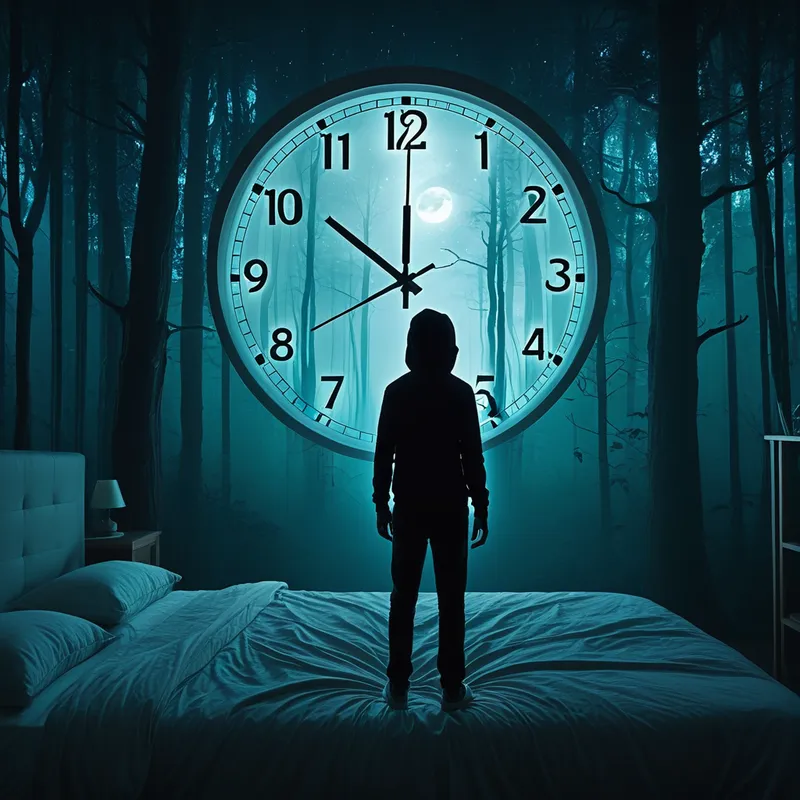
When a modern dreamer encounters the landscape of the Witching Hour—finding themselves awake in a dream at 3 AM, hearing whispers in a familiar house now gone strange, or seeing spectral figures at a window—they are experiencing a direct resonance with this mythic pattern. Psychologically, this signals a potent activation of the unconscious.
Somatically, it may feel like a chilling dread, a paralysis, or a racing heart—the body’s ancient alarm system responding to perceived threat. This is the psyche’s “liminal time,” often occurring during life transitions, periods of deep stress, or when repressed material demands integration. The dream-ego, like Donnchadh, is stationed at a personal crossroads.
The figures that appear are messengers. A threatening presence might symbolize a repressed fear or a powerful aspect of the dreamer’s own character they have disowned. A guiding, if eerie, light could be an intuition or insight breaking through. The critical process is the dreamer’s reaction. Do they flee, fight, hide, or freeze? Or is there a moment, however small, of turning toward the phenomenon with curiosity? That moment is the beginning of the alchemical work.
Alchemical Translation
The myth of the Witching Hour models the alchemical nigredo, the necessary descent into darkness for purification and transformation. Donnchadh’s journey is one of psychic transmutation, a blueprint for individuation.
First, there is the Call to the Threshold: The boast or dare that leads him to the crossroads. In our lives, this is the crisis, the depression, the nagging feeling, or the synchronicity that pushes us toward unfamiliar inner territory. We must leave the comfort of the known (the firelit hall) for the unknown (the dark forest).
Second, the Confrontation with the Shadow: The procession of spirits. This is the stage of shadow-work, where we encounter the repressed, the shameful, the fearful, and the autonomous complexes that have been running our lives from the basement of the psyche. It is chaotic, frightening, and feels alien.
Individuation is not achieved by banishing the spirits, but by learning their language and paying their due.
Third, and most crucial, is the Encounter with the Sovereign: Meeting the Morrígan. This is the confrontation with the core of the Self. The ego’s grandiosity is stripped away. The heroic solution (fighting) is useless. The only viable action is the symbolic, humble offering—the surrender of ego-control and the acknowledgment of a higher, integrating principle within.
The resolution—surviving until dawn—symbolizes the albedo. The dreamer, or the individual in analysis, returns to consciousness changed. They have not “solved” the unconscious, but they have established a line of communication. They have learned that the Witching Hour within is not a curse to be avoided, but a sacred, if terrifying, space where the soul’s most profound work of integration is done. The world looks the same at dawn, but the one who kept vigil is forever altered, carrying a hard-won respect for the vast, mysterious country that exists just beyond the hearth-light of daily awareness.
Associated Symbols
Explore related symbols from the CaleaDream lexicon: