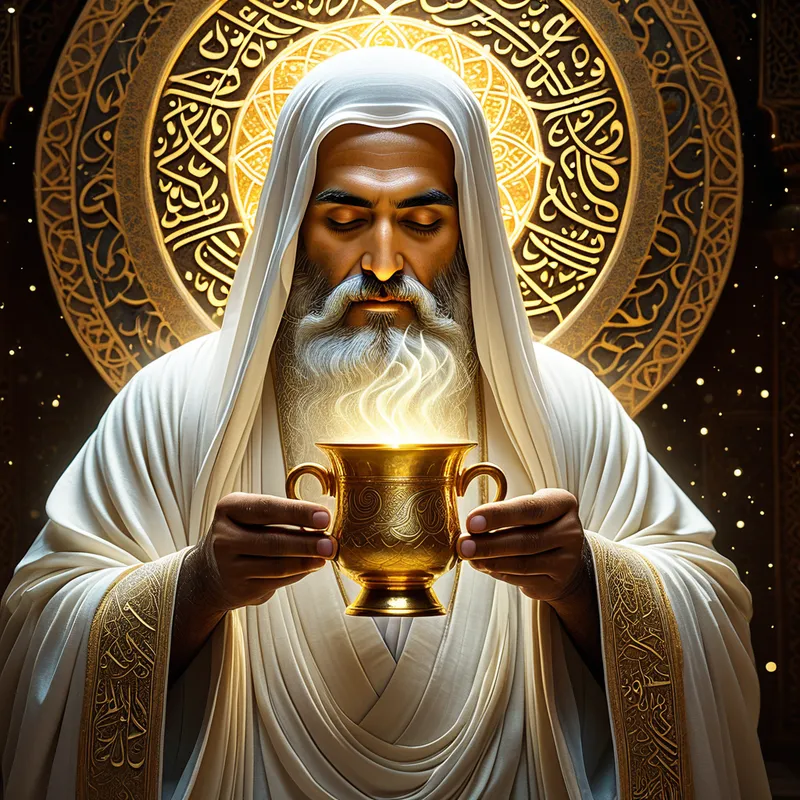
The Wine of the Mystics Myth Meaning & Symbolism
A mystical allegory where the seeker drinks a divine wine, shattering the ego's vessel to become one with the infinite, eternal Beloved.
The Tale of The Wine of the Mystics
Listen, and let the veils thin.
There was once a seeker, a traveler of the path, whose thirst was a desert inside his ribs. He had walked from city to city, sat at the feet of masters, memorized the sacred texts until the words were worn smooth as river stones in his mind. Yet his heart remained a locked chest, his soul a dry well echoing with the wind of his own longing. He knew about the Beloved, but he did not know the Beloved. This knowing was a fire he could not light.
One evening, as the sun bled into the horizon, he found himself in a quarter of the city he had never seen. The air smelled of dust and distant spices. A narrow alley led him to a door, unmarked, from which a faint, amber light spilled. A sound drew him—not music, but the resonant silence that follows a perfect note. He pushed the door.
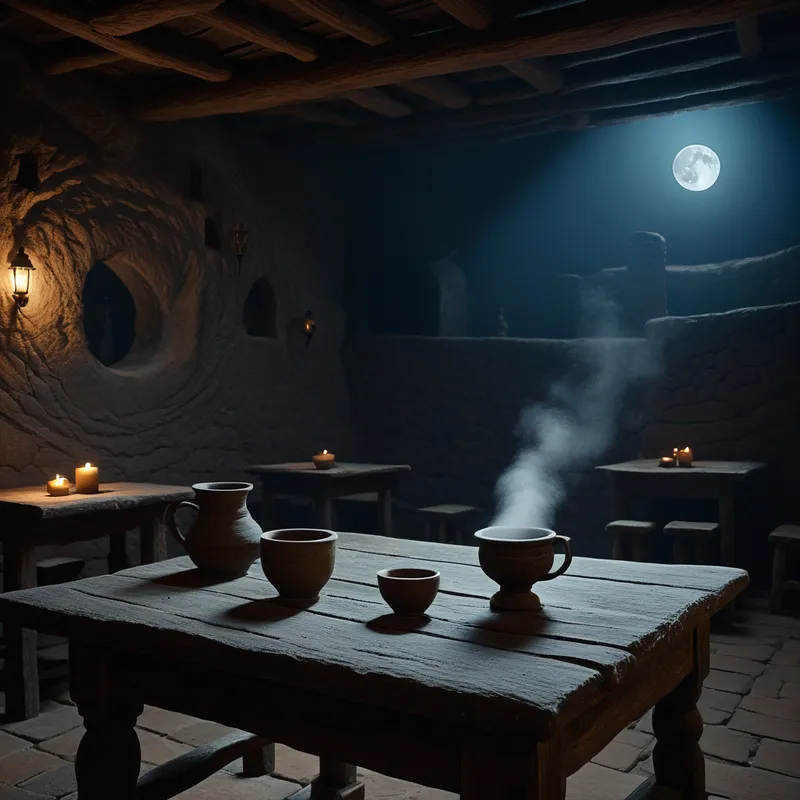
Within was no grand hall, but a simple room. A few others sat on worn carpets, their faces turned toward an old man who seemed less a man and more a stillness given form. This was the Murshid. Before him sat a single, unadorned cup. It was not gold nor silver, but plain clay, the color of earth after rain.
The Murshid looked at the seeker, and his gaze was like a key turning in a long-rusted lock. Without a word, he lifted the cup. It was full of a wine that was no wine—it shimmered with a light that had no single color, holding within it the deep purple of twilight, the gold of dawn, and the clear black of the space between stars.
“This,” said the Murshid, his voice the sound of a distant river, “is the Wine of the Mystics. It is pressed from the grapes of annihilation. To drink is to die. To die is to live.”
A terror, cold and sharp, seized the seeker’s throat. To drink was to lose everything he was—his name, his learning, the very “he” that was thirsty. Yet the thirst itself roared, a lion in the cage of his chest. The wine in the cup called to a deeper, forgotten part of him, a part that remembered flight.
Hand trembling, he reached out. His fingers closed around the clay. It was warm, like a living thing. He brought it to his lips.
The first drop was fire and ice. It was the taste of every goodbye and every homecoming. It flooded him, not through his throat, but through the cracks in his soul he never knew were there. The room dissolved. The faces of the others melted into light. His body—the vessel of his pride and pain—began to tremble, not with fear, but with a seismic joy. He felt the clay of his own being crack.
He was no longer drinking the wine. The wine was drinking him. It consumed his memories, his regrets, his cherished identity, turning all to vapor. In the great annihilating fire, a single truth remained, singing: I am not. Only Thou art.
And in that utter, blissful zero, he found the infinite one. The shattered pieces of his self did not vanish; they became mirrors, each reflecting the face of the Beloved. The drinker, the wine, and the cup were one. The seeker was gone. Only the Sought remained, gazing at Itself in the ecstatic silence of its own eternal being.
Cultural Origins & Context
The allegory of the Wine of the Mystics is not a single, codified myth but a pervasive and potent metaphor that flows through the bloodstream of Sufism. It finds its most famous poetic expression in the works of masters like Jalal ad-Din Rumi and Hafez, for whom the tavern (kharabat) and the cup of wine (jam) are central images. This “wine” is strictly forbidden in orthodox Islam, making its symbolic use a powerful act of mystical rebellion, pointing to an intoxication beyond the law—the ecstasy of divine love (‘ishq).
The tale was passed down not in scriptures, but in the oral teachings of Sufi orders (tariqas), in the rhythmic chanting of dhikr (remembrance of God), and most importantly, in the poetry sung in gatherings (sama). Its societal function was subversive and transformative. It offered a map of the inner journey (suluk) for the initiate, validating the experience of ego-dissolution (fana) as the necessary prelude to abiding in God (baqa). It served as a coded language, a way for mystics to communicate profound, often ineffable experiences of union to those with ears to hear, while remaining veiled to literalist authorities.
Symbolic Architecture
The myth is a perfect symbolic diagram of the Sufi [path](/symbols/path “Symbol: The ‘path’ symbolizes a journey, choices, and the direction one’s life is taking, often representing individual growth and exploration.”/). The [Seeker](/symbols/seeker “Symbol: A person actively searching for meaning, truth, or a higher purpose, often representing the dreamer’s own quest for identity or fulfillment.”/) represents the conscious ego, the nafs (the lower self), which is all desire and restlessness. The Murshid is the guiding principle of higher [consciousness](/symbols/consciousness “Symbol: Consciousness represents the state of awareness and perception, encompassing thoughts, feelings, and experiences.”/) or the transmitted grace of the [lineage](/symbols/lineage “Symbol: Represents ancestral heritage, family connections, and the transmission of traits, values, and responsibilities across generations.”/), the necessary catalyst for the transformation.
The cup is the human heart, which must be empty of self to be filled with the divine. It is cracked by the very intensity of what it contains, for a perfect vessel could hold the ocean, but never become it.
The [Wine](/symbols/wine “Symbol: Wine often symbolizes celebration, indulgence, and the deepening of personal connections, but it can also represent excess and escape.”/) itself is the essence of divine [reality](/symbols/reality “Symbol: Reality signifies the state of existence and perception, often reflecting one’s understanding of truth and life experiences.”/) (haqiqa), the uncreated light of God’s love and [knowledge](/symbols/knowledge “Symbol: Knowledge symbolizes learning, understanding, and wisdom, embodying the acquisition of information and enlightenment.”/). It is “intoxicating” because it shatters the rational, ordering mind, allowing the intuitive, unitive [heart](/symbols/heart “Symbol: The heart symbolizes love, emotion, and the core of one’s existence, representing deep connections with others and self.”/) to perceive. The act of drinking is the total surrender (islam in its deepest sense) of the will, the final “yes” that allows the process of psychic [death](/symbols/death “Symbol: Symbolizes transformation, endings, and new beginnings; often associated with fear of the unknown.”/) and [rebirth](/symbols/rebirth “Symbol: A profound transformation where old aspects of self or life die, making way for new beginnings, growth, and renewal.”/) to commence. The tavern is the world itself, or the Sufi lodge—the humble, often scorned place where this radical [alchemy](/symbols/alchemy “Symbol: A transformative process of purification and creation, often symbolizing personal or spiritual evolution through difficult stages.”/) occurs, far from the proud mosques of mere [outward](/symbols/outward “Symbol: Movement or orientation away from the self or center; expansion, expression, or externalization of inner states into the world.”/) observance.
The Dreamer’s Resonance
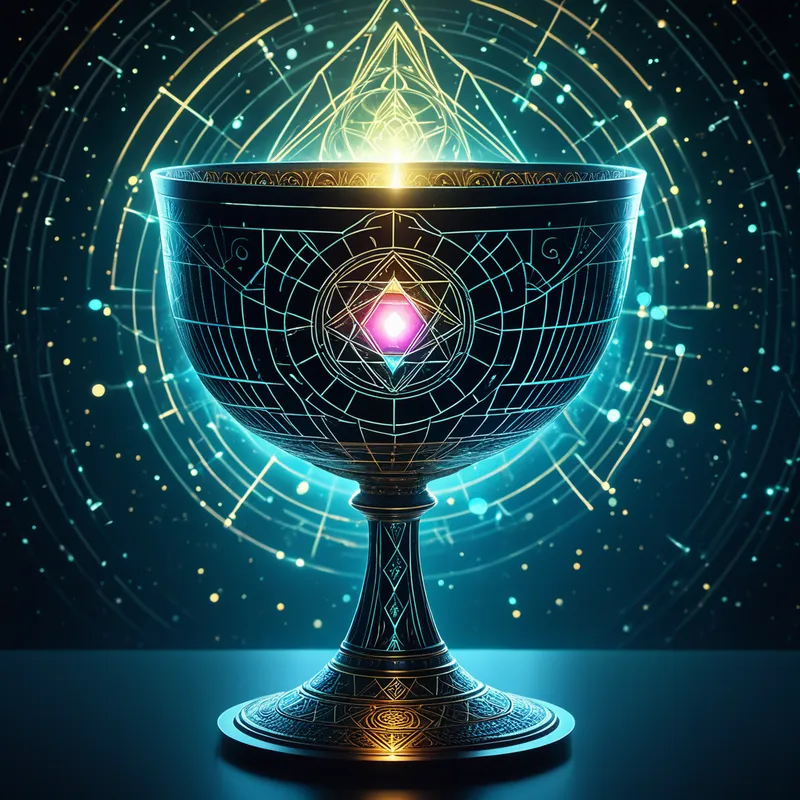
When this myth stirs in the modern dreamer, it signals a profound somatic and psychological tipping point. To dream of being offered a strange, luminous drink, or of finding a cup that glows with inner light, speaks to a soul-deep readiness for a fundamental change that the conscious personality fears.
The body may register this as anxiety—the “trembling hand” of the dream-ego. This is the somatic signature of the ego sensing its own impending dissolution. The dreamer is at the threshold where accumulated knowledge, therapy, and self-improvement have reached their limit. A deeper, more terrifying, and more ecstatic process is being demanded: not adjustment, but annihilation of the old identity structure. The dream is the unconscious presenting the cup, saying the old self must die for the more authentic, unified Self to be born. The conflict is not against an external monster, but against the inner inertia that clings to the familiar prison of “me.”
Alchemical Translation
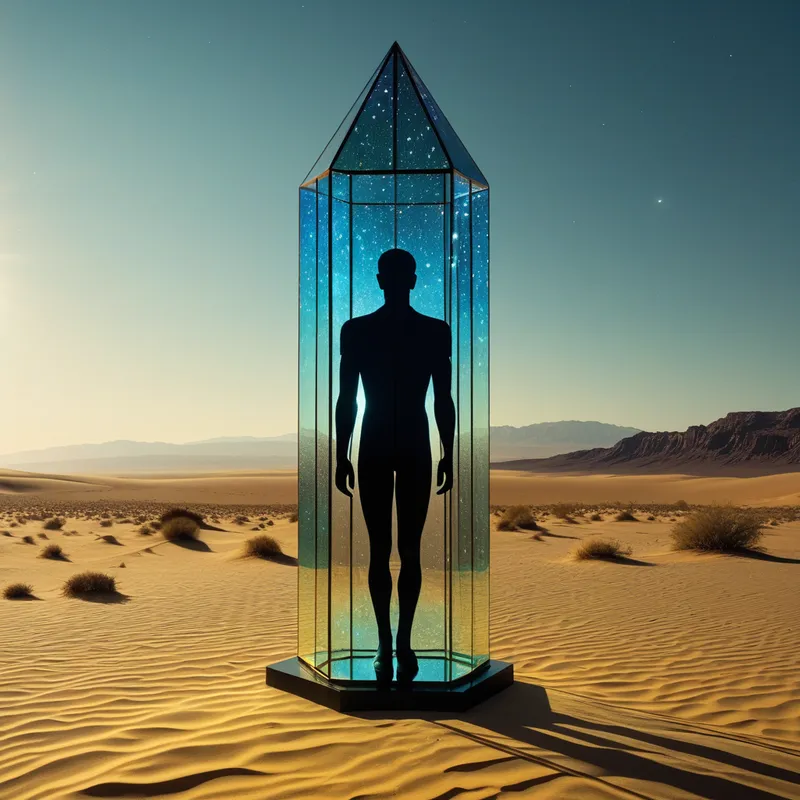
Psychologically, the myth models the pinnacle of the individuation process: the integration of the Self, where the ego-consciousness relinquishes its central command and acknowledges a greater, transpersonal authority within.
The “drunkenness” is the state where the complexes dissolve, and the psyche is flooded with the contents of the collective unconscious—not as a chaotic invasion, but as a unitive knowing. The ego becomes a permeable membrane, not a fortress wall.
The first alchemical stage is nigredo: the “thirst,” the dark night of the soul, the feeling of arid intellectualism or emotional emptiness. The meeting with the Murshid is the beginning of albedo—the illumination, the granting of the transformative agent (the wine). The drinking is the rubedo, the reddening, the fierce, passionate agony and ecstasy of transformation where the lead of the ego-personality is exposed to the sacred fire. The shattering of the cup is the mortificatio, the necessary death. The final union is the coniunctio oppositorum (the conjoining of opposites)—the marriage of the limited human consciousness with the infinite, archetypal realm of the Self.
For the modern individual, this translates to the moment when one must “drink” a painful truth, a overwhelming grief, a boundless love, or a revolutionary insight that one knows will irrevocably change them. It is the choice to be shattered by reality rather than to maintain the illusion of a separate, intact self. The triumph is not victory, but unity; not achievement, but homecoming.
Associated Symbols
Explore related symbols from the CaleaDream lexicon:
- Cup — The vessel of the heart or soul, which must be offered, filled, and ultimately broken open to achieve union with the divine essence.
- Wine — The intoxicating spirit of divine love and gnosis, the transformative agent that dissolves the boundaries of the separate self.
- Fire — The purifying and annihilating force of divine passion that consumes the dross of the ego in the ecstasy of union.
- Door — The threshold of initiation, the moment of choice where the seeker leaves the known world of the ego to enter the mysterious tavern of transformation.
- Mirror — In the state of union, all shattered fragments of the self become mirrors reflecting the one true Reality, the face of the Beloved.
- Death — The essential, voluntary death of the ego-identity, the fana, which is the only gateway to true spiritual life and abiding (baqa).
- Light — The uncreated, radiant essence of the Divine that constitutes the “Wine,” illuminating and transmuting all it touches from within.
- Heart — The central organ of mystical perception, the seat of the inner cup, which aches with thirst until it is shattered by the fullness of what it desires.
- Thirst — The fundamental driving ache of the soul, the divine discontent that propels the seeker on the entire journey toward the source.
- Union — The ultimate goal and resolution of the myth, the state where all duality between lover and Beloved, drinker and wine, is completely erased.
- Ecstasy — The overwhelming somatic and emotional state that accompanies the dissolution of the ego, a joy beyond comprehension that is often indistinguishable from agony.