The Wind Myth Meaning & Symbolism
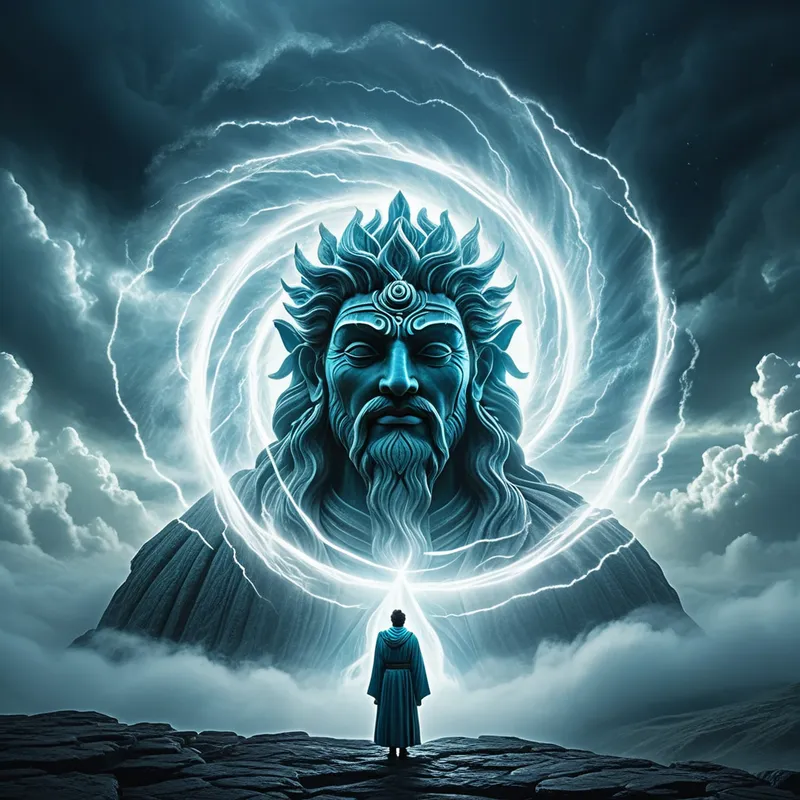
The Wind is the world's first breath, a restless deity of change, messenger of the gods, and the invisible force that sculpts all life and destiny.
The Tale of The Wind
In the time before time, when [the world](/myths/the-world “Myth from Tarot culture.”/) was a sleeping giant of stone and sea, there was silence. A deep, dreaming silence. Then, from [the void](/myths/the-void “Myth from Buddhist culture.”/) between the stars, from the hollow of the mountain’s heart, it came. Not with a roar, but with a sigh—the first sigh. It was the Wind.
It slipped through the unmoving branches of the first forest, and the trees learned to whisper. It skimmed the face of the still waters, and [the sea](/myths/the-sea “Myth from Greek culture.”/) learned to ripple and dance. It was restless, ceaseless, a traveler with no home. It was called by many names: the Boreas who rode down from the ice-rimmed mountains with a cloak of snow; the [Zephyrus](/myths/zephyrus “Myth from Greek culture.”/) who carried the scent of blooming orchards; the Eurus and the fierce Notus. They were brothers, children of the dawn and dusk, each with a temper and a task.
But the Wind was more than these faces. It was the messenger. When the Sky Father wished to speak to the Earth Mother, he sent the Wind to carry his words, rustling through her grassy hair. It carried the seeds of the [World Tree](/myths/world-tree “Myth from Global culture.”/) to barren lands, and the prayers of mortals from smoky altars up to the ears of the gods. It could be a gentle caress, coaxing a sail across the wine-dark sea, or a furious shriek, tearing the roofs from houses and upending the order of things.
The great conflict was not of its making, but of its nature. For the Wind, in its essence, was change. It opposed the stagnant, the fixed, the tyrannical stillness. It was said that a cruel king, who demanded absolute silence in his realm, once built a palace of crystal without a single crack or door. He imprisoned the very air. For a day, there was perfect, dead quiet. Then, a low hum began, a vibration born of pure yearning. It grew to a moan, then a scream that no wall could contain. The crystal palace did not shatter; it sang itself into a new, wild shape, full of whistling arches and humming corridors, and the king was never heard from again. The Wind had translated him into a lesson.
Its story has no end, for its resolution is eternal motion. It is the breath in your lungs right now—the same breath that animated [the first storyteller](/myths/the-first-storyteller “Myth from Global culture.”/) under the first stars. It is the unseen hand that turns the page, the invisible force that promises that nothing, not even stone, sleeps forever.

Cultural Origins & Context
The myth of the Wind is perhaps humanity’s most universal narrative, born not from a single culture but from the shared somatic experience of existence. Every human, in every corner of the globe, has felt the caress and the lash of the air in motion. This myth emerged independently among seafaring Polynesians navigating by the stars and the trades, the steppe nomads of Mongolia who heard the voices of ancestors in the whistling grasslands, the Indigenous peoples of the Americas who understood the directions as sacred grandfathers, and the ancient Greeks who systematized them into Anemoi.
It was passed down not in codified epics alone, but in practical knowledge and daily ritual. The farmer knew the myth in the feel of an approaching rain-laden breeze; the sailor knew it in the set of the sails. It was told by elders explaining the weather, by parents calming a child frightened by a storm, and by shamans who interpreted its sounds as the language of spirits. Its societal function was fundamental: to explain the most powerful invisible force in the natural world, to offer a way to relate to it (through prayer, sacrifice, or respect), and to encode vital survival information about weather patterns and seasonal change into a memorable, personified story.
Symbolic Architecture
Psychologically, the Wind is the archetypal [symbol](/symbols/symbol “Symbol: A symbol can represent an idea, concept, or belief, serving as a powerful tool for communication and understanding.”/) of the [Spirit](/symbols/spirit “Symbol: Spirit symbolizes the essence of life, vitality, and the spiritual journey of the individual.”/) itself—invisible, intangible, yet possessing undeniable force and [presence](/symbols/presence “Symbol: Presence in dreams often signifies awareness or acknowledgment of something significant in one’s life.”/). It represents the [psyche](/myths/psyche “Myth from Greek culture.”/) in its dynamic, flowing state.
The Wind is the breath of the world-soul, the invisible mover that proves reality is not solid, but a relationship between forces.
It symbolizes Change as a primal, neutral constant. It is not “good” or “evil”; it is the agent of [erosion](/symbols/erosion “Symbol: Erosion in dreams represents gradual decay, loss of structure, or the wearing away of foundations over time through persistent forces.”/) and [pollination](/symbols/pollination “Symbol: Symbolizes natural exchange, fertilization, and the transfer of life essence, often representing emotional or creative cross-pollination.”/), of destruction and dissemination. It scatters the old order and brings the seeds of the new. It is Communication, the connective [tissue](/symbols/tissue “Symbol: Represents emotional release, vulnerability, and the delicate nature of feelings or physical fragility.”/) between realms ([heaven](/symbols/heaven “Symbol: A symbolic journey toward ultimate fulfillment, spiritual transcendence, or connection with the divine, often representing life’s highest aspirations.”/)/[earth](/symbols/earth “Symbol: The symbol of Earth often represents grounding, stability, and the physical realm, embodying a connection to nature and the innate support it provides.”/), gods/humans, conscious/unconscious) and the [carrier](/symbols/carrier “Symbol: A tool or object that transports, holds, or conveys something from one place to another, often representing responsibility, burden, or the movement of ideas.”/) of thought, inspiration, and rumor. Most profoundly, it embodies Freedom and the unbound psyche. It cannot be owned, caged, or truly directed; it is the ultimate non-[conformist](/symbols/conformist “Symbol: A person who adheres to established social norms, often suppressing individuality for acceptance.”/), answerable only to its own mysterious laws.
The different winds represent the facets of our own emotional and psychic weather: the gentle Zephyrus of creative inspiration, the fierce Notus of passionate upheaval, the clearing Boreas of cold, rational thought. The myth teaches that to be alive is to be subject to these internal winds, and wisdom lies not in stopping them, but in learning to set your sail.
The Dreamer’s Resonance
When the Wind appears powerfully in modern dreams, it often signals that the dreamer’s psyche is in a state of powerful, yet intangible, flux. A gentle, soothing breeze may indicate the arrival of new inspiration or a sense of spiritual relief—the feeling of “fresh air” in a stifling life situation. A howling gale or tornado, however, almost always points to intense emotional or psychological turbulence that feels outside of the dreamer’s control. The dream ego is often buffeted, struggling to stand, or seeking shelter.
Somatically, this connects to anxiety—that feeling of a “knotted” stomach or “tight” chest that is the body’s response to unseen threats. The dream of a great wind is the psyche’s dramatization of this internal pressure system. It asks: What force is threatening to uproot you? What old, rigid structure in your life is being tested? The wind in dreams rarely speaks in words; it communicates through pure sensation and transformative action. To dream of speaking to the wind, or of understanding its language, suggests a profound step toward integrating the unconscious, chaotic, or spiritual elements of [the self](/myths/the-self “Myth from Jungian culture.”/) that have felt alien and external.
Alchemical Translation
The alchemical process mirrored in the Wind myth is the [Solve et Coagula](/myths/solve-et-coagula “Myth from Alchemical culture.”/)—“Dissolve and Coagulate.” The Wind is the prime agent of Solve. It dissolves the fixed, the calcified, the outworn identities and psychic structures that imprison the individual. This is the storm that tears the roof off the house of [the ego](/myths/the-ego “Myth from Jungian culture.”/), exposing its inhabitants to the vastness of [the sky](/myths/the-sky “Myth from Persian culture.”/). It is a terrifying but necessary stage of individuation.
The individual must first be scattered, like seeds before the gale, before they can take root in soil they did not choose, becoming a self they did not plan.
The subsequent Coagula is not performed by the Wind, but is made possible because of it. The scattering allows for new combinations. The seeds of potential carried from afar find new ground. The inspired thought (“a gust of inspiration”) coalesces into a new idea. The psychic dissolution allows for a reintegration at a higher, more complex level. The modern individual undergoing this process may feel “blown about by fate” or “lost in the storm.” The myth validates this experience not as a failure, but as the essential, chaotic first phase of [the Magician](/myths/the-magician “Myth from Tarot culture.”/)‘s work—disrupting the old reality to make space for the new. The goal is not to become the still point in the storm, but to learn the art of navigation, to become, in a sense, the sailor who uses the very forces that threaten to destroy them to journey toward a distant and unknown shore.
Associated Symbols
Explore related symbols from the CaleaDream lexicon: