The Wilderness Myth Meaning & Symbolism
A people, freed from bondage, wander a vast desert for forty years, tested by hunger, doubt, and their own nature, to become a covenant nation.
The Tale of The Wilderness
Listen. There is a story written not on [papyrus](/myths/papyrus “Myth from Egyptian culture.”/), but on the skin of a people, in the salt of their tears and the dust of their feet. It begins not with a king, but with a cry—a cry that rose from the mud-brick pits of Mitzrayim, a cry heard in the very bones of the cosmos.
And a voice answered, not from a palace, but from a burning bush in the forgotten backcountry of Midian. It called a stuttering shepherd, [Moses](/myths/moses “Myth from Biblical culture.”/), and gave him a staff that could drink [the sea](/myths/the-sea “Myth from Greek culture.”/) and a name that could not be spoken. With plagues as its arguments, this voice broke the iron will of a god-king and led a ragged multitude out from under the lash, across a seabed turned to dry ground, walls of [water](/myths/water “Myth from Chinese culture.”/) towering like crystalline mountains on either side.
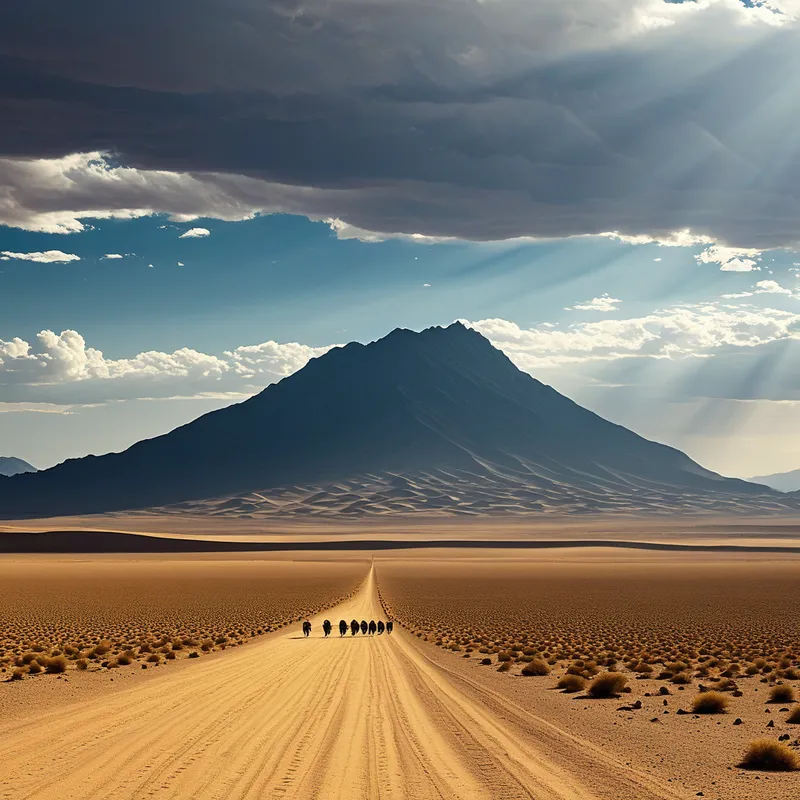
They emerged, breathless and singing, on the far shore. Before them lay not a land of milk and honey, but the Wilderness. An expanse of sheer, terrifying possibility. A landscape of stone and sky, where [the horizon](/myths/the-horizon “Myth from Various culture.”/) shimmered with heat and doubt. Here, the memory of slavery—the certainty of a meager ration—began to taste sweeter than the uncertain freedom of the open waste.
Their hunger became a roar. Their thirst became a madness. And from the barren rock, the voice provided: fine, flaky [manna](/myths/manna “Myth from Biblical culture.”/) that appeared with [the dew](/myths/the-dew “Myth from Alchemical culture.”/), and water that gushed forth when Moses struck the stone. A [pillar of cloud](/myths/pillar-of-cloud “Myth from Biblical culture.”/) led them by day, a pillar of fire by night—a constant, unsettling reminder that they were not lost, but guided. They were being led, not to a city, but to a mountain: Horeb, the smoking mountain, where the voice would etch its covenant onto tablets of stone amidst thunder so thick it could be felt in the teeth.
But a people shaped by bricks cannot become a nation of priests in a day. In [the shadow](/myths/the-shadow “Myth from Jungian culture.”/) of the very mountain, they fashioned a god of their own understanding—a [Golden Calf](/myths/golden-calf “Myth from Biblical culture.”/), molten and mute. The covenant shattered before it was fully given. The wilderness, patient and severe, absorbed their rebellion, their longing, their terror. For forty years—a generation’s lifetime—they wandered in a great, purgatorial circle. Their clothes did not wear out. Their feet did not swell. They were kept alive, but not allowed to arrive. The generation that knew the taste of Egyptian leeks had to die in that sand, so that a new generation, born in [the wind](/myths/the-wind “Myth from Various culture.”/) of the wilderness, knowing no law but the voice and [the manna](/myths/the-manna “Myth from Biblical culture.”/), could be forged.
They were tested by serpents of fire and by battles with desert kings. Their leader, Moses, who spoke to the voice face-to-face as a man speaks to his friend, was himself barred from the final prize for a moment of struck-rock anger. He saw [the Promised Land](/myths/the-promised-land “Myth from Biblical culture.”/) from a high mountain in Moab, a land of vineyards and fig trees, a stark contrast to the austerity that had formed him. And then he died there, in the wilderness, his work complete. The people, under a new leader, finally crossed the Jordan, their souls etched deep with the memory of the waste, the first and truest home of their identity.
Cultural Origins & Context
This is the core narrative of the Book of Exodus and much of the subsequent books of Numbers and Deuteronomy. It is the foundational national epic of ancient Israel, likely compiled and refined during the monarchy or the Babylonian exile—periods of profound crisis where the question “Who are we?” was answered by looking back to this formative trial.
It was not merely history but liturgy, recited during pilgrim festivals like Shavuot and [Sukkot](/myths/sukkot “Myth from Jewish culture.”/). To dwell in a temporary booth for a week was to ritually re-enter the fragility and dependence of the wilderness. The story functioned as a societal mirror: it explained their unique covenantal relationship with YHWH, justified their claim to the land, and, most importantly, served as a perpetual warning and inspiration. It taught that identity is not given by empire, but forged in the vulnerable space between slavery and promise, through obedience, failure, and relentless grace.
Symbolic Architecture
The [Wilderness](/symbols/wilderness “Symbol: Wilderness often symbolizes the untamed aspects of the self and the unconscious mind, representing a space for personal exploration and discovery.”/) is the ultimate symbolic container for the liminal [space](/symbols/space “Symbol: Dreaming of ‘Space’ often symbolizes the vastness of potential, personal freedom, or feelings of isolation and exploration in one’s life.”/)—the critical, in-between state where old structures have dissolved and new ones are not yet formed. It is the anti-Egypt: where Egypt was predictable oppression, the wilderness is unpredictable freedom. It represents the terrifying necessity of de-structuring before re-structuring can occur.
The Wilderness is not a place of punishment, but of revelation. It is where the soul, stripped of the false identities provided by its ‘Egypt,’ meets its own hunger and the terrifying, intimate presence of the divine.
The forty years symbolize a complete cycle of purification, a full [gestation](/symbols/gestation “Symbol: A period of development and preparation before a significant birth or emergence, symbolizing potential, transformation, and the journey toward manifestation.”/) for a new [consciousness](/symbols/consciousness “Symbol: Consciousness represents the state of awareness and perception, encompassing thoughts, feelings, and experiences.”/). The [Tabernacle](/myths/tabernacle “Myth from Biblical culture.”/), constructed in [the desert](/myths/the-desert “Myth from Biblical culture.”/)‘s [heart](/symbols/heart “Symbol: The heart symbolizes love, emotion, and the core of one’s existence, representing deep connections with others and self.”/), symbolizes that the sacred center must be carried within; it is mobile, not fixed to a territory. The constant, complaining “murmuring” of the people is the [psyche](/myths/psyche “Myth from Greek culture.”/)’s [resistance](/symbols/resistance “Symbol: An object or tool representing opposition, struggle, or the act of pushing back against external forces or internal changes.”/) to the process, its addiction to the known [misery](/symbols/misery “Symbol: A profound state of emotional suffering, often involving deep sadness, hopelessness, and psychological distress that can manifest physically.”/) over the demanding [mystery](/symbols/mystery “Symbol: An enigmatic, unresolved element that invites curiosity and exploration, often representing the unknown or hidden aspects of existence.”/). The manna—which could not be hoarded, which required daily trust—represents grace that must be gathered anew each morning, the sustenance that comes only when we relinquish control.
The Dreamer’s Resonance
When the Wilderness appears in modern dreams, it rarely manifests as a literal desert. It is the feeling of being in a career transition, a relationship ending, a period of depression or profound doubt after a rigid belief system collapses. The somatic sense is one of exposure: feeling unsheltered, vulnerable, and disoriented. You may dream of wandering in a vast, empty office building after hours, or driving on a featureless highway with no exits.
This dreamscape signals that the dreamer is in a necessary, if painful, psychic wilderness. [The ego](/myths/the-ego “Myth from Jungian culture.”/)’s familiar landmarks—job title, relationship status, certainties—have fallen away. The dream is not a prescription for despair, but an affirmation of process. The hunger and thirst felt in the dream are the soul’s authentic needs crying out, now audible in the silence left by the departed “Egypt.” The dream asks: Can you tolerate this emptiness without rushing to build a new, premature identity (a Golden Calf)? Can you learn to gather the daily, subtle manna of small insights and moments of presence?
Alchemical Translation
The alchemical journey of the Wilderness is [the opus](/myths/the-opus “Myth from Alchemical culture.”/) of individuation. Egypt is the [prima materia](/myths/prima-materia “Myth from Alchemical culture.”/), the leaden state of unconscious identification with collective norms and personal complexes (slavery). [The Exodus](/myths/the-exodus “Myth from Abrahamic culture.”/) is the [separatio](/myths/separatio “Myth from Alchemical culture.”/), the violent, necessary rupture. But the true work happens in the [nigredo](/myths/nigredo “Myth from Alchemical culture.”/) of the desert—the blackening, the dissolution, the confrontation with the shadow (the complaining, idol-making self).
The Promised Land is not a geographic location, but a state of integrated being. One does not escape the Wilderness to reach it; one must take the Wilderness into oneself to become it.
The forty years are the slow albedo and [rubedo](/myths/rubedo “Myth from Alchemical culture.”/)—the whitening and reddening—where the elements of the personality are purified and recombined under a new, self-authored law (the covenant). The ego (Moses) that bravely led the revolt must ultimately die at the border, for the final crossing into wholeness requires surrendering the leadership of the heroic ego to the broader, wiser Self. The individual who completes this journey carries an inner tabernacle: a resilient, mobile center of meaning that is not dependent on external circumstances, forged in the very fires of uncertainty and sustained by the daily grace of conscious attention. The Wilderness, therefore, is not a place one leaves behind, but the sacred ground of becoming.
Associated Symbols
Explore related symbols from the CaleaDream lexicon: