The Wild Geese Myth Meaning & Symbolism
A myth of exiled warriors transformed into wild geese, forever yearning for their lost homeland across the sea, embodying the soul's restless journey.
The Tale of The Wild Geese
Listen now, by the fire’s glow, to a tale not of conquest, but of loss. A tale not of staying, but of going. It begins not in the green heart of Éire, but on its farthest, foam-lashed edge.
There was a king, a lord of men, whose name is lost to the sighing of [the wind](/myths/the-wind “Myth from Various culture.”/). His hall was strong, his people fierce, his heart bound to the grey stone and the green field. But fate, that weaver of shadows, cast a different lot. Through treachery or battle-luck turned sour, he was driven out. Not just he, but his band of loyal warriors—the very soul of his tribe. With the salt of their homeland’s shore still on their lips, they were cast adrift, condemned to wander.
They took to [the sea](/myths/the-sea “Myth from Greek culture.”/) in slender, skin-clad boats, [the womb](/myths/the-womb “Myth from Various culture.”/) of the ocean becoming their tomb of hope. They sought a new land, a place to plant their roots again. Some say they found it, in a hidden isle beyond the ninth wave. But the heart has its own geography, and theirs was forever mapped to the hills they had left behind. The longing did not fade; it grew. It became a physical ache, a haunting melody played on the harp of the bones. They would stand on the shores of their new home, looking east, their eyes seeing not the [water](/myths/water “Myth from Chinese culture.”/) before them, but the remembered curves of a lost valley.
And so the land itself took pity, or perhaps it was the work of the Tuatha Dé Danann, those old gods who understand the price of exile. The transformation was not a punishment, but a release. As the autumn gales began to blow, a great restlessness seized the exiles. Their human forms grew insubstantial as mist. Their strong arms softened, lengthened, became pinions. Their keen, sorrowful cries shifted in tone, becoming the haunting, echoing call that cuts through the sea mists. Where men once stood, a flock of wild geese now gathered.
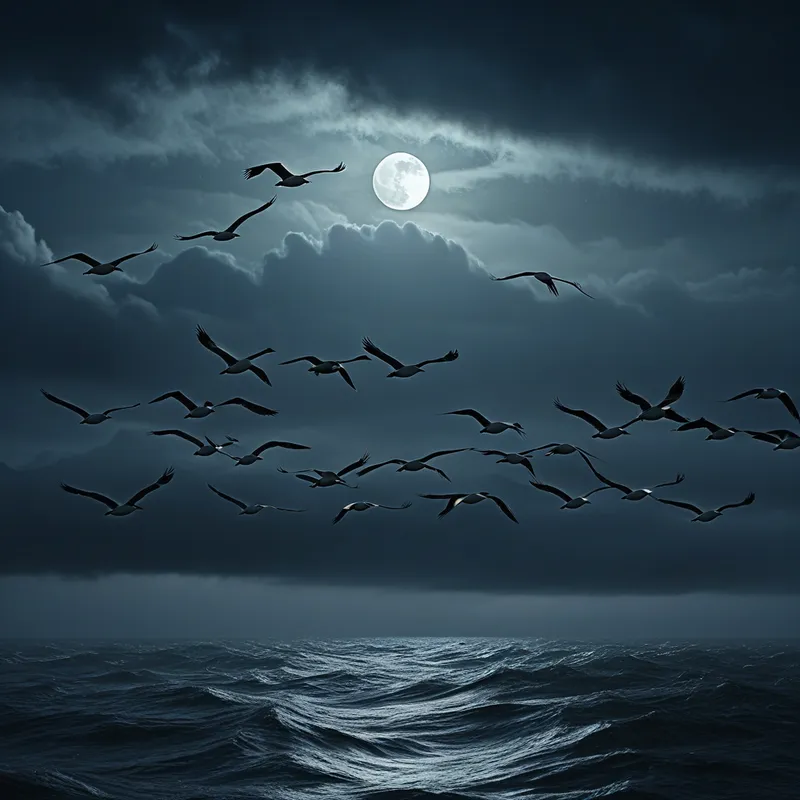
Each year, as the sun weakens, they take wing. Their powerful beat carries them not to a new feeding ground, but on a pilgrimage of memory. They fly over the endless, rolling ocean, a disciplined arrowhead against the leaden sky, driven by an instinct deeper than hunger, older than reason: the need to return. They circle the shores of their homeland, their cries a lament only the stones can fully understand. But they cannot land. They cannot take back their human shape. They are forever in-between—of the land in spirit, of the air and the far place in body. They are the Fianna of [the sky](/myths/the-sky “Myth from Persian culture.”/), eternal exiles on a journey that is both their freedom and their chain.

Cultural Origins & Context
The motif of the Wild Geese is less a single, codified myth and more a powerful, pervasive folkloric strand woven through the tapestry of Irish and broader Celtic storytelling. It belongs to the realm of the fíanaigecht, the tales of warrior bands and their liminal existence on the edges of society and the wild. These stories were kept alive by the filid, the poet-historians, and later by the seanchaí, the traditional storytellers, around hearths and in communal gatherings.
Its societal function was multifaceted. On one level, it served as an etiological tale, explaining the poignant, seasonal migration of geese—why they fly in such purposeful formations and cry with such a lonely sound. On a deeper, human level, it provided a narrative container for the profound Celtic experiences of exile, displacement, and clan loyalty. For a culture where connection to the ancestral land (dúchas) was a core component of identity, forced departure was a kind of living death. The myth of the Wild Geese transmuted this historical and personal trauma into a resonant, natural symbol. It told the people that their longing was seen, that their lost ones were not gone but transformed, and that the bond to the homeland was so potent it could defy even the laws of form.
Symbolic Architecture
At its core, the Wild Geese myth is an archetypal map of the [soul](/symbols/soul “Symbol: The soul represents the essence of a person, encompassing their spirit, identity, and connection to the universe.”/) in a state of irreducible longing. The exiled warriors represent that part of the [psyche](/myths/psyche “Myth from Greek culture.”/) which feels severed from its [source](/symbols/source “Symbol: The origin point of something, often representing beginnings, nourishment, or the fundamental cause behind phenomena.”/), its authentic home, or a state of wholeness. This “home” is not merely a physical place, but a psychological and spiritual [condition](/symbols/condition “Symbol: Condition reflects the state of being, often focusing on physical, emotional, or situational aspects of life.”/) of belonging, integrity, and meaning.
The goose is the soul-bird, whose migration is not across continents, but between the shores of the known self and the forgotten self.
The transformation into geese is the critical alchemical [image](/symbols/image “Symbol: An image represents perception, memories, and the visual narratives we create in our minds.”/). It signifies that the pain of [exile](/symbols/exile “Symbol: Forced separation from one’s homeland or community, representing loss of belonging, punishment, or profound isolation.”/) has become so total that it necessitates a change in one’s very [nature](/symbols/nature “Symbol: Nature symbolizes growth, connectivity, and the primal forces of existence.”/). The [human](/symbols/human “Symbol: The symbol of a human represents individuality, complexity of emotions, and social relationships.”/), bound to a single [plot](/symbols/plot “Symbol: A plot symbolizes the unfolding of a story, representing personal narratives and life direction.”/) of [earth](/symbols/earth “Symbol: The symbol of Earth often represents grounding, stability, and the physical realm, embodying a connection to nature and the innate support it provides.”/), cannot sustain the [journey](/symbols/journey “Symbol: A journey in dreams typically signifies adventure, growth, or a significant life transition.”/) of longing. The [bird](/symbols/bird “Symbol: Birds symbolize freedom, perspective, and the connection between the earthly and spiritual realms, often representing the soul’s aspirations or personal growth.”/), [creature](/symbols/creature “Symbol: Creatures in dreams often symbolize instincts, primal urges, and the unknown aspects of the psyche.”/) of air and instinct, can. Thus, the [exile](/symbols/exile “Symbol: Forced separation from one’s homeland or community, representing loss of belonging, punishment, or profound isolation.”/) is not cured, but embodied. The psychological wound is given wings. The wild goose becomes the [symbol](/symbols/symbol “Symbol: A symbol can represent an idea, concept, or belief, serving as a powerful tool for communication and understanding.”/) of the liberated yet tethered [spirit](/symbols/spirit “Symbol: Spirit symbolizes the essence of life, vitality, and the spiritual journey of the individual.”/)—free to traverse vast distances (of [memory](/symbols/memory “Symbol: Memory symbolizes the past, lessons learned, and the narratives we construct about our identities.”/), of the unconscious), yet forever pulled by an invisible thread to a point of [origin](/symbols/origin “Symbol: The starting point of a journey, often representing one’s roots, source, or initial state before transformation.”/).
Their inability to land is the myth’s most profound psychological [truth](/symbols/truth “Symbol: Truth represents authenticity, honesty, and the quest for knowledge beyond mere appearances.”/). It speaks to the condition where one can never fully “return” to a prior state of [innocence](/symbols/innocence “Symbol: A state of purity, naivety, and freedom from guilt or corruption, often associated with childhood and moral simplicity.”/) or [integration](/symbols/integration “Symbol: The process of unifying disparate parts of the self or experience into a cohesive whole, often representing psychological wholeness or resolution of internal conflict.”/). The journey itself, the cyclical [flight](/symbols/flight “Symbol: Flight symbolizes freedom, escape, and the pursuit of one’s aspirations, reflecting a desire to transcend limitations.”/), becomes the new state of being. The home is not a [destination](/symbols/destination “Symbol: Signifies goals, aspirations, and the journey one is on in life.”/) to be reached, but a [pole](/symbols/pole “Symbol: A pole in dreams often symbolizes stability, support, or a point of reference in life.”/)-star by which to navigate.
The Dreamer’s Resonance
When the motif of the Wild Geese arises in modern dreams, it rarely appears as a literal retelling. Instead, it manifests as the feeling of the myth. The dreamer may experience:
- Somatic Sensations: A profound, aching pull in the chest, a feeling of being “drawn” in a specific direction while physically rooted. The sound of distant, echoing cries (of birds, or even voices) that stir deep, wordless sadness or urgency.
- Imagery: Dreaming of flying in a strict, purposeful formation, but without knowing the destination. Seeing a landscape (a childhood home, a particular hill) from a great height, beautiful yet inaccessible. Finding feathers in unlikely places, or feeling one’s own arms become heavy, as if preparing for flight.
- Psychological Process: This dream pattern signals an active confrontation with the “exiled” parts of [the self](/myths/the-self “Myth from Jungian culture.”/). It may coincide with life transitions, emigration, estrangement from family or culture, or a deep sense of not belonging in one’s current life. The psyche is using the ancient symbol to communicate a foundational rift. The dream is not offering a solution, but is insisting on the reality of the longing itself. It is making the inner exile conscious, giving it form and motion. The work implied is to acknowledge the flight path—to identify what the “lost homeland” represents psychologically (a lost potential, a disowned passion, a spiritual connection) and to begin to honor the journey toward it, even if a full return is impossible.

Alchemical Translation
For the modern individual navigating the path of individuation—the process of becoming an integrated, whole self—the Wild Geese myth models a crucial and often misunderstood phase: the spiritualization of longing.
The initial exile (the trauma, the loss, the feeling of being cast out from one’s true nature) is the [prima materia](/myths/prima-materia “Myth from Alchemical culture.”/), the leaden, suffering state. The instinctive response is to try to row back, to reclaim the old shore. The alchemy of the myth shows us this is futile. The transformation into the goose is the [nigredo](/myths/nigredo “Myth from Alchemical culture.”/), the blackening—the acceptance of the irreversible change. “I am no longer who I was; my old form cannot contain this experience.”
Individuation is not the eradication of longing, but the learning to fly with it as your compass.
The cyclical migration is the heart of the work. It represents the conscious, repeated engagement with the source of one’s longing. This is the albedo and citrinitas, the whitening and yellowing. Each flight is a meditation, a therapy session, a creative act, a prayer—any process that journeys toward the inner homeland. One learns the skills of the journey: navigation by inner stars (values, dreams), endurance, the use of the V-formation (seeking guidance from those ahead, offering support to those behind, the communal aspect of growth).
The ultimate goal is not to land, but to achieve the [rubedo](/myths/rubedo “Myth from Alchemical culture.”/), the reddening, in flight. This is the realization that the wholeness sought is not behind, but is being forged in the very act of seeking. The exiled warrior and the wild goose are integrated. The individual becomes the one who contains the journey. The longing ceases to be a symptom of brokenness and becomes the engine of a profound, lifelong pilgrimage. The soul finds its home not in a place, but in its own purposeful, beautiful, and eternal motion between the worlds of memory and becoming.
Associated Symbols
Explore related symbols from the CaleaDream lexicon: