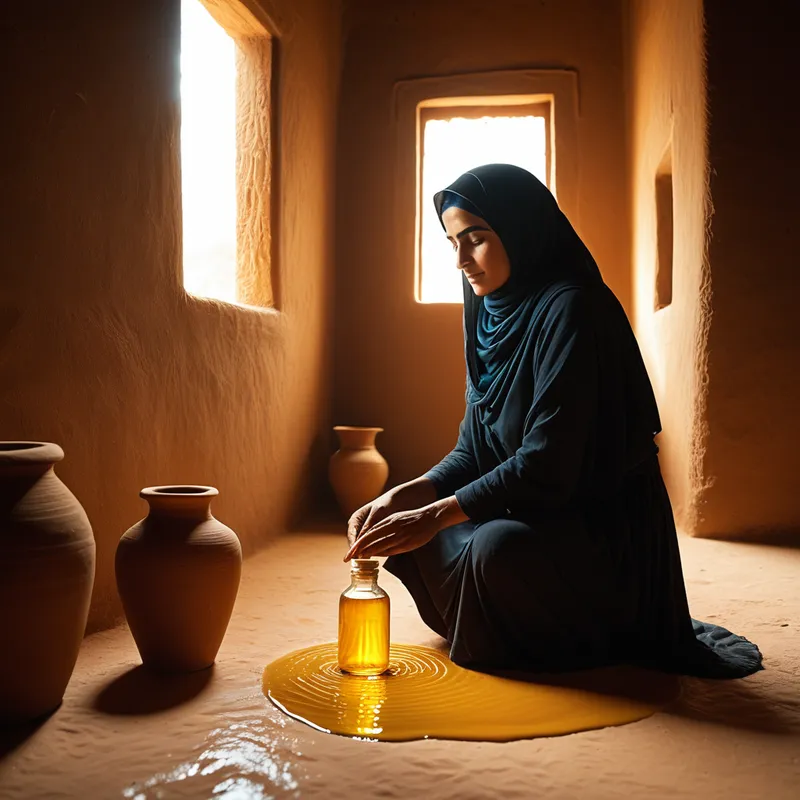
The Widow's Jar of Oil Myth Meaning & Symbolism
A destitute widow, facing debt and slavery, finds her last jar of oil multiplies endlessly, saving her family through faith and divine intervention.
The Tale of The Widow’s Jar of Oil
The sun was a merciless bronze coin in a white-hot sky, and the dust of Zarephath clung to everything—to the parched earth, to the widow’s worn sandals, to the hollow ache in her belly. Her world had shrunk to the four walls of a room that echoed with absence. The laughter of her husband was a ghost memory. Now, a new specter haunted her threshold: the creditor. His shadow fell across her door not with the heat of the sun, but with the chill of the grave. Her two sons, the last flickering lights of her life, were the price. Slavery awaited them, a living death to pay a debt she could not fathom.
In the crushing silence of her despair, a knock. Not the creditor’s imperious rap, but a steady, foreign sound. At her door stood a man, his cloak dusty, his eyes holding a strange, weary fire. He was Elisha, a man of the unseen God, and he asked for [water](/myths/water “Myth from Chinese culture.”/). As she turned to fetch it, he called after her, “Please, bring me a morsel of bread.”
Her breath caught. The laugh that escaped her was dry as the bones in the valley. “As the Lord your God lives,” she whispered, the words scraping her throat, “I have nothing baked, only a handful of meal in a jar and a little oil in a jug. I am gathering two sticks, that I may go in and prepare it for myself and my son, that we may eat it, and die.”
The prophet’s gaze did not waver. “Do not fear,” he said, his voice a low river in [the desert](/myths/the-desert “Myth from Biblical culture.”/). “Go and do as you have said. But first, make me a little cake of it and bring it to me. For thus says the Lord, the God of Israel: ‘The jar of meal shall not be spent, and the jug of oil shall not be empty, until the day that the Lord sends rain upon [the earth](/myths/the-earth “Myth from Hindu culture.”/).’”
The command was impossible. To give away the very last of life, the final handful that stood between her family and the end. The air in the room grew thick, charged with a choice more profound than hunger. She looked at her sons, then at [the stranger](/myths/the-stranger “Myth from Biblical culture.”/) whose eyes held a promise older than fear. A wild, desperate trust took root. She turned her back on the specter of death and walked into her house.
The meal jar was nearly empty. The oil jug was frighteningly light. With hands that trembled not from weakness now, but from a terrifying hope, she poured. She mixed. She baked a small cake and brought it to the man of God. Then, heart hammering against her ribs, she returned to her jars.
She peered inside. The handful of meal was still there. She tilted the oil jug. A glimmer of gold liquid met the rim. She poured for her son. She poured for herself. The meal did not diminish. The oil did not fail. Day followed parched day. The creditor’s shadow lingered at the edge of her world, but could not cross her threshold. Inside, a miracle of quiet constancy unfolded. Every morning, the jar was full. Every evening, after feeding her family, it remained. The oil flowed from a source unseen, a silent, abundant reply to an act of impossible surrender. The widow and her sons lived, not in sudden wealth, but in a sustained, daily grace—a river of oil springing from the rock of her despair.

Cultural Origins & Context
This narrative is embedded within the 2 Kings cycle of stories surrounding the prophet Elisha. It originates from the Northern Kingdom of Israel in the 9th century BCE, a period of political instability, religious syncretism, and social inequality. The story was preserved and shaped by the Deuteronomistic historians, who framed Israel’s history through the lens of covenant faithfulness.
Its societal function was multifaceted. For a community facing famine, drought, and foreign oppression, it served as a theological anchor: Yahweh, not the Canaanite god Baal (whose failure to bring rain is the story’s backdrop), is the true provider. It reinforced the prophetic authority of figures like Elisha as conduits of divine will and mercy. On a social level, it was a pointed commentary on [justice](/myths/justice “Myth from Tarot culture.”/), highlighting the vulnerability of widows and orphans—archetypal figures of societal neglect protected by Mosaic law. The story was not mere folklore; it was a sacred argument for faith in the covenant God’s provision, especially for the most marginalized, told and retold to strengthen communal identity and trust during times of collective scarcity.
Symbolic Architecture
At its [heart](/symbols/heart “Symbol: The heart symbolizes love, emotion, and the core of one’s existence, representing deep connections with others and self.”/), the myth is a profound map of a psychological and spiritual [crisis](/symbols/crisis “Symbol: A crisis symbolizes turmoil, urgent challenges, and the need for immediate resolution or change.”/). The widow represents the ego at its absolute limit, stripped of all external support ([husband](/symbols/husband “Symbol: In dreams, the symbol of a husband often represents commitment, partnership, and the dynamics of intimate relationships.”/), [wealth](/symbols/wealth “Symbol: Wealth in dreams often represents abundance, security, or inner resources, but can also symbolize burdens, anxieties, or moral/spiritual values.”/), [status](/symbols/status “Symbol: Represents one’s social position, rank, or standing within a group, often tied to achievement, power, or recognition.”/)). Her “last jar of oil” is the final [reservoir](/symbols/reservoir “Symbol: A contained body of water representing stored resources, emotions, or potential, often signifying controlled or suppressed aspects of the self.”/) of psychic [energy](/symbols/energy “Symbol: Energy symbolizes vitality, motivation, and the drive that fuels actions and ambitions.”/), the last vestige of hope, libido, or [life](/symbols/life “Symbol: The symbol of ‘Life’ represents a journey of growth, interconnectedness, and existential meaning, encompassing both the joys and challenges that define human experience.”/) force that has not been claimed by the “creditor”—the crushing demands of [reality](/symbols/reality “Symbol: Reality signifies the state of existence and perception, often reflecting one’s understanding of truth and life experiences.”/), [debt](/symbols/debt “Symbol: A symbolic representation of obligations, burdens, or imbalances that extend beyond financial matters into psychological and moral realms.”/), depression, or [obligation](/symbols/obligation “Symbol: A perceived duty or responsibility imposed by social norms, relationships, or internalized expectations, often involving a sense of being bound to act.”/) that threaten to enslave the future (her sons).
The miracle does not begin with the multiplication, but with the surrender. The act of pouring out the last of oneself for another is the alchemical key that unlocks the infinite.
Elisha, the [prophet](/symbols/prophet “Symbol: A messenger or seer who receives divine revelations, often warning of future events or guiding moral direction.”/), symbolizes the mediating function of the Self or the transcendent principle. He does not bring the oil from outside; he directs her [attention](/symbols/attention “Symbol: Attention in dreams signifies focus, awareness, and the priorities in one’s life, often indicating where the dreamer’s energy is invested.”/) to the inner dynamic required to access it. His instruction is an archetypal [pattern](/symbols/pattern “Symbol: A ‘Pattern’ in dreams often signifies the underlying structure of experiences and thoughts, representing both order and the repetitiveness of life’s situations.”/): facing the [abyss](/symbols/abyss “Symbol: A profound void representing the unconscious, the unknown, or a spiritual threshold between existence and non-existence.”/) (the final [meal](/symbols/meal “Symbol: A meal often symbolizes nourishment, not just physically but emotionally and spiritually, representing the aspects of sharing and community.”/)), one must first offer the last of one’s resources to the transpersonal (the divine, the greater [purpose](/symbols/purpose “Symbol: Purpose signifies direction, meaning, and intention in life, often reflecting personal ambitions and core values.”/), the symbolic Other). This act of sacred expenditure breaks [the ego](/myths/the-ego “Myth from Jungian culture.”/)’s [logic](/symbols/logic “Symbol: The principle of reasoning and rational thought, often representing order, structure, and intellectual clarity in dreams.”/) of [scarcity](/symbols/scarcity “Symbol: A dream symbol representing lack, limitation, or insufficient resources, often reflecting fears of deprivation or unmet needs.”/) and opens a channel to the unconscious’s boundless potential.
The oil itself is rich [symbolism](/symbols/symbolism “Symbol: The use of symbols to represent ideas or qualities, often conveying deeper meanings beyond literal interpretation. In dreams, it’s the language of the unconscious.”/). It is anointing oil, consecrating the mundane for sacred purpose. It is fuel for light, representing [consciousness](/symbols/consciousness “Symbol: Consciousness represents the state of awareness and perception, encompassing thoughts, feelings, and experiences.”/) and hope. It is nourishment, sustaining life. Its endless flow from a finite [vessel](/symbols/vessel “Symbol: A container or structure that holds, transports, or protects something essential, representing the self, emotions, or life journey.”/) is the ultimate [symbol](/symbols/symbol “Symbol: A symbol can represent an idea, concept, or belief, serving as a powerful tool for communication and understanding.”/) of the [psyche](/myths/psyche “Myth from Greek culture.”/)’s paradoxical [nature](/symbols/nature “Symbol: Nature symbolizes growth, connectivity, and the primal forces of existence.”/): from a point of acknowledged [emptiness](/symbols/emptiness “Symbol: Emptiness signifies a profound sense of void or lack in one’s life, often related to existential fears, loss, or spiritual quest.”/) springs a continuous, sustaining grace.

The Dreamer’s Resonance
When this myth stirs in the modern dreamer, it often surfaces during periods of profound depletion—emotional, creative, or financial. To dream of an empty jar, a final, precious resource, or a looming, faceless debt collector, is to feel the widow’s somatic reality. The body in such dreams may feel heavy, hollow, or paralyzed.
The psychological process at work is the confrontation with the shadow of scarcity thinking. The dream ego, like the widow, is being forced to acknowledge that its old strategies of conservation and fear have reached their end. The miracle in the dream may manifest not as a literal jar, but as an unexpected helper (the Elisha figure), a sudden insight, or the discovery of a forgotten inner resource. The dream is initiating a critical transition: it is forcing the dreamer to the brink where the only remaining choice is between a fearful, logical end and an illogical, trust-filled action. The healing lies in recognizing that the “oil”—the sustaining energy—is not gone, but its flow is blocked by the ego’s terrified grip. The dream invites a release, a pouring out, to restart the cycle of inner abundance.

Alchemical Translation
The myth models the individuation process—the psychic transmutation of leaden despair into golden vitality—with elegant precision. The “creditor” is the complex, the internalized pressure of societal expectations, past traumas, or neurotic patterns that demands payment, threatening to enslave our potential (the “sons”).
The alchemical [nigredo](/myths/nigredo “Myth from Alchemical culture.”/), the blackening, is the widow’s despair, the recognition of utter poverty and [the shadow](/myths/the-shadow “Myth from Jungian culture.”/) of death. The albedo, the whitening, begins with Elisha’s command—the call from [the Self](/myths/the-self “Myth from Jungian culture.”/) to perform a counter-intuitive, sacred act. Giving away the last of the oil is the sacrificium intellectus, the sacrifice of the rational mind that calculates only loss. This is the moment of [solutio](/myths/solutio “Myth from Alchemical culture.”/), dissolution, where the old form of the ego (based on scarcity) breaks down.
The vessel does not change; the relationship to its contents does. Individuation is not about acquiring a new self, but discovering the infinite depth of the self you already are.
The miracle of multiplication is the [rubedo](/myths/rubedo “Myth from Alchemical culture.”/), the reddening or culmination. The libido (oil), once blocked and hoarded, is now in conscious relationship with the Self and flows freely. The sustenance is daily, not a one-time windfall, mirroring the ongoing, committed work of psychological integration. One is not saved from the condition of life (the famine remains outside), but is sustained through it. The final state is not one of grandiose wealth, but of grounded, resilient trust—a vessel perpetually filled from a source within, transforming existential debt into a covenant of inner abundance. The individual becomes both the widow and the jar: the one who receives and [the vessel](/myths/the-vessel “Myth from Alchemical culture.”/) through which limitless potential is made manifest in the finite world.
Associated Symbols
Explore related symbols from the CaleaDream lexicon: