The Widow and the Unjust Judge Myth Meaning & Symbolism
A powerless widow's unyielding plea for justice finally compels a corrupt judge to act, revealing the transformative power of tenacious faith.
The Tale of The Widow and the Unjust Judge
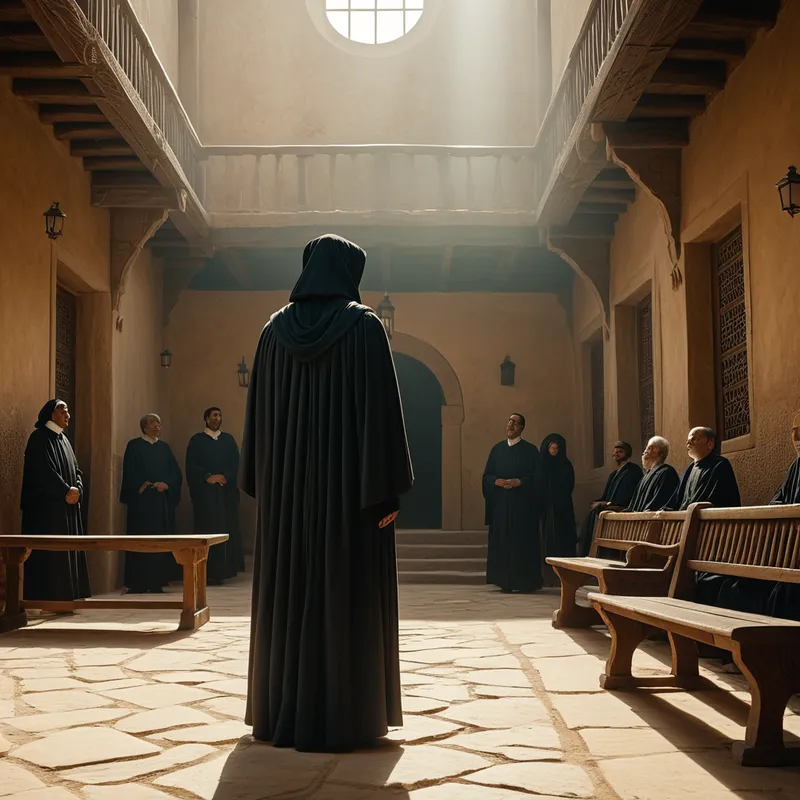
In a city where the sun baked the stones white and the dust of commerce settled on everything, there was a judge. He sat in the place of authority, but the fear of God was not upon him. Nor did he care for the opinion of men. His heart was a closed gate, his [justice](/myths/justice “Myth from Tarot culture.”/) a commodity traded for favor or coin. He was a man carved from the cold rock of self-interest.
And in that same city, there was a widow.
Her world had shrunk to the size of a grievance. An opponent—perhaps a relative, a neighbor, a powerful man—had taken what was hers. Her portion, her security, her dignity. In the eyes of [the world](/myths/the-world “Myth from Tarot culture.”/), she was nothing. No husband to speak for her, no sons to defend her, no wealth to grease the wheels of [the law](/myths/the-law “Myth from Biblical culture.”/). She was a whisper against a shout, a single reed before a windstorm.
Yet, she possessed a weapon they had not accounted for: a will that would not break.
Day after day, she came. She did not come with bribes or flattery. She came with her story. She stood in the public place, at the city gate where the judge held court, and she voiced her plea. “Grant me justice against my adversary.” Her voice was not loud, but it was persistent. It was a drop of [water](/myths/water “Myth from Chinese culture.”/), falling in the same spot, day after day.
At first, the judge dismissed her. He would not even look up from his scrolls. Her presence was a gnat, a minor irritation in his day. He expected her to fade away, to be swallowed by her poverty and despair.
But she returned.
Her plea became the stubborn background hum of his proceedings. “Grant me justice.” It met him in the morning as he took his seat. It followed him as he left in the evening. It was in the eyes of the crowd, who began to watch this strange, unequal duel. The widow’s resolve was a quiet fire that would not be extinguished. She wore down his indifference not with force, but with sheer, unassailable presence.
The judge, this man of marble, began to feel a crack. It was not conscience. It was not a sudden love for justice. He reasoned within his own cold heart: “Even though I don’t fear God or care what people think, yet because this widow keeps bothering me, I will see that she gets justice. If I don’t, she will eventually come and wear me out completely.”
And so, the unthinkable happened. The gate swung open. The judge, moved by nothing but the sheer, grinding persistence of a powerless woman, rendered a verdict in her favor. Justice, long delayed, was finally delivered. Not because the system was good, but because one human spirit refused to let the system rest in its corruption.

Cultural Origins & Context
This story is presented as a parable within the Gospel of Luke. It is a teaching of [Jesus](/myths/jesus “Myth from Christian culture.”/), told not as a historical account of a specific event, but as a crafted narrative designed to puncture assumptions and provoke insight. Its primary audience was a 1st-century Judean society intimately familiar with the vulnerability of widows, who were legally and economically dependent and thus emblematic of the most defenseless in society.
The parable functions on two cultural levels. First, it is a subversive piece of social commentary, highlighting the profound corruption possible within human institutions of power. The judge is explicitly labeled “unjust,” a stark contrast to the biblical ideal of judges who are to embody divine fairness. Second, and more importantly, it is a lesson on prayer and faith within the early Jesus movement. It was told to encourage disciples who might feel that their prayers were unheard by a distant God. The parable uses a “how much more” logic: if even a corrupt human judge can be moved by relentless petition, how much more will a loving, just God respond to the persistent cries of his chosen ones? It was an oral teaching, meant to be remembered, repeated, and internalized as a source of endurance during times of persecution and doubt.
Symbolic Architecture
The myth’s power lies in its stark, almost alchemical pairing of opposites. The Widow and the Unjust Judge are not just characters; they are psychic principles in dynamic [tension](/symbols/tension “Symbol: A state of mental or emotional strain, often manifesting physically as tightness, pressure, or unease, signaling unresolved conflict or anticipation.”/).
The Widow symbolizes the [soul](/symbols/soul “Symbol: The soul represents the essence of a person, encompassing their spirit, identity, and connection to the universe.”/) in a state of profound need—the part of us that has been wronged, overlooked, or rendered powerless by circumstance or by the inner “adversary” of self-doubt, [trauma](/symbols/trauma “Symbol: A deeply distressing or disturbing experience that overwhelms the psyche, often manifesting in dreams as unresolved emotional wounds or psychological injury.”/), or oppression. She is the [orphan](/symbols/orphan “Symbol: Represents spiritual abandonment, primal vulnerability, and the quest for belonging beyond biological ties. Often signifies a soul’s journey toward self-reliance.”/) [archetype](/symbols/archetype “Symbol: A universal, primordial pattern or prototype in the collective unconscious that shapes human experience, behavior, and creative expression.”/), but one activated into rebellion. Her [weapon](/symbols/weapon “Symbol: A weapon in dreams often symbolizes power, aggression, and the need for protection or defense.”/) is not [strength](/symbols/strength “Symbol: ‘Strength’ symbolizes resilience, courage, and the ability to overcome challenges.”/), but tenacity. She represents the irreducible core of [the Self](/myths/the-self “Myth from Jungian culture.”/) that refuses to be negated, the quiet voice of [truth](/symbols/truth “Symbol: Truth represents authenticity, honesty, and the quest for knowledge beyond mere appearances.”/) that will not stop speaking, even when no one seems to listen.
The Widow’s power is not in overcoming the Judge, but in ceaselessly presenting her case. Her persistence is the friction that grinds down the illusion of his absolute authority.
The Unjust Judge symbolizes the hardened, impersonal structures we face—both external ([bureaucracy](/symbols/bureaucracy “Symbol: Dreams of bureaucracy often represent feelings of powerlessness, frustration with rigid systems, or anxieties about societal structures and personal agency.”/), systemic [injustice](/symbols/injustice “Symbol: A perceived violation of fairness, rights, or moral order, often evoking a sense of imbalance or ethical breach.”/), unfeeling [authority](/symbols/authority “Symbol: A symbol representing power structures, rules, and control, often reflecting one’s relationship with societal or personal governance.”/)) and internal (the inner critic, cynical rationality, the defensive ego that denies deeper needs). He “neither fears God nor respects man,” meaning he is a [system](/symbols/system “Symbol: A system represents structure, organization, and interrelated components functioning together, often reflecting personal or social order.”/) utterly closed to higher values or [human](/symbols/human “Symbol: The symbol of a human represents individuality, complexity of emotions, and social relationships.”/) [empathy](/symbols/empathy “Symbol: The capacity to understand and share the feelings of others, often manifesting as emotional resonance or intuitive connection in dreams.”/). He is [consciousness](/symbols/consciousness “Symbol: Consciousness represents the state of awareness and perception, encompassing thoughts, feelings, and experiences.”/) trapped in its own self-referential [logic](/symbols/logic “Symbol: The principle of reasoning and rational thought, often representing order, structure, and intellectual clarity in dreams.”/).
The myth’s [resolution](/symbols/resolution “Symbol: In arts and music, resolution refers to the movement from dissonance to consonance, creating a sense of completion, release, or finality in a composition.”/) reveals a shocking truth: even the most corrupt, closed system is not immutable. It can be transformed, not by a direct assault it is designed to withstand, but by the relentless, focused [application](/symbols/application “Symbol: An application symbolizes engagement, integration of knowledge, or the pursuit of goals, often representing self-improvement and personal development.”/) of a single, truthful [vibration](/symbols/vibration “Symbol: A rhythmic oscillation or resonance, often representing energy, connection, or unseen forces. In dreams, it can signal awakening, disturbance, or spiritual communication.”/). Justice here is not given; it is extracted through the [alchemy](/symbols/alchemy “Symbol: A transformative process of purification and creation, often symbolizing personal or spiritual evolution through difficult stages.”/) of unwavering insistence.

The Dreamer’s Resonance
When this myth patterns a modern dream, it often signals a somatic and psychological process of claiming one’s voice in the face of an inner or outer “unjust system.”
You may dream of endlessly filing paperwork that gets lost, shouting in a soundproof room, or trying to get the attention of a faceless official who is always turning away. These are the dreamscapes of the Widow. The somatic feeling is one of frustration laced with a strange, tireless determination—a sense that you must keep trying, even if it feels hopeless. Psychologically, this indicates that a part of the [psyche](/myths/psyche “Myth from Greek culture.”/) that has felt powerless or silenced is now mobilizing. The “adversary” in the dream could be a boss, a parent, a partner, or a shadowy figure—representing an aspect of life, or of yourself, that denies your worth or your right to be heard.
The dream is not a forecast of failure, but a map of the process. The very act of showing up in the dream, of repeating the plea, is the therapeutic work. It is [the ego](/myths/the-ego “Myth from Jungian culture.”/) beginning to consistently champion the cause of a neglected inner value or truth, wearing down the internalized “unjust judge” of old conditioning, shame, or apathy.

Alchemical Translation
The psychic transmutation modeled here is the journey from powerless victimhood to sovereign agency through the furnace of persistence. It is a core process of individuation, where one must become the advocate for one’s own soul.
The initial state is identification with the Widow: feeling wronged, small, and at the mercy of an uncaring universe (the Judge). The alchemical fire is lit when we stop waiting for the Judge to change his nature and begin the work of the Widow: the daily, disciplined practice of presenting our case to ourselves and the world. This is the prayer, the meditation, the therapy session, the setting of a boundary, the creation of art—any act that affirms “I am here, and this is my truth.”
The triumph is not in the Judge’s verdict, but in the Widow’s unbroken will. The verdict is merely the external world finally conforming to the reality she has insisted upon all along.
The Judge, too, is transmuted. He begins as an externalized obstacle. Through the process, we realize he is also an internal structure—our own cynicism, our resignation, our belief that “nothing will ever change.” The Widow’s persistence forces this inner Judge to engage, to finally hear the case it has been dismissing. In doing so, the cold, impersonal structure of the Judge is slowly infused with the living water of the soul’s demand. The system of the psyche is reformed.
The ultimate gold produced is not merely justice in a single case, but the forging of an indomitable will. The individual learns that their most profound power lies not in controlling the Judge, but in mastering their own capacity for faithful, relentless return. They become both the persistent petitioner and the seat of justice within their own being, integrating the rebel’s fire with the ruler’s authority. The myth thus charts the path from pleading for justice to embodying the principle of justice through unwavering commitment to one’s own deepest truth.
Associated Symbols
Explore related symbols from the CaleaDream lexicon: