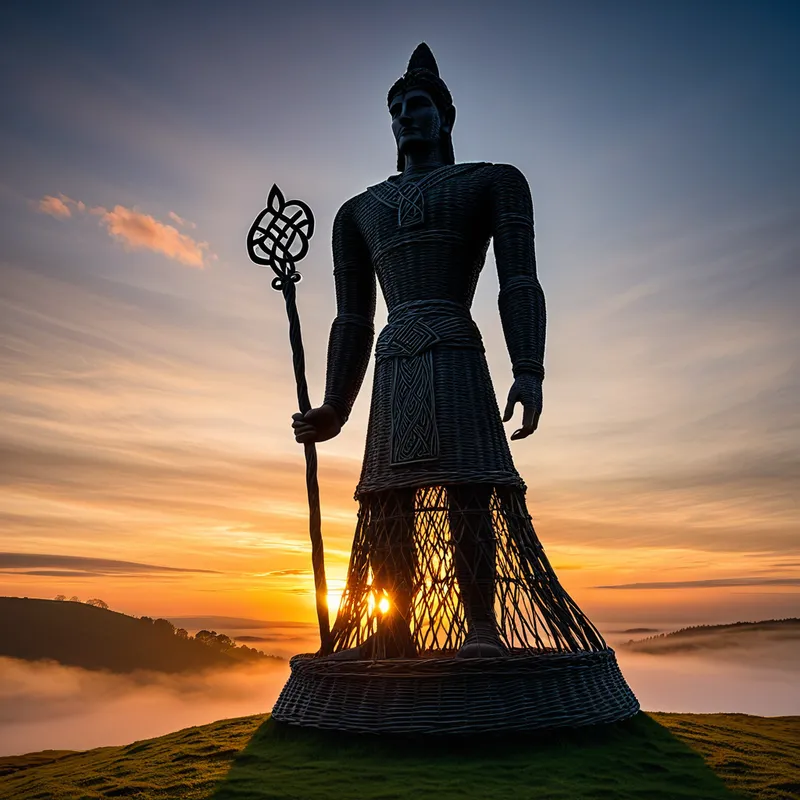
The Wicker Man Myth Meaning & Symbolism
A colossal figure woven from willow and filled with offerings is set alight, a sacred sacrifice to ensure the land's fertility and the tribe's survival.
The Tale of The Wicker Man
Listen. The wind does not just blow across the moor; it carries a memory of smoke and a whispered prayer. In the time when the oak was king and the mist clung to the hollows like a second skin, the people knew a hunger that was more than empty bellies. It was a thinning in the world itself. The sun grew weak, the earth grew hard, and the breath of life seemed to hesitate in the throat of the land.
The Druids gathered at the heart of the sacred grove, their faces etched with the gravity of stars and seasons. They read the omens in the flight of crows and the entrails of a sacred white stag. The message was clear, terrible, and absolute: the pact was fraying. The great wheel of the year was stuck. The vitality that flowed from the Otherworld into this one had slowed to a trickle. To grease the axle of the cosmos, to compel the sun to climb once more and the soil to quicken, a debt of immense proportion was due. Not a token, but a totality. A sacrifice that mirrored the scale of the need.
And so the word went out, not with fear, but with a solemn, dreadful purpose. From every farmstead and hillfort, the people came. They did not bring weapons, but offerings. The finest sheaf of the last harvest. The first-born lamb of the spring. Tools of their craft. Vessels of clay and bronze. And they brought the willow, the flexible, living wood of the waterways, cut with reverence.
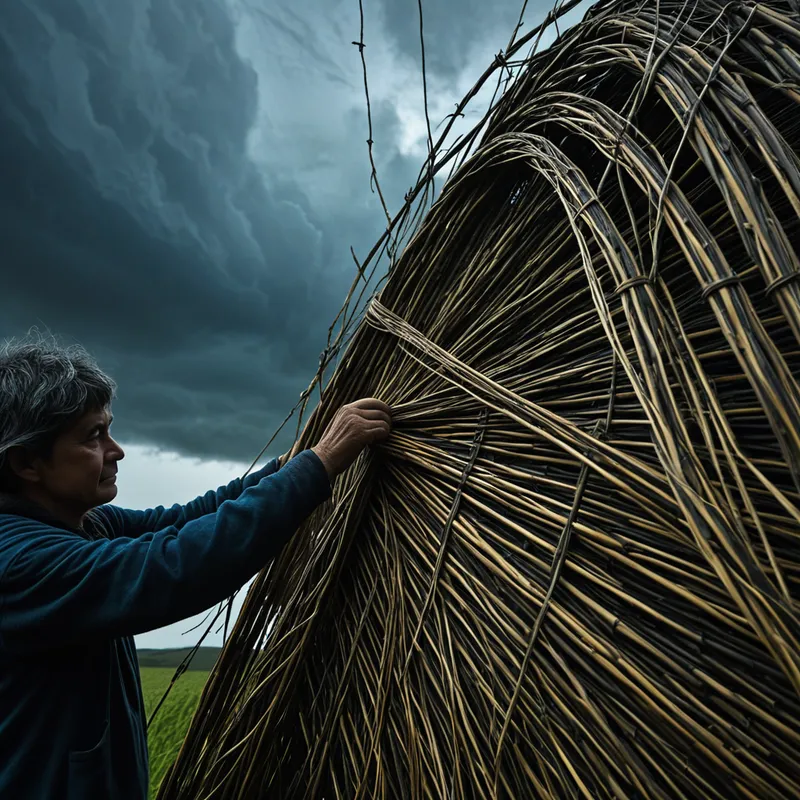
For days, a strange and sacred industry took hold. Under the guidance of the Druids, a skeleton of immense proportions rose against the sky. Willow withes, still green with sap, were woven into legs thick as tree trunks, a vast barrel of a chest, arms outstretched as if to embrace or demand. This was the Wicker Man. It was not built; it was grown, shaped by countless hands into a vessel of emptiness. Into his hollow belly and limbs, the offerings were placed—the grain, the animals, the artifacts of a year’s labor. Some accounts whisper of captives, of criminals, or of volunteers who, in an ecstasy of devotion, offered themselves to become the spark.
As the sun bled its last light on the appointed day, a silence fell, deeper than any night. The Druid, clad in white, raised a torch that burned with a strange, blue-tinged flame. A chant began, low and guttural, a sound to pull the divine ear. The torch was touched to the dry tinder at the giant’s feet.
Fire, the great transformer, took its time. It licked, then climbed, then roared. The Wicker Man became a cage of light, a screaming silhouette against the deepening dark. The crackle of willow was the sound of the world breaking open. The smoke that poured skyward was thick with the essence of everything given—the scent of bread, of wool, of life itself, all turned to vapor and aspiration. The people watched, their faces painted in gold and shadow, not with horror, but with a desperate, hopeful awe. They watched until the last woven strand glowed like a vein of magma and collapsed into a mound of pulsating embers.
And in the days that followed, as the ashes cooled and were scattered upon the fields, a subtle shift was felt. A softening in the air. A green hint at the base of the blackened earth. The wheel, heavy and reluctant, began to turn again.
Cultural Origins & Context
The primary source for this vivid, haunting ritual is the Roman general and author Julius Caesar, who recorded it in his Commentarii de Bello Gallico as a practice of the Gauls. It is crucial to approach this with scholarly caution; Caesar was both an observer and a propagandist, seeking to justify his conquests by portraying Celtic cultures as barbaric. However, the symbolic core aligns with well-attested Indo-European and specifically Celtic cosmological principles.
This was not a myth told for entertainment, but a ritual reality embedded in the Celtic worldview. The cosmos was seen as a sacred contract. The tribe and the land were a single organism. Fertility, victory, and stability were not guaranteed but were gifts from the Otherworld, maintained through reciprocal exchange. The Wicker Man ritual was likely a Beltane or crisis rite, a massive act of sympathetic magic. By constructing a giant humanoid form—a microcosm of the community—and filling it with the literal fruits of their labor, the people performed a radical act of symbolic accounting. They presented the totality of their worldly substance back to the source, in hopes of triggering a reciprocal flood of renewed vitality. It was the ultimate gamble: sacrificing the known to seed the unknown future.
Symbolic Architecture
The Wicker Man is not merely a method of sacrifice; it is a profound symbolic edifice. It represents the constructed self of the community—and by extension, the individual. The willow frame is the flexible, living structure of identity, culture, and ego. The offerings placed inside are the contents of that life: our achievements, our dependencies (the livestock), our tools and talents, our cherished possessions.
To stand before the Wicker Man is to confront the terrifying truth that everything we have built and gathered can—and sometimes must—become fuel.
Fire is the inevitable agent of alchemy in this myth. It represents the catalytic, often destructive, force of necessity—be it a crisis, a profound loss, or the simple, relentless pressure of time that renders old forms obsolete. The ritual’s power lies in its conscious, collective engagement with this destruction. It is not a disaster that happens to them, but a transformation they choose to enact, however dreadfully. The goal is not annihilation, but transmutation. The smoke carries the essence of the old form upward, as a prayer, to become the rain that will nourish the new growth.
The Dreamer’s Resonance
When this myth stirs in the modern psyche, it rarely appears as a literal giant of wicker. Instead, one may dream of being trapped in a house that is also one’s own body, as it fills with smoke. Or of watching a beloved, familiar structure—a childhood home, a workplace—burn down with a sense of eerie necessity. There may be dreams of voluntarily placing valued objects into a furnace, or of being inside a complex, fragile machine that is powering down or overheating.
These are somatic dreams of impending psychic death and renewal. The “wicker” is the dreamer’s current life-structure: a career identity, a long-held self-concept, a relationship dynamic, or a belief system that has become rigid. The body in the dream registers the tension of this structure straining to hold contents that have outgrown it. The fire is the unconscious, instinctual pressure for transformation, often felt as anxiety, illness, or a deep, inarticulate crisis. The dream is not a prophecy of literal doom, but a depiction of the process already underway in the psyche—the painful, necessary deconstruction of an outworn stage of life.
Alchemical Translation
For the individual on the path of individuation, the Wicker Man myth models the most demanding phase of the work: the mortificatio and calcinatio. Our psychological development is not a linear accumulation, but a series of deaths and rebirths. We must periodically become both the Druid and the offering.
The alchemical fire is lit when we can no longer deny the cost of maintaining a false self. The sacrifice begins when we consciously choose to stop feeding a structure that is starving our soul.
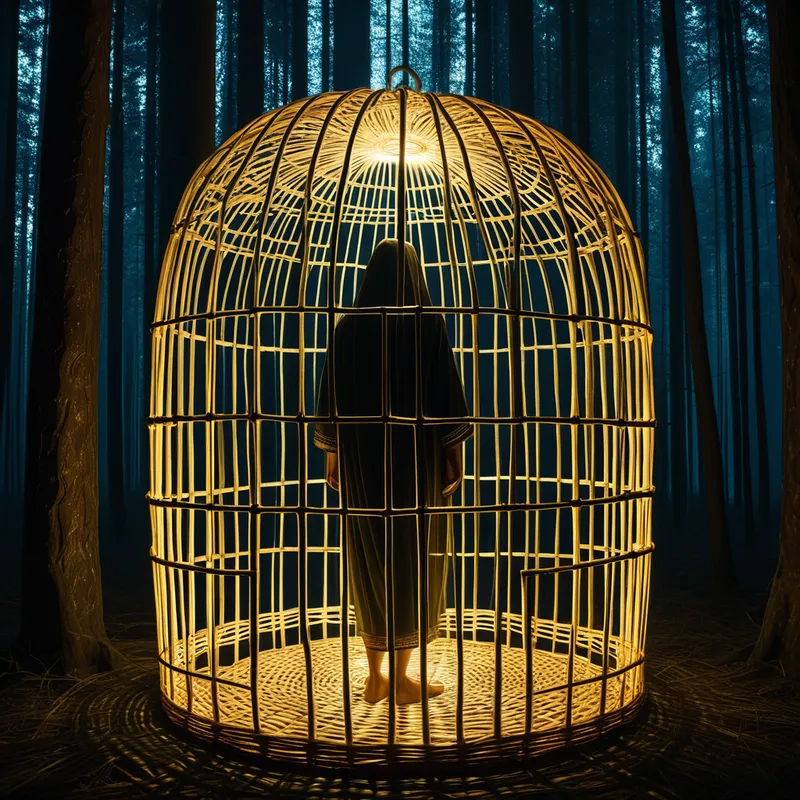
This translates to the courage to willingly de-identify. To place into the symbolic fire the title that no longer fits, the grievance we’ve nursed for years, the version of ourselves we perform for approval, the safe but soul-numbing path. It is an act of radical honesty and trust—trust that from the ashes of what we willingly let burn, a more authentic vitality will emerge. We do not know what the new growth will look like; the ritual’s purpose is only to clear the ground for it. The modern Wicker Man is not about literal destruction, but about the sacred, terrifying act of releasing our tight grip on a known form, so that the unknown, potential self has space to take root. We burn the wicker cage to stop being its prisoner, and in doing so, we make an offering of our old life to the possibility of a new one.
Associated Symbols
Explore related symbols from the CaleaDream lexicon: