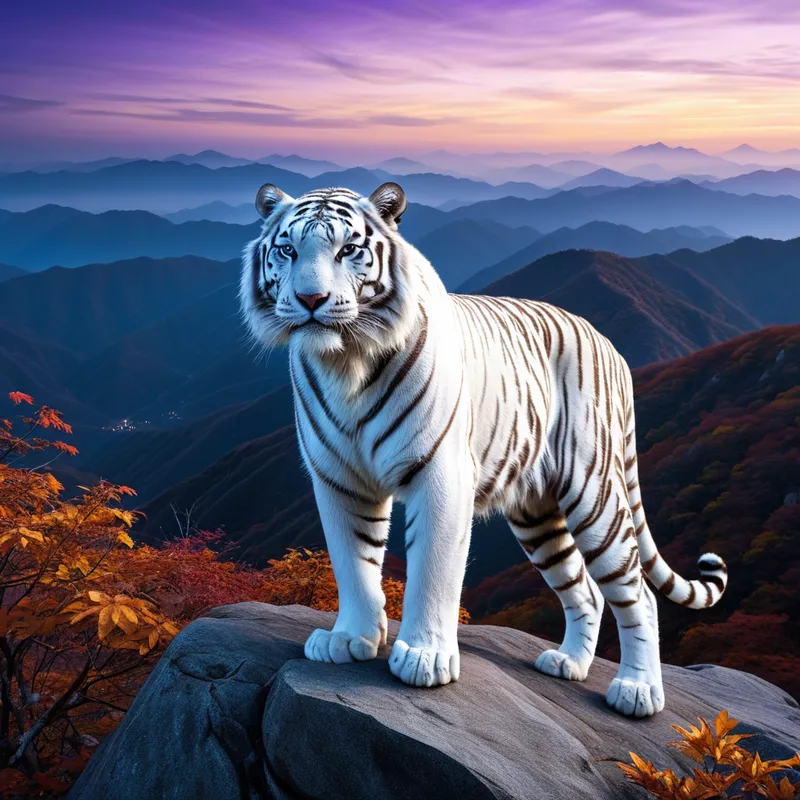
The White Tiger of the West Myth Meaning & Symbolism
The celestial guardian of the West, a white tiger embodies righteous power, seasonal change, and the sacred duty of protecting the boundary between worlds.
The Tale of The White Tiger of the West
Listen, and hear the tale whispered on the wind that sweeps down from the high peaks when the sun sinks into the world’s edge. In the time when the world was young and the patterns of heaven were still being woven into the fabric of earth, the four directions were given their sovereigns. To the West, where the day dies in a blaze of glory and the long shadows gather, was appointed a guardian of such fierce purity it could chill the blood and calm the raging heart in the same breath: Baekho, the White Tiger.
He was not born of flesh and blood, but condensed from the essence of autumn, from the metal of the forge and the frost of the first killing night. His form was that of the great tiger, but his pelt was the white of untouched snow on a high crag, of bleached bone that has endured centuries, of the moon’s cold heart. His eyes held the pale, unwavering light of the evening star. His domain was the mountain ranges that carved the horizon, the deep valleys where rivers ran cold and clear, and the crisp, thinning air that heralds the fall of leaves.
Each year, as the balance of Yin and Yang tipped, the White Tiger would stir from his celestial watch. His breath became the west wind, sharp and scouring, that stripped the green from the trees. His roar was the distant thunder that promised not rain, but the coming silence of winter. He was the necessary executioner, the bringer of harvest’s end, clearing the old to make way for the new cycle. But his fierceness was not malice; it was a sacred, terrible duty.
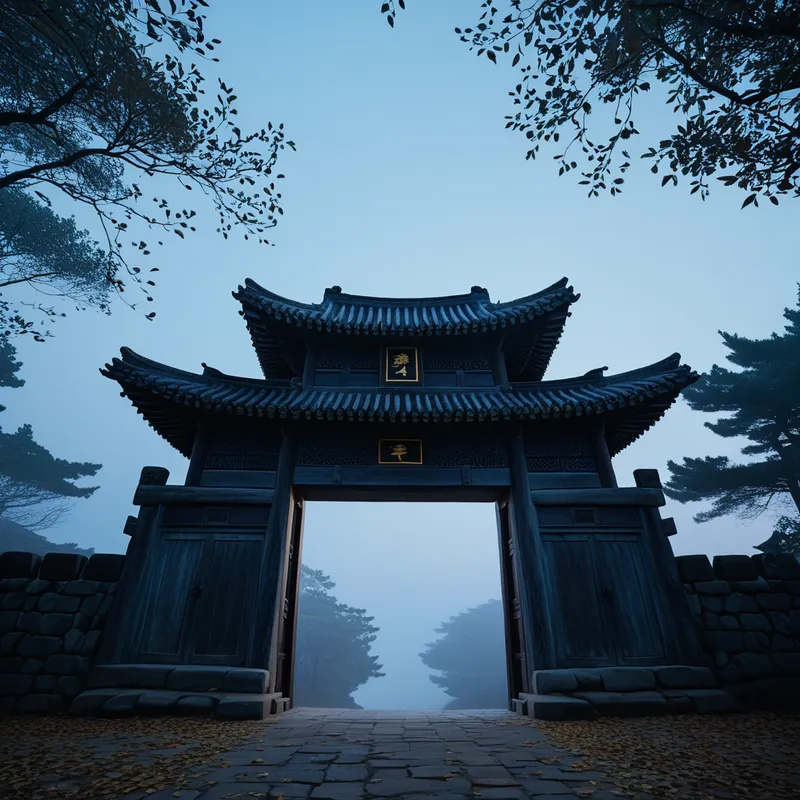
The people knew. They built their fortress gates facing west, not in defiance, but in reverence. They painted his image on banners and carved his likeness into stone, for they understood that true protection often wears the face of what we fear. They told stories of travelers, lost in the western mountains as dusk fell, who would see a flash of white between the dark pines. Not a pursuit, but an escort—a silent, majestic presence ensuring they did not stray beyond the boundaries of the mortal world into the realms where only spirits walk. The White Tiger did not offer comfort; he offered the stark, unyielding safety of the line that must not be crossed, the righteous power that guards the threshold between chaos and order, between life and what lies beyond.
Cultural Origins & Context
The myth of the White Tiger, or Baekho, is not a singular narrative but a foundational element of Korean cosmology, deeply integrated with Taoism and indigenous Korean spiritual beliefs. It is one of the Sasin or Ssu Ling, who govern the four cardinal directions and their corresponding seasons, elements, and virtues.
This myth was passed down not merely as a story, but as a living symbolic language used in architecture, astronomy, and statecraft. The White Tiger of the West was associated with the season of autumn, the element of metal (representing structure, discipline, and decay), and the color white. Its image was employed in the geomancy of Pungsu (Feng Shui) to protect tombs and palaces from malignant western influences. In the Goguryeo tomb murals, it appears alongside the Cheongnyong, a powerful visual prayer for balance and safe passage for the soul. Its societal function was profound: to codify the natural world’s cycles into a cosmic order, providing a framework for understanding change, death, and protection as interconnected, sacred forces.
Symbolic Architecture
Psychologically, the White [Tiger](/symbols/tiger “Symbol: The tiger symbolizes power, courage, and primal instincts, often representing untamed energy and aggression.”/) represents the [archetype](/symbols/archetype “Symbol: A universal, primordial pattern or prototype in the collective unconscious that shapes human experience, behavior, and creative expression.”/) of the righteous [Warrior](/symbols/warrior “Symbol: A spiritual archetype representing inner strength, discipline, and the struggle for higher purpose or self-mastery.”/), but one tasked with a paradoxical duty. It is not the [hero](/symbols/hero “Symbol: A hero embodies strength, courage, and the ability to overcome significant challenges.”/) who conquers external enemies for glory, but the [guardian](/symbols/guardian “Symbol: A protector figure representing safety, authority, and guidance, often embodying parental, societal, or spiritual oversight.”/) who masters internal and external [chaos](/symbols/chaos “Symbol: In Arts & Music, chaos represents raw creative potential, uncontrolled expression, and the breakdown of order to forge new artistic forms.”/) to preserve sacred boundaries.
The White Tiger is the psyche’s own necessary severity, the force that says “enough” and enforces the limit, not with cruelty, but with the cold, clear truth of autumn.
Its whiteness symbolizes not [innocence](/symbols/innocence “Symbol: A state of purity, naivety, and freedom from guilt or corruption, often associated with childhood and moral simplicity.”/), but refined potency—a power purified of base instinct and aligned with a higher principle ([metal](/symbols/metal “Symbol: Metal in dreams often signifies strength, transformation, and the qualities of resilience or coldness.”/), [structure](/symbols/structure “Symbol: Structure in dreams often symbolizes stability, organization, and the framework of one’s life, reflecting how one perceives their environment and personal life.”/)). It is the [energy](/symbols/energy “Symbol: Energy symbolizes vitality, motivation, and the drive that fuels actions and ambitions.”/) of discernment, of cutting away what is no longer viable (the [autumn](/symbols/autumn “Symbol: A season symbolizing transition, harvest, and decay, representing life’s cycles between abundance and decline.”/) harvest/[death](/symbols/death “Symbol: Symbolizes transformation, endings, and new beginnings; often associated with fear of the unknown.”/)). The [direction](/symbols/direction “Symbol: Direction in dreams often relates to life choices, guidance, and the path one is following, emphasizing the importance of navigation in personal journeys.”/) West, where the sun sets, connects it to the inevitable—the ending, the completion, the [shadow](/symbols/shadow “Symbol: The ‘shadow’ embodies the unconscious, repressed aspects of the self and often represents fears or hidden emotions.”/). Thus, the White Tiger becomes the guardian of the shadow itself. It does not destroy the shadow (the unknown, the repressed) but patrols its border, ensuring that its contents do not overwhelm the conscious world, while also preventing the conscious ego from arrogantly invading realms it does not understand.
The Dreamer’s Resonance
When the White Tiger pads into modern dreams, it often appears during life phases requiring fierce boundaries, decisive endings, or the integration of a powerful, disciplined aspect of the self. Dreaming of a white tiger observing you from a distance suggests the psyche is mobilizing a protective, authoritative energy. You may be in a situation requiring sober judgment and moral courage.
If the tiger is pacing or seems agitated, it can indicate that a necessary “autumn” in your life is being resisted—a job, relationship, or habit that has reached its natural end is being clung to, and the tiger’s energy is frustrated. A dream of being chased by a white tiger (not with malice, but with relentless intent) may point to an unavoidable truth or consequence you are fleeing. Conversely, finding yourself under the protection of the white tiger, perhaps walking alongside it through a dark forest, signals a profound alignment with your own inner authority and the courage to face an ending or a formidable challenge, knowing you are backed by a refined, impersonal strength.
Alchemical Translation
The myth models a critical stage in individuation: the confrontation with and transmutation of raw instinct into disciplined, conscious power. The journey begins in the “east” of our personality—our burgeoning, spring-like identity. As we develop, we inevitably encounter the “west”—the limits, the failures, the aspects of life we cannot control (symbolized by autumn and metal).
The alchemical work is not to slay the tiger of instinct and power, but to win its allegiance, to have its fierce purity guard the treasury of the self.
This is the process of “whitening” (albedo). We take our natural aggression, territoriality, and passion (the red, fiery tiger) and subject it to the refining frost of conscious awareness and ethical choice. Through this discipline, it is transmuted into the White Tiger: a protective force that serves the totality of the psyche, not just the ego’s desires. It becomes the inner guardian that allows us to set boundaries with clarity, to end chapters without guilt, and to stand with unwavering integrity at the thresholds of our own being, ensuring that what enters and exits serves the soul’s greater architecture, not merely passing whims or fears.
Associated Symbols
Explore related symbols from the CaleaDream lexicon:
- Tiger — The raw archetype of power, instinct, and territorial sovereignty, which in its whitened form becomes a disciplined, celestial guardian.
- West — The direction of endings, autumn, and the descent into the shadow, the domain that the White Tiger is ordained to protect and oversee.
- Mountain — The sacred, liminal space where earth meets sky, often the dwelling and patrol ground of the White Tiger, representing spiritual ascent and formidable challenges.
- Autumn — The season governed by the White Tiger, symbolizing necessary release, harvest, and the beautiful, melancholy wisdom of cycles ending.
- Boundary — The core function of the myth; the White Tiger is the living embodiment of the sacred limit, the line that defines and protects order from chaos.
- Metal — The associated element, representing the qualities of structure, discernment, cutting away the superfluous, and unyielding strength.
- Guardian — The primary role of the White Tiger, a protector whose vigilance ensures the integrity of a sacred space or psychic domain.
- Shadow — The psychological territory the White Tiger guards, representing the unknown, repressed, or feared aspects of the self that must be acknowledged but contained.
- Threshold — The physical and metaphysical point of transition, the gate where the White Tiger stands watch, governing passage between states of being.
- Order — The cosmic principle the White Tiger serves, the harmonious structure of the universe that requires both creative and destructive forces to maintain balance.
- Death — Not as finality, but as the transformation and clearing away overseen by the White Tiger, a necessary phase in the cycle of rebirth.
- Power — The essential energy, which in its untamed state is dangerous, but when aligned with celestial purpose becomes righteous authority and protection.