The White Stag Myth Meaning & Symbolism
A luminous, otherworldly stag appears, leading heroes and kings into the deep forest on a perilous quest that transforms their destiny and soul.
The Tale of The White Stag
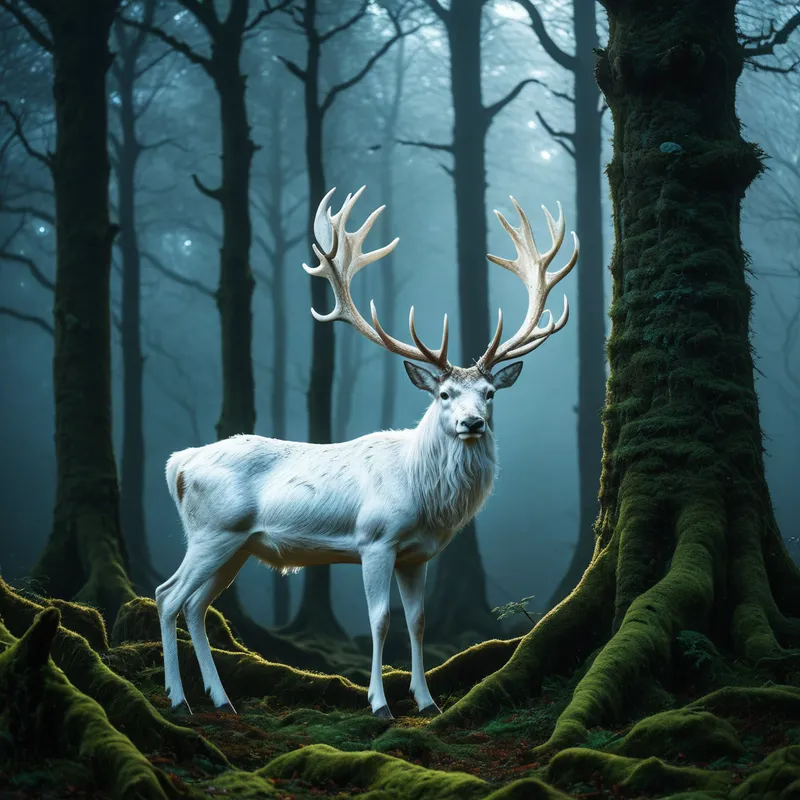
Listen, and let the mists of the Brythonic world gather. In the deep heart of the forest, where the sunlight fractures into a thousand green spears and the air hums with the memory of older gods, a vision moves. It is not a beast of flesh and blood, not truly. It is a creature of bone-white light, a stag whose coat holds the pallor of [the moon](/myths/the-moon “Myth from Tarot culture.”/) and whose antlers are a crown of living birch. This is the White Stag.
It appears when [the world](/myths/the-world “Myth from Tarot culture.”/) is poised on a knife’s edge—when a king’s rule grows stale, when a hero’s purpose falters, when [the veil](/myths/the-veil “Myth from Various culture.”/) between This World and the [Otherworld](/myths/otherworld “Myth from Celtic culture.”/) wears thin. It is seen first as a flash, a phantom at the edge of the hunting party’s vision. A hush falls. The dogs, who moments before bayed with blood-lust, whimper and tuck their tails. The horses stamp and shy. The hunters feel it in their marrow: this is no ordinary quarry.
The chase begins. Not a chase of conquest, but of compulsion. The White Stag leads them from the known paths, from the sunlit meadows into the tangled, whispering dark. It is never frantic; its gait is a graceful, maddening invitation. It pauses on the crest of a fern-clad hill, silhouetted against a bruised sky, waiting for them to stumble close—only to vanish and reappear a hundred yards deeper in the gloom. The familiar forest transforms. The trees grow stranger, their bark silvered, their leaves whispering in a tongue just beyond understanding. The sounds of the mortal world fade, replaced by a profound, listening silence.
The hero—be it a king like Arthur or a warrior of the old tales—finds himself alone, his companions lost to the maze of roots and shadow. His breath plumes in air grown cold. His heart hammers not with exertion, but with a sacred terror. He is no longer hunting. He is being led.
And then, in a clearing where a single shaft of impossible moonlight pierces the canopy, the Stag stands. It turns. Its eyes are not the eyes of an animal; they are pools of ancient, star-flecked night. In that gaze, the hero’s identity—his titles, his victories, his mortal fears—strips away like old bark. The Stag does not speak, yet a question echoes in the hollow of the soul: Will you follow? To raise a weapon now is sacrilege. To flee is to be forever lost. The only choice is surrender. The Stag dips its magnificent head. A branch of its antlers might gleam with silver apples, or a message might be tied there by unseen hands, or it may simply turn and step through a waterfall that was not there a moment before. The chase is over. The true journey has just begun.
Cultural Origins & Context
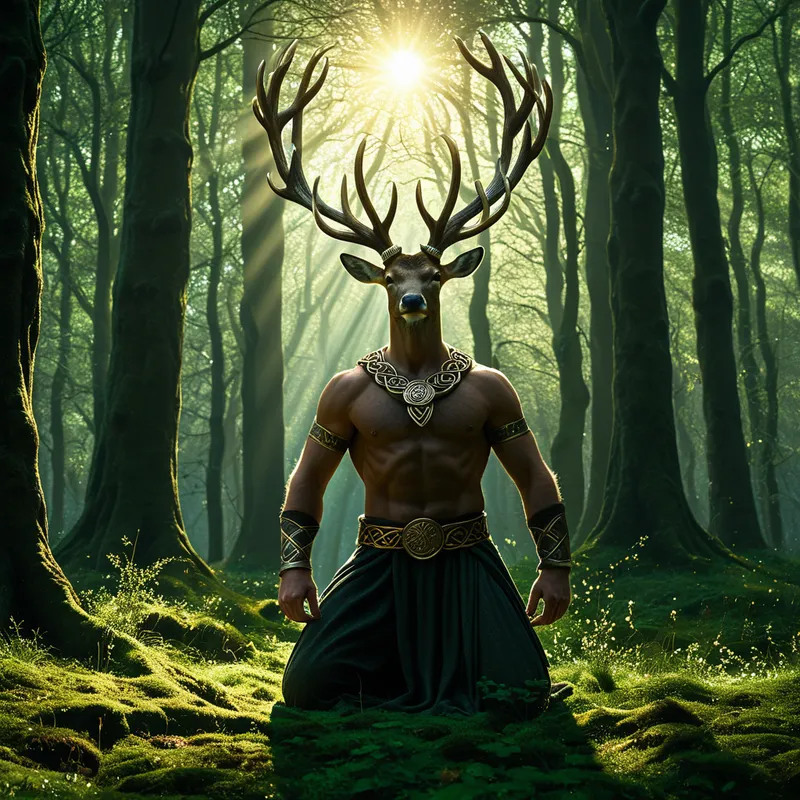
The motif of the White Stag is not a single, codified myth from a specific text, but a pervasive and powerful archetype woven through the oral traditions of the various Celtic cultures. It appears in early Welsh literature like the Mabinogion, in the burgeoning legends of Arthur, and in the folklore of Ireland and Scotland. This was a creature known to the Druids, for whom the stag was a sacred animal associated with the forest god Cernunnos, the “Horned One.”
In a culture where the natural world was profoundly animate and [the Otherworld](/myths/the-otherworld “Myth from Celtic culture.”/) was a parallel, interpenetrating reality, the White Stag functioned as a [psychopomp](/myths/psychopomp “Myth from Greek culture.”/)—a guide between worlds. Its appearance signaled that the ordinary rules of time and space were suspended. Stories of it were likely told around hearth-fires and in royal halls not merely as entertainment, but as teaching narratives. They reinforced a worldview in which destiny was not a straight road, but a mysterious, spiraling path into the unknown, initiated by a call from the cosmos itself. The stag taught that true sovereignty—of land or of self—required a willing descent into the wild, untamed realms beyond the safety of the tribe’s firelight.
Symbolic Architecture
At its core, the White Stag is the embodiment of the numinous call—an [invitation](/symbols/invitation “Symbol: An ‘Invitation’ symbolizes opportunities, connections, or decisions awaiting the dreamer.”/) from the deeper [psyche](/myths/psyche “Myth from Greek culture.”/) that cannot be ignored. It represents the [soul](/symbols/soul “Symbol: The soul represents the essence of a person, encompassing their spirit, identity, and connection to the universe.”/)’s own longing for something beyond the confines of the conscious ego’s territory.
The White Stag is the Self, in its wild and untamed form, calling the ego to a meeting it both desires and fears.
Its color, white, signifies its otherworldly, spiritual [nature](/symbols/nature “Symbol: Nature symbolizes growth, connectivity, and the primal forces of existence.”/). It is not of the earthly [herd](/symbols/herd “Symbol: Represents collective behavior, social conformity, and group dynamics. Symbolizes both safety in numbers and loss of individuality.”/). The stag, as a [symbol](/symbols/symbol “Symbol: A symbol can represent an idea, concept, or belief, serving as a powerful tool for communication and understanding.”/), carries multiple layers: masculine vitality (the antlers), graceful sovereignty, and a deep [connection](/symbols/connection “Symbol: Connection symbolizes relationships, communication, and bonds among individuals.”/) to the cyclical, regenerative forces of [nature](/symbols/nature “Symbol: Nature symbolizes growth, connectivity, and the primal forces of existence.”/) (the annual shedding and regrowth of antlers). To [chase](/symbols/chase “Symbol: Dreaming of a chase often symbolizes avoidance of anxiety or confrontation, manifesting as fleeing from something threatening or overwhelming in one’s waking life.”/) it is to engage in a sacred hunt, where the prize is not capture, but transformation. The [hero](/symbols/hero “Symbol: A hero embodies strength, courage, and the ability to overcome significant challenges.”/) who pursues it is enacting the fundamental [human](/symbols/human “Symbol: The symbol of a human represents individuality, complexity of emotions, and social relationships.”/) [drama](/symbols/drama “Symbol: Drama signifies narratives, emotional expression, and the exploration of human experiences.”/) of seeking meaning, wholeness, or a lost part of oneself. The inevitable [moment](/symbols/moment “Symbol: The symbol of a ‘moment’ embodies the significance of transient experiences that encapsulate emotional depth or pivotal transformations in life.”/) in the clearing, where [the hunter](/myths/the-hunter “Myth from African culture.”/) stands face-to-face with the quarry, is the critical [juncture](/symbols/juncture “Symbol: A critical point of decision, transition, or convergence where paths, choices, or timelines meet, demanding action or reflection.”/) of recognition. The external [quest](/symbols/quest “Symbol: A quest symbolizes a journey or search for purpose, fulfillment, or knowledge, often representing life’s challenges and adventures.”/) becomes an internal confrontation.
The Dreamer’s Resonance
When the White Stag appears in a modern dream, it signals that the unconscious is issuing a powerful summons. The dreamer is likely at a crossroads, feeling a restless, inarticulate yearning for a life that feels more authentic, more aligned with a deeper purpose. The somatic feeling in the dream is key: the breathless chase, the mixture of awe and anxiety, the profound solitude.
Psychologically, this dream marks the beginning of an individuation process. The conscious mind (the hunter/ego) has caught a glimpse of a larger, more complete potential (the Stag/Self). The dream is an enactment of the psyche’s attempt to bridge that gap. If the dreamer kills the stag, it may reflect an ego attempting to forcibly assimilate or control this new calling, often leading to a sense of hollow victory or guilt. If the dreamer follows the stag into a new landscape—through the waterfall, into a cave, across a river—it indicates a willingness to let the unconscious lead, to enter a period of disorientation and deep inner work where old identities must be shed.
Alchemical Translation
The myth of the White Stag is a perfect map for the alchemical process of psychic transmutation. The initial sighting is the [nigredo](/myths/nigredo “Myth from Alchemical culture.”/)—the blackening, the first stirring of discontent with the status quo, the “call to adventure.” The frantic, disorienting chase through the unfamiliar forest represents the albedo—the whitening, the purification. Here, [the ego](/myths/the-ego “Myth from Jungian culture.”/) is stripped of its certainties and forced to wander in [the wilderness](/myths/the-wilderness “Myth from Biblical culture.”/) of its own psyche, separating the essential from the superficial.
The clearing is the crucible. The confrontation is the coniunctio—the sacred marriage of the seeking ego and the guiding Self.
The moment of eye contact in the clearing is the pivotal coniunctio, [the sacred marriage](/myths/the-sacred-marriage “Myth from Various culture.”/) of opposites: human and divine, seeker and guide, conscious and unconscious. This meeting does not produce a simple answer, but a transformation of the question itself. The hero does not return with the stag’s head as a trophy, but with a gift from its antlers—a new insight, a sacred object, or simply a changed perspective. This is the [rubedo](/myths/rubedo “Myth from Alchemical culture.”/)—the reddening, the integration of this profound experience into a renewed life.
For the modern individual, the myth instructs us to honor those moments of numinous calling, however they appear—as a sudden inspiration, a recurring dream, a deep pull toward an unexplored path. It warns us not to try to “capture” or commodify this calling, but to surrender to the disorienting journey it initiates. The goal is not to possess the vision, but to be remade by the pursuit of it. The White Stag forever leads us deeper into the forest of the soul, ensuring we never mistake the map for the territory, or [the crown](/myths/the-crown “Myth from Various culture.”/) for the true sovereignty it represents.
Associated Symbols
Explore related symbols from the CaleaDream lexicon: