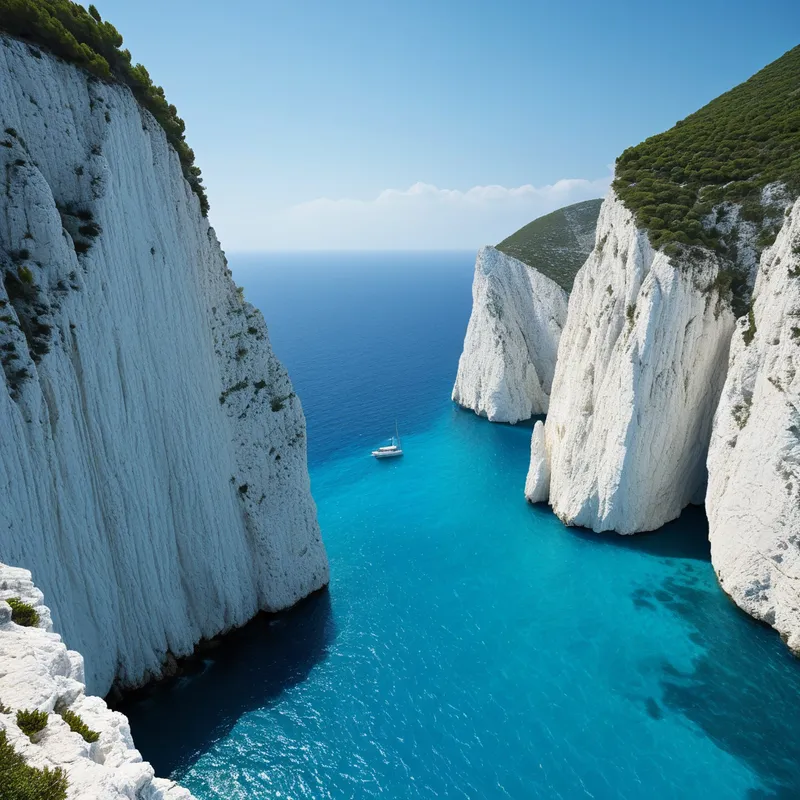
The White Rocks of Leukas Myth Meaning & Symbolism
A priest of Apollo, cursed to fall in love, leaps from the white cliffs of Leukas to purge his divine madness, seeking death or clarity in the sea.
The Tale of The White Rocks of Leukas
Hear now of the white bones of [the earth](/myths/the-earth “Myth from Hindu culture.”/), where [the sky](/myths/the-sky “Myth from Persian culture.”/) meets [the sea](/myths/the-sea “Myth from Greek culture.”/) in a shattering of light. On the isle of Leukas, the cliffs are not stone but solidified glare, a monument to the sun’s unforgiving gaze. And to this place, by the will of gods who play with mortal hearts as with dice, came a man named Cephalus.
His crime was not of blood or theft, but of purity. A devoted priest of Apollo, he sought to keep his soul as a clear vessel for the god’s light, untouched by the wild, earth-bound fire of Aphrodite. He spurned her rites, dismissed her power. From his temple, he looked upon [the world](/myths/the-world “Myth from Tarot culture.”/) and saw only divine geometry, not the pulsing, messy beat of desire.
Aphrodite, whose pride is as vast as the sea, heard his disdain. A smile, cold as [pearl](/myths/pearl “Myth from Chinese culture.”/), touched her lips. She would not strike him down; she would unravel him from within. She cast upon Cephalus a pothos—a longing so profound it borders on sickness, a divine madness. Not for a specific woman, but for Love itself as a consuming, obliterating force. The clear vessel of his mind was flooded with a torrent of confusion, heat, and unbearable yearning. The rational light of Apollo was drowned in the chaotic, rose-scented dark of Aphrodite.
Driven from his temple, a stranger to himself, Cephalus wandered. The world had become a mirror reflecting only his own torment. The songs of birds were taunts, the rustle of leaves a whisper of unattainable union. His sanity, once a fortified citadel, was now a ruin. In his agony, he heard of the White Rocks—the Leukatas—and the ancient rite. It was said that here, a desperate soul could leap, and [the fall](/myths/the-fall “Myth from Biblical culture.”/) would either grant death or, by the grace of Apollo, purify the madness and grant a terrible clarity.
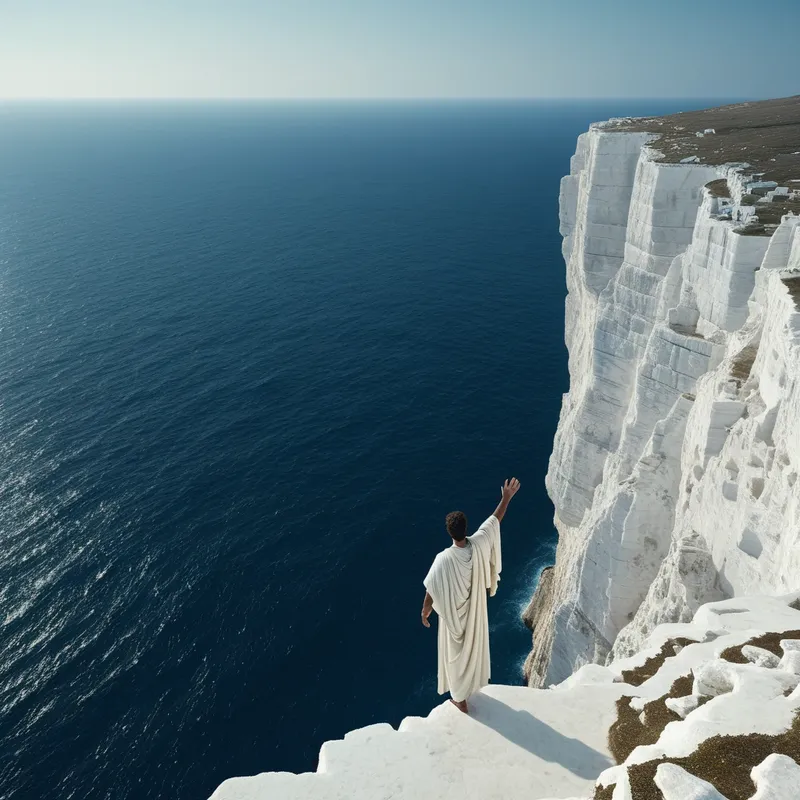
With the salt wind pulling at his robes, Cephalus climbed. [The white stone](/myths/the-white-stone “Myth from Alchemical culture.”/) scraped his hands, blinding in the midday sun. Below, the Ionian Sea churned, a deep blue maw. This was no heroic act, but the final, stark choice of a broken man: to be shattered upon the rocks or cleansed in [the abyss](/myths/the-abyss “Myth from Kabbalistic culture.”/). He did not pray. He simply stepped into the air.
The fall was a lifetime. [The wind](/myths/the-wind “Myth from Various culture.”/) roared in his ears, stripping away thought, identity, the very pothos that plagued him. He was not a man, but a projectile of fate. And then—impact. Not with stone, but with the shocking, cold embrace of the sea. The waters took him down into silence. And when he surfaced, gasping, born anew from the salty womb, the madness was gone. Washed away. He swam to shore, exhausted, hollow, but clean. The love-madness had been sacrificed to the leap, and he was free, though forever marked by the knowledge of the abyss he had traversed.
Cultural Origins & Context
The myth of the White Rocks of Leukas is not a single, canonical tale from a primary epic like the Iliad, but a potent strand of local lore and poetic tradition, most notably preserved and transformed by the lyric poets. Its most famous association is with the poet Sappho. Later legends, recorded by authors like the geographer Strabo, claimed that Sappho, herself tormented by unrequited love, took the “Lover’s Leap” from these very cliffs. While historically dubious, this connection is culturally profound. It shows how the site and its myth functioned: as a powerful geographical symbol for the extreme, potentially self-annihilating nature of erotic passion (pothos) in the Greek imagination.
The myth served multiple societal functions. On one level, it was an aetiological myth, explaining the origin of a local ritual purification leap, possibly performed annually to appease Apollo or ward off misfortune. On a deeper level, it provided a narrative container for a terrifying psychological and social reality: love-sickness as a form of divine possession. In a culture where mental states were often attributed to external divine forces, Cephalus’s ordeal gave a name and a mythical resolution to an experience that could otherwise lead to social exile or tragedy. It acknowledged the power of Aphrodite while ultimately reaffirming the possibility of reintegration through Apollo’s domain—purification and clarity, however brutally won.
Symbolic Architecture
The myth’s power lies in its stark, almost alchemical [symbolism](/symbols/symbolism “Symbol: The use of symbols to represent ideas or qualities, often conveying deeper meanings beyond literal interpretation. In dreams, it’s the language of the unconscious.”/). Cephalus represents the ego-[consciousness](/symbols/consciousness “Symbol: Consciousness represents the state of awareness and perception, encompassing thoughts, feelings, and experiences.”/) that believes it can live by pure principle (Apollo’s light, order, reason) while denying a fundamental archetypal power (Aphrodite’s eros, [chaos](/symbols/chaos “Symbol: In Arts & Music, chaos represents raw creative potential, uncontrolled expression, and the breakdown of order to forge new artistic forms.”/), [connection](/symbols/connection “Symbol: Connection symbolizes relationships, communication, and bonds among individuals.”/)). His is the tragedy of one-sidedness.
The cliff is the razor’s edge of the conscious mind, where the known self ends and the unconscious begins.
Aphrodite’s [curse](/symbols/curse “Symbol: A supernatural invocation of harm or misfortune, often representing deep-seated fears, guilt, or perceived external malevolence.”/) is not merely [punishment](/symbols/punishment “Symbol: A dream symbol representing consequences for actions, often tied to guilt, societal rules, or internal moral conflicts.”/); it is the forced [eruption](/symbols/eruption “Symbol: A sudden, violent release of pent-up energy or emotion from beneath the surface, often representing transformation or crisis.”/) of the denied [aspect](/symbols/aspect “Symbol: A distinct feature, quality, or perspective of something, often representing a partial view of a larger whole.”/) of his own [psyche](/myths/psyche “Myth from Greek culture.”/). The pothos, the maddening longing, is the [soul](/symbols/soul “Symbol: The soul represents the essence of a person, encompassing their spirit, identity, and connection to the universe.”/)’s rebellion against its own [fragmentation](/symbols/fragmentation “Symbol: The experience of breaking apart, losing cohesion, or being separated into pieces. Often represents disintegration of self, relationships, or reality.”/). He is not longing for an other, but for the missing part of himself—the [capacity](/symbols/capacity “Symbol: A measure of one’s potential, limits, or ability to contain, process, or achieve something, often reflecting self-assessment or external demands.”/) for passionate, embodied connection that he has ritualistically excluded.
The White Rocks themselves are a magnificent [symbol](/symbols/symbol “Symbol: A symbol can represent an idea, concept, or belief, serving as a powerful tool for communication and understanding.”/). They are not welcoming. They are blinding, severe, and absolute. They represent the necessary, unforgiving threshold. There is no gentle descent into self-[knowledge](/symbols/knowledge “Symbol: Knowledge symbolizes learning, understanding, and wisdom, embodying the acquisition of information and enlightenment.”/) here; only a stark, binary [choice](/symbols/choice “Symbol: The concept of choice often embodies decision-making, freedom, and the multitude of paths available in life.”/) between annihilation and transformation. The leap is the ultimate act of surrender, [the ego](/myths/the-ego “Myth from Jungian culture.”/) relinquishing control. The sea below is the [collective unconscious](/symbols/collective-unconscious “Symbol: The Collective Unconscious refers to the part of the unconscious mind shared among beings of the same species, embodying universal experiences and archetypes.”/)—the primal, salty [womb](/symbols/womb “Symbol: A symbol of origin, potential, and profound transformation, representing the beginning of life’s journey and the unconscious source of creation.”/) of all [life](/symbols/life “Symbol: The symbol of ‘Life’ represents a journey of growth, interconnectedness, and existential meaning, encompassing both the joys and challenges that define human experience.”/) and the [realm](/symbols/realm “Symbol: The symbol of ‘Realm’ often signifies the boundaries of one’s consciousness, experiences, or emotional states, suggesting aspects of reality that are either explored or ignored.”/) of [dissolution](/symbols/dissolution “Symbol: The process of breaking down, dispersing, or losing form, often representing transformation, release, or the end of a state of being.”/).
His survival and purification signify a [rebirth](/symbols/rebirth “Symbol: A profound transformation where old aspects of self or life die, making way for new beginnings, growth, and renewal.”/). The old, rigidly defined Cephalus—the [priest](/symbols/priest “Symbol: A priest symbolizes spirituality, guidance, and the quest for understanding the deeper meanings of life.”/) who denied love—“dies” in the fall. The man who emerges from the sea is integrated. He has acknowledged and passed through the power of the [archetype](/symbols/archetype “Symbol: A universal, primordial pattern or prototype in the collective unconscious that shapes human experience, behavior, and creative expression.”/) that possessed him. He is now a man who knows the [depths](/symbols/depths “Symbol: Represents the subconscious, hidden emotions, or foundational aspects of the self, often linked to primal fears or profound truths.”/), both of [passion](/symbols/passion “Symbol: Intense emotional or physical desire, often linked to love, creativity, or purpose. Represents life force and deep engagement.”/) and of the cleansing void.
The Dreamer’s Resonance
When this myth pattern stirs in the modern dreamer, it rarely manifests as a literal cliff. Instead, one might dream of standing before a terrifying but necessary decision—quitting a soul-crushing job, ending a toxic relationship, or finally confronting a buried trauma. The somatic feeling is one of vertigo, a hollowing in the gut, a tightening in the chest. There is a palpable edge.
The “white rocks” in a dream could be any immovable, glaring truth one has been avoiding: a stark diagnosis, a betrayal uncovered, the undeniable passage of time. The “madness” of Cephalus translates as a period of intense psychological disorientation—anxiety, obsessive rumination, or a feeling of being possessed by an emotion (like grief or rage) so strong it threatens one’s identity.
The dream is presenting the edge of a psychic process. To dream of hesitating at such a brink indicates the ego’s terror of the dissolution required for growth. To dream of leaping, even fearfully, signals that the unconscious is orchestrating a necessary death-and-rebirth sequence. The dreamer is in the midst of a profound enantiodromia—where an extreme conscious position is generating its opposite in the unconscious, demanding a leap into a new state of being.

Alchemical Translation
The journey of Cephalus is a brutal map of individuation. It models the phase of the work known as [nigredo](/myths/nigredo “Myth from Alchemical culture.”/)—the blackening, the descent, the confrontation with [the shadow](/myths/the-shadow “Myth from Jungian culture.”/). His initial state is one of inflated consciousness, identified solely with the spiritual, solar principle (Apollo). The eruption of Aphrodite is the arrival of the repressed anima, the feminine principle of relatedness and emotion, which shatters this inflation.
The purification is not in avoiding the fall, but in the total surrender to its trajectory.
The leap from the White Rocks is the active, willed engagement with the nigredo. It is the ego’s agreement to participate in its own dissolution for the sake of the whole psyche. This is the alchemical [solutio](/myths/solutio “Myth from Alchemical culture.”/)—dissolution in the primal waters. The conscious mind must be broken down, its rigid structures liquefied, so that a new, more fluid and inclusive consciousness can precipitate.
His emergence from the sea represents the albedo—the whitening. He is cleansed, not because [the passion](/myths/the-passion “Myth from Christian culture.”/) was evil, but because his identification with it was absolute and possessive. He has been separated from the complex. The passion is now an experience he has survived and integrated, not a god that owns him. He returns to life capable of holding both Apollo’s light and the memory of Aphrodite’s dark sea. He is no longer just a priest of an external god, but a man initiated into the inner [pantheon](/myths/pantheon “Myth from Roman culture.”/). For the modern individual, the myth does not counsel literal self-destruction, but the courage to make those terrifying psychic leaps—into therapy, into vulnerability, into authentic feeling—where the old, brittle self must fall away so the true, more resilient self can surface, gasping and new, from the depths.
Associated Symbols
Explore related symbols from the CaleaDream lexicon: