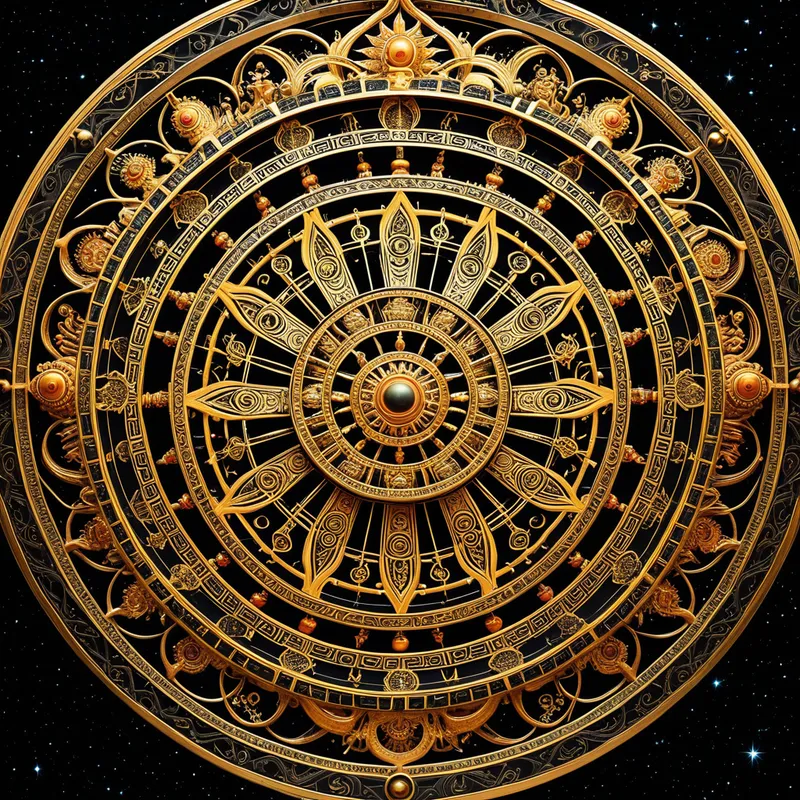
The Wheel of Samsara Myth Meaning & Symbolism
The cosmic wheel of birth, death, and rebirth, spun by desire and karma, from which the soul seeks liberation.
The Tale of The Wheel of Samsara
Listen. Beyond the clamor of the world, beneath the silence of the stars, there is a turning. A grinding, celestial motion older than the mountains. This is the tale of that turning—the Wheel of Samsara.
In the beginning, before a beginning was counted, there was only the One. And from the dream of the One, the worlds were breathed forth—not once, but again and again, like waves upon a shore that has no end. To govern this endless flux, a law was set in motion, a wheel forged from the very substance of action and consequence. They say it is held in the grip of Yama, the stern king, whose eyes see the sum of every life, whose ledger is the heart itself.
The wheel is vast, its rim the circle of time, its hub the pivot of the individual soul, the jiva. Its spokes are the six realms of becoming, glowing with terrible and beautiful light. At the top, the realm of the Devas shimmers with nectar and music. Below, the Asuras clash in perpetual, jealous war. In the middle, the human realm pulses with a bittersweet ache—the pain of loss, the joy of love, the searing gift of choice. Then, descending, the animal realm of instinct and hunger; the realm of the Preta, with bellies swollen and throats parched; and at the bottom, the cold, pressurised hells of the Narakis.
And what spins this wheel? It is spun by the twin oxen of desire and aversion, driven by the charioteer of ignorance, Avidya. With every thought of “I want,” with every shudder of “I hate,” the wheel gains momentum. The jiva, clinging to the experiences of the senses, mistakes the ride for the rider, the costume for the self. After the body falls away, Yama judges the weight of its deeds, its karma. Then, drawn by the deepest grooves of its longing, the soul is flung once more onto the spinning rim—a god one lifetime, a worm the next, a human lost in memory the one after that. The rising action is this very rising and falling, an eternal drama of attainment and loss, pleasure and pain, birth and death.
But in the tale, there is a whisper, a resolution woven into the fabric of the wheel itself. It is the promise that the wheel can be broken. That by seeing the oxen for what they are, by releasing the grip of the charioteer, the momentum slows. The wheel, deprived of its driving force, begins to wobble, to crack. And through that crack shines a light not of any realm, but of the source of all realms. The soul, recognizing itself not as the passenger but as the space in which the wheel turns, steps off. This is Moksha—not an escape to somewhere else, but the profound, shattering discovery that you were never truly trapped in the first place. The wheel turns on, but for that one, it turns in empty space.
Cultural Origins & Context
The myth of the Wheel of Samsara is not a single story with a fixed author, but a foundational metaphysical concept that permeates the spiritual landscape of the Indian subcontinent. Its earliest, most systematic expressions are found in the ancient Upanishads, composed between 800 and 200 BCE. It was further elaborated in the great epics—the Mahabharata and Ramayana—and codified in the philosophical systems of Samkhya and Yoga.
This was not merely priestly doctrine. The myth was disseminated through every layer of society by storytellers, wandering ascetics (sannyasins), and in the teachings of village elders. Its societal function was profound: it provided a complete cosmology and a moral framework. The law of karma embedded in the wheel justified social duties (dharma) and explained the inequalities of life—not as random cruelty, but as the just outcome of past actions. It offered both a warning against heedless living and the ultimate hope of liberation, making it a cornerstone for ethical conduct and spiritual aspiration for millennia.
Symbolic Architecture
The Wheel is the ultimate symbol of conditioned existence. It represents the psyche itself, caught in its own self-generated patterns.
The Wheel is the mind that mistakes its own projections for reality, forever seeking stability in that which is inherently transient.
The six realms are not literal places, but symbolic states of consciousness. The god realm (Deva-loka) is the psychology of inflation and blissful ignorance. The jealous titan realm (Asura) is the consciousness of comparison and bitter striving. The human realm is the critical pivot—the only state with enough awareness of suffering and enough freedom of choice to seek a way out. The animal, hungry ghost (Preta), and hell realms represent states of overwhelming instinct, insatiable craving, and self-tormenting despair, respectively. We cycle through these psychological states daily, even hourly.
Yama, the holder of the wheel, is the archetypal inner judge, the super-ego magnified to cosmic scale. He is the internalised voice of law, consequence, and the unflinching record of all we have been. The oxen of desire and aversion are the primal drives of the psyche—the push and pull that rob us of present-moment awareness. The hub, the still point, symbolizes the true Self (Atman), which is paradoxically both the centre of the personal journey and identical with the boundless whole (Brahman).
The Dreamer’s Resonance
When the Wheel of Samsara appears in modern dreams, it rarely manifests as a literal, mythological image. Instead, the dreamer is immersed in its process.
One may dream of being on a treadmill that accelerates with their anxiety, or trapped in a revolving door of identical offices or relationships. They may experience rapid, disjointed scene changes where they are different people in different eras, feeling a visceral sense of “This again?” A common motif is the looped corridor or the endless staircase—moving with urgency but arriving back at the same starting point, often with a growing sense of dread or futility. Somatically, the dreamer may wake with a feeling of exhaustion, tightness in the chest, or a grinding sensation in the joints, as if the body itself has been turning.
Psychologically, these dreams signal that the conscious ego is caught in a karmic loop—a repetitive pattern of thought, emotion, or behaviour that feels inescapable. It is the psyche’s way of shouting, “You are asleep within your own life! You are mistaking the pattern for the path.” The dream presents the wheel not to condemn, but to make the pattern visible, to force a confrontation with the cyclical nature of one’s own suffering.
Alchemical Translation
The alchemical work modeled by this myth is the ultimate transmutation: turning the lead of identified suffering into the gold of liberated consciousness. It is the core of the individuation process.
The first step is Seeing the Wheel. This is the painful, necessary disillusionment where one recognizes the repetitive nature of one’s neuroses, relationship failures, and self-sabotaging narratives. It is the end of blaming the external world and the beginning of taking responsibility for one’s inner landscape—one’s personal karma.
The alchemy begins not with escaping the wheel, but with becoming utterly conscious of its every turn, its every creak and groan within your own soul.
The second step is Stopping the Oxen. This is the practice of mindfulness and restraint. It is the moment we pause between stimulus and reaction, between desire and compulsive action. In psychological terms, it is strengthening the observing ego to witness the drives (the oxen) without being driven by them. This slows the momentum.
The final, transformative step is Stepping Out. This is not an egoic achievement, but an egoic dissolution. It is the realization that the “I” that has been journeying, suffering, and seeking is itself part of the wheel’s display. The triumph is not a victory over something, but a waking from something. The centre (the jiva) discovers its identity with the boundless space (Brahman) in which all wheels turn. The pattern may continue in life—habits, old pains may arise—but they are now seen as patterns, not as the self. This is Moksha in the here and now: the liberation of attention from its own compulsive creations. The wheel spins, but you are finally, irreducibly, free.
Associated Symbols
Explore related symbols from the CaleaDream lexicon: