The Wheel of Fortune Myth Meaning & Symbolism
A cosmic wheel, spun by fate, lifts souls to glory and dashes them to dust, teaching the eternal dance of ascent, reign, and surrender.
The Tale of The Wheel of Fortune
Listen, and hear the turning of [the world](/myths/the-world “Myth from Tarot culture.”/).
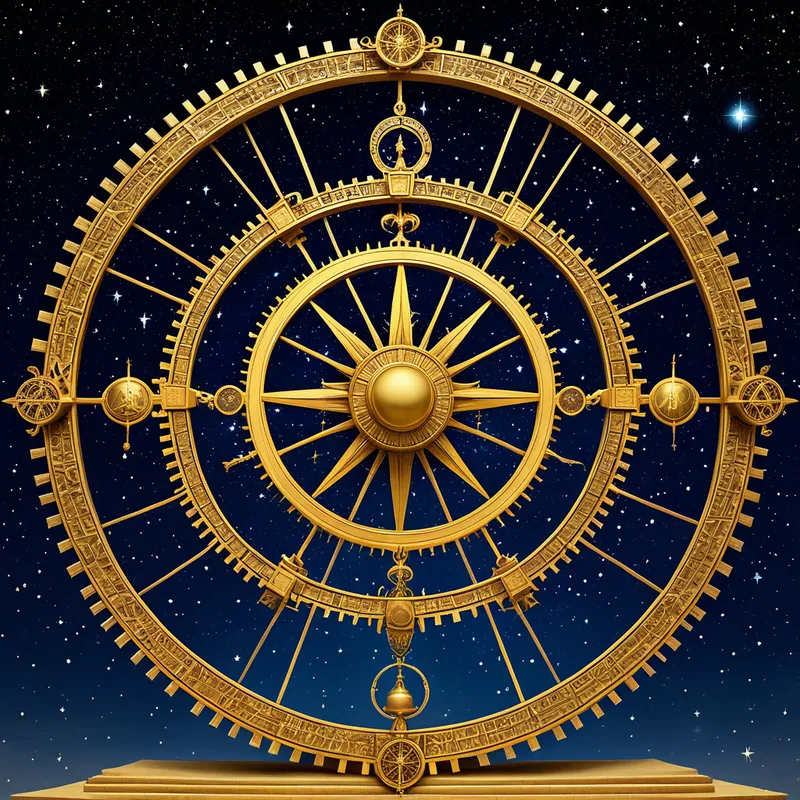
There is a place beyond the maps, in the silent chamber between heartbeats, where the great machinery of destiny grinds. Here spins the [Wheel of Fortune](/myths/wheel-of-fortune “Myth from Tarot culture.”/), a loom of gold and shadow wider than [the sky](/myths/the-sky “Myth from Persian culture.”/). Its hub is the still point of all becoming, and its rim is etched with every name that ever was and ever will be.
Upon its highest point, serene and inscrutable, sits a [Sphinx](/myths/sphinx “Myth from Greek culture.”/). She holds a sword of flame, and her eyes are twin pools of frozen time. She does not turn the Wheel; she witnesses its turning, the keeper of the riddle that is written in the rise and fall of kingdoms and the sigh of a single soul.
And see! From the murky depths to the left, a creature emerges, part man, part beast, clinging to the ascending spoke. Some call him Anubis, [the psychopomp](/myths/the-psychopomp “Myth from Various culture.”/), his form dark and earnest. He climbs, laboring upward from [the underworld](/myths/the-underworld “Myth from Greek culture.”/) of memory and forgotten things, his eyes fixed on the zenith he has not yet known. His ascent is hope, effort, the slow pull from obscurity into the light.
But what rises must, in time, descend. From the glorious peak to the right, a figure plummets. He is often shown as [Typhon](/myths/typhon “Myth from Greek culture.”/), the titan, crowned and robed in the vestments of power now turning to rags. His grip fails; the Wheel’s relentless spin hurls him from his throne. His fall is not of malice, but of necessity—the inevitable conclusion of every zenith, the price of the view from the top.
And below, in the churning mists where the Wheel meets [the void](/myths/the-void “Myth from Buddhist culture.”/), four winged beings—the Kerubic Beasts—read from scrolls of law. They are the elements made word: the Lion of Fire, the Eagle of [Water](/myths/water “Myth from Chinese culture.”/), the Angel of Air, the Bull of Earth. Their chant is the hum of the cosmos itself, the immutable laws that govern the Wheel’s spin—cause, effect, cycle, season.
This is the tale without end. It is the story of the farmer who becomes king, and the king who becomes a beggar. It is the second chance granted in a moment of grace, and the stable ground that vanishes in an earthquake of fate. There is no villain, no hero—only the Wheel, [the Sphinx](/myths/the-sphinx “Myth from Greek culture.”/), the climber, the faller, and the eternal, whispering chant of what is. The drama is not in stopping the turn, but in understanding the ride.
Cultural Origins & Context
The Wheel of Fortune is one of the most enigmatic and ancient members of the [Major Arcana](/myths/major-arcana “Myth from Tarot culture.”/). Its roots are not in a single culture, but in a syncretic fusion of medieval European thought. The card first appeared in the 15th-century Italian card games known as tarocchi, but its symbolism is a palimpsest of older wisdom.
Its imagery draws directly from the medieval concept of Rota Fortunae, the Wheel of Fortune, a popular motif in art and literature, most famously in Boethius’s Consolation of Philosophy. This philosophical idea depicted the Roman goddess [Fortuna](/myths/fortuna “Myth from Roman culture.”/) spinning a wheel that randomly raised humans to greatness or cast them down into misery, teaching the virtue of equanimity. The Tarot artists layered this with Hermetic and Kabbalistic symbolism—the Hebrew letters YHVH often appear on the Wheel’s spokes, and the four creatures correspond to the Tetramorph of Ezekiel and the [four evangelists](/myths/four-evangelists “Myth from Christian culture.”/).
This myth was not told around campfires but contemplated in the studies of scholars, artists, and early psychologists of the soul. Its societal function was mnemonic and meditative. In a world governed by plague, war, and the caprice of nobility, the card served as a profound reminder: your station is not your soul. It was a tool for navigating the unpredictable tides of life, a visual sermon on [impermanence](/myths/impermanence “Myth from Buddhist culture.”/) encoded in a playing card.
Symbolic Architecture
The myth’s power lies in its non-[linear](/symbols/linear “Symbol: Represents order, predictability, and a direct, step-by-step progression. It symbolizes a clear path from cause to effect.”/), cyclical [architecture](/symbols/architecture “Symbol: Architecture in dreams often signifies structure, stability, and the framing of personal identity or life’s journey.”/). It models the fundamental [pattern](/symbols/pattern “Symbol: A ‘Pattern’ in dreams often signifies the underlying structure of experiences and thoughts, representing both order and the repetitiveness of life’s situations.”/) of existence itself—the [archetype](/symbols/archetype “Symbol: A universal, primordial pattern or prototype in the collective unconscious that shapes human experience, behavior, and creative expression.”/) of the cycle.
The Wheel is the breath of the cosmos: the inhalation of fortune, the exhalation of loss. To be on the Wheel is to be alive; to wish to be off it is to wish for death.
The [Sphinx](/symbols/sphinx “Symbol: The Sphinx is a mythical creature that embodies the convergence of strength and intelligence, often associated with mystery, protection, and the challenge of riddles.”/) represents the reconciled [consciousness](/symbols/consciousness “Symbol: Consciousness represents the state of awareness and perception, encompassing thoughts, feelings, and experiences.”/), the unified self that has solved the [riddle](/symbols/riddle “Symbol: A puzzle or enigmatic statement requiring cleverness to solve, symbolizing hidden truths, intellectual challenge, and the search for meaning.”/) of its own [nature](/symbols/nature “Symbol: Nature symbolizes growth, connectivity, and the primal forces of existence.”/) (“What goes on four [legs](/symbols/legs “Symbol: Legs in dreams often symbolize movement, freedom, and the ability to progress in life, representing both physical and emotional support.”/) in the morning, two at [noon](/symbols/noon “Symbol: The peak of daylight, representing clarity, achievement, and the height of power or awareness.”/), and three in the evening?”—Man, in his [life](/symbols/life “Symbol: The symbol of ‘Life’ represents a journey of growth, interconnectedness, and existential meaning, encompassing both the joys and challenges that define human experience.”/) stages). She is the achieved wisdom that can observe the cycles of gain and [loss](/symbols/loss “Symbol: Loss often symbolizes change, grief, and transformation in dreams, representing the emotional or psychological detachment from something or someone significant.”/) without identifying with them. The climbing figure (Anubis) symbolizes the animating [spirit](/symbols/spirit “Symbol: Spirit symbolizes the essence of life, vitality, and the spiritual journey of the individual.”/) in its phase of [effort](/symbols/effort “Symbol: Effort signifies the physical, mental, and emotional energy invested toward achieving goals and personal growth.”/), aspiration, and evolution. It is the [psyche](/myths/psyche “Myth from Greek culture.”/) moving from unconsciousness toward [consciousness](/symbols/consciousness “Symbol: Consciousness represents the state of awareness and perception, encompassing thoughts, feelings, and experiences.”/), from potential to actualization.
The falling figure (Typhon) is not a “bad” [symbol](/symbols/symbol “Symbol: A symbol can represent an idea, concept, or belief, serving as a powerful tool for communication and understanding.”/), but a necessary one. It represents the [dissolution](/symbols/dissolution “Symbol: The process of breaking down, dispersing, or losing form, often representing transformation, release, or the end of a state of being.”/) of outworn structures, the hubris that precedes a fall, and the necessary surrender of a form that has served its [purpose](/symbols/purpose “Symbol: Purpose signifies direction, meaning, and intention in life, often reflecting personal ambitions and core values.”/). It is [the ego](/myths/the-ego “Myth from Jungian culture.”/) being humbled, the old [king](/symbols/king “Symbol: A symbol of ultimate authority, leadership, and societal order, often representing the dreamer’s inner power or external control figures.”/) making way for the new. The four beings with scrolls signify that this cycle is not [chaos](/symbols/chaos “Symbol: In Arts & Music, chaos represents raw creative potential, uncontrolled expression, and the breakdown of order to forge new artistic forms.”/), but ordered by natural law—the physical, emotional, mental, and instinctual frameworks of [reality](/symbols/reality “Symbol: Reality signifies the state of existence and perception, often reflecting one’s understanding of truth and life experiences.”/).
Psychologically, the Wheel represents the autonomous complex of [Fate](/symbols/fate “Symbol: Fate represents the belief in predetermined outcomes, suggesting that some aspects of life are beyond human control.”/), the seemingly external forces that shape our lives. It is the encounter with [synchronicity](/symbols/synchronicity “Symbol: Meaningful coincidences that suggest an underlying connection between events, often interpreted as guidance or confirmation from the universe.”/)—meaningful coincidence—where inner psychological states and outer events align in a pattern that feels destined.
The Dreamer’s Resonance
When this myth stirs in the modern dreamer, it often manifests as profound disorientation within a pattern of change. One does not simply dream of a wheel. One dreams of sudden, inexplicable promotions or windfalls that feel unearned, followed by vertiginous losses of status, home, or relationship. The somatic experience is one of literal vertigo—a spinning sensation, losing footing, or being on a rollercoaster whose tracks vanish ahead.
The dreamer might find themselves in an endless bureaucratic building where floors transform from opulent offices to dank basements as the elevator moves. Or they may witness a loved one’s face morph from joy to despair and back again in a loop. These dreams surface during life’s major transitions: career changes, the end of relationships, sudden illness, or unexpected opportunity. The psyche is processing the archetype of reversal, forcing the ego to relinquish its illusion of control and confront its role as a passenger, not the driver, of its destiny vehicle. It is the unconscious preparing the conscious mind for a turn of the Wheel.
Alchemical Translation
The alchemical work modeled by the Wheel is the transmutation of one’s relationship to circumstance. The goal is not to seize the Wheel’s rim and stop it—a task of titanic folly—but to move one’s center of identity from the rim to the hub.
Individuation is the migration from the spinning circumference, where one is flung between glory and ruin, to the silent, unmoving axle, from which one can observe the turn with compassionate detachment.
The climbing phase is the albedo, the whitening, where effort and aspiration purify the base material of [the self](/myths/the-self “Myth from Jungian culture.”/). The reign at the top is the fleeting citrinitas, the yellowing, a glimpse of solar brilliance. [The fall](/myths/the-fall “Myth from Biblical culture.”/) is the crucial [nigredo](/myths/nigredo “Myth from Alchemical culture.”/), the blackening—not a punishment, but the necessary dissolution of the inflated ego that believed the zenith was a permanent home. In the darkness of the descent, all that is not essential is stripped away.
The ultimate [triumph](/myths/triumph “Myth from Roman culture.”/) is to achieve the stance of the Sphinx. This is the [rubedo](/myths/rubedo “Myth from Alchemical culture.”/), the reddening, the creation of the philosophical gold: a consciousness that contains both the climber’s hope and the faller’s humility, yet is defined by neither. The modern individual engaged in this work learns to say, “This fortune is mine to steward, not my essence,” and “This loss touches me, but it is not my totality.” They become the witness within the whirlwind, finding their immutable core in the very center of change. They do not escape fate; they marry it, becoming co-creators with the turning of their own wheel.
Associated Symbols
Explore related symbols from the CaleaDream lexicon: