The Wheel of Dharma Myth Meaning & Symbolism
A cosmic tale of a divine wheel, set in motion to end suffering and illuminate the path from ignorance to ultimate liberation for all beings.
The Tale of The Wheel of Dharma
Listen. In the time before time, when [the world](/myths/the-world “Myth from Tarot culture.”/) was thick with the fog of unknowing, a profound stillness settled over the land. Beings wandered in a twilight sleep, mistaking the shadows on [the cave](/myths/the-cave “Myth from Platonic culture.”/) wall for the sun, the echo for the song, the dream for the waking world. Hunger gnawed, not of the belly, but of the spirit—a deep, aching thirst for a truth that seemed forever veiled.
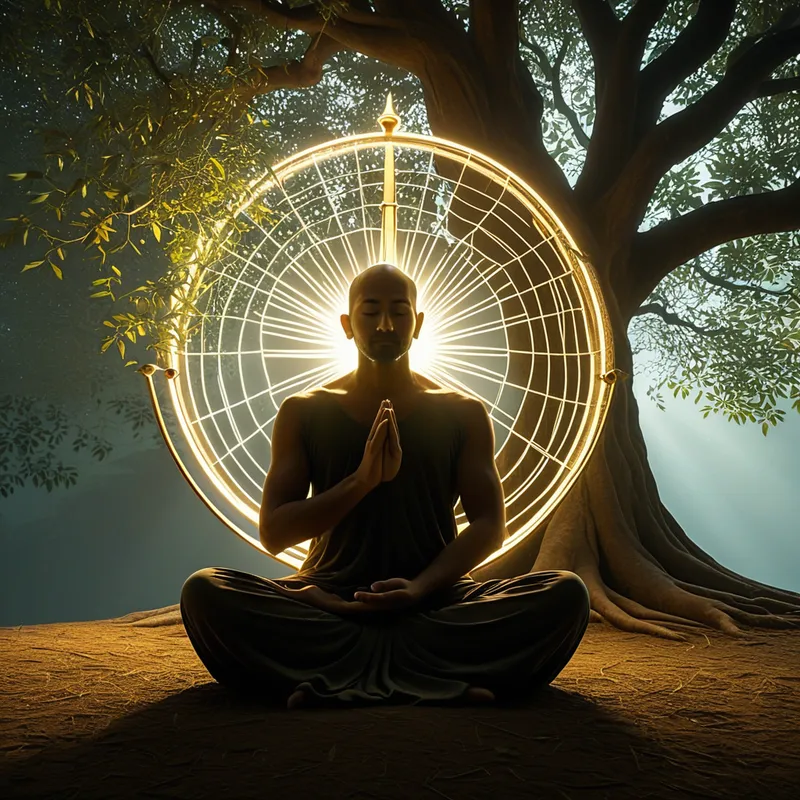
In the heart of this great slumber, beneath the spreading branches of the Bodhi Tree, a prince sat. He was no ordinary man. He had tasted every pleasure of the palace and walked every path of austerity in the forest, finding only hollow echoes in both. Now, he sat upon a seat of kusha grass, vowing not to rise until he had pierced the very heart of reality.
The night deepened. Mara, the lord of illusion, marshaled his terrible armies. He sent storms of doubt, legions of desire, and haunting visions of loss. “By what right do you seek the throne of awakening?” Mara thundered, his voice [the chorus](/myths/the-chorus “Myth from Theater culture.”/) of a thousand fears. The prince did not flinch. He reached down and touched [the earth](/myths/the-earth “Myth from Hindu culture.”/), calling the very world to witness his resolve. The ground trembled in affirmation, and Mara’s phantoms vanished like smoke.
Then, in the deepest watch of the night, as the last star held its breath, [the veil](/myths/the-veil “Myth from Various culture.”/) tore asunder. He saw—truly saw. He witnessed the endless turning of lives, linked by cause and effect, a vast, sorrowful wheel powered by craving and ignorance. He saw the origin of this suffering and the path that leads to its cessation. In that moment of supreme, silent knowing, he was no longer Prince Siddhartha. He was the Buddha.
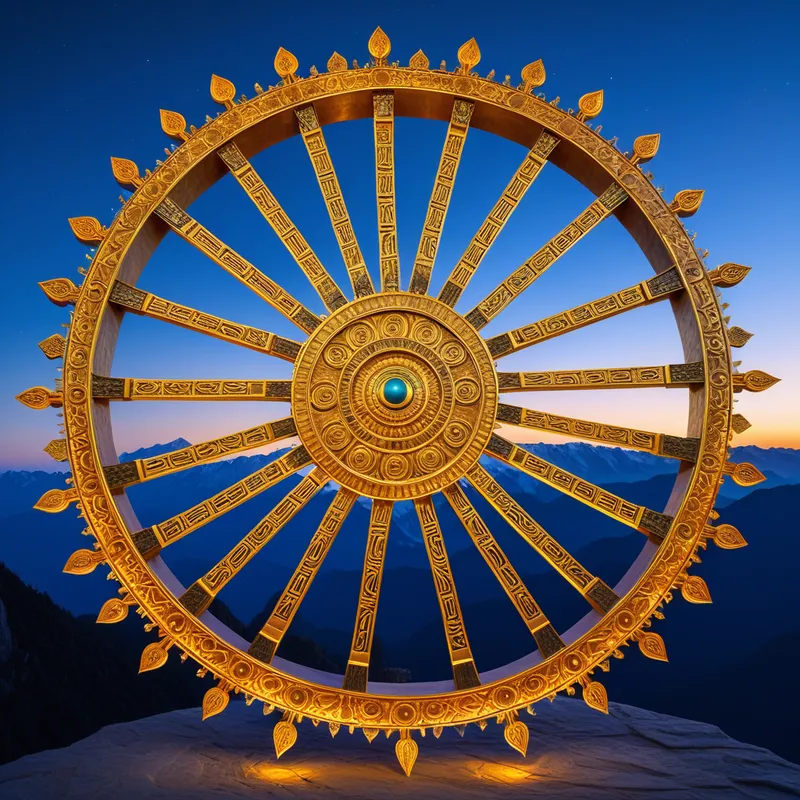
And from the depth of his compassion, he set in motion that which had never been set in motion before. Not with hands, but with mind; not with force, but with truth. Before him, in the clear air of dawn, a Wheel appeared. It was not forged of metal, but of luminous understanding. Its hub was the still center of wisdom; its spokes were the noble truths that frame existence; its rim was the perfect discipline of the path. With a sound like a universe sighing in relief, it began to turn.
Its first revolution was at the Deer Park of Sarnath, where five ascetics, weary of dead-end paths, became its first witnesses. The Wheel’s turning was the teaching itself—a profound, rolling thunder that dispelled darkness. It turned in the marketplaces and the royal courts, in the huts of the poor and the minds of the wise. Wherever it turned, it left in its wake a trail of light, a path worn not in earth, but in consciousness, leading out of the tangled forest of suffering toward an open, boundless sky.
Cultural Origins & Context
This is the mythic heart of Buddhism, a tradition that emerged in the Gangetic plains of northern India around the 5th century BCE. The story of the Wheel’s first turning is not a single, fixed text but a living narrative woven from the earliest discourses, the Sutta Pitaka. It was passed down orally for centuries by communities of monks and nuns, the [Sangha](/myths/sangha “Myth from Buddhist culture.”/), who were the custodians of the Dharma.
Its societal function was revolutionary. In a culture defined by rigid caste hierarchy and complex ritual sacrifice, the Wheel presented a path to liberation that was, in principle, open to all—king, merchant, servant, or outcaste. It provided a cosmic framework for ethics ([karma](/myths/karma “Myth from Hindu culture.”/)), a diagnosis for the human condition (dukkha, or suffering), and a practical prescription for its cure ([the Noble Eightfold Path](/myths/the-noble-eightfold-path “Myth from Buddhist culture.”/)). The myth established [the Buddha](/myths/the-buddha “Myth from Buddhist culture.”/) not as a god to be worshipped, but as a physician and a guide, and the Dharma as the medicine and the map.
Symbolic Architecture
The Wheel is the ultimate [symbol](/symbols/symbol “Symbol: A symbol can represent an idea, concept, or belief, serving as a powerful tool for communication and understanding.”/) of dynamic order emerging from [chaos](/symbols/chaos “Symbol: In Arts & Music, chaos represents raw creative potential, uncontrolled expression, and the breakdown of order to forge new artistic forms.”/), of a [cosmos](/symbols/cosmos “Symbol: The entire universe as an ordered, harmonious system, often representing the totality of existence, spiritual connection, and the unknown.”/) governed not by capricious gods, but by intelligible, compassionate law.
The Wheel turns, but its hub is still. This is the great paradox: liberation is found not in stopping the world, but in finding the unmoving center within its ceaseless motion.
Psychologically, the [Samsara](/myths/samsara “Myth from Buddhist culture.”/) it confronts represents the neurotic, repetitive patterns of the personal and [collective unconscious](/symbols/collective-unconscious “Symbol: The Collective Unconscious refers to the part of the unconscious mind shared among beings of the same species, embodying universal experiences and archetypes.”/)—our ingrained habits of thought, [emotion](/symbols/emotion “Symbol: Emotion symbolizes our inner feelings and responses to experiences, often guiding our actions and choices.”/), and [reaction](/symbols/reaction “Symbol: A reaction in a dream signifies the subconscious emotional responses to situations we face, often revealing our coping mechanisms and fears.”/) that keep us trapped in cycles of dissatisfaction. The [Buddha](/symbols/buddha “Symbol: The image of Buddha embodies spiritual enlightenment, peace, and a quest for inner truth.”/)-figure represents the emergent Self, the [consciousness](/symbols/consciousness “Symbol: Consciousness represents the state of awareness and perception, encompassing thoughts, feelings, and experiences.”/) that can observe these patterns without being identified with them.
The three turnings referenced in later tradition—of [the Four Noble Truths](/myths/the-four-noble-truths “Myth from Buddhist culture.”/), the Perfection of Wisdom, and the Buddha-[Nature](/symbols/nature “Symbol: Nature symbolizes growth, connectivity, and the primal forces of existence.”/)—map onto a deepening psychological process: [diagnosis](/symbols/diagnosis “Symbol: A medical or psychological assessment revealing a condition, often symbolizing self-awareness, vulnerability, or a need for change.”/), deconstruction, and ultimate reconciliation. The Wheel symbolizes the entire psychic [structure](/symbols/structure “Symbol: Structure in dreams often symbolizes stability, organization, and the framework of one’s life, reflecting how one perceives their environment and personal life.”/) becoming aligned with [reality](/symbols/reality “Symbol: Reality signifies the state of existence and perception, often reflecting one’s understanding of truth and life experiences.”/), where every thought, [word](/symbols/word “Symbol: Words in dreams often represent communication, expression, and the power of language in shaping our realities.”/), and deed becomes a spoke reinforcing the integrity of the whole.
The Dreamer’s Resonance
When this myth stirs in the modern dreamscape, it often appears not as a literal wheel, but as a profound felt sense of pattern and release. A dreamer may find themselves in a vast, bureaucratic maze (samsara) following meaningless rules, only to discover a hidden, quiet office at the center where a single document explains the entire system (the Dharma). Or they may dream of a broken machine, a stalled vehicle, or a stuck record, experiencing immense frustration until a sudden, intuitive insight—a “click”—sets everything into smooth, harmonious motion.
Somatically, this can correlate with the release of a long-held tension, a literal “weight off one’s shoulders.” Psychologically, it marks a moment where compulsive, unconscious behavior (karma) is seen through and interrupted by conscious insight (prajna). The dream signals a readiness to step out of an old, suffering-producing cycle—be it a toxic relationship, a self-sabotaging belief, or a paralyzing fear—and onto a new, self-directed path.

Alchemical Translation
The alchemy modeled here is the transmutation of leaden, repetitive suffering into the gold of liberated consciousness. It is the core process of individuation, framed with spiritual precision.
The first noble truth—the acknowledgment of suffering—is the [nigredo](/myths/nigredo “Myth from Alchemical culture.”/), the blackening, the confrontation with [the shadow](/myths/the-shadow “Myth from Jungian culture.”/) and the reality of one’s own pain. It is the end of denial. The second and third truths (the origin and cessation of suffering) constitute the albedo, the whitening, the analysis and separation of the pure from the impure, understanding how the [psyche](/myths/psyche “Myth from Greek culture.”/) creates its own prison and the possibility of its door. The fourth truth, [the Eightfold Path](/myths/the-eightfold-path “Myth from Buddhist culture.”/), is the [rubedo](/myths/rubedo “Myth from Alchemical culture.”/), the reddening, the conscious, disciplined, and integrated application of this understanding into every facet of life—thought, speech, action, livelihood.
To set the Wheel in motion is to initiate the psyche’s own revolution, where every insight becomes a torque, every ethical choice a gear, spinning the soul toward its own inherent, awakened nature.
The modern individual may not seek [Nirvana](/myths/nirvana “Myth from Buddhist culture.”/), but they seek integration, meaning, and freedom from their inner conflicts. The Wheel’s teaching is that this freedom is structured. It is not a vague feeling of wellness, but a path built with the materials of right view, right intention, right speech, right action, right livelihood, right effort, right mindfulness, and right concentration. To walk this path is to perform the ultimate alchemy: turning the wheel of one’s own fate, consciously, from within the still center of [the Self](/myths/the-self “Myth from Jungian culture.”/).
Associated Symbols
Explore related symbols from the CaleaDream lexicon: